
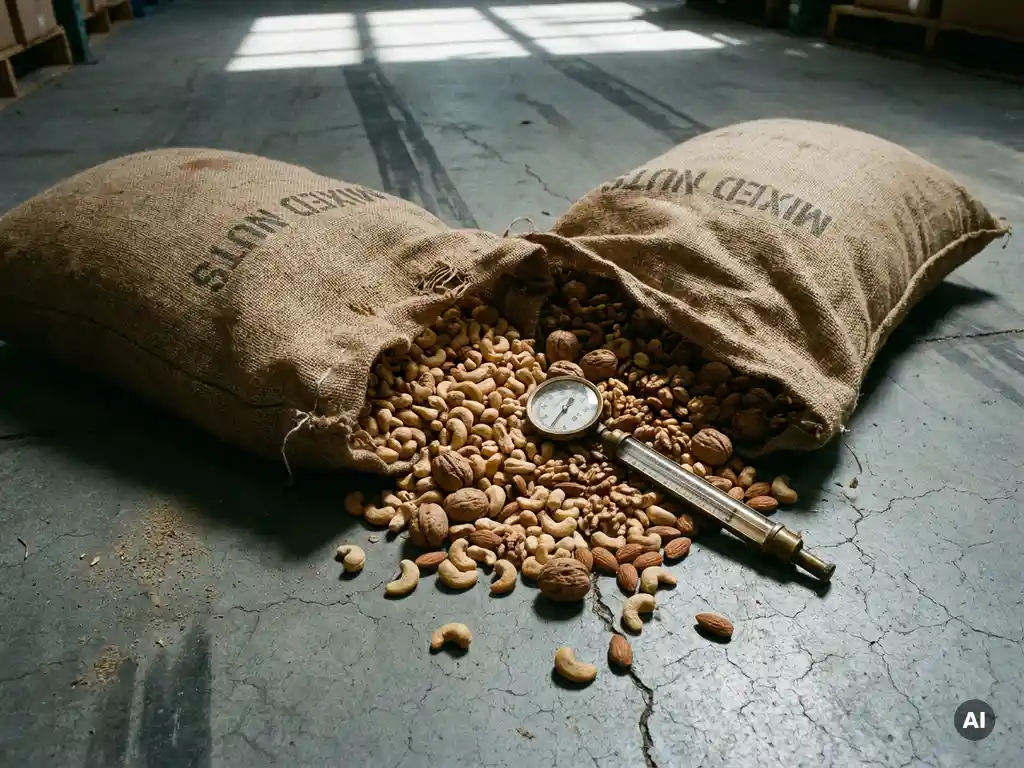
Temperature control for nuts is important because nuts naturally have a high fat content, causing them to become rancid quickly at excessively high temperatures. Furthermore, improper storage leads to mold growth, loss of quality, and even spoilage of entire batches. For logistics and supply chain partners working with nuts on a large scale, controlled storage is not a luxury but a necessity. This article answers the most frequently asked questions about the proper storage conditions for nuts.
What happens to nuts at the wrong temperature?
At excessively high temperatures, the fats in nuts oxidize rapidly, leading to a rancid taste and smell. This process is called fat oxidation and is irreversible: once nuts have become rancid, they cannot be saved. In addition, heat promotes the growth of mold and bacteria, particularly when humidity is not properly controlled.
Specifically, the following problems can arise from insufficient temperature control of nuts:
- Rancidity due to oxidation of polyunsaturated fatty acids
- Mold growth, including the formation of aflatoxins in certain nut varieties
- Loss of taste, color, and texture
- Shortening of the expiration date
- Rejection during import inspections or quality controls
For importers and wholesalers, this means direct financial damage: a batch rejected upon arrival or deemed unacceptable by the processor yields no profit. Especially with larger volumes, storage quality makes the difference between a profitable and a loss-making delivery.
What temperature is ideal for storing nuts?
The ideal storage temperature for most nuts is between 0 and 10 degrees Celsius. At these temperatures, the oxidation of fats is significantly slowed down, and the shelf life remains considerably longer than at room temperature. For long-term storage of several months, the lower end of this range is often maintained.
The exact optimal temperature varies by type of nut. Walnuts and pecans are more sensitive to heat than almonds, for example, and benefit more from storage close to freezing. Pistachios and cashews also require cool conditions but tolerate slightly higher temperatures than walnuts. For shorter storage periods of a few weeks, a temperature of up to approximately 15 degrees Celsius may still be acceptable, provided that humidity is properly controlled.
What all nut varieties have in common is that temperature fluctuations are harmful. Fluctuating temperatures cause condensation on the products, which greatly increases the risk of mold formation. A stable and consistent climate is therefore at least as important as the absolute temperature value.
How does humidity affect the quality of nuts?
Humidity has a direct impact on the quality of nuts: relative humidity that is too high promotes mold growth and moisture absorption, while humidity that is too low leads to drying out and loss of texture. The recommended relative humidity for nuts is generally between 55 and 70 percent.
When nuts absorb too much moisture, their structure changes. They become soft or sticky, which negatively affects both taste and processability. Furthermore, the risk of mold formation increases significantly at higher humidity levels. Molds produce mycotoxins, including aflatoxins, in certain nut varieties, which are strictly regulated in the European Union. Batches exceeding legal standards are immediately rejected.
Humidity control for nuts is therefore inextricably linked to temperature control. Both parameters must be monitored and regulated together to guarantee quality throughout the entire storage period. This requires professional climate control equipment that continuously measures and adjusts both temperature and humidity.
What are the risks of improper cold storage for nuts?
Poor cold storage for nuts leads to loss of quality, financial damage, and potential rejection during statutory inspections. The risks are both commercial and legal in nature and affect importers, wholesalers, and processing companies that depend on consistent product quality.
The main risks can be ordered as follows:
- Rancidity and spoilage: Fat oxidation at excessive temperatures renders nuts unsaleable, even if they still look visually good.
- Mold formation and mycotoxins: Insufficient climate control can lead to mold growth and the presence of aflatoxins, resulting in statutory rejection.
- Condensation due to temperature changes: Sudden temperature changes cause moisture on the products, which accelerates spoilage.
- Loss of shelf life: Products that become unsaleable sooner than expected lead to direct financial losses and disruptions in the supply chain.
- Reputational damage: Structural quality problems affect the relationship with customers and supermarket purchasing organizations.
For companies working with large volumes and fixed delivery schedules, these risks are unacceptable. In that case, professional cold storage is not an expense, but an investment in security of supply.
Does the storage of nuts differ from that of other dried fruit?
Yes, the storage of nuts differs fundamentally from that of other dried fruit such as raisins or dried apricots. Nuts contain a high content of unsaturated fats, making them more susceptible to oxidation and rancidity. Dried fruit contains mainly sugars and is less prone to fat oxidation, but more sensitive to moisture absorption and insects.
Nuts generally require lower temperatures and stricter humidity control than most types of dried fruit. While dried fruit can be stored at room temperature or lightly chilled, nuts clearly benefit from active refrigeration, especially during longer storage periods. Sensitivity to odors is also a point of attention: nuts easily absorb ambient odors and should therefore not be stored together with strongly scented products.
In addition, specific legal standards regarding mycotoxins apply to nuts, which are stricter than for many other dry food products. This makes quality control throughout the entire supply chain particularly relevant.
When is professional refrigerated storage necessary for nuts?
Professional refrigerated storage for nuts is necessary whenever the storage period exceeds a few weeks, volumes are large, or the products are intended for customers with strict quality requirements. For importers, wholesalers, and processing companies, controlled storage is the only responsible choice in virtually all cases.
For short-term throughput of small quantities, storage at a stable room temperature may sometimes suffice, but as soon as one of the following situations applies, professional cooling is recommended:
- Storage periods of more than four weeks
- Large volumes where the loss of a batch has significant financial consequences
- Deliveries to supermarket chains or processing plants with strict quality standards
- Seasonal purchasing where products need to be stored for months
- Nut varieties with a high fat content, such as walnuts or pecans
In practice, most professional parties in the nut trade opt for specialized storage facilities, precisely because the risks of inadequate climate control far exceed the costs of professional storage.
How ZZColdstores helps with nut storage
ZZColdstores has a dry storage warehouse with a capacity of 12,000 pallet spaces, with separate areas specifically designated for the storage of nuts, peanuts, and seeds. The facilities in Kruiningen and Vlissingen are equipped to precisely tailor the climate to the specific requirements of the product, so that loss of quality during storage is prevented.
What ZZColdstores offers for parties working with nuts:
- Dedicated storage areas for nuts, peanuts, and seeds, separated from other product categories
- Climate control tailored to the specific requirements of dry food products
- Flexible storage that connects to incoming transport, including container handling from Rotterdam and Antwerp
- Assistance with import inspections via the KCB (part of the NVWA) and customs clearance
- Certifications including BRC, SKAL, and Demeter, which align with the quality requirements of processing plants and supermarket buyers
Do you work with larger volumes of nuts, or are you looking for a reliable storage partner for your supply chain? Contact ZZColdstores to discuss which storage solution best suits your specific situation.
Frequently Asked Questions
How long do nuts keep when professionally refrigerated?
Under optimal conditions — a temperature between 0 and 10 degrees Celsius and a relative humidity of 55 to 70 percent — most nut varieties can be stored for 6 to 12 months without significant loss of quality. Walnuts and pecans generally have a shorter shelf life than almonds or hazelnuts due to their higher content of polyunsaturated fatty acids. Seasonal buyers who wish to supply year-round therefore benefit most from professional climate control.
What is the difference between refrigerated storage and conditioned dry storage for nuts?
Refrigerated storage refers to active cooling where the temperature is deliberately kept below room temperature, typically between 0 and 10 degrees Celsius. Conditioned dry storage focuses primarily on controlling humidity and ventilation, but not necessarily on active cooling. For nuts, a combination of both is most effective: the temperature must be low enough to slow down fat oxidation, while humidity is closely monitored to prevent mold formation.
Can nuts be stored together with other products?
This is strongly advised against. Nuts easily absorb ambient odors from other products, which negatively affects taste and quality. Furthermore, strongly scented or damp products can influence climatic conditions in the storage area. Dedicated storage areas — specifically designed for nuts, peanuts, and seeds, separated from other product categories — are the only way to completely prevent cross-contamination and odor transfer.
How do I recognize if a batch of nuts has been damaged due to poor storage?
Visual signs of poor storage include discoloration, mold spots, a sticky or soft texture, and an unpleasant, rancid, or musty odor. Also look for condensation stains on the packaging, which indicate temperature fluctuations during transport or storage. Important to note: fat oxidation is not always visible — nuts may still look good visually while already being rancid, making taste and smell checks upon receipt essential.
Which certifications are important when choosing a storage partner for nuts?
For parties supplying supermarket chains or processing plants, certifications such as BRC (British Retail Consortium) and FSSC 22000 are the most relevant quality standards for food safety. If you work with organic nuts, SKAL and potentially Demeter certification are required for a continuous organic supply chain. Also check whether the storage partner offers assistance with import inspections via the NVWA or the KCB, as nuts are subject to strict mycotoxin standards upon import into the European Union.
What do I need to arrange for the storage of nuts coming directly from a container?
For container shipments, it is important that the nuts are transferred to a temperature-controlled storage area as soon as possible after unloading, as containers are often exposed to fluctuating temperatures and humidity during transport. Ensure a prompt quality check upon receipt and do not leave the products on a loading dock for an unnecessarily long time. A storage partner with a direct connection to container terminals in Rotterdam or Antwerp, and experience with customs clearance and import inspections, significantly shortens the time between arrival and temperature-controlled storage.
Are there specific legal standards that nuts must meet for storage and import into the EU?
Yes, the European Union applies strict maximum limits for aflatoxins in nuts, laid down in EU Regulation 2023/915. For nuts intended for direct human consumption, a maximum limit of 10 micrograms of aflatoxin B1 per kilogram applies, and 15 micrograms for total aflatoxins. Nuts that do not meet these standards upon import or during storage are rejected and may not enter the EU market. This makes demonstrable climate control throughout the entire storage chain not only a matter of quality but also a legal obligation.
Related articles
- How do you plan the inventory turnover of dry raw materials with a long lead time?
- What is the difference between a bonded warehouse and a regular warehouse?
- What is buffer storage and how does it help your factory run stably?
- What is the difference between ambient storage and cold room storage for food?
- How does the logistics chain from port to factory for dry raw materials work?