External food storage becomes attractive for importers when their own storage capacity, costs, or expertise are no longer proportionate to the volumes and quality requirements of the product flow. This applies particularly to importers of fresh or dry food products dealing with seasonal peaks, growing sales markets, or strict certification requirements. The questions below will help you determine whether and when external storage is the right step for your supply chain.
Which products are suitable for external dry storage?
Products suitable for external dry storage are foodstuffs that remain stable at a controlled ambient temperature, without refrigeration or freezing. Examples include nuts, peanuts, seeds, dried food products, and starchy raw materials such as potato flakes. It is essential that the product does not require active refrigeration but does benefit from a stable climate.
Dry storage, also known as ambient warehousing, works best for products where quality depends primarily on humidity and temperature stability, not on active cooling. A storage temperature of approximately 11 degrees is ideal for many dry food products: cool enough to extend shelf life, but not so cold that condensation or quality loss occurs upon delivery.
Concrete examples of products suitable for external dry storage:
- Nuts and peanuts
- Seeds and grains
- Dried and processed food ingredients
- Packaged dry food products for further processing
Products that require active temperature control, such as fresh fruit or frozen products, fall outside the scope of dry storage and require climate-controlled cooling.
When does on-site storage become too expensive for importers?
In-house storage becomes too expensive for importers when the fixed costs of warehouse space, installations, and personnel are no longer covered by actual usage. This is particularly relevant for seasonal volumes, rapid growth, or when quality requirements necessitate investments in certified facilities that fall outside the core business.
The most common situations in which the balance tips towards external storage:
- Seasonal peaks: You temporarily need more storage capacity than your own warehouse offers, but do not want to make a long-term investment for occasional peaks.
- Certification pressure: Customers such as supermarkets or processing plants require BRC- or SKAL-certified storage. Obtaining and maintaining these certifications requires significant investments in systems, audits, and personnel.
- Growing volumes: When import volumes increase but your own storage space does not grow accordingly, on-site storage creates bottlenecks in the flow.
- Quality Assurance: Fresh or perishable products require 24/7 monitoring of temperature and humidity. Without the right systems and expertise, you run quality risks that directly impact your relationships with customers.
For importers targeting the European market, particularly Germany as a sales market, the logistical location of the warehouse also plays a role. An external partner with a strategic location in the Rotterdam-Antwerp corridor can reduce total transport costs and shorten lead times.
What are the benefits of external storage for the supply chain?
External storage offers importers flexibility, economies of scale, and access to specialized facilities without the fixed costs of their own warehouse space. It enables companies to focus on their core business, while the storage partner takes care of quality assurance, traceability, and logistics services surrounding the product.
In addition to direct cost benefits, external storage also provides operational added value. A specialized storage partner has systems for barcode-driven traceability, whereby every pallet is traceable from arrival to delivery. Grower and LOT numbers are linked to the correct products, which is essential for food safety and audits.
Additional benefits for the supply chain include:
- Quality control upon arrival: Inspections for damage, labeling, and product condition immediately upon entry, including temperature and humidity measurements.
- Value-added logistics: Services such as labeling, repalletizing, box picking, and EDI connections for automated order processing and inventory updates.
- Fast throughput: Efficient integration between inbound processes, warehousing, and delivery, including shuttle transport to nearby production locations.
- Scalability: Adjust capacity to match your volumes, without being tied to long-term commitments for your own warehouse space.
How do you choose a reliable external storage partner?
You choose a reliable external storage partner for food products based on certifications, technical facilities, demonstrable experience with your product category, and the extent to which the partner can unburden the entire logistics chain. Price is a factor, but quality assurance and reliability weigh more heavily for importers supplying supermarkets or processing plants.
Concrete criteria to assess:
- Certifications: Ask for BRC, SKAL, and relevant inspection certificates. These are basic requirements for suppliers to the food industry.
- Technical facilities: Does the partner have climate chambers that are adjustable per product? Are temperature and humidity monitored 24/7?
- Traceability: Is there a barcode system that allows every pallet to be tracked from arrival to delivery?
- Location and accessibility: Is the warehouse strategically located in relation to the port, production sites, and sales markets?
- Flexibility: Can the partner scale up with your volumes and adapt to changing sailing schedules or delivery rhythms?
- Additional services: Does the partner also offer customs clearance, import inspection, container handling, and value-added services?
When making a selection, always ask for references within your product category and check whether the partner has experience with the specific requirements of your customers.
What is the difference between cold storage and dry storage for food?
The difference between cold storage and dry storage for food lies in the storage temperature and the type of product. Cold storage stores fresh and perishable products at refrigerated or frozen temperatures with precise climate control. Dry storage, also called ambient storage, stores stable food products at a controlled room temperature, typically around 11 degrees.
Cold storage: for fresh and perishable products
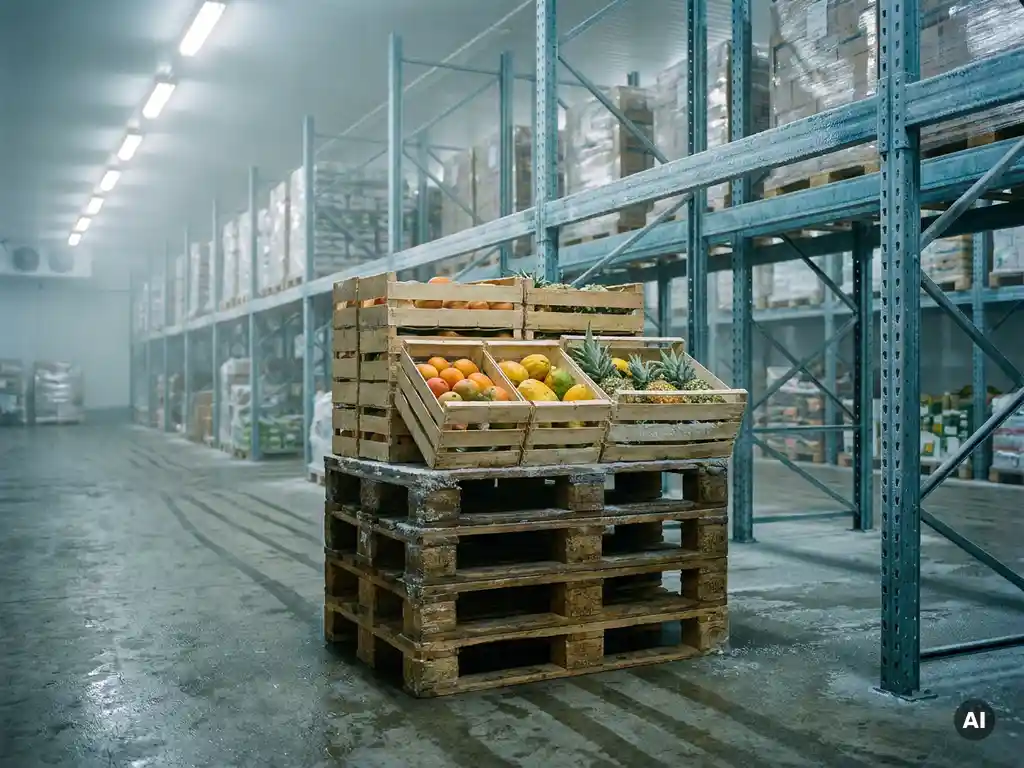
Climate-controlled cold storage is intended for products that require active cooling to ensure quality and safety. Examples include exotic fruits such as bananas and citrus fruits, vegetables, and other fresh food products. Temperature, humidity, and air circulation are continuously monitored, and climate chambers are adjustable per product type. Even minor deviations in storage conditions can lead to loss of quality or premature spoilage.
Dry storage: for stable food products
Dry storage is suitable for products that do not require active cooling but benefit from a stable, controlled environment. Nuts, peanuts, seeds, and dry food ingredients are typical examples. The focus is on preventing humidity fluctuations and temperature spikes that can affect shelf life or quality. This type of storage is generally less expensive than refrigerated storage but still requires professional facilities and monitoring.
The choice between the two storage methods depends entirely on the product characteristics and the requirements of the customer. Some importers require both, for example, when they import both fresh fruit and dry ingredients.
Which certifications must a food warehouse have?
A professional food warehouse supplying the food sector must possess at least BRC certification for food safety and, depending on the product categories, also SKAL certification for organic products. Additionally, inspection certificates from KCB (part of the NVWA) are relevant for importers of fresh fruit and vegetables.
An overview of the most relevant certifications:
- BRC (British Retail Consortium): The international standard for food safety in storage and distribution. Virtually all major supermarket chains and processing plants require this from their suppliers.
- SKAL: Mandatory for the storage of organically certified products. Without SKAL certification, a warehouse may not store organic products that are marketed as organic.
- Demeter: A supplementary certification for biodynamic products, relevant to a specific segment of the organic market.
- KCB/NVWA: The inspection service for the import inspection of fresh fruit and vegetables. Importers of fresh products are legally obliged to have their shipments inspected by the NVWA, with the KCB acting as the executor.
Always ask a potential storage partner for current certificates and verify whether the certification applies to the specific storage location and the type of product you wish to store. Certifications that exist on paper but do not apply to the relevant department or product category offer no protection during an audit by your customer.
How ZZColdstores helps with external food storage
ZZColdstores has been active since 1994 and combines dry storage and climate-controlled cold storage from strategically located sites in Kruiningen and Vlissingen, directly in the Rotterdam-Antwerp corridor. For importers looking for a reliable partner for food storage, ZZColdstores offers the following:
- Dry storage warehouse with a capacity of 12,000 pallet spaces, suitable for nuts, peanuts, seeds, and dry food ingredients at approximately 11 degrees
- Climate-controlled cold storage for fresh and perishable products, with 24/7 monitoring of temperature, humidity, and air circulation.
- Barcode-driven traceability per pallet, including linking of grower and LOT numbers
- Quality control upon arrival, including temperature and humidity measurements and QC reports
- Value-added services such as labeling, repalletizing, box picking, and EDI connections
- Certifications: BRC, SKAL, and Demeter, supplemented with import inspection via KCB/NVWA
- Container handling and customs clearance as part of a fully hassle-free logistics process
Would you like to know if external storage at ZZColdstores fits your product flow and sales market? Contact us for a no-obligation consultation.
Frequently Asked Questions
How long does it take on average to switch to external food storage?
The transition to external storage typically takes two to six weeks, depending on the complexity of your product flow and the required integrations such as EDI connections or customs procedures. Start with an intake during which the storage partner maps out your volumes, product specifications, and customer requirements. This clarifies which facilities, certifications, and additional services are needed before the first shipment arrives.
What happens if my product does not meet the quality requirements upon arrival?
A professional storage partner performs a quality control upon arrival and records any discrepancies in a QC report, including photos, temperature measurements, and a description of the observed damage or deviation. Based on this report, you can take immediate action towards the supplier or insurer, avoiding subsequent disputes regarding the condition of the product upon arrival. When selecting a partner, ensure that these reports are prepared and shared as standard practice, not just upon request.
Can I also use external storage for small volumes, or am I bound by minimum quantities?
Most specialized storage partners work with minimum purchases or a minimum number of pallet spaces per period, but the thresholds vary significantly by partner. For importers with smaller or fluctuating volumes, it is advisable to inquire in advance about flexible contract forms or rates based on actual usage rather than fixed capacity reservations. This way, you only pay for the space you actually use, making external storage cost-efficient even for smaller importers.
How do I ensure that my customers have access to traceability data of my stored products?
Many professional warehousing partners offer EDI connections or portal access, providing you and potentially your customers with real-time insight into inventory levels, LOT numbers, and delivery status per pallet. When selecting a partner, discuss which data exchange formats are supported, such as EDIFACT or API connections, and whether the partner can provide reports that align with your customers' audit processes. Traceability is not only an operational advantage but also a requirement for inspections by supermarket chains or certifying bodies.
What are the most common mistakes when choosing an external storage partner?
The most common mistake is choosing based on price without thoroughly checking the certifications and technical facilities against the requirements of your specific customers. A second common mistake is not asking for references within your own product category: experience with dry ingredients is fundamentally different from experience with fresh fruit. Additionally, always check whether the certifications apply to the specific storage location and department where your product is stored, not just to the company as a whole.
As an importer, do I have to arrange customs clearance myself, or can the storage partner take this over?
Many specialized food warehouses offer customs clearance and import inspection as part of a complete logistics package, meaning you do not have to coordinate this yourself with a separate customs broker. This is particularly valuable if you regularly import shipments from third countries outside the EU, where NVWA inspections and customs documentation must be precisely aligned. During the intake, explicitly ask which customs services are offered and whether the partner holds an AEO license or works with a certified customs broker.
How does the location of a storage partner affect my total logistics costs?
The location of a warehouse relative to the port of arrival, your production locations, and sales markets has a direct impact on transport and lead time costs. For example, a location in the Rotterdam-Antwerp corridor shortens the distance between the seaport and the storage location, saving costs on container handling and pre-carriage. For importers serving Germany as a key sales market, a strategically located warehouse in Zeeland or South Holland can significantly reduce total supply chain costs compared to a partner located further inland.
Related articles
- Can you rent storage space for containers of food products that are delivered in installments?
- Can you rent temporary storage space for a large food shipment?
- How does warehousing work after the arrival of a sea container?
- How do you know if your current storage location is suitable for nuts?
- What is the difference between refrigerated storage and dry storage?