
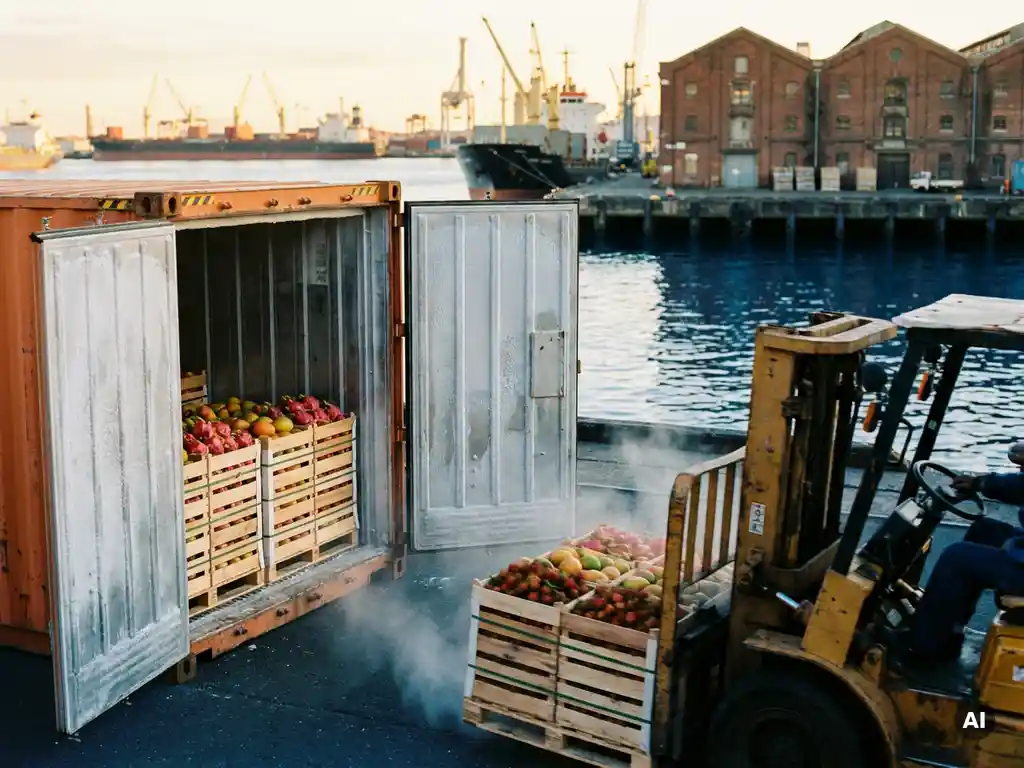
Yes, it is possible to rent storage space for containers of food products that are delivered in installments. This is also known as batch storage or partial delivery: the entire container contents are stored at one location, after which the goods are delivered in separate batches or on demand to various customers or at different times. For companies that work with large import volumes but maintain flexible delivery schedules, this is a logical and efficient model.
The following sections answer the most frequently asked questions about container storage with partial delivery for foodstuffs, from practical operation to the requirements that certified storage must meet.
What are the benefits of shared delivery from a single storage location?
Shared delivery from a single storage location means that a full container or batch is stored at one address and subsequently delivered in multiple smaller shipments. This offers importers, wholesalers, and suppliers direct benefits in terms of costs, quality management, and logistical flexibility.
The main benefits are:
- Cost efficiency: Importing and storing one large shipment is cheaper than handling multiple small shipments. The costs for customs clearance, inspections, and transport are spread over a larger quantity of product.
- Flexible delivery planning: Customers can be supplied on demand, without the importer having to arrange a new container every week. This is particularly valuable when demand fluctuates or when customers have different delivery times.
- Improved quality control: Because all goods are stored in one location, quality checks can be performed centrally. Products that do not meet the standard are immediately separated before they enter the supply chain.
- Less waste: Products remain stored under controlled conditions until needed, avoiding unnecessary exposure to fluctuating temperatures during intermediate storage.
For suppliers to supermarket purchasing organizations or processing plants, partial delivery also offers the advantage that deliveries can be precisely tailored to the end customer's demand, without large buffer stocks at the customer's own premises.
Which product types are suitable for combined container and partial storage solutions?
Products that are imported in large volumes but delivered in smaller quantities are ideally suited for combined container and partition storage solutions. This applies particularly to fresh and dry food products with a longer shelf life or a stable storage temperature.
Fresh products with climate requirements
Exotic fruits such as bananas and citrus fruits are typically imported in large container shipments. Because they are sensitive to temperature fluctuations and ripening processes, controlled storage is essential. Partial delivery makes it possible to spread the ripening phase and supply customers with product at the desired degree of ripeness at the right moment.
Dry foods at room temperature
Nuts, peanuts, seeds, and other dry food products are well-suited for combined container storage and partial delivery. They do not require refrigeration but do require a stable, controlled environment, typically around 11 degrees Celsius, to prevent loss of quality and pests. Large lots can be stored and subsequently delivered in smaller batches to processing plants or wholesalers.
Products less suitable for partial storage solutions are goods with a very short shelf life or products that must be processed immediately after opening the packaging. For those product flows, direct throughput is generally a better option.
How does the inbound and outbound movement of containers work at a cold storage company?
The inbound and outbound flow of containers at a cold storage company follows a fixed sequence of steps: arrival and unloading of the container, quality control upon entry, palletizing and storage, followed by order-driven outbound flow at the time of delivery.
Upon arrival, the container is unloaded and the goods are immediately taken to the correct storage cell. The faster this happens, the better the quality is preserved, especially with fresh products. Companies with their own quay next to the cold storage facility, such as in the port of Vlissingen, minimize the time between unloading and controlled storage.
Following receipt, a quality control check is performed. This checks for damage, temperature deviations, packaging errors, and product specifications. Products that do not meet the standards are immediately separated. Each pallet receives a barcode guaranteeing full traceability, including linkage to grower and LOT numbers.
Upon dispatch, orders are processed using barcode tracking. This means that the correct pallets or packages are picked based on the order information, provided with the correct labels and documentation, and subsequently prepared for transport. Through EDI connections, stock status and delivery notifications can be automatically transmitted to the client's system.
What are the requirements for certified storage of food in containers?
Certified food storage requires that the storage location meets specific standards for food safety, traceability, and hygiene. In the Netherlands and Europe, the most relevant certifications are BRC, SKAL, and the inspection requirements of KCB (part of the NVWA).
The most important requirements are:
- BRC certification: The British Retail Consortium standard is the standard required by most supermarket chains and purchasing organizations. It includes requirements for hygiene, temperature control, traceability, and documentation.
- SKAL certification: SKAL certification is required for organic products. Storage of organically certified goods must take place in a SKAL-certified environment to maintain the organic status.
- KCB/NVWA inspection: A phytosanitary inspection is mandatory for the import of fresh fruit and vegetables from third countries. The KCB, as part of the NVWA, carries out these inspections. A good storage location works closely with the inspection service to prevent delays.
- Temperature and humidity recording: Continuous monitoring and recording of storage conditions is a requirement for certification. This must be demonstrable and verifiable.
- Traceability: Every product must be fully traceable from arrival to delivery, including batch numbers and origin documentation.
Companies renting storage space for food products would do well to check which certifications the storage location holds and whether these align with the requirements of their own customers or certification bodies.
Where in the Netherlands can you rent container storage for food products?
Container storage for foodstuffs in the Netherlands is primarily concentrated around the major port areas: Rotterdam, Antwerp (just across the border), and the Zeeland ports such as Vlissingen and Kruiningen. These locations were logically chosen due to their direct connection to maritime shipping and the presence of customs offices and inspection services.
For importers and exporters working with container loads of exotic fruit, nuts, or other dry food products, locations in the Rotterdam-Antwerp corridor offer the best combination of accessibility, turnaround time, and availability of certified storage space. The proximity of customs and inspection services significantly accelerates customs clearance.
Vlissingen has the advantage that ships can dock here directly without the congestion of the major mainports. For parties entering via the Western Scheldt, this can result in significant time savings. Kruiningen, a short distance from Vlissingen, offers additional storage capacity for both refrigerated and dry products.
When choosing a location, it is advisable to consider: existing certifications, the distance to the unloading port, the availability of cooling or dry storage depending on the product, and the possibility of partial delivery or shuttle runs to customers within a radius of 40 kilometers.
How much does it cost to rent storage space for containers of food?
The costs for renting storage space for food containers vary widely and depend on the type of storage, the storage duration, the volume, and the additional services purchased. There is no fixed market price that applies generally, as rates are tailored to individual needs.
Factors that determine the price include:
- Type of storage: Climate-controlled cold storage is more expensive than dry storage at ambient temperature, due to energy costs and more complex technical installations.
- Storage duration: Short-term transit has a different rate than long-term batch storage. The longer the goods are stored, the more storage costs accumulate.
- Volume and pallet spaces: Most warehousing companies charge per pallet space per week or per month. Larger volumes generally lead to economies of scale.
- Additional services: Quality control, labeling, palletizing, EDI connections, and shuttle runs are billed separately. These value-added services can constitute a significant portion of the total costs.
- Certification requirements: Certified storage (BRC, SKAL) entails higher operational costs, which are passed on in the rate.
For an accurate cost estimate, it is always necessary to request a customized quotation from the storage location. Please indicate the product involved, the expected volume, the desired storage temperature, and the frequency of inbound and outbound movements.
How ZZColdstores helps with container storage and partial delivery of food products
ZZColdstores offers a fully integrated solution for importers and wholesalers looking to rent storage space for containers of food products delivered in installments. With locations in Vlissingen and Kruiningen, a private quay in the Port of Vlissingen, and certified storage (BRC, SKAL, KCB/NVWA), ZZColdstores is equipped for exactly this type of logistics.
What ZZColdstores offers for batch storage with partial delivery:
- Climate-controlled storage for fresh products such as bananas and citrus fruits, with 24/7 monitoring of temperature, humidity, and air circulation
- Dry storage at approximately 11 degrees for nuts, peanuts, seeds, and other dry food products, with a capacity of 12,000 pallet spaces
- Quality control upon arrival, including QC reporting and sampling
- Full traceability via barcode systems linked to grower and LOT numbers
- EDI connections for automatic order processing, inbound notifications, and inventory updates
- Own transport for shuttle trips within a radius of 40 kilometers
- Customs clearance and KCB inspection as part of the total service package
Would you like to know if climate-controlled storage at ZZColdstores aligns with your product flow and delivery schedule? Then contact ZZColdstores for a no-obligation consultation. The team is happy to help find the most efficient solution for your specific situation.
Frequently Asked Questions
What is the maximum period I can store a batch of food products for in the case of partial delivery?
The maximum storage duration depends on the product type and the expiration date. Dry products such as nuts and seeds can generally be stored for several months under the right climate conditions, while fresh products such as bananas and citrus fruits have a shorter storage period due to their ripening process. When concluding a storage agreement, always discuss the expected turnaround time per batch so that the storage location can guarantee the correct conditions and rotation.
What happens if part of my batch is rejected during quality control?
Products that do not meet the set quality standards are immediately separated from the approved batch and stored separately or returned, depending on the agreements with the client. You will receive a QC report with the findings, enabling you to liaise with your supplier or insurer in a timely manner. This is one of the concrete benefits of centralized storage: rejection is detected early, before the product reaches the end customer.
As a smaller importer, can I also make use of container storage with partial delivery, or is this only available to large players?
Container storage with partial delivery is certainly not exclusive to large importers. Smaller companies that import one or a few containers per month can also benefit from bulk storage, especially if they serve multiple customers with varying delivery times or quantities. However, it is advisable to make clear agreements in advance regarding minimum volumes and the frequency of delivery so that the storage location can plan the logistics efficiently.
How is my inventory managed, and can I view the status of my batch in real time?
Modern storage facilities utilize barcode systems and Warehouse Management Systems (WMS) that provide real-time insight into inventory status per batch, pallet, or package. Via EDI connections, inventory updates, inbound notifications, and delivery notifications can be automatically transmitted to your own ERP or order system. When selecting a storage partner, always inquire about the available digital connections and whether they integrate with your existing systems.
What is the difference between renting cold storage space and purchasing a full logistics services package?
Renting only cold storage space means you are responsible for inbound and outbound logistics, quality control, documentation, and transport yourself. A complete logistics services package, also known as third-party logistics (3PL), includes all these services, including traceability, EDI connections, customs clearance, and own transport. For importers who want to focus on purchasing and sales rather than operational logistics, a 3PL solution is typically more efficient and cost-effective in the long run.
Do I need to arrange customs clearance for my container myself, or can the storage location take care of this?
Many specialized storage locations near ports offer customs clearance as part of their service package or work closely with a designated customs broker. This is a major practical advantage, as clearance can then be handled directly at the location where the container is unloaded and stored. Check in advance whether the storage location can also facilitate KCB/NVWA inspections, especially if you are importing fresh vegetables or fruit from third countries outside the EU.
How do I choose the right storage location if I need to supply multiple customers in different regions?
Choose a storage location that is centrally located relative to your customers and has its own transport capabilities or established logistics partners for last-mile delivery. Also consider the distance to the unloading port, the availability of the correct certifications for your product type, and the flexibility of delivery schedules. A location that provides shuttle runs within a fixed radius offers the most control over delivery times and costs, especially if your customers need to be supplied daily or weekly.
Related articles
- How does pallet handling work in warehousing?
- Can you rent storage space for pallets of fresh produce?
- Can poor storage of nuts lead to rejection during import inspection?
- What are the advantages of storage close to the port of Antwerp or Rotterdam?
- How does a logistics partner ensure continuous delivery to your factory?