
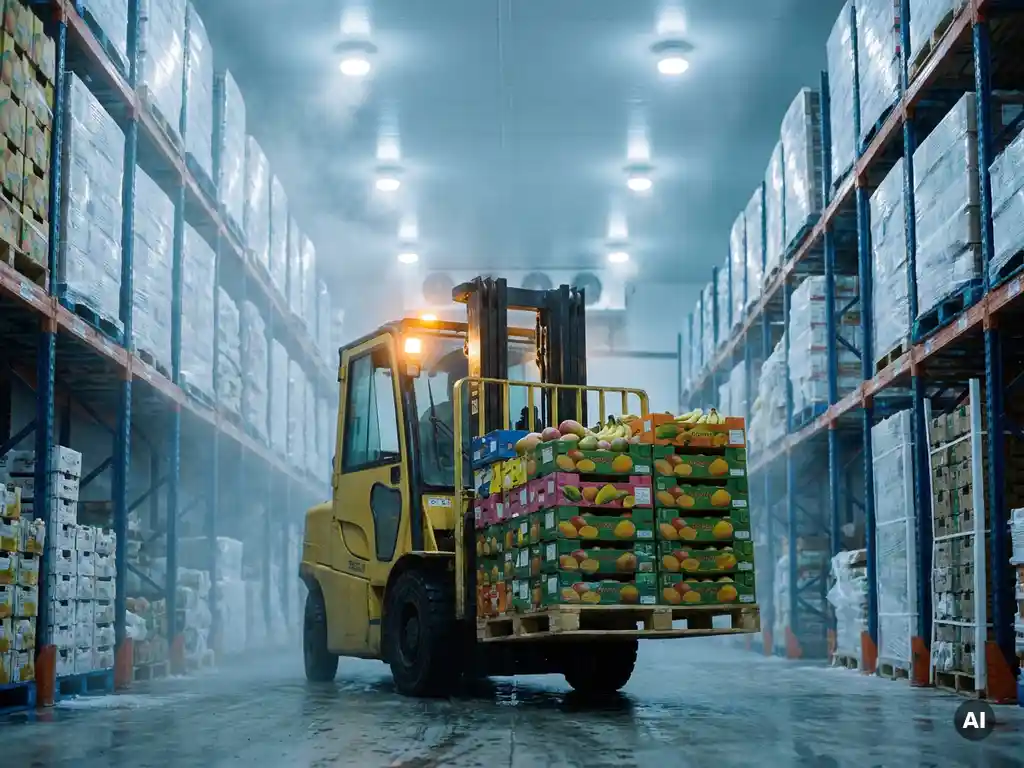
Pallet handling within warehousing encompasses all operations a pallet undergoes from the moment of arrival to delivery: unloading, registering, storing, moving, and loading. It is the backbone of an efficient warehouse process. For logistics managers and buyers at agri-food companies and trading houses, a well-organized pallet process directly determines the quality, speed, and reliability of the flow of goods. The questions below answer the most frequently asked questions about pallet handling in professional warehousing.
What steps does a pallet go through in a warehouse?
A pallet typically goes through five core steps in a warehouse: arrival and unloading, registration and labeling, inbound to a storage location, any processing or quality control, and finally outbound and loading. Each step has a direct impact on the accuracy of inventory records and the quality of the product upon delivery.
Upon arrival, the pallet is checked for damage, labeling, and compliance with the shipping documents. Subsequently, each pallet is assigned a unique identification number, often via a barcode or RFID label, so that the location and status are traceable at all times. After registration, the warehouse management system (WMS) determines the optimal storage location based on product type, temperature requirement, and turnover rate.
During the storage period, pallets may be moved for order picking, quality control, or re-evaluation. Upon dispatch, pallets are released in a fixed sequence (FIFO or LIFO) and prepared for transport. A tightly controlled pallet process minimizes errors, prevents damage, and ensures that products are available at the right time.
What are the most commonly used types of pallets in storage?
The most commonly used pallet types in warehousing are the Euro pallet (EUR pallet, 120 x 80 cm), the block pallet (120 x 100 cm), and the industrial pallet (120 x 120 cm). The Euro pallet is the standard in European food logistics and is the most requested by supermarket chains and processing plants.
In addition to the dimensions, the material differs: wooden pallets are the most common and cost-effective, but plastic pallets are increasingly being used for the refrigerated storage of fresh products due to their hygienic properties and longer lifespan. For international transport, ISPM-15 phytosanitary requirements apply to wooden pallets, which means that the wood must be treated to prevent the spread of plant diseases.
When choosing a pallet type, load capacity, stackability, compatibility with racking systems, and customer requirements play a role. Importers of exotic fruit often work with Euro pallets because they align with the purchasing standards of major supermarket organizations.
What equipment is used for pallet handling?
The most commonly used equipment for pallet handling in a warehouse is the hand pallet truck, the electric pallet truck, the reach truck, and the counterbalance forklift. Each device has a specific application depending on the warehouse layout, the driving height, and the weight of the load.
Manual pallet trucks are used for short movements at low levels, for example when unloading containers or preparing orders. Electric pallet trucks increase speed and reduce physical strain when handling larger volumes. Reach trucks are designed for narrow-aisle warehouses and can place pallets to great heights, increasing storage capacity per square meter.
In larger distribution centers, automated systems are also deployed, such as automated storage systems (AS/RS) or conveyor belts. For food logistics, all equipment must be suitable for use in refrigerated environments where applicable, and maintenance must comply with the hygiene standards required by certifications such as BRC.
How does storage temperature affect pallet handling?
Storage temperature influences pallet handling in two ways: it places demands on equipment and personnel, and it determines how quickly pallets must be processed to keep the cold chain intact. In refrigerated or climate-controlled storage, the time a pallet spends outside the conditioned area must be as short as possible.
In a cold storage warehouse, forklifts and pallet trucks must be suitable for low temperatures, as standard batteries and hydraulic systems perform less effectively in the cold. Employees work in shifts with shorter exposure times and appropriate protective clothing. The scheduling of inbound and outbound goods is coordinated with the arrival of ships or trucks to minimize temperature fluctuations.
For fresh products such as exotic fruit, the link between arrival and cooling is crucial. The shorter the transition from a ship's hold to the cold storage facility, the better product quality is safeguarded. This is also the reason why the location of a cold storage facility relative to the quay or terminal is a strategic factor in the choice of a storage partner.
What is the difference between FIFO and LIFO in pallet storage?
FIFO (First In, First Out) means that the pallet received first is also dispatched first. LIFO (Last In, First Out) works the other way around: the most recently received pallet leaves the warehouse first. For fresh and perishable food products, FIFO is the standard method because older batches are given priority for delivery.
LIFO is occasionally applied to non-perishable products where the processing order is less critical, or in specific racking systems where access from one side is more efficient. In practice, however, LIFO is rarely suitable for food logistics because the risk of expired best-before dates is too high.
A good WMS records the receipt date of every pallet and automatically triggers FIFO issuance. This is not only a matter of efficiency but also a requirement under food safety certifications. Auditors actively check whether inventory rotation is demonstrable and consistent.
How many pallet spaces does a warehouse need?
The required number of pallet spaces in a warehouse depends on the average inventory level, peak inventory levels, product turnover rate, and the buffer needed for unexpected supply or delays in demand. There is no universal figure: the calculation is always tailored to each product and supply chain.
A rule of thumb in the sector is to reserve at least 15 to 20 percent overcapacity alongside average capacity for peaks, returns, and quarantine pallets. For seasonal products such as citrus fruits, the required capacity can fluctuate significantly on a quarterly basis.
When determining the required pallet spaces, racking layout and row height also play a role. A warehouse with high racking and narrow aisles can utilize more pallet spaces within the same floor area than a warehouse with wide aisles and low storage. Logistics managers who purchase capacity from an external warehousing partner would do well not to base their decisions solely on the average, but also to calculate peak scenarios.
Which certifications are important for pallet handling in food warehousing?
For pallet handling in food warehousing, the most relevant certifications are BRC Global Standard for Storage and Distribution, SKAL (for organic products), and inspection by KCB (part of the NVWA) for importing batches of fresh products from outside the EU. These certifications set requirements regarding hygiene, traceability, temperature control, and documentation.
BRC is the standard required by most European supermarket chains and processing plants from their logistics partners. The standard covers, among other things, warehouse layout, cleaning procedures, pest management, temperature data recording, and pallet traceability. A BRC-certified warehouse offers customers the assurance that products are handled according to established protocols.
SKAL certification is mandatory for companies that store organic products and wish to market them as certified organic. Without SKAL certification, a warehouse may store organic products, but they may not be resold as organic. For importers who process both conventional and organic products, it is important that the warehouse can guarantee a strict separation.
How ZZColdstores supports pallet handling in climate-controlled storage
ZZColdstores offers professional warehousing for fresh and perishable food products, where pallet handling is fully tailored to the requirements of the product and the customer. The facilities in Kruiningen and Vlissingen are designed for efficient and temperature-controlled goods flows, with the following characteristics:
- Climate-controlled storage with 24/7 monitoring of temperature, humidity, and air circulation, tailored per product type
- Complete traceability of every pallet via barcode systems, from arrival to departure
- Private quay in Vlissingen for direct transfer from ship to cold storage, with minimal exposure to outside temperatures
- Quality control upon arrival, including temperature, humidity, and Brix measurements and QC reporting
- Certified according to BRC, SKAL, and Demeter, with import inspection via KCB/NVWA
- Dry storage capacity of 12,000 pallet spaces for nuts, peanuts, seeds, and other ambient products
Would you like to know how climate-controlled storage at ZZColdstores fits into your supply chain? Please contact us to discuss the possibilities for your specific products and volumes.
Frequently Asked Questions
How do I choose the right warehousing partner for pallet handling of fresh products?
When choosing a warehousing partner, pay attention to certifications (BRC, SKAL), the location relative to ports or terminals, the availability of climate-controlled cells per product type, and the level of traceability offered by the WMS. Always ask about peak availability and how the partner handles unexpected supply peaks or quarantine situations, as it is precisely in those moments that the quality of a partnership becomes apparent.
What happens if a pallet is damaged or not according to specification upon arrival?
A professional warehouse adheres to a documented receiving protocol in which damaged or non-conforming pallets are immediately marked as quarantine pallets and set aside. The sender and/or recipient are informed via a damage report accompanied by photographic documentation, and the pallet is only released upon approval by the responsible party. This process is part of the BRC standard and must be demonstrable and traceable.
How is pallet handling adjusted during seasonal peaks, for example during large supplies of citrus fruits?
During seasonal peaks, professional warehouses scale up by deploying extra shifts, reserving capacity in advance, and tightly aligning inbound and outbound planning with the arrival of ships or trucks. As an importer, it is advisable to consult with your warehousing partner in a timely manner regarding expected volumes so that racking capacity, equipment, and personnel are available on time. Flexible overcapacity of 15 to 20 percent is a minimum buffer in this regard.
Can a warehouse store both organic and conventional products at the same time?
Yes, but only if the warehouse can guarantee a demonstrable physical or administrative separation between organic and conventional products. Official organic certification requires SKAL accreditation, and auditors actively check whether cross-contamination or mixing is ruled out. Explicitly ask your warehousing partner about the separation of product flows and the documentation available regarding this.
What information do I need to provide as an importer so that a warehouse can process my pallets correctly?
Please provide at least the following information: product description and country of origin, required storage temperature and humidity, expiration date or harvest date, the number of pallets and the weight per pallet, and any certification requirements such as organic or Demeter. The more complete the information provided in advance, the faster and more accurately the warehouse can register, store, and release the pallet according to the correct priority.
What is the risk of a warehouse without its own WMS for my inventory management?
Without a fully-fledged warehouse management system, real-time insight into inventory levels, pallet locations, and expiration dates is not guaranteed, leading to a higher risk of errors during dispatch, expired products, and inadequate traceability during recalls. Furthermore, for food-related products, digital traceability is a requirement under BRC and food safety legislation. Always choose a partner that can provide real-time reporting and pallet-specific registration.
How can I control the costs of external pallet handling without compromising on quality?
Aim for a stable, predictable supply and communicate volumes to your warehousing partner in a timely manner, as last-minute changes often lead to additional costs due to the extra deployment of equipment and personnel. Consider fixed contract agreements for a base volume with flexible options for peaks, and request specified rate structures per transaction so you know exactly where the costs lie. Investing in correct palletizing and labeling upfront saves significantly on correction and repalletizing costs in the warehouse.
Related articles
- How does packaging quality affect the shelf life of dried fruit?
- How long can you safely store garlic in a temperature-controlled warehouse?
- What are the consequences of aflatoxin in poorly stored peanuts?
- What are the NVWA rules for import inspection of dried fruit in 2026?
- What are the most common mistakes when importing nuts from third countries?