
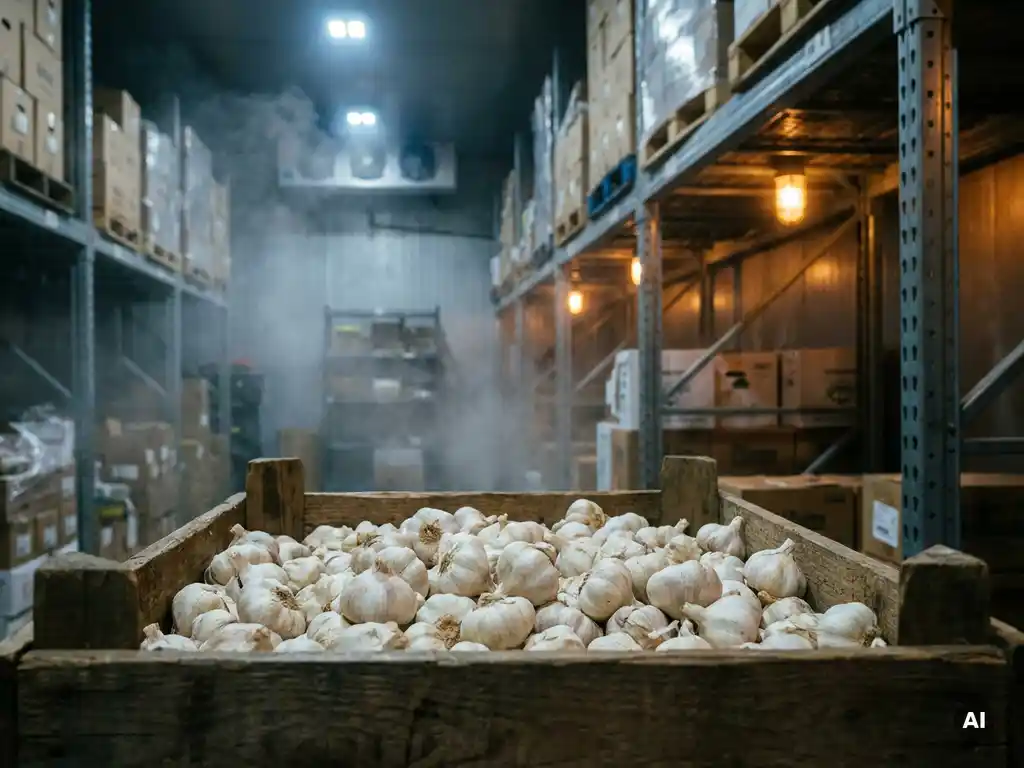
In a temperature-controlled warehouse, you can safely store garlic for up to eight months. The key lies in a combination of the correct temperature, low humidity, and good ventilation. As soon as any of these factors deviate, the quality deteriorates rapidly. The questions below answer everything importers, wholesalers, and logistics managers need to know about safely storing garlic in a professional storage environment.
How long does garlic keep at controlled temperature?
Garlic remains edible for six to eight months under controlled temperature and humidity . This applies to unpeeled, dry garlic bulbs stored at a temperature between 0 and 4 degrees Celsius or at approximately 10 to 15 degrees Celsius in a dry, well-ventilated room. Outside this range, quality loss occurs considerably faster.
The shelf life of garlic depends heavily on its condition upon arrival. Garlic that has been properly dried after harvest and is delivered without damage performs significantly better in storage than batches that have been exposed to fluctuating temperatures or humidity for some time. Early intervention in the event of quality deviations prevents part of a batch from affecting the rest.
For B2B parties importing garlic for further distribution to supermarket chains or processing plants, monitoring shelf life is not only a matter of product quality, but also of commercial reliability towards customers.
What are the ideal temperature and humidity conditions for garlic?
The ideal storage conditions for garlic are a temperature between 0 and 4 degrees Celsius with a relative humidity of 60 to 70 percent. At higher humidity, mold forms; at humidity that is too low, the garlic dries out too quickly and loses weight and flavor. Stable air circulation is essential in this regard.
There is also a second suitable storage method: storage at room temperature of 10 to 15 degrees Celsius, combined with low humidity and good ventilation. This is the classic approach for dry storage of garlic, where active cooling is not necessary. The shelf life is shorter in this case than with cold storage, but the method is suitable for shorter storage periods or for batches that move through quickly.
What both methods have in common: temperature fluctuations are the greatest enemy. Even short periods of higher temperature can cause condensation, which greatly increases the risk of spoilage. Constant monitoring is therefore not a luxury, but a basic requirement.
What is the difference between dry storage and cold storage for garlic?
The difference lies in the combination of temperature, humidity, and intended storage duration. Dry storage (also known as ambient storage) stores garlic at a stable ambient temperature of 10 to 15 degrees Celsius without active cooling. Cold storage reduces the temperature to 0 to 4 degrees Celsius, thereby significantly extending the shelf life.
For the practice of importers and wholesalers, this means the following:
- Dry storage is suitable for batches that are delivered on within two to three months. Storage costs are lower and the logistical flow is simpler.
- Cold storage is the better choice for seasonal stocks or larger batches held for longer periods, for example to absorb price fluctuations or to offer a delivery guarantee to regular customers.
- For cold storage, it is essential that the garlic acclimatizes gradually upon leaving the cell to prevent condensation from forming on the bulbs.
- Dry storage requires less technical infrastructure but is more susceptible to seasonal fluctuations when the outside temperature rises.
The choice between the two storage forms depends on the inventory turnover rate, the desired shelf life, and the specific requirements of the end customer.
What quality problems arise from improper storage of garlic?
Improper storage of garlic leads to a range of quality problems that can quickly undermine the marketability of a batch. The most common problems are mold formation, premature sprouting, drying out, and rotting. Each of these defects has a different cause, but they are all preventable with proper storage conditions.
The most important risks at a glance:
- Mold formation: occurs when humidity is too high, especially in combination with insufficient ventilation. Mold spreads quickly from bulb to bulb and can render an entire batch unsaleable.
- Premature sprouting: occurs at temperatures above 10 degrees Celsius, especially if the batch has been stored for a longer period. Sprouted garlic loses flavor and is unacceptable to many buyers.
- Dehydration and weight loss: with excessive humidity or high air circulation, the outer skin dries out too quickly, leading to weight loss and a less presentable product.
- Rotting: occurs when damaged or excessively moist bulbs are not sorted and separated from the rest of the batch in a timely manner. This is a classic consequence of insufficient quality control upon arrival.
- Odor transfer: Garlic has a strong odor and can affect the taste and smell of other products in a shared storage area. Proper zoning in the warehouse is therefore important.
Timely quality control upon arrival, in which damaged or defective products are immediately sorted out, is the most effective way to prevent chain reactions within a batch.
Which certifications are important for temperature-controlled garlic storage?
For the professional storage of garlic in a B2B context, BRC (British Retail Consortium) and KCB/NVWA certification the most relevant quality marks. BRC sets requirements for food safety, hygiene, traceability, and quality management in the warehouse. KCB is the inspection body that conducts import inspections for fresh fruit and vegetables, including garlic, on behalf of the NVWA.
For importers supplying garlic to supermarket chains or processing plants, BRC certification is often a strict requirement from the buyer in practice. Without this certificate, batches are simply not accepted by many purchasing organizations.
In addition, SKAL certification is relevant for parties storing organic garlic. SKAL verifies whether the organic status of the product is maintained throughout the entire chain, including the storage phase. A warehouse that stores both conventional and organic garlic must be able to demonstrably separate and trace which batch has which status.
Traceability is the unifying theme here: from grower and lot numbers to delivery, every step in the chain must be demonstrably recorded.
When is outsourcing garlic storage to a third party sensible?
Outsourcing garlic storage makes sense whenever internal storage capacity, climate control, or certification requirements do not align with customer demands or regulations. For most importers and wholesalers, a specialized temperature-controlled warehouse more efficient than on-site storage, especially when volume is seasonal.
Concrete situations in which outsourcing is preferred:
- The own storage capacity is insufficient to accommodate large seasonal batches.
- The warehouse does not possess the required BRC or KCB certification demanded by customers.
- Climate control in on-site storage is not stable enough for long-term storage.
- The logistical location of the own storage does not connect to the supply route from the port.
- Quality control, sorting, and repalletization consume too much time and capacity internally.
A third party that combines these functions reduces operational pressure and shifts the quality risk to a specialized environment.
How ZZColdstores helps with garlic storage
ZZColdstores offers temperature-controlled dry storage in Kruiningen and Vlissingen, specifically suitable for products such as garlic that require a stable, dry storage environment. The new dry storage warehouse offers space for 12,000 pallet spots and is designed for products such as nuts, seeds, and food products with similar storage requirements. The environment is maintained at approximately 11 degrees Celsius, which aligns with the recommended storage temperature for garlic for short to medium storage periods.
What ZZColdstores specifically offers for parties who want to store garlic:
- Conditioned dry storage at stable temperature and humidity
- Quality control upon arrival, including inspection for damage and packaging deviations
- Sorting and repalletizing according to the client's specifications
- Barcode-driven traceability with linking of lot and grower numbers
- BRC, SKAL, and KCB/NVWA certification for full compliance with the requirements of supermarket chains and processing plants
- EDI connections for automatic order processing and inventory updates
Would you like to know if ZZColdstores' storage conditions align with your specific product and logistics chain? Contact Frans van der Maas, Operations Director, for a no-obligation discussion about the possibilities.
Frequently Asked Questions
How do I check the quality of a batch of garlic upon arrival at the warehouse?
Upon arrival, systematically check the bulbs for damage, an abnormal odor, visible mold, and the degree of drying of the outer skin. Take samples from multiple pallets and record findings directly linked to the lot and grower number for traceability. Batches with damaged or excessively moist bulbs must be sorted out immediately before entering the storage area; otherwise, there is a risk that abnormalities will spread throughout the entire batch like a chain reaction.
What should I do if the temperature in the warehouse has temporarily fluctuated?
Check the batch as soon as possible for signs of condensation on the bulbs, which is the first visible consequence of a temperature spike. Temporarily increase air circulation to remove excess moisture and document the deviation, including the time and duration, for your quality records. If the temperature deviation has lasted longer than a few hours, a full visual inspection of the batch is recommended to detect sprouting or mold formation early.
Can garlic be stored together with other products in the same storage room?
That is possible, but requires careful zoning due to the strong odor emitted by garlic. Garlic can affect the taste and smell of odor-sensitive products such as nuts, seeds, or dried herbs when stored in the same room without sufficient separation. Ensure physical separation or use separate compartments, and check that the storage temperature and humidity of the garlic are also compatible with the requirements of the other products in the room.
How do I prevent condensation when garlic leaves the cold room?
Always allow garlic to acclimatize gradually after cold storage by first placing the batch for some time in an intermediate space or airlock at a temperature between the cell temperature and the outside temperature. Never move the batch directly from 0–4 degrees Celsius to a warm loading dock or outdoor environment, as the temperature difference immediately causes condensation to form on the bulbs. Condensation significantly increases the risk of mold formation, even if the garlic is otherwise in perfect condition.
Which documents do I need to properly store and distribute imported garlic in the Netherlands?
For the import and storage of garlic from third countries, you need at least a phytosanitary certificate, an import permit, and the associated KCB/NVWA inspection documents. For organic garlic, a SKAL certificate from the supplier is additionally required, and the organic status must be demonstrably passed on throughout the chain via batch documentation. For deliveries to supermarket chains, many purchasing organizations also expect the storage warehouse itself to be BRC-certified, which further tightens the documentation requirements regarding traceability, hygiene, and quality management.
How do I calculate how much storage capacity I need for a seasonal batch of garlic?
Start with the gross weight of the batch and convert this to the number of Euro pallets based on the stacked packaging units used by your supplier, typically nets or crates of 5 to 10 kilograms. Allow for a margin of 10 to 15 percent extra space for work aisles, quality control, and potential repalletization. Discuss the expected turnover rate with your storage partner in advance so that capacity planning aligns with both the supply peak after the harvest season and your customers' purchasing schedules.
What are the most common mistakes made in garlic storage that importers can avoid?
The most common mistake is storing batches without prior quality control upon arrival, whereby damaged or excessively moist bulbs enter the storage area unnoticed and affect the rest of the batch. A second common mistake is mixing batches with different origins or harvest dates on the same pallet, which complicates traceability and masks quality differences. Finally, many importers underestimate the importance of constant temperature monitoring: a single measurement upon receipt is insufficient; continuous logging is the only way to detect quality deviations in a timely manner and document them for customers.
Related articles
- How does packaging quality affect the shelf life of dried fruit?
- What is buffer storage and how does it help your factory run stably?
- What is the difference between ambient storage and cold room storage for food?
- What is the correct storage temperature for potato flakes and powder?
- How do you choose a suitable storage partner for dry food products?