
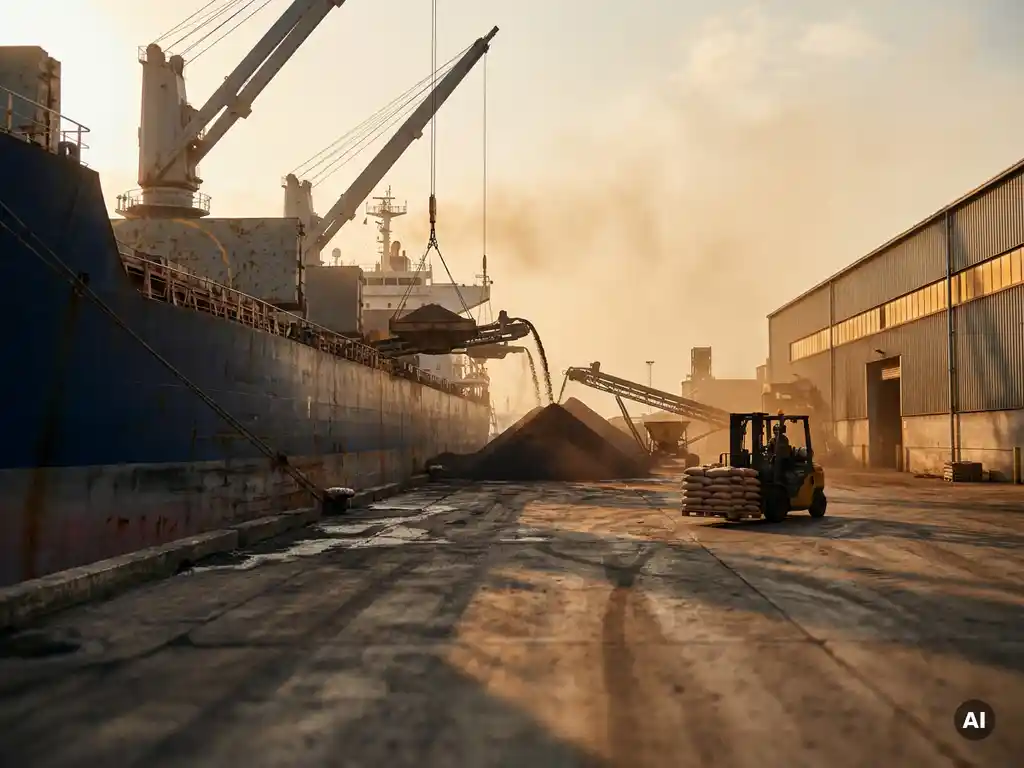
The port-to-factory logistics chain for dry raw materials encompasses the entirety of steps between the arrival of a ship and the final delivery of raw materials to a processing plant. This chain typically consists of unloading, inspection, customs clearance, storage, and transport to the final destination. For supply chain managers and buyers at processing companies, insight into this chain is essential to manage risks and optimize lead times. The questions below elaborate on each step in concrete terms.
Which links form the logistics chain from port to factory?
The logistics chain for dry raw materials from port to factory consists of five main links: arrival and unloading in the port, import inspection and customs clearance, temporary storage in a dry warehouse, inland transport, and delivery to the factory. Each link has its own lead time, risk profile, and quality requirements. A hiccup in one link directly affects the rest of the chain.
Moreover, for dry food raw materials such as nuts, peanuts, and seeds, specific requirements apply regarding climate control, food safety, and traceability. This makes the supply chain more complex than for non-food goods. Choosing a logistics partner that manages multiple links in-house shortens transfer times between steps and reduces the risk of quality loss or communication errors.
How is the unloading of dry raw materials carried out in the port?
The unloading of dry raw materials in the port takes place via bulk unloading or container handling, depending on how the cargo was shipped. In container handling, the containers are driven from the ship to a terminal, after which they are opened, inspected, and transferred to pallets or stored directly. The speed of unloading depends heavily on the port infrastructure and the location of the storage warehouse relative to the quay.
A short distance between the quay and the cold storage or dry warehouse is just as important for dry raw materials as it is for refrigerated products. The longer a shipment remains on the quay, the greater the risk of moisture, temperature fluctuations, or damage to the packaging. Efficient container handling of dry raw materials therefore begins with the selection of a port with a direct warehouse connection.
What are the requirements for dry storage of food raw materials?
Dry storage of food raw materials requires a stable ambient temperature, low humidity, good ventilation, and strict separation of product categories. In addition, legal requirements regarding food safety apply, such as HACCP principles and certifications like BRC. Pest control and hygienic storage are not options, but obligations for every serious warehousing partner.
Additional requirements apply to specific raw materials. Nuts and peanuts are susceptible to mold formation in high humidity, which can lead to the formation of aflatoxins. Seeds require a stable temperature to maintain germination capacity or edibility. A well-designed dry storage warehouse takes all these variables into account for each product type.
The minimum requirements for dry storage of food raw materials are:
- Stable ambient temperature (typically 10 to 18 degrees Celsius, depending on the product)
- Relative humidity below 65 percent
- Sufficient ventilation and air circulation to prevent condensation
- Separate storage by product category to avoid cross-contamination
- Certification such as BRC for food safety
- Traceability system per batch or lot
How does the port location affect the lead time of raw materials?
The port location has a direct impact on the lead time of dry raw materials in the supply chain. The closer the storage warehouse is located to the unloading point, the less transport time is lost between unloading and storage. With a private quay next to the warehouse, a shipment can be moved from the ship to storage within a few minutes, minimizing quality loss and accelerating administrative processing.
In addition, the port location determines which customs procedures apply and how quickly an import inspection can take place. Ports with established infrastructure for food products, such as the presence of the NVWA or recognized inspection services, significantly accelerate customs clearance. For importers of raw materials from third countries, this represents a concrete time saving of sometimes several working days.
What role does flexibility play in the supply chain of dry raw materials?
Flexibility in the dry raw materials supply chain is essential because shipping schedules, harvest volumes, and factory demand rarely align precisely. A logistics partner must be able to handle fluctuating supply volumes, varying arrival times, and short-term requests for additional pallet space or expedited delivery.
This calls for a warehouse with scalable capacity and an operational team that adapts to the customer's rhythm rather than the other way around. Port pallet storage that is flexibly scalable provides importers and factories with the buffer they need to absorb peaks in supply or demand without disrupting their own production process.
What are the biggest risks in the chain from port to factory?
The greatest risks in the logistics chain from port to factory for dry raw materials are quality loss due to moisture or temperature fluctuations, delays in customs clearance, improper storage leading to product rejection, and communication errors during transfer between links. Each of these risks can lead to financial damage, loss of batches, or disruptions in the factory production line.
The risks are greatest at the transition points: from ship to quay, from quay to warehouse, and from warehouse to transport. At those moments, the cargo is most vulnerable to external conditions and human error. An integrated approach in which one partner manages multiple links reduces the number of transfers and thereby the risk.
The most common risks summarized:
- Moisture damage due to prolonged exposure to outdoor air or inadequately controlled storage
- Delays in inspection or customs clearance due to incomplete documentation or capacity problems at customs
- Incorrect storage where products are combined with incompatible goods
- Loss of information during transfer between parties, compromising traceability
- Capacity problems in the warehouse due to unexpectedly large supply volumes
How do you choose the right logistics partner for dry raw materials?
The right logistics partner for dry raw materials possesses certified storage facilities, a port location with a fast connection to the warehouse, demonstrable experience with food raw materials, and the capacity to scale flexibly. Certifications such as BRC are a minimum requirement for every serious partner in the food sector.
In addition to technical suitability, operational culture also counts. A partner who adapts to the customer's ship schedules and production rhythms, rather than imposing a rigid system, is structurally more valuable to importers and factories. During the selection process, always inquire about the exact distance between the quay and the warehouse, the available pallet capacity, and how inspections and customs clearance are coordinated.
How ZZColdstores helps with dry storage of raw materials
ZZColdstores offers a complete solution for the storage and handling of dry food raw materials, with locations in Kruiningen and Vlissingen. From its own quay in Vlissingen, goods are transported directly to the warehouse after unloading, minimizing exposure time and protecting the quality of the cargo.
What ZZColdstores specifically offers for dry raw materials:
- A dry storage warehouse with a capacity of 12,000 pallet spaces
- Separate areas for nuts, peanuts, seeds, and other food products
- BRC, SKAL, and Demeter certifications for demonstrable food safety
- Import inspection via KCB (part of the NVWA) and customs clearance
- Flexible storage that moves with ship schedules and production planning
For supply chain managers and buyers looking for a reliable partner for dry storage of raw materials, ZZColdstores is the logical partner. Contact us to discuss how the facilities align with your specific logistical requirements.
Frequently Asked Questions
How long does average customs clearance take for dry food raw materials?
The turnaround time for customs clearance of dry food raw materials typically varies between one and five working days, depending on the completeness of the documentation, the country of origin, and the availability of inspection services such as the NVWA or KCB. For products from third countries outside the EU, a phytosanitary inspection or aflatoxin control may take additional time. You significantly shorten the turnaround time by having all necessary documents—such as the certificate of origin, the health declaration, and the analysis report—ready well before the ship arrives.
What is the difference between BRC-certified storage and standard dry storage?
BRC-certified storage complies with the British Retail Consortium's Global Standard for Storage and Distribution, which means that the storage location is structurally audited for food safety, hygiene, traceability, and risk management. Ordinary dry storage offers no demonstrable guarantees in these areas and is often not accepted by major retailers and food producers as a link in the chain. For importers of food raw materials, BRC certification is therefore not a luxury, but a practical requirement to maintain access to their customers.
How do I prevent aflatoxin problems when storing nuts and peanuts?
Aflatoxins are produced by molds that grow in excessively high humidity and temperature — the most important preventive measure is therefore maintaining a relative humidity below 65 percent and a stable temperature between 10 and 18 degrees Celsius. In addition, it is essential to have batches sampled and analyzed for aflatoxin content upon arrival, so that contaminated batches are identified early and stored separately. Choose a storage partner that has a certified batch traceability system, so that in the event of a positive result, it is immediately clear which pallets are involved.
As an importer, can I also make use of flexible pallet storage if my supply volumes vary significantly by season?
Yes, flexible pallet storage is specifically designed for importers with seasonal or irregular supply patterns. Instead of a fixed lease agreement for a specific number of pallet spaces, with flexible storage you pay based on actual usage, which reduces fixed logistics costs during quiet periods. When selecting a partner, explicitly discuss how quickly extra capacity is available during a major supply peak, and whether a guaranteed minimum capacity applies during busy periods.
What minimum documents do I need to import dry raw materials from a third country?
For the import of dry food raw materials from countries outside the EU, you require at least the following documents: a commercial invoice, a packing list, a bill of lading or airway bill, a certificate of origin, and — depending on the product — a phytosanitary certificate or a health declaration. For high-risk products such as nuts and peanuts, a laboratory analysis for aflatoxins is additionally mandatory upon import into the EU. Incomplete documentation is one of the most common causes of customs clearance delays, so check the requirements per product category with your customs broker.
How do I know if a logistics partner really has experience with food raw materials and not just general dry goods?
Ask the partner for concrete references from customers in the food sector and for the specific certifications they hold, such as BRC, SKAL, or Demeter — these are only granted to parties that demonstrably comply with strict food safety standards. Also inquire about internal procedures for product separation, pest control, and batch traceability, as this reflects practical knowledge of food logistics. A partner with genuine experience in food raw materials will be able to answer these questions directly and in detail without referring to general warehouse procedures.
What should I do if a batch of raw materials does not meet the quality requirements upon arrival?
In the event of a batch being rejected, it is crucial that the shipment is immediately separated from approved goods and that the findings are documented with photos, inspection reports, and a written notification to the supplier and any insurer. Depending on the nature of the problem—moisture, contamination, or deviating specifications—the options are re-export, destruction, or disposal through an alternative channel outside the food chain. Always ensure that your logistics partner has a clear protocol for handling rejected batches, including segregated storage space and direct lines of communication with inspection services.
Related articles
- How much does it cost to rent a storage unit?
- What role does warehousing play between the port and the customer?
- What is the difference between a bonded warehouse and a regular warehouse?
- How does humidity affect the quality of stored almonds?
- How are big bags unloaded and redistributed onto pallets in a warehouse?