
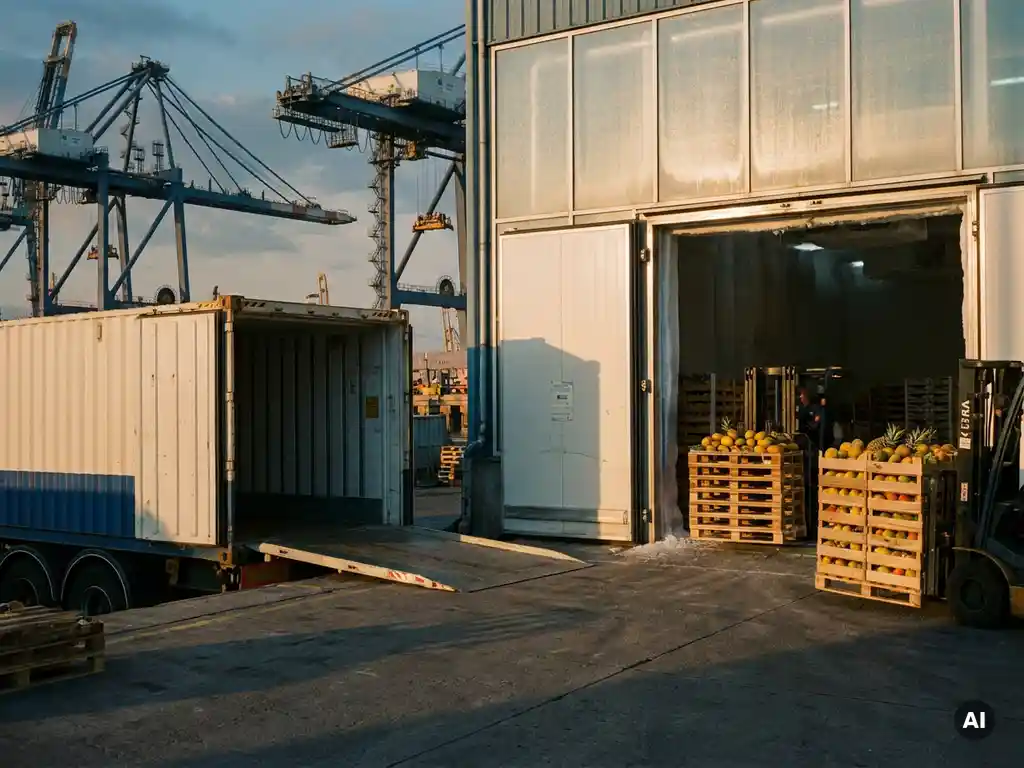
Yes, warehousing and container handling combine excellently, and for many B2B logistics flows, that combination is even the most efficient choice. By outsourcing storage and container handling to a single party, you reduce transshipment times, save on transport costs, and maintain better control over the quality of temperature-sensitive products. In this article, we answer the most frequently asked questions about how such an integrated approach works and when it yields the best results.
What are the benefits of combined storage and container handling?
Combined storage and container handling reduces the number of links in the logistics chain. Instead of first transporting containers to a terminal and then separately to a storage location, unloading, inspection, and storage are performed at a single location. This saves time, transport movements, and the risk of quality loss with each additional transfer.
The benefits are most noticeable with fresh and temperature-sensitive products. The shorter the time between unloading the container and reaching the correct storage temperature, the better product quality is preserved. However, for dry products such as nuts, peanuts, and seeds, fewer handling steps also reduce the risk of damage or contamination.
Concrete benefits of an integrated approach:
- Fewer transport movements between terminal and warehouse
- Shorter lead time from arrival to storage
- One point of contact for planning, documentation, and quality control
- Lower risk of temperature breakage or damage during transfer
- Better alignment with ship sailing schedules
How does combining warehousing and container handling work in practice?
In practice, the process begins with the arrival of a ship or container. The containers are unloaded, inspected immediately, and then transported to the storage location, which is ideally situated directly next to or on the quay. This minimizes the time between unloading and storage, without additional road trips.
After unloading, a quality control check typically follows, during which the shipment is inspected for damage, labeling, and product condition. Temperature, humidity, and Brix measurements may be part of this process, depending on the product specifications. Products that do not meet the standards are immediately separated from the batch. Subsequently, the goods are stored under the appropriate conditions and registered in a traceability system.
The combination works most smoothly when the storage location is physically connected to the handling infrastructure. This prevents products from being unnecessarily exposed to fluctuating ambient temperatures or waiting times outside a temperature-controlled room.
Which products are suitable for combined storage and transshipment?
Virtually all fresh food products imported via containers are suitable for a combined approach to transshipment and warehousing. This applies in particular to products where quality deteriorates rapidly if the supply chain is not properly aligned, such as exotic fruit, citrus fruits, and other fresh agricultural products.
However, dry products also benefit from an integrated approach. While nuts, peanuts, seeds, and other ambient products do not require refrigeration, they do require protection against moisture, temperature fluctuations, and contamination. Storage at a constant temperature of approximately 11 degrees is common for this type of product and requires specific facilities.
Products that are particularly suitable for combined handling and storage:
- Exotic fruits such as bananas and citrus fruits
- Fresh vegetables and other chilled fresh products
- Nuts, peanuts and seeds (dry storage)
- Other food products that require precise climate control
What is the difference between a standalone storage partner and an integrated terminal?
A standalone storage partner offers only warehouse capacity. Container handling, transport from the port to the warehouse, and the associated administration are then the responsibility of the client or a separate party. An integrated terminal combines unloading, transshipment, storage, and often quality control and customs clearance at a single location.
The difference lies not only in physical proximity but also in the division of responsibilities. With a separate storage partner, the client must link the chain together themselves: a freight forwarder arranges the transport, a terminal handles the container, and the warehouse only takes over the goods upon delivery. This requires more coordination and increases the risk of miscommunication or delays.
With an integrated approach, there is one party that oversees the entire process, from the arrival of the ship to the moment the goods are ready for further distribution. For supply chain managers and buyers, this means less operational pressure and a better overview of the chain.
When does it make sense to combine warehousing and container handling?
Combining warehousing and container handling makes sense as soon as you regularly import container volumes and the quality of the goods depends directly on a fast and controlled transfer from ship to storage. The larger the volume and the more sensitive the product, the more an integrated approach pays off.
Specific situations where the combination offers clear added value:
- You import fresh or temperature-sensitive products where every extra link can mean a loss of quality
- You work with tight sailing schedules where rapid unloading and immediate storage are essential
- You want to simplify logistical coordination and limit the number of suppliers
- You require combined quality control, import inspection, and storage at one location
- You distribute from a central point to multiple European destinations
For companies distributing from the Rotterdam-Antwerp corridor to Germany, Eastern Europe, or other European markets, an integrated location in Zeeland offers a strategic position that saves logistical time and costs.
What role does customs clearance play in combined warehousing and container handling?
Customs clearance is an indispensable part of the import chain and follows directly from container handling. Products imported from third countries must be cleared by customs before they can be released into free circulation or stored further. If customs clearance takes place at the same location as transshipment and storage, unnecessary waiting times and additional transport movements are avoided.
For fresh food products, in addition to customs control, an import inspection is also carried out by the KCB, a division of the NVWA. This inspection is mandatory for certain categories of fruit and vegetables entering the European market. When this inspection can be performed directly at the storage location, the batch flows through more quickly and quality remains better safeguarded.
An integrated partner that handles both customs clearance and import inspection relieves importers and freight forwarders of a significant portion of the administrative and operational burden.
How ZZColdstores helps with combined warehousing and container handling
ZZColdstores combines container handling, storage, and customs clearance at a single location in the Port of Vlissingen, with its own quay directly next to the cold storage facility. This makes it possible to place products in the correct storage environment within moments of unloading. For fresh and temperature-sensitive products, this is a crucial advantage.
What ZZColdstores offers within an integrated approach:
- Climate-controlled storage for fresh products such as bananas and citrus fruits, with 24/7 monitoring of temperature, humidity, and air circulation
- Dry storage for nuts, peanuts, seeds, and other ambient products, with a capacity of 12,000 pallet spaces
- Quality control upon arrival, including temperature, humidity, and Brix measurements
- Import inspection via KCB (NVWA) and on-site customs clearance
- Full traceability per pallet via barcode system
- Flexible scheduling aligned with the sailing schedule of arriving ships
ZZColdstores is certified according to BRC, SKAL, and Demeter, and operates exclusively B2B. Whether you are an importer, wholesaler, freight forwarder, or supply chain manager: if you are looking for a reliable partner who can handle the entire process from arrival to delivery, please contact us via the ZZColdstores contact page or explore the options for climate-controlled storage.
Frequently Asked Questions
How quickly can goods be stored after arrival if warehousing and container handling are combined?
At an integrated location where the quay is directly adjacent to the cold storage facility or warehouse, goods can be placed at the correct storage temperature within minutes to hours after unloading. This is significantly faster than a traditional approach where containers first go to a separate terminal and are then transported by truck to a storage location. For temperature-sensitive products such as bananas and citrus fruits, this difference can be decisive for the final product quality and shelf life.
What are common mistakes when separating container handling and storage?
A common mistake is underestimating the amount of time and quality loss that occurs with each additional transfer between terminal, transport, and warehouse. Importers often schedule transport time between locations too optimistically, causing products to remain outside a temperature-controlled environment longer than desired. Additionally, working with multiple parties often leads to miscommunication regarding documentation, quality control, and customs status, resulting in delays and extra costs. An integrated approach eliminates these risks by making a single party responsible for the entire process.
Is an integrated approach also worthwhile if I import relatively small volumes?
Yes, even with smaller volumes, an integrated approach can offer benefits, particularly when working with quality-sensitive products or where a fast turnaround time is essential. In that case, the savings lie less in economies of scale and more in the simplification of coordination and the reduction of the risk of quality loss or delays. It is wise to weigh the total logistics costs of a split approach – including transport, coordination time, and potential quality losses – against the costs of an integrated partner.
How does communication and reporting work at an integrated warehousing and container handling partner?
With a good integrated partner, you have a single point of contact that keeps you informed about the status of your shipment, from the ship's arrival through storage and delivery. Pallet-level traceability systems, such as barcode systems, give you real-time insight into the location and status of your products. When selecting a partner, ensure that you make clear agreements regarding reporting frequency, quality reports upon arrival, and the method for communicating deviations.
Which certifications should I check when choosing a combined warehousing and container handling partner?
For food products, certifications such as BRC (British Retail Consortium) and SKAL (for organic products) are important indicators of quality and food safety standards. Additionally, check whether the partner is recognized for customs clearance and whether import inspections via the NVWA/KCB can be carried out on-site. Depending on your product category and customers, additional certifications such as Demeter (for biodynamic products) or specific retail certifications may be required.
How do I align the logistics with the sailing schedule when switching to an integrated approach?
An integrated partner aligns its planning directly with ship arrival times, meaning that as an importer, you do not have to manage the coordination between the terminal and the warehouse yourself. Share your sailing schedules with your partner as early as possible so that capacity for unloading, quality control, and storage can be planned in a timely manner. Clear agreements regarding flexibility in the event of ship delays are also important, as sailing schedules frequently deviate in practice.
What is the strategic added value of a storage location in Zeeland compared to Rotterdam or Antwerp?
A location in Zeeland, such as the Port of Vlissingen, offers direct access to the North Sea and is strategically situated between Rotterdam and Antwerp, allowing ships to often dock and unload more quickly without the congestion of the major mainports. From Zeeland, the Dutch, Belgian, German, and Eastern European markets are easily accessible, making the location suitable as a central distribution point for European deliveries. For importers who prioritize speed and maintaining quality, this can be a decisive advantage over overcrowded terminals in the major ports.
Related articles
- How does pallet storage for food work?
- When does it make sense to combine inventory management with customs clearance?
- How does import inspection via the KCB and NVWA work in the Netherlands?
- Can poor storage of nuts lead to rejection during import inspection?
- What are the most common mistakes when importing nuts from third countries?