
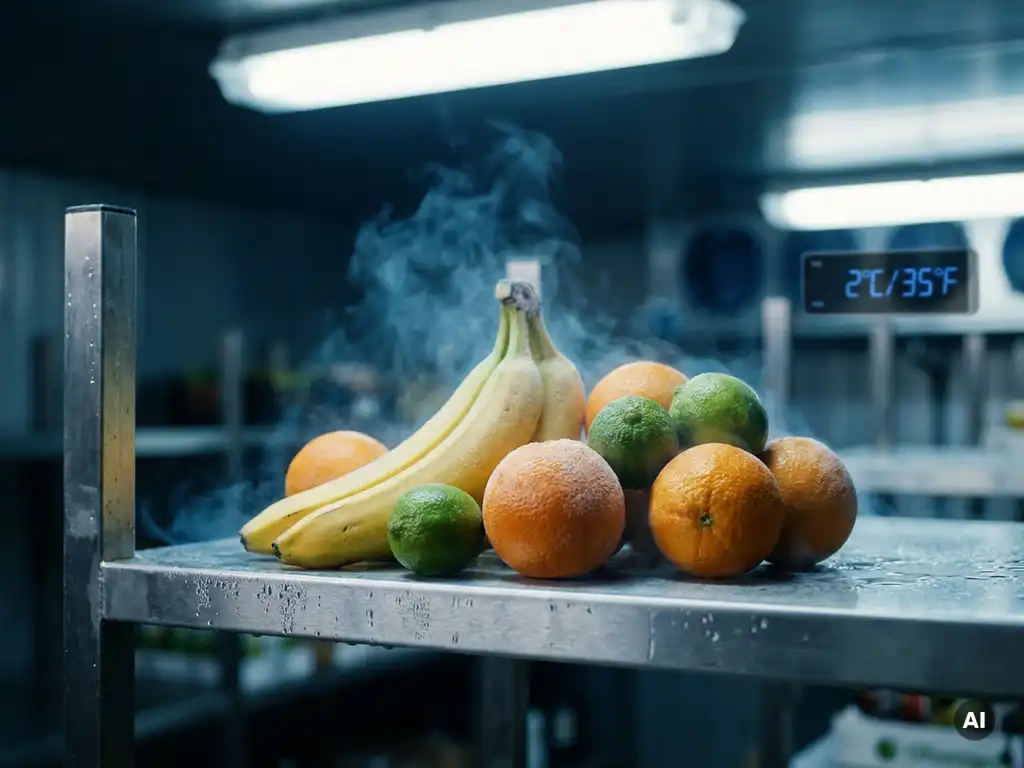
Storage duration has a direct and measurable impact on the quality of refrigerated food products. The longer a product is stored, the more moisture, flavor, texture, and nutritional value are lost. For fresh and perishable products such as exotic fruit, every day counts. The questions below answer the most practical aspects of cold storage and shelf life.
How quickly does refrigerated food lose quality at the wrong temperature?
Refrigerated food loses quality as soon as the temperature deviates by even a few degrees from the optimal storage temperature. Depending on the product, a temperature deviation of just 2 to 4 degrees Celsius can halve the shelf life. This applies particularly to fresh products with a high water content, such as tropical fruit and leafy vegetables.
The reason is biological: higher temperatures accelerate the cellular respiration of the product, causing sugars to be converted more quickly, ethylene production to increase, and ripening processes to be accelerated. At temperatures that are too low, cold damage occurs, which becomes visible as brown spots, soft spots, or loss of flavor. Both extremes are harmful and lead to rejection or spoilage in the supply chain.
For B2B parties working with tight delivery schedules to supermarket organizations or processing plants, temperature control is not a luxury, but a basic requirement. A constant, precisely controlled environment is the only way to limit quality loss.
What is the maximum shelf life for refrigerated food products?
The maximum shelf life for refrigerated food products varies significantly by product category. Citrus fruits can be stored for several weeks at the correct temperature and humidity, while soft tropical fruits such as mango or papaya are only shelf-stable for a few days to a week after arrival in the cold storage. There is no universal answer; the product and storage requirements determine the limit.
The condition upon arrival is also a determining factor. A product that is already partially ripened or is damaged during transport has a shorter remaining shelf life. Importers and wholesalers would be wise to carry out a thorough quality control upon arrival so that the shelf life can be realistically estimated and orders can be planned in a timely manner.
For dry products such as nuts, peanuts, and seeds, storage periods are considerably longer, but here too, temperature and humidity determine the limits.
Which factors determine how long refrigerated products remain fresh?
The shelf life of refrigerated products is determined by a combination of temperature, humidity, air circulation, the condition upon arrival, and the speed at which the product enters the refrigerator. None of these factors stands alone: they reinforce or undermine each other.
- Temperature: The most critical factor. Deviations, even short-lived, can cause irreversible damage.
- Humidity: Too dry leads to dehydration and weight loss; too humid promotes mold growth.
- Air circulation: Ensures an even temperature distribution in the storage area, even deep inside the pallet.
- Ethylene control: Some products produce ethylene, thereby accelerating the ripening of surrounding goods. Separation or active ethylene removal is then necessary.
- Condition on arrival: Products that are already damaged or partially ripened have a shorter shelf life.
- Transfer time: The time between unloading and placement in cold storage is crucial and is explained further below.
What happens to the quality of exotic fruit when stored for too long?
If stored for too long, exotic fruit shows visible and measurable quality deterioration: discoloration, soft spots, loss of taste and aroma, and in severe cases, mold formation or complete spoilage. The exact symptoms vary by fruit type, but the underlying mechanism is the same for all fresh products: biological processes continue, even in refrigeration.
Bananas are a good example. They are typically supplied green and undergo controlled ripening. If storage requirements are not strictly followed, or if the storage period is too long, they ripen too quickly or unevenly. This makes them unsaleable for supermarket chains that maintain strict quality standards.
Citrus fruits are slightly more robust, but they too suffer from prolonged storage: the skin dries out, the taste becomes flatter, and the presentation deteriorates. For importers and suppliers working with supermarket purchasing organizations, this is a direct commercial risk.
How does the storage time affect the total shelf life of the product?
The transfer time, the period between unloading the ship or container and the moment the product is actually placed in cold storage, has a direct and often underestimated impact on the total shelf life. Every minute outside the controlled environment accelerates biological processes and shortens the remaining shelf life margin.
In practice, this means: the shorter the route from the hold to cooling, the better. Locations with a direct connection between the quay and the cold storage facility have a structural advantage in this regard. A transfer time of just a few hours can already make a noticeable difference for sensitive products such as tropical fruit.
For logistics planners and supply chain managers, this is a reason to look not only at storage capacity and rates, but also at the physical layout of the location and the speed of the unloading process.
When is dry storage a better choice than cold storage?
Dry storage is a better choice than cold storage when the product does not require active cooling but does require a stable, controlled environment. This applies to products such as nuts, peanuts, seeds, and other dry food products that are sensitive to moisture and temperature fluctuations but do not spoil at a storage temperature of approximately 11 degrees Celsius.
The choice between dry and cold storage depends on the product specifications, the desired storage duration, and the customer's logistical requirements. Dry storage generally offers more flexibility regarding storage duration and is suitable for larger volumes with a higher turnover rate.
For companies with both fresh and dry products in their assortment, it is practical to work with a storage partner that offers both types of storage and can smoothly manage the transition between the two.
How ZZColdstores helps with temperature-controlled storage
ZZColdstores offers a complete solution for companies working with fresh, fragile products that require precise storage. The approach focuses on minimizing quality loss throughout the entire logistics chain, from arrival to shipment.
- Climate-controlled cold warehouses in Kruiningen and Vlissingen, with 24/7 monitoring of temperature, humidity, and air circulation
- A private quay in Vlissingen directly next to the cold storage, minimizing transshipment time
- Quality control upon arrival, including temperature, humidity, and Brix measurements
- Dry storage capacity of 12,000 pallet spaces for nuts, peanuts, seeds, and other dry food products
- Full traceability via barcode systems, linked to grower and LOT numbers
- Certifications, including BRC, SKAL, and KCB/NVWA, for demonstrable quality assurance
ZZColdstores operates exclusively B2B and adapts to the client's wishes and the vessels' sailing schedule. Would you like to know what climate-controlled storage can mean for your logistics chain? Contact us and discuss the possibilities directly with the specialists at ZZColdstores.
Frequently Asked Questions
How do I know if a storage partner can guarantee the correct temperature conditions for my specific product?
When considering a potential storage partner, always ask about current certifications such as BRC, SKAL, or KCB/NVWA, and inquire about the monitoring systems they use for temperature, humidity, and air circulation. A reliable partner offers 24/7 recording of climate conditions and can make historical data available as proof of consistency. Also, ask about their protocol for temperature deviations: how quickly are actions taken, and how are you, as the client, informed?
What are the most common mistakes when planning cold storage for imported tropical fruit?
A common mistake is underestimating the condition upon arrival: importers plan storage duration based on ideal conditions, without taking into account the state of ripeness after a long sea voyage. Additionally, the turnaround time between unloading and cooling is too often viewed as an unavoidable detail, whereas this is actually a critical moment. A third common mistake is mixing ethylene-producing products with ethylene-sensitive products in the same storage area, which leads to accelerated spoilage of both.
Can I store both refrigerated and dry products with a single storage partner, and what are the benefits of doing so?
Yes, and working with a single storage partner for both product types offers significant logistical advantages. You maintain an overview of the entire inventory via one system, simplify communication and administration, and can switch more flexibly when products need to be transferred from dry to refrigerated storage. However, ensure that the partner has demonstrable expertise in both storage methods and can organize the transition between the two smoothly.
As an importer or wholesaler, how can I accurately estimate the remaining shelf life of a product upon arrival?
Thorough quality control upon arrival is essential for this. This includes at a minimum a visual inspection, temperature measurement of the product itself (not just the container), and, for fruit, a Brix measurement to determine the sugar content and degree of ripeness. Based on this data, combined with knowledge of the product category and transport conditions, a realistic shelf-life forecast can be drawn up, which serves as the basis for order planning and delivery schedules.
What is the difference between climate-controlled storage and conventional cooling, and when is climate control truly necessary?
Conventional refrigeration primarily regulates temperature, whereas climate-controlled storage also actively manages humidity, air circulation, and sometimes ethylene concentration. For robust products with a long shelf life, standard refrigeration may be sufficient, but for fresh and fragile products such as tropical fruit, leafy vegetables, or products destined for supermarket chains with strict quality standards, climate control is not a luxury but a requirement. The difference in quality preservation over longer storage periods is measurable and has a direct impact on spoilage and commercial value.
How does traceability affect quality assurance in the cold chain?
Traceability via barcode systems linked to grower and lot numbers makes it possible to quickly determine, in the event of a quality problem, which batch is affected, when and under what conditions it was stored, and which other orders may be at risk. This significantly shortens response times to deviations and limits commercial damage. Moreover, for suppliers to supermarket organizations, full traceability is often a contractual obligation.
What factors should I consider when choosing a storage location for imported food products?
In addition to storage capacity and rates, the physical location relative to the port, the availability of a private quay, and the speed of the unloading process are decisive factors. The shorter the route from the hold to cooling, the less quality loss occurs with sensitive products. Also consider existing certifications, flexibility in scheduling sailing timetables, and the possibility of quality control upon arrival as part of the total package.
Related articles
- Which storage method suits different types of food?
- What should you look for when renting storage space for food?
- How does the traceability of dry raw materials work in a European warehouse?
- How does ambient storage for nuts and dried fruit work?
- What is the correct storage temperature for potato flakes and powder?