
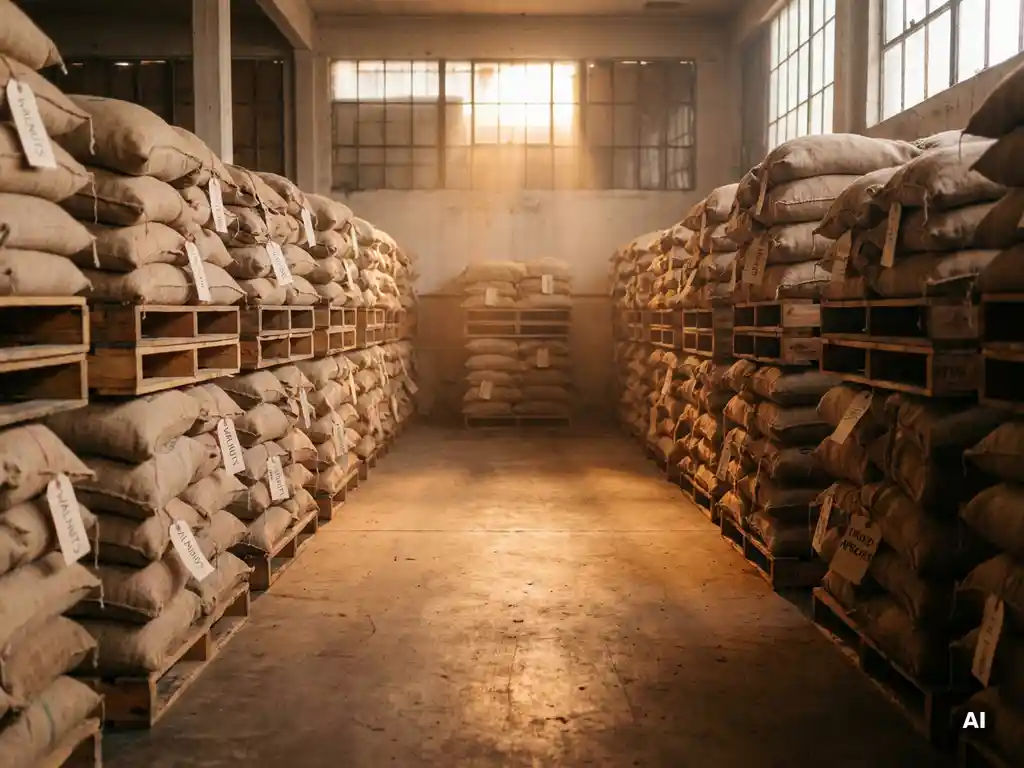
Ambient storage for nuts and dried fruit means storing these products at a stable room temperature, without active cooling, in a dry and controlled warehouse. The key lies in controlling temperature, humidity, and air circulation, as these three factors determine whether a batch of nuts or dried fruit retains its quality and shelf life. The most frequently asked questions about dry storage of food products are answered below.
What are the ideal storage conditions for nuts and dried fruit?
The ideal storage conditions for nuts and dried fruit are a temperature between 10 and 18 degrees Celsius, a relative humidity of 55 to 65 percent, and good air circulation without direct drafts. Under these conditions, the products remain stable, mold formation is prevented, and the fat content in nuts remains intact for as long as possible.
Nuts naturally contain a high percentage of unsaturated fats. These fats oxidize quickly when exposed to heat, light, or humidity, leading to a rancid taste and smell. Dried fruit is sensitive to moisture absorption: as soon as ambient humidity rises too high, products such as dried figs, apricots, or raisins attract moisture, clump together, and can develop mold.
In addition to temperature and humidity, the absence of odors and cross-contamination also plays a role. Nuts quickly absorb ambient odors, meaning that storage alongside strongly scented products can affect quality. A well-designed dry warehouse keeps this product flow separate.
What is the difference between ambient storage and cold storage?
Ambient storage takes place at a controlled room temperature without active cooling, whereas cold storage actively keeps products at a lower temperature, typically between 0 and 8 degrees Celsius. For nuts and dried fruit, ambient storage is the right choice in most cases, provided the conditions are properly monitored.
Cold storage is primarily intended for fresh, perishable products that deteriorate rapidly at room temperature, such as fresh fruit, vegetables, or dairy products. Nuts and dried fruit have already been processed or dried to extend their shelf life, meaning they do not require active refrigeration as long as ambient conditions remain stable.
There are exceptions, however. Pine nuts and macadamia nuts contain so much fat that prolonged storage at higher temperatures degrades their quality more quickly. In that case, refrigerated storage may be considered. For most common nuts such as walnuts, cashews, almonds, and peanuts, and for dried fruit, a well-organized dry warehouse suffices.
What risks arise from improper ambient storage of notes?
Improper ambient storage of nuts creates risks such as mold formation, oxidation of fats, aflatoxin contamination, and loss of quality due to moisture absorption. These risks are not only a quality problem but can also lead to rejected batches during import inspections and financial losses for the importer or wholesaler.
The most feared risks are:
- Mold formation: Occurs due to excessive humidity or temperature fluctuations that cause condensation.
- Aflatoxins: Toxic mold toxins that can develop under moist and warm conditions, particularly in peanuts, pistachios, and almonds.
- Rancidity: Oxidation of unsaturated fats due to heat, light, or exposure to oxygen.
- Pests and insects: Insufficient sealing of the warehouse attracts rodents and insects that contaminate products.
- Odor transfer: Storage next to strongly scented products affects the taste of nuts.
All these risks are manageable with the right infrastructure, but they occur quickly as soon as conditions fall outside safe margins. This makes professional storage with continuous monitoring of humidity and temperature not a luxury, but a necessity for every importer or wholesaler working with large batches.
How long can nuts and dried fruit be stored in ambient storage?
With proper ambient storage, most nuts can be kept for six to twelve months without significant loss of quality. Dried fruit generally has a shelf life of six to eighteen months, depending on the product and the degree of drying. These periods apply under stable temperature, low humidity, and adequate packaging.
The exact shelf life varies by product. Dried dates and raisins last longer than dried apricots or mango, which are more susceptible to discoloration and moisture absorption. Among nuts, walnuts and pine nuts are more fragile than cashews or almonds due to their higher content of unsaturated fats.
Packaging plays a major role. Nuts and dried fruit in vacuum packaging or modified atmosphere packaging (MAP) last considerably longer than unpackaged or loose products. Therefore, good outer packaging with a moisture barrier is a requirement for palletized bulk storage.
Which certifications are required for food storage in a dry warehouse?
For professional food storage in a dry warehouse, at least BRC certification (British Retail Consortium) or a comparable GFSI-recognized standard is required in the Netherlands and Belgium. Importers and supermarket chains generally make this certification a strict requirement. Depending on the product, SKAL certification for organic products and Demeter certification for biodynamic products may also be relevant.
BRC Food Safety is the most widely used standard in European food logistics. The standard sets requirements for hygiene, traceability, pest control, temperature recording, and documentation. A warehouse without this certification is not accepted by most professional buyers as a storage location for food products.
For organically certified batches of nuts or dried fruit, SKAL supervision is mandatory in the Netherlands. This means that the warehouse itself must also be SKAL-certified to guarantee the organic status of the products during storage. Mixing with non-organic batches must be demonstrably prevented.
How is air quality controlled in an ambient warehouse?
Air quality in an ambient warehouse is monitored via continuous measurement of humidity and temperature, combined with a regulated ventilation system that supplies fresh air and removes humid air. Sensors record ambient values and trigger an alarm in case of deviations outside the set margins.
A well-designed dry warehouse uses multiple measuring points distributed throughout the storage area, because temperature and humidity can vary by zone, especially in large warehouses. Near loading doors, the variation is greater due to the influx of outside air during loading and unloading.
In addition to climate control, pest prevention is also part of monitoring air quality in a broad sense. Insects and rodents not only cause physical damage but also contaminate the air and products. Professional warehouses work with certified pest control plans as part of their food safety system.
When is a specialized dry warehouse better than on-site storage?
A specialized dry warehouse is better than on-site storage as soon as volumes, food safety requirements, or certification requirements exceed the capacity of an internal storage solution. For importers and wholesalers working with varying batch sizes and multiple product groups, external pallet storage in a certified warehouse is almost always the more efficient choice.
In-house storage seems cheaper, but it entails hidden costs: investments in climate control, certifications, pest control, traceability systems, and personnel. As soon as a company requires BRC certification for its customers, building that infrastructure in-house is not profitable for most non-logistics companies.
In addition, a specialized dry warehouse offers flexibility in capacity. Seasonal peaks in supply, such as during the nut harvest in the autumn, can be accommodated without a company having to maintain excess capacity itself. This makes external pallet storage for food products attractive to any company that wants to keep its logistics costs variable.
How ZZColdstores helps with ambient storage of nuts and dried fruit
ZZColdstores operates a certified dry storage warehouse with a capacity of 12,000 pallet spaces, specifically designed for the storage of nuts, peanuts, seeds, and other dry food products. The warehouse meets the requirements of BRC, SKAL, and Demeter, which means that both conventional and organic and biodynamic batches can be stored while maintaining their certification status.
What sets ZZColdstores apart for B2B partners in food logistics:
- Certified storage: BRC, SKAL, and Demeter certification for nuts, peanuts, seeds, and dried fruit.
- Flexible capacity: 12,000 pallet spaces with the ability to adjust batch sizes to seasonal peaks and delivery schedules.
- Climate monitoring: Continuous monitoring of temperature and humidity to keep storage conditions within the required margins.
- Separation of product flows: Separate areas for different product groups to prevent odor transfer and cross-contamination.
- Locations in Kruiningen and Vlissingen: Strategically located near the port, connecting to import flows via Rotterdam and Antwerp.
Would you like to know if dry storage meets your logistical needs? Contact us for a discussion about the possibilities.
Author: Frans van der Maas, Operations Director at ZZColdstores
Frequently Asked Questions
How do I know if my batch of nuts has already been exposed to poor conditions during transport before it reaches the warehouse?
Upon arrival, always request the transport documentation including temperature and humidity logs for the reefer container or truck. In case of doubt, have an incoming quality control performed involving the taking of samples for sensory assessment and, for high-risk products such as peanuts and pistachios, for aflatoxin analysis. A specialized dry warehouse with incoming goods inspection can perform this check as part of the receiving process, ensuring that a problematic batch is immediately identified and stored separately.
What should I do if I discover mold or an unusual odor in a stored batch?
Immediately isolate the affected batch from the rest of the stock and document the finding with the date, location, and a visual description. Subsequently, have a laboratory analysis performed to determine whether mold toxins such as aflatoxins are present, as this determines whether the batch can be partially salvaged or must be completely rejected. Also inform your customers and, if the batch has already been resold, activate your traceability system to map the spread.
Can I store nuts and dried fruit in the same storage compartment, or must they always be kept separate?
In principle, nuts and dried fruit can be stored in the same warehouse, but separation by product group is strongly recommended. Dried fruit has a higher moisture activity than nuts and, if not separated sufficiently, can locally increase ambient humidity, which is detrimental to nuts in the immediate vicinity. Additionally, strongly scented dried products such as figs or dates can cause odor transfer to neutral nuts such as cashews or almonds.
How do seasonal fluctuations affect the ambient storage of nuts and dried fruit?
During the summer months, outdoor temperatures rise, making it more difficult to maintain a stable warehouse temperature without additional cooling or extra ventilation. In the autumn and winter, when large batches of nuts arrive from the harvest, busy periods and rapid changes in warehouse occupancy can cause temporary climate variations near loading doors. A professional warehouse anticipates these seasonal patterns by proactively adjusting climate settings and reserving capacity for peak periods.
Which packaging forms are most suitable for bulk storage of nuts on pallets?
For bulk storage on pallets, big bags with an internal moisture barrier layer, or cardboard boxes with an inner PE film, are the most commonly used and effective packaging forms. Vacuum packaging and modified atmosphere packaging (MAP) offer the longest shelf life, but are more expensive and less flexible for large bulk volumes. Always ensure that the outer packaging is damage-resistant and that pallets are covered with shrink wrap to minimize dust accumulation and moisture ingress during storage.
How does the transfer of a batch from ambient storage to distribution proceed, and what are the points to consider?
Upon dispatch from the warehouse, it is important that the batch is checked for temperature and condition before being loaded onto the transport vehicle, so that any deviations do not go unnoticed in the chain. Ensure that the freight documentation lists the storage conditions, the batch or lot number, and the remaining shelf life for full traceability. When delivering to customers with specific quality requirements, such as supermarket chains, it is advisable to include a Certificate of Analysis (CoA) as proof that the batch has been stored under the required conditions.
At what volume does it make sense to switch from on-site storage to an external specialized dry warehouse?
As a rule of thumb, external storage becomes financially attractive as soon as you structurally require more than 20 to 30 pallet spaces, or as soon as your customers require certifications such as BRC or SKAL that you cannot obtain internally in a cost-efficient manner. Companies that purchase large seasonal volumes at harvest time and then deliver them in a staggered manner benefit particularly from the flexible capacity of an external warehouse without having to maintain excess capacity themselves. A consultation with a specialized logistics partner helps to provide insight into the total cost comparison.
Related articles
- What role does warehousing play between the port and the customer?
- Can you use cold storage for temporary peak stocks?
- Can you combine warehousing with container handling?
- When does it make sense to combine inventory management with customs clearance?
- How does repalletization work and when is it necessary for bulk import?