
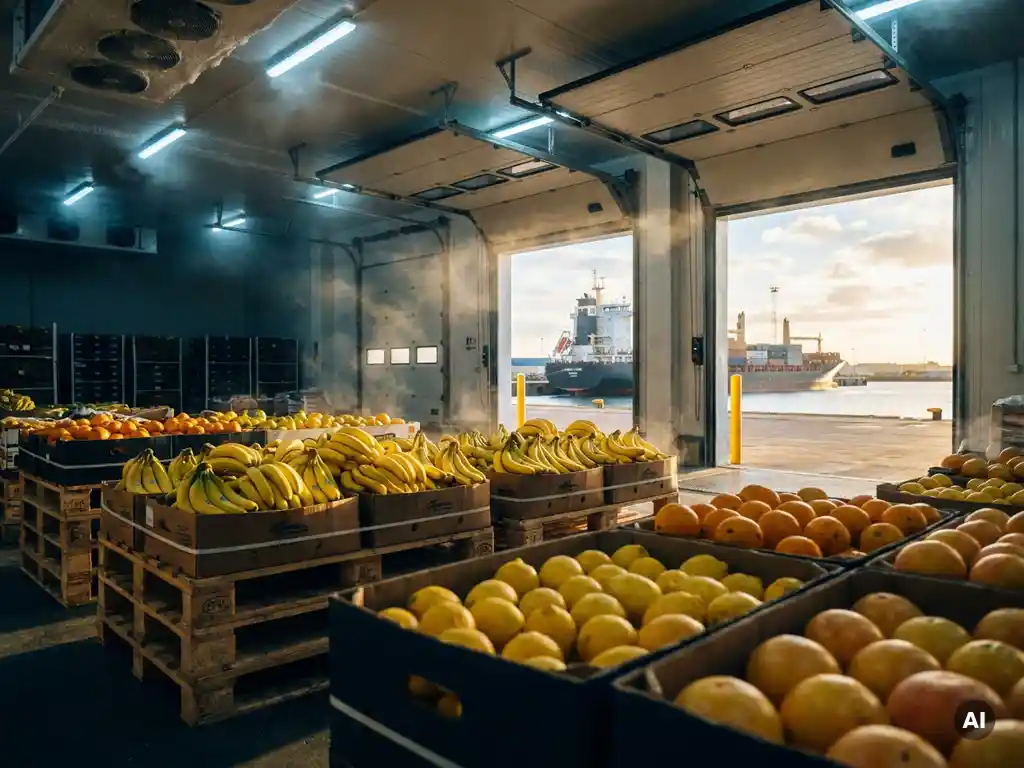
Yes, you can rent storage space for temporary stock between the port and the customer. This is a common and practical solution for many importers and wholesalers of fresh food products, especially when the arrival of a shipment does not seamlessly connect with delivery to the end customer. The questions below will give you a clear picture of what you need to know when choosing the right storage location.
What type of storage space is suitable for food products between the port and the customer?
For food products between port and customer, you need storage space tailored to the specific storage conditions of the product. Fresh products such as exotic fruit require climate-controlled cooling, while dry products such as nuts, peanuts, and seeds are stored well in a ventilated, dry storage area at a constant temperature of approximately 11 degrees.
The choice between cold storage and dry storage depends on the product, the desired shelf life, and the customer's quality requirements. Both storage types must comply with food safety standards and preferably be certified. In addition to the storage itself, it is valuable when a storage location also offers supplementary services, such as quality control upon arrival, labeling, and barcode-driven traceability. This way, you know exactly which batch is located where and what condition it is in at any given moment.
How does temporary storage work near a seaport?
Temporary storage near a seaport acts as a link between the arrival of a shipment and further distribution to customers. As soon as a ship docks, the containers are unloaded and transported to the nearby warehouse as quickly as possible. The shorter the distance between the quay and the cold storage facility, the less the quality of fresh products suffers during transport.
In practice, this process takes place in a number of steps. Upon arrival, an initial quality control check is performed, during which the shipment is inspected for damage, temperature deviations, and the condition of the packaging. Subsequently, the goods are stored under the appropriate conditions, prepared for distribution, and, if desired, provided with customer-specific labels or documentation for customs clearance.
The proximity of the storage location to the port is crucial. A location with its own quay eliminates virtually all transport time between the ship and the controlled storage environment, which directly benefits the freshness and quality of products.
What is the difference between cold storage and dry storage for imported products?
Cold storage keeps products at a low temperature with controlled humidity and air circulation, while dry storage focuses on preserving products at a stable ambient temperature without active cooling. For imported products, the nature of the product determines which type of storage is required.
Cold storage for fresh and perishable products
Fresh products such as bananas and citrus fruits are sensitive to temperature fluctuations. Cold storage offers 24/7 monitoring of temperature, humidity, and air circulation. The settings are precisely tailored to the specific requirements of the product to maximize shelf life and prevent loss of quality.
Dry storage for nuts, seeds and similar products
Dry products such as nuts, peanuts, and seeds do not require active cooling but do benefit from a stable, controlled environment. A constant temperature of approximately 11 degrees and low humidity prevent spoilage, mold formation, and loss of quality. A well-designed dry storage warehouse offers separate areas for different product categories to avoid cross-contamination and odor transfer.
When is renting flexible storage space better than reserving fixed capacity?
Renting flexible storage space is better than reserving fixed capacity when your supply is seasonal, when ship schedules are irregular, or when your inventory volumes vary significantly from period to period. Fixed capacity incurs costs, even when you are not using the space, whereas flexible storage only lets you pay for what you actually use.
For importers and wholesalers of fresh food products, supply is rarely fully predictable. Delays at sea, fluctuating harvest volumes, or sudden peaks in demand from supermarkets make it difficult to efficiently utilize fixed storage capacity on an annual basis. A storage partner that adapts to ship schedules and the client's wishes offers a clear advantage in these situations.
Fixed capacity can be sensible when you have a constant, highly predictable supply and when you know for certain that the space is structurally required. In all other cases, flexible storage offers more financial and operational flexibility.
Which certifications must a storage location have for exotic fruit and nuts?
A storage location for exotic fruit and nuts must possess at least BRC (British Retail Consortium) certification as proof of food safety and quality management. In addition, SKAL certification is relevant for organic products, and the KCB inspection (part of the NVWA) plays a role in the import control of fresh fruit and vegetables.
For importers trading in certified organic products, it is essential that the storage location is also SKAL-certified. Without this certification, you may not resell organic products as such. Demeter certification is an additional quality mark for products from biodynamic agriculture.
When choosing a storage partner, it is wise to ask which certifications are current and whether the location can also facilitate import inspections. A location that collaborates with the NVWA and can perform the KCB inspection on-site saves significantly on transport movements and speeds up customs clearance.
Where in the Rotterdam-Antwerp corridor can you rent refrigerated storage space?
In the Rotterdam-Antwerp Corridor, multiple locations are available for renting refrigerated storage space, particularly in the port areas of Vlissingen and Kruiningen. These locations are strategically situated between Europe's two largest container ports and offer direct access to both maritime shipping and road transport towards Germany and other European markets.
As a port, Vlissingen holds a growing position as an alternative to Rotterdam and Antwerp, offering shorter waiting times and direct connections for bulk goods and refrigerated cargo. For importers shipping products from tropical countries, a storage location with its own quay in Vlissingen is particularly attractive: the distance between the ship's hold and the climate-controlled storage is minimal, which directly benefits the quality of fresh products.
For shuttle runs to customers within a radius of approximately 40 kilometers, locations in this corridor offer the possibility of daily or multiple trips per week, with a direct link to inbound processes such as quality control, sorting, and palletizing.
How ZZColdstores helps with temporary storage between port and customer
ZZColdstores offers a fully integrated storage solution in Vlissingen and Kruiningen for importers, wholesalers, and logistics service providers seeking temporary storage space between the port and the customer. The Vlissingen location features its own quay directly adjacent to the cold storage facility, minimizing the time between unloading and controlled storage.
- Climate-controlled cold storage for fresh products such as bananas and citrus fruits, with 24/7 monitoring of temperature, humidity, and air circulation.
- Dry storage at approximately 11 degrees for nuts, peanuts, seeds, and similar products, with a capacity of 12,000 pallet spaces.
- Quality control upon arrival, including temperature, humidity, and Brix measurements and a detailed QC report
- Barcode-driven traceability per pallet, including linking of grower and LOT numbers
- Certifications: BRC, SKAL and Demeter, supplemented with KCB/NVWA import inspection
- Flexible capacity tailored to sailing schedules and the specific wishes of the client.
- Shuttle runs for distribution within a radius of approximately 40 kilometers
Would you like to know if climate-controlled storage at ZZColdstores meets your logistical needs? Contact us for a no-obligation discussion about the possibilities.
Frequently Asked Questions
How quickly can my shipment be stored after arrival at the port?
At a storage location with its own quay, such as in Vlissingen, a shipment can be transferred to climate-controlled storage almost immediately after unloading. In practice, this means that fresh products are already stored under the correct conditions within a few hours of the ship's arrival. This minimizes the so-called 'temperature break' and optimally protects the quality and shelf life of your product.
What happens if my ship is delayed and the scheduled storage period shifts?
A good storage partner cooperates flexibly with shifts in the sailing schedule and adjusts the reserved capacity based on the ship's actual arrival time. When entering into a storage agreement, it is wise to ask how the partner handles delays and whether extra costs are charged for unforeseen changes. Flexible storage partners accustomed to the vagaries of maritime shipping usually offer clear agreements regarding this.
Can I have part of my stock delivered while the rest remains in storage?
Yes, this is a widely used method for importers who supply multiple customers or who wish to deliver their stock spread over several weeks. Thanks to barcode-driven traceability per pallet, it is possible to specifically pick and ship specific batches, LOT numbers, or customer orders, while the rest of the shipment remains in storage undisturbed. Discuss with your warehousing partner the applicable minimum order quantities and how picking costs are calculated.
How can I be sure that the temperature and quality of my product are guaranteed during storage?
A reliable storage partner offers 24/7 monitoring of temperature, humidity, and air circulation, combined with detailed QC reporting upon arrival and during the storage period. When selecting a partner, always ask about temperature data logging and whether you, as the client, have access to this data. Certifications such as BRC are objective confirmation that the location complies with recognized food safety standards and quality management processes.
What are the most common mistakes importers make when choosing temporary storage space?
A common mistake is choosing based on price alone, without considering the distance to the port, available certifications, or the partner's experience with specific product categories. Additionally, importers often underestimate the importance of supplementary services such as quality control, labeling, and customs facilitation, which can save significant time and costs in the long run. Finally, some importers opt for fixed storage capacity, even though their supply is actually too irregular to utilize that capacity efficiently.
Is temporary storage also suitable for organically certified products?
Yes, provided the storage location itself is also SKAL-certified. Without a valid SKAL certification of the storage partner, your product loses its organic status as soon as it leaves the location, which has direct commercial and legal consequences. Therefore, always check whether the certification is up-to-date and whether the location has separate storage areas for organic and non-organic products to prevent cross-contamination.
How do I calculate whether temporary storage between port and customer is financially advantageous compared to direct delivery?
Compare the total storage costs (rent, handling, quality control) with the costs of alternatives such as express transport in the event of a timing mismatch, loss of quality due to uncontrolled storage, or maintaining your own warehouse capacity. In many cases, storage costs are far outweighed by the financial damage caused by rejections, returns, or emergency solutions for logistical bottlenecks. A storage partner with transparent rates and flexible contract forms helps you make this assessment concrete.