
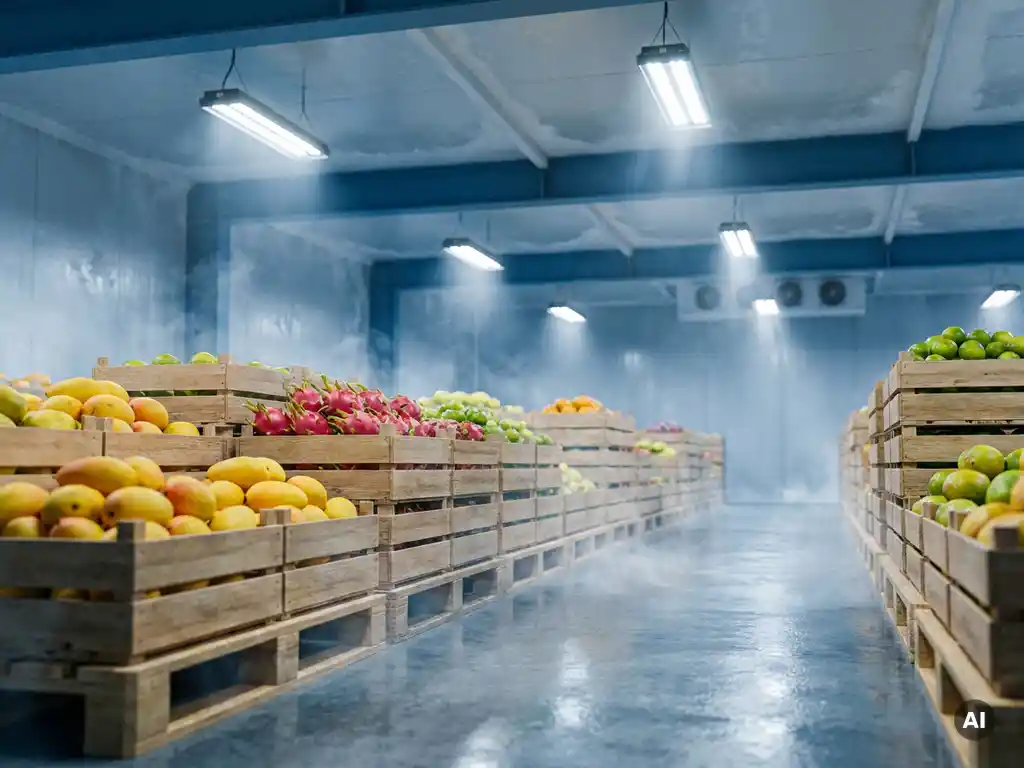
For business users, renting storage space typically costs between 10 and 30 euros per pallet space per month, depending on the type of storage, location, and desired services. Rates for climate-controlled or refrigerated storage are significantly higher than for dry, uncooled storage space. The final price depends heavily on factors such as volume, contract duration, and additional logistics services. In this article, we answer the most frequently asked questions about storage costs so that you, as a buyer or supply chain manager, can make a well-informed comparison.
Which factors determine the price of storage space?
The price of renting storage space is determined by a combination of the type of storage, the location, the volume, and the desired services. There is no fixed market price: every offer is custom-made, with the specific requirements of the product and the logistical context being the deciding factors.
The most important cost factors at a glance:
- Storage type: Dry (ambient) storage is cheaper than refrigerated or climate-controlled storage. The more precise the temperature and humidity control, the higher the operating costs.
- Volume and occupancy: Larger volumes almost always lead to lower rates per pallet space. Storage companies operate with economies of scale.
- Location: Storage near major ports such as Rotterdam or Antwerp is logistically attractive but can be more expensive due to higher land prices. Locations slightly further from the port sometimes offer a better price-quality ratio.
- Contract duration: Long-term contracts provide suppliers with certainty and are generally rewarded with lower rates. Flexible, short-term contracts are more expensive per month.
- Product-specific requirements: Sensitive products such as exotic fruit, nuts, or seeds require specific conditions, which affects the storage price.
- Additional services: Quality checks, labeling, repalletization, and EDI connections are billed separately and increase the total price.
For B2B parties storing large volumes, such as importers or wholesalers of fresh food products, it is advisable to always request a customized quotation instead of comparing based on published list prices.
What are the average costs per pallet space per month?
For dry, uncooled storage, rates in the Netherlands average between 8 and 18 euros per pallet space per month. For climate-controlled storage, where temperature and humidity are continuously monitored, costs rise to 20 to 35 euros per pallet space per month or more, depending on the required conditions.
These amounts are guide prices based on current market rates in 2026 and are not binding. The actual price depends on the factors mentioned earlier. Please note that the rates per pallet space per month are generally exclusive of:
- Handling in and handling out
- Quality checks upon arrival
- Transport to and from the storage location
- Administrative processing and reporting
For products with a high turnover rate, such as fresh fruit or vegetables, a rate based on lead time or turnover may be more favorable than a fixed monthly rate per pallet space. Always discuss this with the storage partner.
What is the cost difference between dry storage and cold storage?
Dry storage (also known as ambient storage) is structurally cheaper than cold or climate-controlled storage. The cost difference is significant: climate-controlled storage can be two to three times more expensive per pallet space per month, due to the higher energy costs, advanced systems, and continuous monitoring required.
Dry storage: lower costs, wide applicability
Dry storage is suitable for products that do not require active temperature control but must be protected against moisture, light, and temperature fluctuations. Examples include nuts, peanuts, seeds, and certain dry foods. Storage takes place at a stable ambient temperature, often around 10 to 15 degrees Celsius. Operational costs are lower because no cooling systems need to be active.
Climate-controlled storage: higher costs, better product quality
Climate-controlled storage requires continuous management of temperature, humidity, and air circulation, 24 hours a day, 7 days a week. This is essential for fresh and perishable products such as bananas and citrus fruits. The higher costs are directly related to the energy consumption of the refrigeration systems, system maintenance, and the expertise required to keep conditions stable. However, for products where loss of quality directly leads to financial damage, these higher storage costs are an investment that pays for itself.
What additional costs are on top of the rental price?
The rental price per pallet space almost never covers all costs. When renting storage space, there are always additional costs, which can add up considerably depending on the storage partner and the contract.
Common additional expenses are:
- Handling in and handling out: Costs for receiving and retrieving pallets. This is typically calculated per movement or per pallet.
- Quality Control (QC): Inspection of shipments upon arrival, including temperature, humidity, and Brix measurements. Essential for fresh products, but a separate cost.
- Repalletization and sorting: If products need to be repalletized or sorted upon arrival, labor costs will be charged for this.
- Labeling and packaging: The application of barcodes, expiration dates, or customer-specific labels generally falls under Value Added Services (VAS) and is invoiced separately.
- Transport and shuttle services: Transport to and from the storage location, including any shuttle services between the production location and the warehouse.
- Customs and import inspection: For imported goods, costs for customs clearance and inspections (such as KCB/NVWA) are added to the storage price.
- Administration and reporting: Inventory updates, status reports, and EDI connections can be offered as a separate service.
When requesting a quote, always ask for a complete overview of all costs, including handling, additional services, and any minimum order quantities. This will help you avoid surprises on the invoice.
When is it more cost-effective to outsource storage than to rent it yourself?
Outsourcing storage to a specialized party is almost always more cost-effective as soon as the required infrastructure, certifications, or scale exceed in-house capabilities. For most B2B parties in the agri-food sector, this is the case with climate-controlled storage, specific inspection requirements, or seasonal volume peaks.
Outsourcing is more attractive than renting yourself when:
- Your products require specific temperature or humidity control that demands expensive investments in proprietary infrastructure.
- Your volume fluctuates by season and you do not want to commit to a fixed capacity.
- You wish to make use of additional services such as quality control, repalletization, or customs clearance that a specialized partner can perform more efficiently.
- Your location near a port or transshipment point offers a logistical advantage that you cannot achieve with your own storage.
- You want to meet certification requirements (such as BRC or SKAL) without managing the associated audits and systems yourself.
Renting a property yourself is only more attractive if you have a constant, large volume, no special conditions are required, and you have the people and systems to manage the storage entirely yourself.
How do you request a quote for storage space?
Requesting a quote for storage space is fastest and most effective if you have the right information ready beforehand. The more specific your request, the more accurate the quote you receive.
Ensure that you submit at least the following with the application:
- Product type and storage conditions: What are you storing? What temperature, humidity, or other conditions are required?
- Volume: How many pallet spaces do you need? Is this a fixed volume or does it fluctuate?
- Lead time: How long do goods remain in the warehouse on average? High turnover rate or long-term storage?
- Desired services: Do you require quality control, repalletizing, labeling, transport, or customs clearance?
- Logistical context: Do goods arrive by container, truck, or ship? Which port or location is relevant?
- Contract duration: Are you looking for a long-term contract or flexible capacity?
With this information, a storage partner can prepare a realistic and complete quotation, including handling, additional services, and any minimum rates.
How ZZColdstores helps with renting storage space
ZZColdstores offers B2B parties in the agri-food sector a complete package for both dry and climate-controlled storage, with locations in Kruiningen and Vlissingen. If you are looking for a partner to handle the entire process from arrival to delivery, ZZColdstores offers the following:
- Dry storage for nuts, peanuts, seeds, and other food products, with a capacity of 12,000 pallet spaces
- Climate-controlled cold storage with 24/7 monitoring of temperature, humidity, and air circulation, especially for fresh and perishable products.
- Quality controls, repalletization, labeling, and barcode-driven traceability as part of the Value Added Services offering
- Own quay in Vlissingen for direct transshipment from ship to cold storage, minimizing quality loss
- Customs clearance and import inspections (KCB/NVWA) as an integrated part of the services
- Certifications including BRC, SKAL, and Demeter, for parties working with certified supply chains
Would you like to know what renting storage space via ZZColdstores costs for your specific situation? Contact us for a no-obligation, customized quote.
Frequently Asked Questions
What is a realistic minimum volume to rent storage space from a specialized partner?
Most specialized storage partners work with a minimum purchase requirement, often expressed as a minimum number of pallet spaces per month or a minimum invoice amount. In practice, outsourcing is already worthwhile starting from approximately 20 to 50 pallet spaces per month, depending on the type of storage and the desired services. When requesting a quote, always explicitly ask about the minimum purchase requirement so that you know exactly what to expect.
How can I keep total storage costs as low as possible without compromising on quality?
The most effective way to reduce costs is to optimize your turnover rate: the shorter goods remain in the warehouse, the lower the total storage costs. Additionally, it pays to consider a long-term contract if your volume is predictable, and to negotiate a solid all-in rate including handling and additional services. Also, bundle your volumes where possible, as larger volumes almost always lead to lower rates per pallet space.
What happens if my storage volume fluctuates significantly seasonally?
Many specialized storage partners offer flexible contract models that allow you to scale capacity up and down based on your actual needs. This is one of the biggest advantages of outsourcing compared to renting a property yourself, where you are tied to a fixed rental price regardless of usage. Clearly discuss your seasonal pattern when requesting a quote so that the partner can offer a suitable capacity solution and you do not pay for unused space.
Which certifications should I check before choosing a storage partner?
Which certifications are relevant depends on your product and market. For food products, BRC (British Retail Consortium) is a frequently requested standard that demonstrates that the storage partner meets strict food safety requirements. If you work with organic products, check whether the partner is SKAL-certified. For specific markets or retailers, additional certifications such as Demeter, FSSC 22000, or GlobalG.AP may be required. Always ask for current certificates and verify their validity.
How do I know if the temperature and humidity conditions in the warehouse are actually being adhered to?
A reliable storage partner has a continuous monitoring system that records temperature, humidity, and air circulation 24/7 and alerts in case of deviations. When requesting a quote, ask whether you will have access to temperature logs and reports, and whether these are shared as part of the service. This is important not only for the quality of your product but also for traceability and compliance with regulations such as HACCP.
What is the difference between a rate per pallet space per month and a rate based on lead time?
A rate per pallet space per month means that you pay for the reserved space, regardless of how long the goods actually remain in the warehouse. A rate based on turnaround time or turnover is more favorable if your products have a high turnover rate, as you then only pay for the actual dwell time. For fresh products such as fruit or vegetables, which are sometimes stored for only a few days to weeks, a turnaround time rate can prove significantly more cost-effective. Discuss both options with your storage partner to determine which model best suits your logistics situation.
Can I combine storage space with customs clearance and import inspections through a single party?
Yes, an increasing number of specialized storage partners offer an integrated package where storage, customs clearance, and import inspections, such as KCB or NVWA inspections, are handled under one roof. This saves time, reduces the risk of quality loss due to additional transport, and significantly simplifies administration. When selecting a partner, verify that they possess the correct permits and have direct contacts with the relevant inspection services for your product category.