
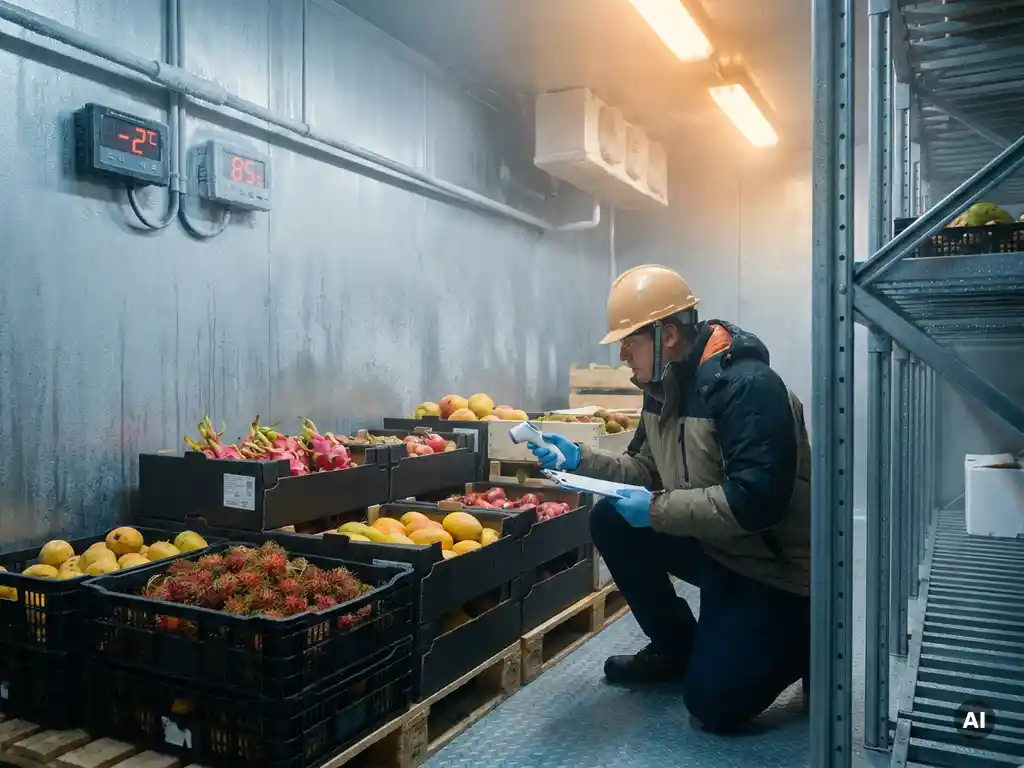
In the Netherlands and the EU, strict legal requirements regarding food safety, temperature control, hygiene, and traceability apply to the commercial storage of food products. Storage companies are required to operate according to HACCP principles and, in many cases, must possess sector-specific certifications such as BRC or SKAL. Requirements vary by product category, but the core remains the same: ensuring that food products pass through the chain safely and with high quality. This article answers the most frequently asked questions about the requirements for food storage in a business context.
Which certifications are required for food storage?
For the commercial storage of foodstuffs, minimum registration with the NVWA and compliance with the European hygiene regulation (EC 852/2004) are required by law. In addition, many buyers and retailers require supplementary certifications such as BRC (British Retail Consortium) or IFS Food. These are not always legally mandatory, but in practice, they are indispensable for access to supermarket chains and the processing industry.
The most relevant certifications for storage companies in the food sector are:
- BRC Global Standard for Storage and Distribution: widely accepted by European retailers and processing plants, with strict requirements regarding food safety, quality management, and operational control.
- IFS Logistics: comparable to BRC, particularly common among suppliers to German and French retail.
- SKAL: mandatory for organic products that may be offered as organic in the supply chain
- KCB/NVWA accreditation: required for import inspections of fresh fruit and vegetables from outside the EU
- Demeter: supplementary label for biodynamic products
The specific certifications required depend on the product categories being stored and the buyers in the chain. An importer of exotic fruit supplying supermarkets usually requires both BRC and KCB accreditation. Always check the contractual requirements of your direct buyers, as these are generally stricter than the statutory minimum requirements.
What temperature requirements apply per product category?
Temperature requirements for food storage are laid down in European and national legislation, but the exact margins vary by product category. Refrigerated products must generally be stored between 0°C and 7°C, while specific product groups such as exotic fruit have their own optimal storage temperatures that sometimes deviate from this.
A number of guidelines per category:
- Exotic fruit (bananas, citrus fruits): susceptible to cold damage; bananas are preferably stored between 12°C and 14°C, citrus fruits generally between 5°C and 10°C, depending on the variety.
- Dry products (nuts, peanuts, seeds): are stored at ambient temperature, approximately 10°C to 15°C, with low humidity to prevent mold formation.
- Frozen products: legally required at a minimum of -18°C
- Refrigerated products in general: maximum 7°C in accordance with the Food Hygiene Decree
It is important that the set temperature is continuously monitored and recorded. Deviations must be demonstrably corrected and documented. For products with specific cold sensitivity, such as tropical fruit, customization of the climate setting is essential to prevent loss of quality.
What are the HACCP obligations for storage companies?
Every company that professionally stores food is legally required to have and implement a HACCP system. HACCP (Hazard Analysis and Critical Control Points) is a systematic method for identifying, controlling, and documenting food safety risks. This obligation stems from the European Hygiene Regulation EC 852/2004.
For storage companies, this means in concrete terms:
- Hazard analysis: identify all biological, chemical, and physical risks that may occur during storage.
- Establish Critical Control Points (CCPs): consider temperature limits and monitoring thereof
- Monitoring procedures: document how and how often CCPs are measured and recorded
- Corrective measures: describe what happens if a CCP falls outside the norm
- Verification and documentation: demonstrating that the system works and is kept up to date
The NVWA checks whether storage companies have a functioning HACCP system. A system on paper is insufficient; it must be demonstrably implemented and recorded. Certifications such as BRC build upon HACCP and add additional requirements.
How are humidity and ventilation controlled in food storage?
In professional food storage, humidity and ventilation are actively controlled via climate control systems that continuously measure and adjust. The correct humidity prevents fresh products from drying out, but also mold formation in the event of excessively high moisture levels. Ventilation ensures the removal of ethylene and CO2, which accelerate ripening and cause loss of quality.
For fresh products such as fruit, the relative humidity generally needs to be between 85% and 95% to prevent dehydration, whereas dry products such as nuts and seeds require low humidity, often below 65%, to prevent mold and spoilage. This makes the management of combined storage areas complex: products with opposing climate requirements must always be stored in separate rooms.
Modern climate-controlled warehouses monitor humidity, temperature, and air circulation via automated systems that operate 24/7. Deviations are immediately detected and corrected. Recording these measurements is not only operationally useful but also a mandatory part of HACCP documentation.
What are the requirements for traceability and registration in storage?
Traceability is legally required for all companies in the food chain under the European General Food Regulation (EC 178/2002). Storage companies must be able to demonstrate from whom they received products and to whom they passed them on. This applies to every link, including storage itself.
In practice, this means:
- Registration of incoming shipments with supplier, product description, quantity, and date
- Linking of batch numbers (LOT numbers) or grower numbers to the stored goods
- Registration of outgoing deliveries including the recipient
- Possibility of rapid recall: it must be clear within an acceptable time which batches are affected
Barcode-driven systems make traceability significantly more reliable than manual registration. Each pallet receives a unique identification that travels through the entire chain. This is not only a legal requirement but also a practical necessity for customers who want to be audit-ready for retail inspections or emergencies.
What are the hygiene requirements for storage areas and personnel?
The hygiene requirements for food storage areas and the personnel working therein are laid down in the European Hygiene Regulation and further elaborated in sector-specific certification standards such as BRC. The core principle is that storage areas, equipment, and employees must not pose a risk to the food safety of the stored products.
Requirements for the storage space
Floors, walls, and ceilings must be smooth, cleanable, and resistant to moisture and cold. Pest control is mandatory and must be documented. Lighting must be sufficient for safe working and inspection. Products may not be stored directly on the floor and must be kept separate from non-food-related goods and cleaning agents.
Requirements for staff
Employees working with or in the vicinity of foodstuffs must be demonstrably trained in food hygiene. This includes personal hygiene, recognizing contamination risks, and correctly reporting illness symptoms. Work clothing must be suitable and changed regularly. At BRC-certified companies, training and hygiene protocols are periodically verified.
How do you choose a storage partner that meets all requirements?
When selecting a food storage partner, certifications are the starting point, but not the end point. A partner that meets all requirements combines the right documentation with demonstrable operational control, flexible climate settings per product category, and a transparent registration system for traceability.
Pay attention to the following criteria during the selection:
- Relevant certifications: BRC, SKAL, or other standards that align with your customers and product category
- Climate flexibility: can the partner offer different temperature and humidity zones tailored to your specific product?
- Traceability system: does the partner work with barcode or LOT number registration that integrates with your systems?
- Location and accessibility: is the warehouse logistically favorably located in relation to the port, production location, or sales market?
- Quality control upon intake: does the partner carry out an incoming inspection and report on it?
- Additional services: think of container handling, customs clearance, labelling, and EDI connections.
A storage partner that manages the entire process from arrival to shipment significantly reduces the risk of quality loss and administrative errors.
How ZZColdstores helps with business food storage
ZZColdstores has been active since 1994 and offers certified storage for fresh and dry food products from locations in Kruiningen and Vlissingen. The company holds BRC, SKAL, and Demeter certification and operates a barcode-driven traceability system in which grower and LOT numbers are linked to every pallet.
What ZZColdstores specifically offers for business storage partners:
- Climate-controlled storage with flexible temperature and humidity settings per room, monitored 24/7
- Dry ambient storage for nuts, peanuts, and seeds at approximately 11°C, with a capacity of 12,000 pallet spaces
- Quality control upon intake including temperature, humidity, and Brix measurements with written reporting
- Own quay in Vlissingen for direct transfer from ship to cooling with minimal downtime
- Import inspection via KCB (part of the NVWA) and customs clearance
- EDI connections for automatic order processing and inventory updates
Would you like to know if ZZColdstores' climate-controlled storage aligns with your product category and logistical requirements? Contact us for a no-obligation discussion about the possibilities.
Frequently Asked Questions
How often should a HACCP system be reviewed or updated?
A HACCP system must be reviewed as soon as changes occur in the stored product categories, storage processes, or facilities. In addition, a periodic reassessment—typically at least once a year—is a requirement for certifications such as BRC. Also consider reviews following incidents, complaints, or internal audits that reveal shortcomings. An up-to-date and demonstrably functioning system is not only a legal obligation but also the basis for maintaining your certifications.
What happens if my storage partner loses its BRC certification?
If a storage partner loses its BRC certification, this can have direct consequences for your supplier status with retailers and customers who contractually require this certification. In practice, this means that you, as the client, may no longer be able to meet your customers' purchasing conditions, which can lead to the rejection of shipments or breach of contract. It is therefore advisable to stipulate in your storage contract that the partner is obliged to inform you immediately of any changes in certification status. Also, periodically check the validity of certificates yourself via the official registers of BRC Global Standards or IFS.
Am I allowed to store different product categories in the same storage space?
That depends on the climate requirements and the contamination risks of the products in question. Products with conflicting requirements for temperature or humidity — such as fresh fruit and dried nuts — may not be stored in the same room without compromising product quality or food safety. Additionally, the hygiene regulation prohibits the storage of foodstuffs together with non-food-related goods or cleaning products. A professional storage partner with multiple climate zones offers the most flexibility in this regard.
How quickly do I need to be able to demonstrate which batches are affected in the event of a recall?
Legislation does not prescribe an exact timeframe, but in practice, retailers and the NVWA apply a standard of 4 to 24 hours for fully mapping affected batches. The sooner you can act, the more limited the damage to the supply chain and your reputation. A barcode-driven traceability system with LOT and grower numbers makes it possible to see within minutes which pallets have been received, where they are stored, and to whom they have been delivered. Manual registration is almost always too slow and too prone to errors in such a situation.
Which documents do I, as the client, need to keep myself, and which are held by the storage partner?
As the client, you are responsible for the traceability of your products throughout the entire chain, including the period during which they are stored at an external partner. This means that you must retain purchase invoices, delivery documents, batch numbers, and certificates of conformity from suppliers in-house. The storage partner is responsible for recording receipt, storage, and issuance within their facility, including temperature logs and HACCP documentation. Ensure that you contractually agree on which reports the partner provides to you, so that your own traceability file is complete.
Is SKAL certification also required if I only export organic products without processing them?
Yes, SKAL certification is also mandatory for the storage and transit of unprocessed organic products if the products are permitted to be offered as organic within the chain. The organic status of a product applies only if every link in the chain — including storage and transport — is demonstrably certified. Without SKAL certification at the storage partner, the product formally loses its organic status, which has direct commercial and legal consequences. Therefore, always check whether both you and your storage partner hold a valid SKAL registration.
What are the most common mistakes when setting up food storage?
A common mistake is underestimating the impact of climate differences within a single storage area, for example by placing products too close to cooling units or loading doors where temperature fluctuations are greater. Additionally, we often see that traceability systems are well-established on paper but are not consistently maintained in practice—a risk that becomes immediately apparent during an NVWA inspection or retail audit. A third common error is failing to renew or update certifications in a timely manner when expanding the product range. Invest in automated monitoring and ensure that registration is a standard part of the daily operational process.