
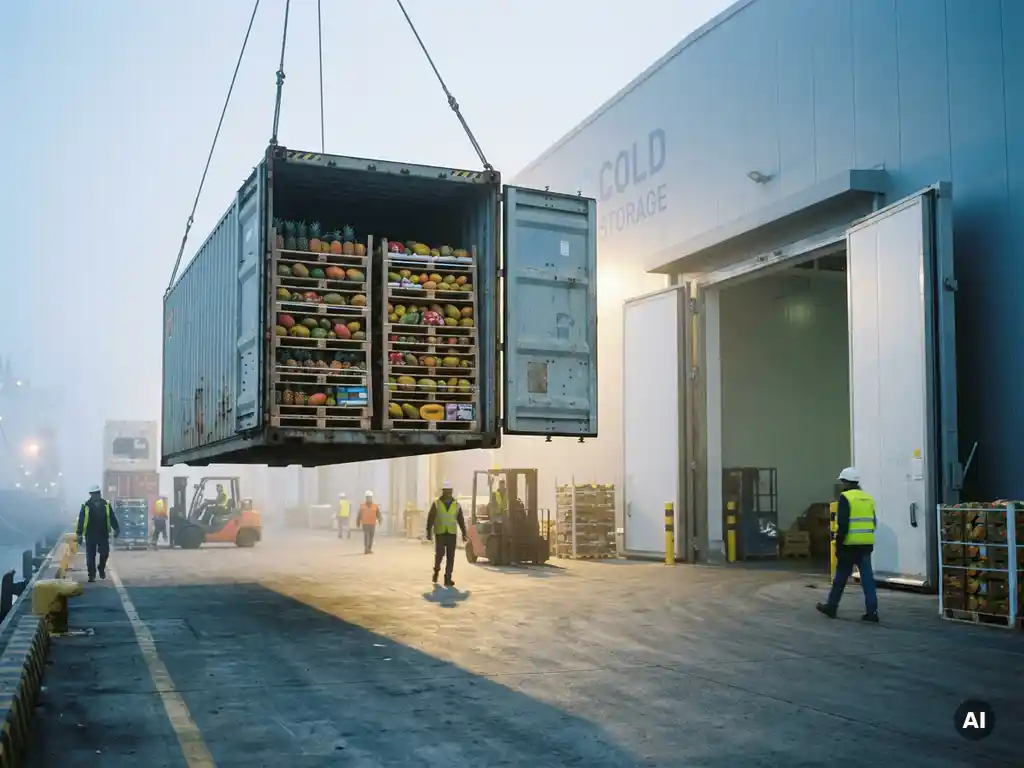
For a large import shipment, temporary storage works as follows: as soon as the goods enter the port, they are unloaded, checked, and transferred to a suitable storage facility until they are released for further transport or distribution. For food products, this means that the storage must be climate-controlled or dry, depending on the product. The questions below answer each part of this process step by step.
What happens to an import shipment immediately after arrival in the port?
Immediately upon arrival in the port, an import shipment is unloaded, inspected, and temporarily stored awaiting customs clearance and any phytosanitary inspection. For food products such as exotic fruit or nuts, speed is crucial in this process: the shorter the time between the ship's hold and a controlled storage environment, the better product quality is preserved.
In practice, this process follows a fixed sequence. After unloading, containers or pallets are transferred to the storage facility, where an initial quality control check takes place. This involves checking for damage, packaging discrepancies, and the temperature upon arrival. Subsequently, the goods are booked into the warehouse system and assigned to a storage location that matches the product specifications.
For fresh and perishable products, the proximity of the storage location to the quay is a determining factor. The shorter the transport route from ship to cold storage, the fewer temperature fluctuations and quality loss. At locations with their own quay directly adjacent to the cold storage facility, this route is minimal, which directly contributes to the shelf life of the product.
How long may a shipment be temporarily stored?
The maximum duration of temporary storage upon import depends on the customs regime and the type of product. Under the EU customs system, goods in temporary storage (also known as “temporary custody”) are subject to a maximum period of 90 days, after which the goods must be assigned a definitive customs destination. For fresh food products, the practical limit is often much earlier, determined by shelf life.
Within those 90 days, the importer must make a choice: release the goods into free circulation via import, store them in a bonded warehouse for longer storage, or forward them to another country. For perishable products such as fruit, commercial shelf life is in most cases the limiting factor, not the customs period.
For dry products such as nuts, peanuts, or seeds, temporary storage at the correct temperature and humidity is feasible over a longer period. In this case, storage conditions determine long-term quality, and a well-managed warehouse significantly extends shelf life.
What is the difference between cold storage and dry storage for an import shipment?
Cold storage is intended for fresh and perishable products that require specific temperature and humidity, such as exotic fruit. Dry storage, also known as ambient storage, is suitable for products that remain stable at room temperature or in a slightly cooled environment, such as nuts, peanuts, and seeds. The difference lies in the climate control and the associated infrastructure.
Cold storage for foodstuffs
In cold storage, temperature, humidity, and air circulation are continuously monitored and adjusted. For products such as bananas or citrus fruits, this is essential: a deviation of a few degrees or incorrect humidity can lead to accelerated ripening, mold formation, or loss of quality. Cold storage therefore requires advanced systems and well-trained personnel.
Dry storage for foodstuffs
Dry storage for food products typically takes place at a controlled temperature of around 11 degrees Celsius. This is relevant for products that do not require refrigeration but are sensitive to heat or moisture, such as nuts and seeds. A well-designed dry warehouse offers sufficient capacity and separation by product type to prevent cross-contamination.
Which documents are required for temporary storage upon import?
For temporary storage of an import shipment, at least the following documents are required: a commercial invoice, a packing list, a Bill of Lading (CMR), and a customs declaration for temporary storage. For food products from third countries, a phytosanitary certificate and an import license are usually added, depending on the product and the country of origin.
For products subject to the control of the KCB (part of the NVWA), such as fresh fruit and vegetables, prior notification is mandatory. The KCB carries out the phytosanitary inspection before the goods are released onto the European market. Without approval from the KCB, goods cannot be legally placed into free circulation.
Organic products require additional certification, such as a SKAL certificate, to demonstrate their organic status upon import and storage. It is advisable to check in advance which documents are specifically required for your product category to avoid delays upon arrival.
How does customs clearance work for temporary storage?
During temporary storage in a port, goods from third countries are placed under customs supervision. This means that the goods have not yet been formally cleared and do not yet have EU customs status. The importer or their customs agent submits a declaration for temporary storage, after which the goods are placed in an approved storage location until the final customs destination is determined.
The most common next step for importers is filing an import declaration, which releases the goods into free circulation. At this stage, import duties and any applicable VAT are paid. Only then may the goods be distributed to customers within the EU.
A logistics partner who can handle customs clearance themselves or works closely with a recognized customs broker significantly shortens lead times. Especially with fresh food products, every day counts, and smooth customs clearance directly impacts the quality that reaches the end customer.
How much does temporary storage cost for a large import shipment?
The costs for temporary storage of a large import shipment depend on several factors: the type of storage (refrigerated or dry), the number of pallets or cubic meters, the storage duration, and the additional services purchased. There is no fixed market price; rates are typically determined on a case-by-case basis, taking into account volume and frequency.
Relevant cost components for temporary storage include inbound handling (unloading and checking in), storage costs per day or week, outbound handling (loading and shipping), and any additional costs for quality control, labeling, or other value-added services. For large or recurring shipments, fixed agreements regarding rates and capacity are common.
When comparing storage partners, it is wise not to look solely at the base storage price, but also at the total costs including additional services. A lower storage price with higher costs for quality control or extra handling can end up being more expensive in the long run.
What should you look out for when choosing a storage partner for import shipments?
When choosing a storage partner for import shipments, certification, location, flexibility, and the range of services are the most important criteria. A partner holding relevant certifications such as BRC, SKAL, and KCB recognition offers demonstrable guarantees regarding food safety and quality assurance. The location relative to the port also influences the speed and quality of the product upon arrival.
Specific points of attention during the selection are:
- Certifications: Check whether the storage partner holds the correct certifications for your product category, such as BRC for food safety or SKAL for organic products.
- Location and quay connection: A storage location directly on the quay shortens the journey from ship to storage and minimizes quality loss for fresh products.
- Climate control: Check if the facility can handle the correct temperature and humidity settings for your specific product.
- Traceability: A barcode system linking each pallet to grower and lot numbers provides full control over inventory and simplifies recalls if necessary.
- Flexibility: Can the partner adapt to fluctuating volumes and sailing schedules? This is particularly relevant for importers who depend on seasonal supply.
- Customs and inspection: A partner who can facilitate KCB inspection and customs clearance saves time and reduces the risk of delays.
System integrations are an often underestimated selection criterion. A warehousing partner that supports EDI connections enables automated order processing, inbound notifications, and inventory updates. This shortens administrative lead times and reduces errors in communication between your systems and the warehouse.
How ZZColdstores helps with temporary storage of import shipments
ZZColdstores offers a fully integrated solution for the temporary storage of large import shipments, with locations in Kruiningen and Vlissingen and its own quay in Vlissingen. These are the core components of the offering:
- Climate-controlled storage for fresh and perishable products such as exotic fruit, with 24/7 monitoring of temperature, humidity, and air circulation.
- Dry storage at approximately 11 degrees Celsius for nuts, peanuts, seeds, and other dry food products, with a total capacity of 12,000 pallet spaces.
- Quality control upon arrival, including temperature, humidity, and Brix measurements and a full QC report
- Barcode-driven traceability per pallet, linked to grower and LOT numbers
- EDI connections for automatic order processing, inbound notifications, and inventory updates
- KCB inspection and customs clearance as part of the total service package
- certifications for demonstrable quality and food safety assurance
Would you like to know more about the options for climate-controlled storage , or would you like to discuss how ZZColdstores can best handle your import shipment? Contact us and discuss the possibilities with a specialist.
Frequently Asked Questions
As an importer, can I choose in which storage facility my shipment is stored?
Yes, as an importer, you are in principle free to choose a storage partner, provided the facility is recognized for temporary storage under customs supervision. It is advisable to make this choice in advance and record it in your logistics plan so that the storage partner is ready when the shipment arrives. Good coordination with your shipping company, customs broker, and storage partner prevents unnecessary delays immediately after unloading.
What happens if my shipment is delayed and arrives later than planned?
In the event of a delayed arrival, it is important to inform your storage partner as early as possible so that reserved capacity and personnel can be rescheduled. For fresh products such as exotic fruit, a delay can also affect shelf life after arrival, meaning the storage strategy may need to be adjusted. A flexible storage partner who can adapt to changing sailing schedules is a major advantage in such situations.
How is the quality of my product guaranteed during temporary storage?
Quality assurance during temporary storage begins upon arrival with a thorough inspection procedure: temperature measurement, visual inspection for damage and packaging deviations, and for fresh products, Brix and humidity measurements. During storage, temperature, humidity, and air circulation are continuously monitored and adjusted. A comprehensive QC report provides you as an importer with insight into the condition of your product at every stage of the storage process.
Is temporary storage also possible for imported organic products, and do different rules apply?
Yes, imported organic products can be stored temporarily, but additional requirements apply. The storage facility must hold SKAL certification, and the goods must be stored physically separated from non-organic products to prevent cross-contamination and loss of status. Additionally, a valid organic certificate, such as a COI (Certificate of Inspection), must be presented upon import before the goods may be released into free circulation.
Can I have my stock processed or repacked during temporary storage?
During temporary storage under customs supervision, processing of the goods is in principle limited to actions that do not substantially alter the condition of the goods, such as checking, sorting, or repacking for protection. If you wish to carry out more extensive operations, such as labeling, repacking, or quality sorting, it is advisable to combine this with final customs clearance or to use a bonded warehouse. Discuss the desired operations in advance with your storage partner and customs broker to determine what is legally possible.
How can I, as an importer, track the progress and stock status of my shipment in real time?
A modern storage partner offers access to a Warehouse Management System (WMS) or inventory management portal that allows you to view the status of your pallets at any time, including location, LOT numbers, and grower information. Via EDI connections, inbound notifications, inventory updates, and outbound confirmations can be automatically forwarded to your own systems, minimizing manual checks and administrative errors. When selecting a storage partner, always inquire about the possibilities for system integration and real-time reporting.
What are the risks if I do not engage a specialized storage partner for my import shipment?
Without a specialized storage partner, as an importer you run the risk of quality loss due to improper climate control, delays caused by insufficient knowledge of customs and inspection procedures, and limited traceability in the event of a recall or quality incident. Additionally, an unapproved storage location can cause problems during customs clearance, which can lead to fines or forced return of goods. For large import shipments of food products, the risks of a generic solution almost always outweigh any potential cost savings.
Related articles
- Can you rent storage space for import shipments that are not being delivered immediately?
- Can you rent storage space for temporary stock between port and customer?
- How does warehousing handle unexpected peaks in supply?
- How much does it cost to rent a storage unit?
- How long can you safely store garlic in a temperature-controlled warehouse?