
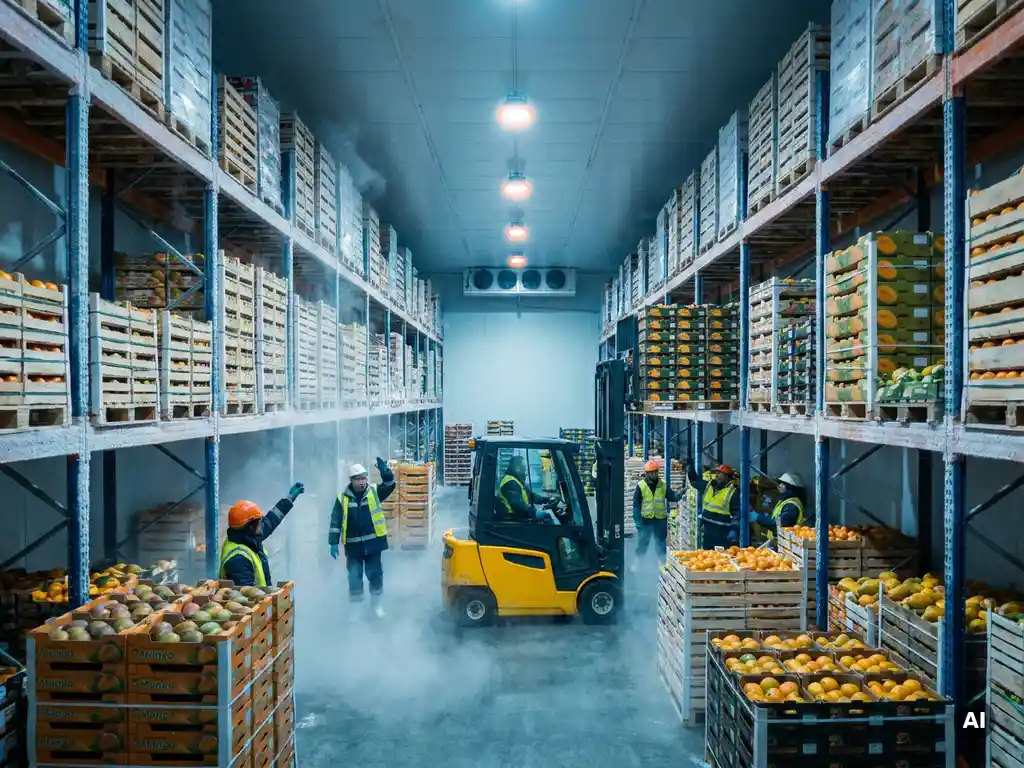
Warehousing helps absorb unexpected supply peaks by providing flexible storage capacity that can be quickly scaled up and down. As a result, importers and wholesalers do not need to reserve their own warehouse capacity for scenarios that might occur only a few weeks a year. The questions below answer the most practical aspects of this issue, from the causes of peaks to choosing the right warehousing partner.
What makes seasonal peaks in supply so difficult to predict?
Seasonal peaks in supply are difficult to predict because they are the result of multiple factors moving simultaneously and independently of each other. Weather conditions in producing countries, shifts in shipping company schedules, fluctuating crop yields, and sudden changes in demand from supermarkets or processing plants can each cause a disruption individually, let alone in combination.
For importers of exotic fruit such as bananas and citrus fruits, biological ripeness also plays a role. A ship arriving later than planned does not extend the shelf life of the fruit. Consequently, the time pressure upon arrival is immediately greater than with non-perishable goods. Moreover, supply flows from tropical production areas are sensitive to climatic disturbances that only become visible late in the season.
Dry products such as nuts, peanuts, and seeds have their own peak pattern linked to harvest cycles in specific regions. Supply from, for example, South America or Asia depends on local harvest dates that are only definitively determined once the harvest is already underway. As a result, logistics planners on the receiving end in Europe always work with a certain margin of uncertainty.
How does flexible storage capacity work in a warehouse?
Flexible storage capacity in a warehouse works by making pallet spaces available based on current supply, rather than fixed contracts with a fixed minimum purchase. A warehousing partner with sufficient total capacity can temporarily accommodate parties without the customer having to pay for that space on a structural basis.
In practice, this means that a warehouse with multiple customers distributes capacity among them based on the actual occupancy rate. When one customer experiences a peak, the space temporarily unused by another customer can be utilized. This requires good planning on the part of the warehousing partner and systems that accurately track inventory per batch.
Barcode-driven traceability is a practical prerequisite in this regard. Every pallet must be traceable to the correct shipment, the correct LOT number, and the correct customer at any time. Without this system, flexible space utilization quickly becomes a source of errors during delivery.
Which products benefit most from flexible dry storage?
Products that benefit most from flexible dry storage are food products with a relatively long shelf life that do not require refrigeration but do require stable environmental conditions. Examples include nuts, peanuts, seeds, and dried food ingredients stored at a constant temperature of around 11 degrees.
For these product categories, the combination of climate stability and flexible capacity is particularly valuable. They are often purchased in large volumes to optimize freight costs, but collection by buyers is spread over a longer period. The warehouse then acts as a buffer between the large-scale purchasing moment and the staggered delivery to processing plants or wholesalers.
Potato products and similar agricultural raw materials produced in the surrounding area fall into the same category. Local producers benefit from a nearby warehousing partner who can quickly scale up when the harvest turns out larger than expected. Shuttle transport between the production site and the warehouse makes this collaboration practically feasible.
How does the transfer from ship to warehouse proceed during a peak in supply?
During a peak in supply, the transfer from ship to warehouse is most efficient when the distance between the quay and the storage area is minimal. The shorter the transport time after unloading, the lower the risk of quality loss, especially for temperature-sensitive products.
In the port of Vlissingen, ZZColdstores has its own quay directly next to the cold storage facility. This means that goods are in the controlled storage area within moments of being unloaded from the hold. This advantage is immediately noticeable in the event of a sudden large influx: no waiting time needs to be factored in for road transport.
Upon arrival, shipments are preferably subjected to a quality control immediately. Damage, deviations in temperature, or packaging issues are then detected right away, ensuring the batch does not move further up the chain before a decision has been made regarding its status. During a major peak, it is particularly important that this process runs quickly and in a structured manner, without the flow grinding to a halt.
What is the difference between dry storage and cold storage for food products?
The difference between dry storage and cold storage for food products lies in the temperature range and the nature of the products for which they are suitable. Dry storage, also known as ambient storage, stores products at a stable ambient temperature, typically around 10 to 15 degrees. Cold storage operates at lower temperatures and is intended for fresh or perishable products.
Dry storage: for stable products with a longer shelf life
Dry storage is suitable for products that do not need to be refrigerated but must be protected against temperature fluctuations, moisture, and light. Nuts, peanuts, seeds, and dried food ingredients are typical examples. The focus is on preventing quality loss by providing a stable environment, not on active cooling.
Cold storage: for fresh and perishable products
Cold storage is essential for products where shelf life is directly linked to temperature. Exotic fruits such as bananas and citrus fruits require precise temperature and humidity control to slow down or direct ripening. climate-controlled cold storage is specifically designed for these types of products, with 24/7 monitoring of temperature, humidity, and air circulation.
When is outsourced warehousing better than in-house storage capacity?
Outsourced warehousing is better than in-house storage capacity when demand for storage space fluctuates significantly and it is not cost-effective to maintain permanent capacity for peak periods. Own warehouses entail fixed costs, regardless of occupancy rates. With an external warehousing partner, a company only pays for the space and services it actually uses.
For importers and wholesalers dependent on seasonal supply, this argument is particularly strong. The costs of an in-house warehouse that operates at full capacity for three months of the year and stands largely empty for nine months are difficult to justify. Outsourcing makes it possible to convert that fixed cost into a variable cost that fluctuates with actual activity.
In addition, a specialized warehousing partner offers expertise and systems that a company would have to build itself: quality control, traceability, customs clearance, and potentially additional logistics services such as repalletization or labeling. This combination of flexibility and specialization is difficult for most trading houses to replicate internally at comparable costs.
Which certifications must a warehousing partner have for food products?
A warehousing partner for food products must possess at least BRC certification, the international standard for food safety in storage and distribution. Depending on the type of product and the market, SKAL certification for organic products and recognition by the KCB (part of the NVWA) for import inspections may also be relevant.
The BRC Global Standard for Storage and Distribution is a strict purchasing requirement for many supermarket chains and processing plants. Without this certificate, a warehousing partner simply does not qualify as a supplier for parties that must meet the requirements of major retailers. The certification covers, among other things, hygiene, traceability, pest control, and the management of product risks.
SKAL certification is mandatory for companies that store or process organic products and wish to continue marketing these products as organic. For importers who process both conventional and organic streams, it is important that the warehousing partner can facilitate both without the risk of mixing.
The KCB accreditation is specifically relevant for the import inspection of fresh products from outside the EU, including exotic fruit. A warehousing partner with this accreditation can have the import inspection carried out directly on-site, which significantly shortens turnaround time after arrival. This represents a concrete operational advantage during a peak in supply.
How ZZColdstores helps with unexpected supply spikes
ZZColdstores offers warehousing solutions specifically designed to handle the variable supply flows that importers, wholesalers, and suppliers in the agri-food sector face daily. The combination of locations in Kruiningen and Vlissingen, a private quay, and both dry and climate-controlled storage space makes it possible to respond quickly to unexpected peaks.
- Flexible pallet capacity for dry storage (approx. 11 degrees) and climate-controlled cooling, tailored to specific product requirements
- Direct transshipment from ship to warehouse via our own quay in Vlissingen, with minimal time losses
- Quality control upon arrival, including temperature and humidity measurements and an optional QC report
- Barcode-driven traceability per pallet, with linking of LOT numbers to the correct shipment
- Additional services such as repalletization, labeling, and EDI connections for seamless integration with your systems
- Certifications: BRC, SKAL and KCB/NVWA accreditation for on-site import inspection
Would you like to know how ZZColdstores can specifically handle your supply peaks? Contact us and discuss the possibilities for your specific product flow and planning.
Frequently Asked Questions
How quickly can a warehousing partner free up extra capacity in the event of an unexpected supply peak?
A good warehousing partner can make extra pallet space available within 24 to 48 hours in the event of an unexpected peak, provided that the expected supply is communicated in a timely manner. The sooner you, as an importer or wholesaler, give a signal—even if that signal is uncertain—the better the warehousing partner can anticipate. In practical terms, it is wise to inquire with your warehousing partner about a peak protocol: a fixed agreement on how and when to request extra capacity, and what the maximum scaling capacity is within your contract.
What are the most common mistakes when choosing a warehousing partner for seasonal products?
The most common mistake is choosing based on price per pallet space without considering the partner's total capacity and their ability to scale during peak periods. A warehouse that is cheap during quiet periods but has no space during your peak season offers no real solution. Other common mistakes include failing to check the correct certifications for your product category and underestimating the importance of location — a warehouse far from the port or your customers increases transport costs and lead time precisely when speed matters most.
As a smaller importer, can I also make use of flexible warehousing, or is that only available to big players?
Flexible warehousing is particularly attractive for smaller importers, as you do not have to finance or manage your own warehouse. You only pay for the space and services you actually use, which significantly lowers the barrier compared to maintaining your own storage capacity. However, it is wise to make clear agreements in advance regarding minimum volumes and notice periods, so that you are not unexpectedly tied to terms that do not suit your scale.
How is loss of quality prevented if goods remain in the warehouse longer than planned during a peak?
For dry products such as nuts and seeds, loss of quality during an extended storage period is primarily a matter of constant climate control: stable temperature, humidity, and protection against light and pests are the critical factors. For fresh products such as exotic fruit, an extended storage period is risky, and temperature control must be precisely tailored to the ripening phase of the product. Always ensure that your warehousing partner prepares a quality report upon arrival, so that in the event of a later claim or discrepancy, you can demonstrate the condition of the goods at the time of receipt.
What do I need to arrange regarding customs and import inspection if my goods arrive earlier than expected during a peak?
If goods arrive earlier than expected, it is essential that your customs documentation — such as the import license, phytosanitary certificates, and any EUR.1 or T1 documents — is already ready or can be provided quickly. A warehousing partner with KCB/NVWA accreditation can have the import inspection carried out directly on-site, saving time compared to an inspection elsewhere. Ensure that you also inform your customs broker of the changed arrival date in a timely manner so that clearance is not delayed and the goods are available for delivery as soon as possible.
How do I connect my own ERP or order management system to my warehousing partner's system?
Most specialized warehousing partners offer EDI (Electronic Data Interchange) connections that automatically transfer inventory movements, inbound and outbound confirmations to your ERP or order management system. When selecting a partner, always ask which EDI standards are supported and whether a test environment is available for the integration. A correct connection prevents manual entry errors, gives you real-time insight into your inventory, and is especially valuable during supply peaks because you know at any moment how much space is still available and which batches have already been checked in.
How do I determine which type of storage — dry or climate-controlled — is most suitable for my product?
The choice between dry storage and climate-controlled cold storage depends on the shelf life, temperature sensitivity, and packaging form of your product. As a rule of thumb: products that can be stored at room temperature but are sensitive to temperature fluctuations, moisture, or light—such as nuts, peanuts, and dried ingredients—benefit from stable dry storage at around 11 degrees. Fresh products with a short shelf life or an active ripening process, such as bananas and citrus fruits, require climate-controlled cooling with precise control of temperature and humidity. In doubt? Discuss the specific storage recommendations from your product's technical datasheet with your warehousing partner to ensure the storage conditions meet your customers' requirements.
Related articles
- What requirements must professional food storage meet?
- What is customs clearance and why is it mandatory for imports?
- What is conditioned storage at a temperature of 11°C?
- What are the risks of larvae and insects when storing dried fruit?
- How does the logistics chain from port to factory for dry raw materials work?