
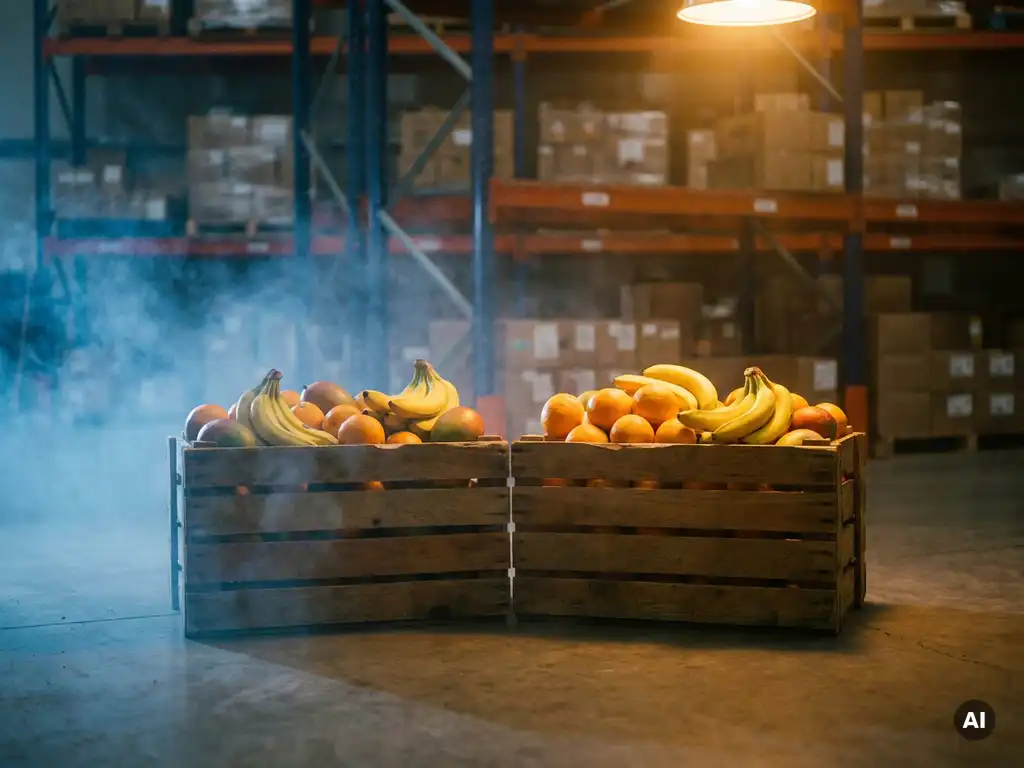
Ambient storage and room temperature storage seem the same at first glance, but there is an important difference: ambient storage is a controlled storage environment with a stable, set temperature, whereas room temperature storage simply refers to the prevailing temperature in a room without active control. For B2B logistics and food storage, that distinction is crucial. This article answers the most frequently asked questions about both concepts so that you can make informed choices for your supply chain.
What temperature corresponds to ambient storage?
Ambient storage refers to storage at a stable, controlled temperature typically between 10 and 18 degrees Celsius, depending on the product and storage requirements. The exact setting is determined by the characteristics of the product, not by the outside temperature or seasonal conditions in a warehouse.
In practice, many dry storage facilities for food products operate at a temperature of around 11 degrees Celsius. This is cool enough to limit bacterial growth and quality loss, but warm enough to avoid deploying unnecessary cooling capacity. Ambient storage thus falls between active cooling (0 to 7 degrees) and uncontrolled room temperature, offering a targeted middle ground for products that do not require cold storage but cannot simply be stored just anywhere.
What is meant by storage at room temperature?
Storage at room temperature means that products are stored at the natural temperature of an indoor space, without active climate control. In a standard warehouse or storage hall, that temperature is typically between 15 and 25 degrees Celsius, but this varies significantly by season, location, and type of building.
The concept of “room temperature” is therefore not very precise in a logistical sense. In the summer, an uncooled warehouse can rise to above 30 degrees, while that same warehouse cools down to below 10 degrees in the winter. Consequently, for non-perishable products that require a stable storage environment, room temperature offers insufficient certainty. In the food industry, the term is sometimes used as an indication on packaging, but for professional storage in the supply chain, it is not a usable standard.
What is the concrete difference between the two forms of storage?
The core difference is control: ambient storage is actively regulated at a fixed temperature, whereas storage at room temperature is passive and uncontrolled. With ambient storage, the temperature is deliberately set and monitored; with room temperature storage, one is dependent on the environment.
That difference has direct consequences for product quality, shelf life, and food safety. Temperature fluctuations promote changes in humidity, condensation, and accelerated product degradation. Particularly with food products such as nuts, seeds, and dried fruit, even small temperature variations can lead to loss of quality, mold formation, or deterioration of taste and texture. Ambient storage eliminates these risks by guaranteeing a stable, predictable storage environment.
A second difference lies in humidity control. Professional ambient storage combines temperature control with the regulation of relative humidity, which is rarely the case with ordinary room-temperature storage.
Which products are suitable for ambient storage?
Ambient storage is suitable for dry and shelf-stable food products that do not require active refrigeration but benefit from a stable, dry, and clean storage environment. This applies to products where temperature fluctuations or humidity can affect quality.
Examples of products suitable for dry ambient storage are:
- Nuts and peanuts
- Seeds and grains
- Flakes (such as potato flakes)
- Dried fruit
- Other shelf-stable dry food products
These product categories are sensitive to moisture, temperature fluctuations, and odor contamination. A controlled ambient environment protects them throughout the entire storage period, from arrival to shipment. Products requiring active cooling, such as fresh fruit or dairy, fall outside the ambient category and require climate-controlled cold storage.
When do you choose ambient storage instead of cooling?
You choose ambient storage when a product requires stable conditions but does not require low temperatures. Active cooling is then not only unnecessary but also more expensive and sometimes even harmful to certain products that cannot withstand the cold.
The choice depends on a number of concrete factors:
- Product specifications: Check the recommended storage temperature of the product. If it is above 10 degrees and the product is dry and shelf-stable, then ambient storage is the logical choice.
- Storage duration: For longer storage periods, climate stability is more important. Ambient storage offers that stability without the costs of cold storage.
- Cost considerations: Cold storage requires more energy and infrastructure. Ambient storage is more cost-efficient for products that do not benefit from it.
- Certification requirements: Some product categories fall under specific standards that prescribe or permit ambient storage. Always check the applicable regulations for your product category.
For processing plants and wholesalers working with dry ingredients or shelf-stable food products, ambient storage is in most cases the most suitable and cost-effective solution.
How is ambient storage controlled from a climate perspective?
Ambient storage is climate-controlled via a combination of temperature management, ventilation, and humidity control. Sensors continuously measure the conditions in the storage space, and systems adjust as soon as values fall outside the set ranges.
In professional ambient food warehouses, the systems are tailored to the specific requirements of the stored product categories. This means that settings can vary per room or zone, depending on what is stored. Good ventilation prevents moisture buildup and ensures an even temperature distribution throughout the entire space. This is particularly important in large warehouses where temperature differences between the floor and the roof can be significant.
In addition to the technical installations, the structural quality of the warehouse also plays a role: insulation, closing doors, and the prevention of heat sources in the storage area all contribute to a stable ambient climate.
Which certifications are relevant for ambient food storage?
For ambient storage of food products, multiple certifications are relevant, depending on the product category and the sales market. The most common are BRC (British Retail Consortium), SKAL (for organic products), and the requirements resulting from NVWA supervision via the KCB.
BRC is an internationally recognized food safety standard required by many supermarket chains and processing industries from their suppliers and logistics partners. A BRC-certified warehouse meets strict requirements regarding hygiene, temperature control, traceability, and quality assurance.
SKAL certification is relevant for companies that store organic products and wish to demonstrate that the biological integrity of the goods remains guaranteed during storage. Demeter is a complementary certification for biodynamic products, a step further than SKAL.
For importers working with products subject to phytosanitary supervision, the involvement of the KCB (part of the NVWA) is important. The KCB conducts import inspections and sets requirements for the conditions under which products are stored during and after the inspection. Which certification is mandatory or desirable for your situation depends on the product, its origin, and the buyer.
How ZZColdstores helps with ambient storage of dry food products
ZZColdstores offers professional ambient storage for dry and non-perishable food products in a stable, controlled environment. The dry storage warehouse in Kruiningen has a capacity of 12,000 pallet spaces and is specifically designed for products such as nuts, peanuts, seeds, flakes, and dried fruit. What sets ZZColdstores apart:
- Stable ambient temperature tailored to product requirements, without unnecessary cooling capacity
- Quality control upon arrival, including temperature and humidity measurements
- Barcode-driven traceability per pallet, linked to grower and LOT numbers
- Possibility for repalletizing, labeling, and EDI connections with your systems
- Certifications: BRC, SKAL and Demeter
- Own shuttle transport within a 40 km radius of Kruiningen
Would you like to know if ambient storage at ZZColdstores meets your logistical needs? Contact us for a no-obligation discussion about the possibilities.
Frequently Asked Questions
How long can dry food products be safely stored in an ambient storage facility?
The maximum shelf life depends heavily on the specific product and packaging, but in a professional ambient environment with stable temperature and humidity control, dry products such as nuts, seeds, and dried fruit can often be stored for several months to more than a year. Always consult the manufacturer's or supplier's product specifications for the exact shelf life. A certified storage partner like ZZColdstores can help you determine the correct storage conditions for each product category.
What are the most common mistakes when transitioning from room temperature storage to ambient storage?
A common mistake is underestimating the transition phase: products that have already been exposed to temperature fluctuations in an uncontrolled environment may have already suffered quality loss upon arrival at an ambient warehouse. Additionally, companies sometimes forget to align their packaging specifications and pallet layouts with the requirements of the new storage facility. Also ensure that the entire chain, from transport to storage, is climate-consistent so that you do not lose quality gains at the last minute.
Can ambient storage be combined with refrigerated or frozen storage within the same logistics operation?
Yes, many logistics service providers offer combined storage solutions where ambient, refrigerated, and frozen storage are provided within a single facility or network. This is particularly useful for companies with a broad product portfolio requiring different storage conditions. When choosing a partner, ensure that the transfer between the different temperature zones is properly managed so that products are not unnecessarily exposed to temperature fluctuations during internal transport or order picking.
As the client, how do I verify whether the ambient storage actually meets the agreed temperature conditions?
A professional ambient storage partner offers transparency through continuous temperature monitoring and reports accessible to the client, often via a digital portal or EDI connection. When entering into a partnership, always inquire about the availability of temperature logs, alarm protocols for deviations, and the calibration frequency of the measuring sensors. Certifications such as BRC require storage companies to provide demonstrable monitoring and documentation, which serves as an additional guarantee.
Is ambient storage also suitable for non-food-related products?
Yes, ambient storage is also used for non-food products that benefit from a stable, dry storage environment, such as pharmaceutical raw materials, cosmetic ingredients, paper, and certain chemicals. However, temperature and humidity requirements may differ from food standards, and certification requirements are often sector-specific. Always verify that the chosen storage facility possesses the appropriate certifications and experience for your specific product category.
What should I include in a request for a quote for ambient storage?
For an accurate quotation, it is important to provide at least the following information: the type of product and the associated storage temperature and humidity requirements, the expected storage volume in pallet spaces, the average turnaround time of the goods, any certification requirements from your customers, and whether you require additional services such as repalletizing, labeling, or transport coordination. The more specific your request, the better a storage partner can assess whether the facility meets your needs and the more accurate the pricing will be.
What role does humidity play in ambient storage, and how does this differ from regular warehouse storage?
Humidity is at least as important as temperature in ambient storage of dry food products: excessively high relative humidity promotes mold growth, clumping, and loss of quality, while excessively low humidity can dry out products and damage their structure. In professional ambient warehouses, relative humidity is actively monitored and regulated, usually in combination with temperature control. In regular warehouses without climate control, there is no active regulation of humidity, meaning seasonal fluctuations directly affect the stored goods.