
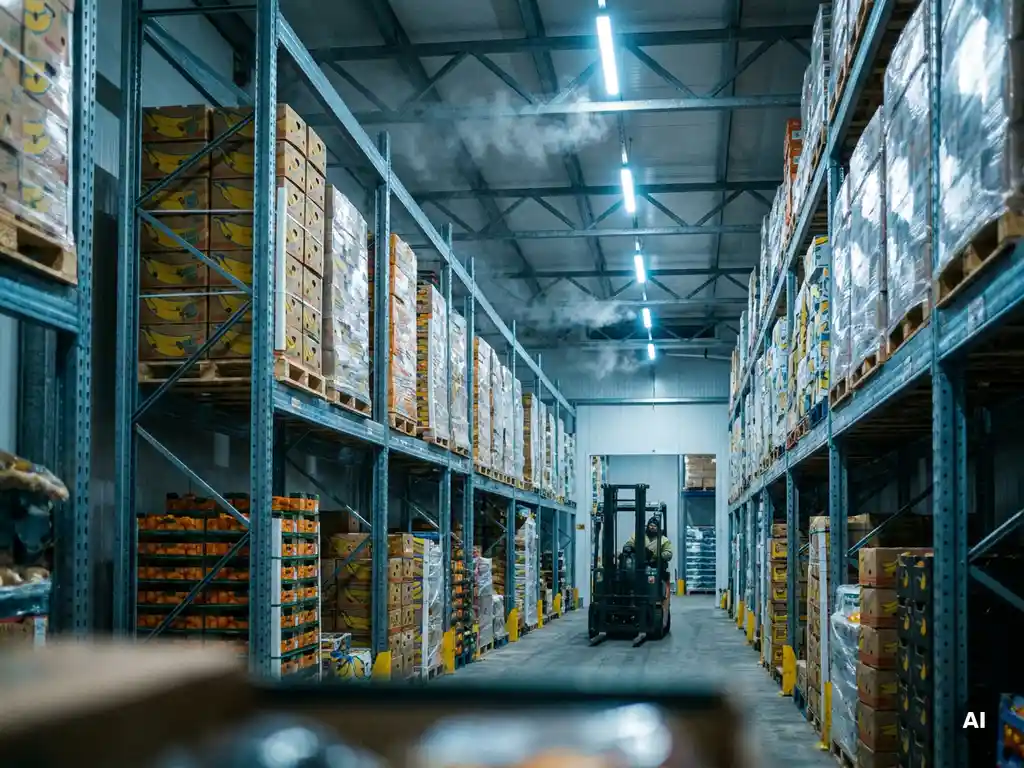
Professional cold storage for food must meet strict requirements regarding temperature control, humidity, certification, and infrastructure. For B2B parties in the food chain, such as importers, wholesalers, and suppliers to supermarkets, choosing the right storage partner directly impacts product quality, food safety, and compliance with laws and regulations. The questions below provide a clear overview of the key requirements that a professional cold storage facility must meet.
What temperature requirements apply to professional cold storage of food?
Professional cold storage for food requires precisely adjustable temperature zones tailored to the specific product. Most fresh food products are stored between 0 and 15 degrees Celsius, but the exact range varies significantly by product category. A cold storage facility that handles multiple product types must be able to control these zones independently of each other.
Exotic fruit has specific requirements. Bananas are typically stored at approximately 13 to 14 degrees Celsius, while citrus fruits often require slightly lower temperatures. If the temperature is set too low, cold damage occurs. Storing at too high a temperature accelerates the ripening process and leads to a loss of quality. A professional cold storage facility is equipped with systems that continuously measure and adjust the temperature, even outside office hours.
In addition to the average temperature, temperature uniformity within the storage area is important. Cold air must be distributed evenly so that products at the back of the room or at the bottom of a stack also reach the correct storage temperature. This requires a well-designed air circulation system and a regularly maintained refrigeration unit.
What are the legal certifications for the cold storage of foodstuffs?
Several certifications are relevant for the professional cold storage of foodstuffs. The most requested is BRC (British Retail Consortium), an international food safety standard required by major retailers and supermarket chains from their suppliers. In addition, SKAL certification applies to organic products and, for certain biodynamic products, the Demeter label.
For the import of fresh products from outside the EU, the involvement of the KCB (Quality Control Office), part of the NVWA, is also important. The KCB carries out import inspections on fruit and vegetables and checks whether products comply with European trade standards. A cold storage location directly involved in the import process must have the appropriate facilities and procedures in place for this purpose.
For companies that store or transit organic products, SKAL certification is mandatory. Without this certification, a storage partner may not process organically certified products without losing their organic status. It is therefore essential to check which certifications are current and for which product categories they apply when selecting a cold storage partner.
How is humidity controlled in a professional cold storage facility?
In a professional cold storage facility, humidity is controlled via automated climate systems that continuously measure and adjust. The ideal relative humidity varies by product, but for most fresh food products, it lies between 85 and 95 percent. Air that is too dry leads to dehydration and weight loss; air that is too humid promotes mold growth.
Air circulation plays a key role in this. By allowing air to flow properly, moisture is distributed evenly and hotspots or condensation points are prevented. This is particularly relevant for stacked pallets of cardboard boxes, where airflow between the boxes determines the shelf life of the product.
Modern cold storage facilities use sensors at multiple points in the storage area to monitor both temperature and humidity. The measurement data is recorded and available for quality reports. This makes it possible to reconstruct retrospectively the conditions under which a product was stored, which is relevant for quality complaints or audits by certifying bodies.
What is the difference between cold storage and dry storage for food?
Cold storage and dry storage are two fundamentally different forms of temperature-controlled preservation. Cold storage is intended for fresh, perishable products that require a specific low temperature and high humidity. Dry storage, also known as ambient storage, is suitable for products that remain stable at a higher ambient temperature, such as nuts, peanuts, seeds, and dried food products.
Cold storage: for fresh and perishable products
In a refrigerated storage area, the temperature is actively kept low, typically between 0 and 15 degrees Celsius depending on the product. Humidity is precisely controlled to prevent drying out or condensation. This type of storage is indispensable for products such as exotic fruit, vegetables, and other fresh foods with a short shelf life.
Dry storage: for stable, non-refrigerated products
Dry storage takes place at a controlled ambient temperature, often around 11 degrees Celsius. This is not refrigeration in the traditional sense, but a climate-controlled environment that limits fluctuations in temperature and humidity. Products such as nuts and seeds are sensitive to heat and moisture but do not require active cooling. A dry storage warehouse with proper climate control protects these products against spoilage and loss of quality.
What requirements apply to the location and infrastructure of a cold storage facility?
The location of a cold storage facility is a strategic consideration for B2B parties in the food chain. A cold storage facility situated close to a port or terminal significantly shortens the time between unloading and cooling. This is crucial for fresh products, where every minute outside the controlled environment can affect quality.
In terms of infrastructure, a professional cold storage facility must have sufficient loading and unloading bays for trucks, the capability to unload containers directly, and preferably a direct connection to the port area. A private quay next to the cold storage facility virtually eliminates transport time between ship and cooling, resulting in a significant quality improvement, particularly for sensitive fruit.
In addition, storage capacity and flexibility are important. A cold storage facility must be able to handle fluctuating supply volumes, depending on ship schedules and product seasonality. Flexible storage capacity, combined with efficient inbound processes such as quality control upon arrival and immediate palletizing, largely determines the throughput speed and reliability of the chain.
How do you recognize a reliable cold storage partner for your supply chain?
A reliable cold storage partner for food is recognizable by up-to-date certifications, demonstrable experience with your product category, and transparency regarding climate conditions and quality controls. For supply chain managers and buyers at agri-food companies, these are the most concrete indicators of reliability, alongside the partner's location and logistical capacity.
Pay attention to the following characteristics when making your selection:
- Current certifications: BRC, SKAL, and potentially Demeter are basic requirements for professional food storage. Always check whether the certificates are valid and for which activities they have been issued.
- 24/7 climate monitoring: Temperature and humidity must be continuously monitored, even outside office hours. Ask for the recording and reporting of measurement data.
- Traceability: Every pallet must be traceable from arrival to departure, preferably via a barcode system linked to grower and LOT numbers.
- Experience with your product category: A partner specializing in exotic fruit or nuts understands the specific storage conditions and risks better than a generalist.
- Flexibility: The partner must be able to adapt to fluctuating supply volumes and sailing schedules without compromising quality or throughput speed.
- Integration options: EDI connections for automatic order processing, inventory updates, and inbound notifications reduce errors and accelerate communication in the supply chain.
During an initial consultation, always ask for references within your product category and how the partner handles quality deviations upon arrival. A partner who performs immediate quality checks upon arrival and separates defective products from the batch protects not only product quality but also your position vis-à-vis the end customer.
How ZZColdstores provides cold storage for food
ZZColdstores combines more than 30 years of experience in temperature-controlled storage with a strategic location in Kruiningen and Vlissingen, directly at the port. The climate-controlled cold storage is specifically designed for fresh and perishable products such as bananas and citrus fruits, with 24/7 monitoring of temperature, humidity, and air circulation.
What sets ZZColdstores apart for B2B parties in the food chain:
- Certified to BRC, SKAL, and Demeter for broad applicability in the food chain
- Own quay in Vlissingen for minimal transport time between ship and cooling
- Quality control upon arrival, including temperature, humidity, and Brix measurements
- Full traceability per pallet via barcode system with grower and LOT numbers
- Flexible settings per storage zone, tailored to the specific requirements of the product
- EDI connections for seamless integration with your own systems
Would you like to know if ZZColdstores is the right partner for your cold storage or supply chain? Contact us and discuss the possibilities for your specific product and logistics situation.
Frequently Asked Questions
How far in advance do I need to reserve cold storage for large import shipments?
For large or seasonal import shipments, it is advisable to reserve capacity at least two to four weeks in advance, especially during peak periods such as the banana season or holidays. Discuss expected supply volumes and sailing schedules with your storage partner to ensure sufficient flexible space is available. A partner with scalable storage capacity can better respond to unexpected volume fluctuations without compromising quality or turnaround time.
What happens if the temperature during storage falls outside the agreed range?
A professional cold storage facility is equipped with automatic alarm systems that respond immediately as soon as the temperature falls outside the set range, even outside office hours. The responsible technician is alerted immediately and can intervene before products are damaged. Always ask your storage partner about the escalation protocol and the maximum response time, and check whether deviations are recorded in the climate reports for potential audits or quality complaints.
Can I store organic and conventional products with the same storage partner?
Yes, that is possible, but only if the storage partner holds a valid SKAL certification and demonstrably maintains separate storage zones or procedures for organic and conventional products. Without strict separation and the correct certification, an organic product loses its certified status, with direct consequences for its marketability. Always check whether the SKAL certification is current and for which specific activities, such as storage and transit, it has been issued.
What information do I need to provide upon arrival of a batch to ensure smooth inbound processing?
For efficient inbound processing, your storage partner typically requires the following information: the expected arrival time, the number of pallets and packages, the product type with the corresponding storage temperature, and the relevant grower and LOT numbers for traceability. If your storage partner supports EDI connections, inbound notifications can be automatically generated from your own system, minimizing errors and increasing processing speed. The more complete the information provided in advance, the faster the product reaches the correct cooling zone.
How is loss of quality prevented during transshipment between transport and cold storage?
The greatest risk factor for quality loss lies in the time products spend outside a controlled environment, the so-called 'warm chain'. A cold storage facility with its own quay or direct port connection virtually eliminates this vulnerable link. In addition, refrigerated loading and unloading bays are essential so that the cold chain remains intact even during the unloading of trucks or containers. Explicitly ask your storage partner about the average time between unloading and placement in the cold storage.
What is the difference between BRC certification Level 1 and higher levels, and which level do I need?
The BRC standard has multiple grades, from 'AA' to 'D', based on the audit result. Large retail chains and supermarket organizations typically set a minimum grade of 'B' or higher as a purchasing requirement for their suppliers. Therefore, check not only whether your warehousing partner is BRC-certified, but also which grade has been achieved and when the last audit took place. A higher grade provides greater assurance regarding the consistency of the quality management systems and simplifies your own audit processes with end customers.
How can I, as a buyer or supply chain manager, remotely monitor the status of my stored inventory?
Modern cold storage partners offer digital portals or EDI connections that provide real-time insight into inventory levels, inbound and outbound movements, and climate data per storage zone. This makes it possible to manage inventory directly from your own ERP or WMS system without manual communication. When selecting a partner, inquire about the available integration options and the frequency with which inventory and climate data are updated, so that you always have an up-to-date picture of your products in storage.
Related articles
- What is the difference between bulk and packaged storage of potato powder?
- What are the risks of improper storage of peanuts and cashews?
- How do you prevent mold formation when storing garlic?
- How does pallet barcoding work in a logistics warehouse?
- Why is conditioned storage better than a regular warehouse for nuts?