
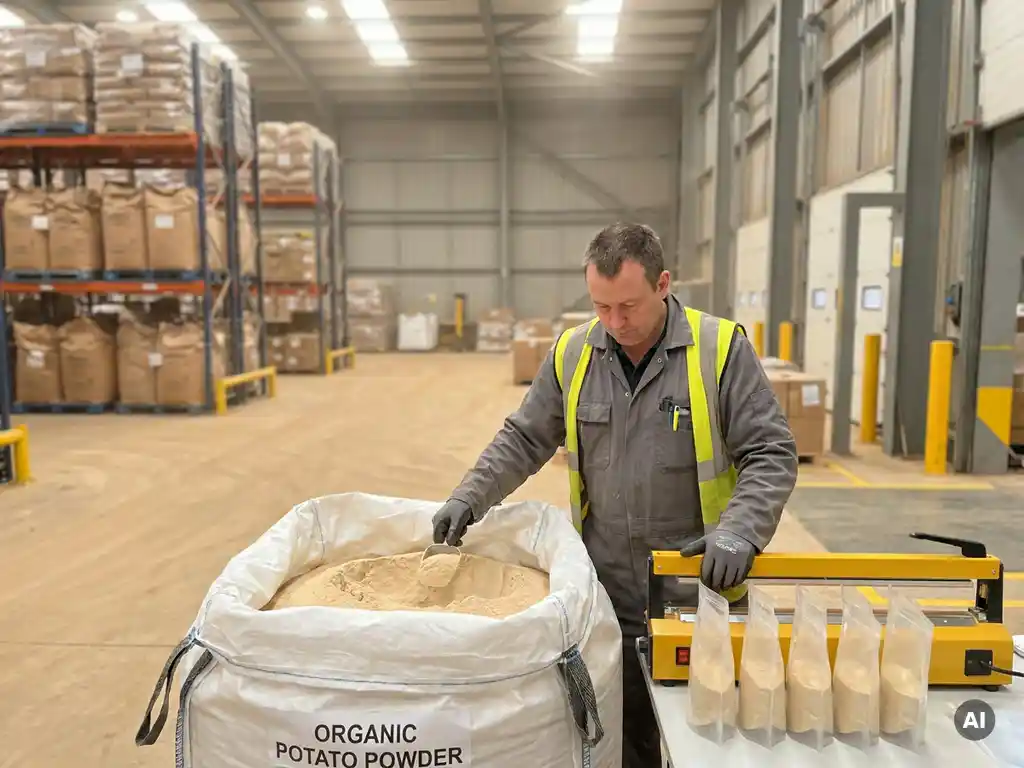
Bulking is the process of repacking a product from smaller packages into larger bulk units, or vice versa. In the case of potato powder, this typically means transferring from big bags into smaller sacks, or consolidating loose sacks into larger units for more efficient transport and storage. This article answers the most frequently asked questions about bulking, from the basics to choosing a suitable partner.
What is the difference between bulk storage and ordinary storage?
Ordinary storage means that goods are kept in the packaging in which they arrive. Bulking goes a step further: the product is actively repacked, consolidated, or split to meet a new packaging requirement. Storage is passive; bulking is a logistical operation that changes the packaging form of a product.
In conventional storage, pallets or bags lie in a warehouse until they are forwarded. With bulking, a physical process takes place: bags are opened, product is transferred to another package, and the new units are resealed and relabeled. This requires specific equipment, space, and knowledge of the product to prevent loss of quality.
How does the bulking process work step by step?
The bulking process proceeds in a fixed sequence: receipt and quality control of incoming goods, followed by repacking into the desired packaging form, and finally sealing, weighing, and preparing for further transport or storage. The exact steps depend on the product and the desired final packaging.
- Receipt and inspection: The incoming cargo is registered and checked for condition, weight, and packaging integrity.
- Preparation: The correct equipment and empty packaging are prepared, tailored to the product and the desired unit size.
- Refilling: The product is transferred from the source packaging to the target packaging, for example from big bags to 25 kg bags.
- Closing and weighing: The new packages are closed, weighed, and provided with the correct labeling.
- Palletizing and storage: The filled units are stacked on pallets and prepared for storage or direct loading.
Why is potato powder specifically bulked?
Potato powder is bulked because it is produced or imported in large quantities but is often purchased by customers in smaller, specific amounts. By bulking potato powder from bulk packaging to smaller units, or vice versa, the packaging aligns with the customer's production demand without unnecessary product loss.
Potato powder is a dry, relatively stable product that withstands repacking processes well, provided the environment is dry and dust-free. Hygiene requirements are high: contact with moisture or contaminants can cause clumping or spoilage. Bulking of potato powder therefore requires a certified environment, such as a warehouse with BRC certification, and strict process control.
What are big bags and how are they used in bulking?
Big bags, also known as FIBCs (Flexible Intermediate Bulk Containers), are large, flexible bags made of woven polypropylene with a load capacity typically ranging from 500 to 1,500 kilograms. In bulking, big bags are used as source or target packaging for dry, bulk products such as potato powder, flour, nuts, or seeds.
When bulking from big bags, the bag is suspended above a hopper or filling station, after which the product is drained through the bottom opening and filled into smaller packages. In the reverse direction, smaller quantities are consolidated into an empty big bag. Big bags are popular in bulk logistics because they are efficient to stack, use relatively little packaging material, and integrate well with automated filling systems.
Which products are suitable for bulking?
Bulking is suitable for dry, bulk products that are stable during filling and do not require special atmospheric protection. Typical examples are flour, potato powder, sugar, nuts, peanuts, seeds, grains, and other dry food ingredients.
- Potato powder and other starches: Dry, free-flowing and well suited for big bag bulking.
- Nuts and peanuts: Are often imported in bulk and resold in smaller units.
- Seeds and grains: Suitable for bulking provided the storage area is dry and pest-free.
- Dry food ingredients: Such as flour, sugar, and legumes that are purchased in bulk but delivered in smaller quantities.
Products that require vacuum packaging or are particularly sensitive to moisture, temperature fluctuations, or oxidation are less suitable for standard bulking and require additional precautions.
What are the benefits of bulking for the supply chain?
Bulking makes the supply chain more efficient by aligning the packaging form of a product with the needs of the next link in the chain. This lowers transport costs, reduces packaging waste, and shortens processing time at the customer.
Specifically, bulking yields the following benefits for supply chain and logistics managers:
- Lower transport costs: Bulk packaging is volumetrically more efficient than many small units.
- Delivery flexibility: Customers receive exactly the quantity they need, in packaging that suits their production process.
- Fewer handling steps for the customer: The customer receives a ready-to-use package and no longer needs to repack it themselves.
- Better inventory management: Smaller, uniform units are easier to count, store, and rotate.
What should you look out for when choosing a bulking partner?
When choosing a bulking partner, certification, product knowledge, and available infrastructure are the three most important criteria. A partner without the proper certifications or experience with food safety can cause quality problems that are difficult to rectify further down the chain.
Pay attention to the following points during the selection:
- Certifications: A minimum of BRC or a comparable food safety standard is required for dry food products.
- Product-specific experience: Ask if the partner has demonstrable experience with the specific product you want to bulk.
- Equipment and capacity: Check whether the correct filling and weighing equipment is available for the desired packaging shape and size.
- Storage conditions: The bulking area must meet the storage requirements of the product, such as dry, dust-free, and pest-free.
- Traceability: A good partner accurately records every batch, so you can always determine which product was repacked and when.
- Flexibility: Can the partner respond to fluctuating volumes and delivery schedules?
How ZZColdstores helps with dry storage and bulking
From its locations in Kruiningen and Vlissingen, ZZColdstores offers a certified environment for the storage and handling of dry food products. With BRC, SKAL, and Demeter certifications and a dry storage warehouse with 12,000 pallet spaces, the infrastructure is in place for the professional storage of products suitable for bulking, such as powdered potatoes, nuts, peanuts, and seeds.
- Dry, controlled storage space suitable for food ingredients
- BRC-certified environment for food-safe storage and handling
- Flexible capacity tailored to the sailing schedule and the customer's delivery needs
- Customs clearance and import inspection via KCB (part of the NVWA) included in the logistics process
- Own quay in Vlissingen for direct transshipment from ship to storage
Would you like to know what ZZColdstores can do for your bulking or storage needs? View the options on the dry storage or contact us directly for a tailored consultation.
Frequently Asked Questions
How long does a typical bulking process take for a batch of potato powder?
The lead time depends on the volume of the shipment, the desired final packaging, and the equipment available at the bulking partner. For a standard shipment of one big bag to 25 kg bags, an experienced partner can usually process this within a few hours. It is advisable to discuss realistic lead times with your partner in advance so that they align with your delivery schedule.
What are the most common mistakes in bulking and how do you avoid them?
The most common mistakes are insufficient moisture control in the storage area, incorrect labeling of new packaging, and the lack of batch registration. This can lead to product clumping, traceability problems, or even product recalls. Prevent this by working exclusively with a certified partner that adheres to strict protocols for hygiene, weighing, and documentation.
Can bulking also be applied to organic products?
Yes, bulking is also possible for organic products, but this places additional requirements on the bulking partner. The partner must possess organic certification, such as SKAL in the Netherlands, and the bulking area and equipment must be separated from non-organic products to prevent cross-contamination and loss of certification. Always inquire about the specific organic certifications of a potential partner before entering into a partnership.
How is the quality of the product ensured during the bulking process?
Quality assurance begins with the incoming inspection and continues through to the final sealing of the new packaging. A professional bulking partner works with validated weighing equipment, controlled environmental conditions (dry, dust-free, pest-free), and documented quality checks per batch. For products such as potato powder, it is also important that the bulking area has stable humidity, as moisture directly affects product quality.
What is the minimum volume at which bulking becomes economically attractive?
There is no universal minimum, but in practice, bulking only becomes truly cost-efficient at volumes starting from a few pallets or multiple big bags per order. For smaller volumes, handling costs per unit can turn out to be relatively high. Discuss the rate structure with your bulking partner and ask about the possibility of consolidating volumes or scheduling them at fixed times to reduce costs.
Can bulking be combined with customs clearance for imports from outside the EU?
Yes, in many cases, bulking can be integrated into the import process, whereby goods are repacked immediately after arrival and clearance before entering the supply chain. This saves additional transport movements and shortens the total lead time. Ensure that your bulking partner holds the correct customs permits and has demonstrable experience with import inspections for food products.
How do I ensure correct traceability after bulking?
Traceability after bulking requires that every new package be provided with a unique batch number that is traceable to the original source packaging and the time of purchase. A good bulking partner records this in a digital system and provides you, as the client, with the corresponding documentation. When selecting a partner, check whether they maintain a demonstrable traceability system that meets the requirements of your customers or certification body.
Related articles
- What are the certification requirements for a warehouse that stores food products?
- What is the difference between ambient storage and room temperature storage?
- How does seasonal supply affect storage planning for importers?
- What are the requirements for ambient storage of pistachios in Europe?
- How does repalletization work and when is it necessary for bulk import?