
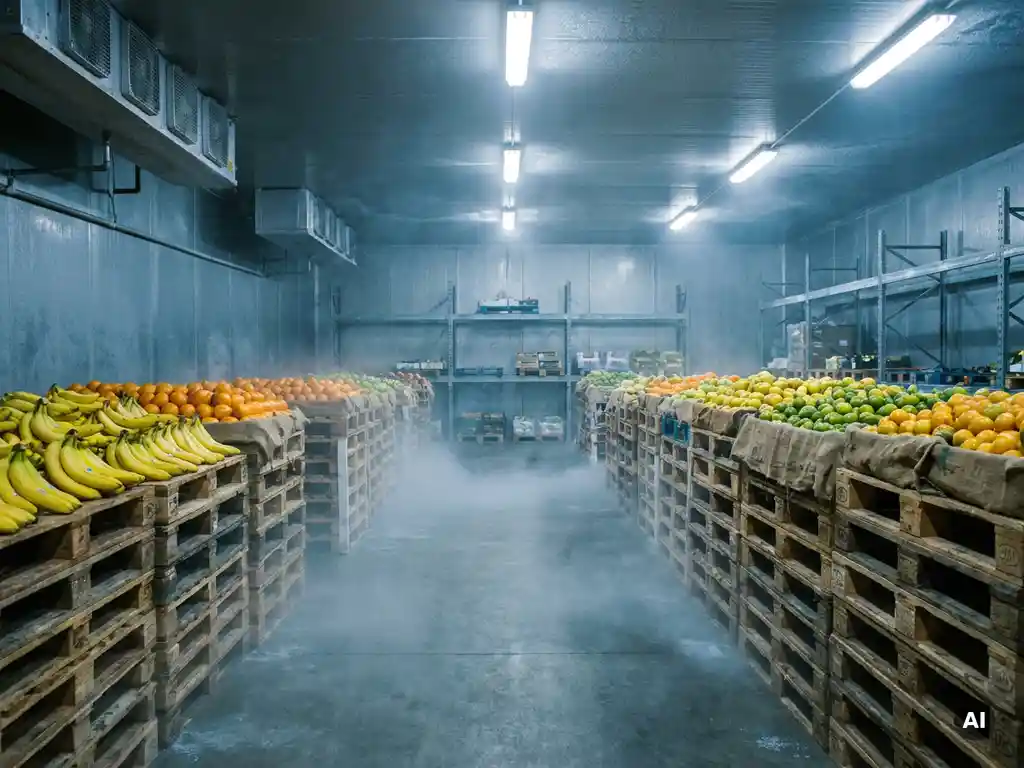
For products that must remain at a constant temperature, a climate-controlled storage space is the right choice. Renting this type of storage space offers the ability to accurately monitor and regulate temperature, humidity, and air circulation, ensuring that sensitive food products retain their quality. Whether it concerns dry storage at a fixed ambient temperature or refrigerated storage for fresh products, the specific requirements for each product determine which type of warehouse is most suitable. In this article, we answer the most important questions regarding temperature-controlled storage for food products.
What temperature is ideal for dry storage of food products?
For dry storage of food products, the ideal temperature is generally between 10 and 15 degrees Celsius, depending on the specific product. Nuts, peanuts, seeds, and other dry food products are preferably stored at approximately 11 degrees, where humidity must also remain low to prevent loss of quality and mold formation.
This so-called ambient or dry storage differs fundamentally from cold room temperatures, yet it still requires a controlled environment. Products stored at excessively high temperatures or under fluctuating conditions risk quality deterioration, premature spoilage, or damage caused by moisture. For B2B parties supplying food products to supermarkets or processing plants, a stable storage temperature is therefore not a minor detail, but a basic requirement.
In addition to temperature, ventilation plays an important role. Good air circulation prevents heat buildup and ensures a uniform temperature distribution throughout the entire warehouse, even with large pallet stocks.
What is the difference between dry storage and cold storage?
Dry storage, also known as ambient warehousing, stores products at a controlled room temperature without active cooling below freezing. Cold storage uses active cooling and maintains temperatures typically between 0 and 8 degrees Celsius, specifically intended for fresh or perishable products that deteriorate rapidly at higher temperatures.
The difference lies not only in the temperature range, but also in the technical installations and the requirements for the storage space:
- Dry storage: controlled ambient temperature, low humidity, good ventilation, suitable for nuts, seeds, grains, and dry food products
- Cold room storage: active cooling, precise temperature and humidity control, suitable for fresh fruit, vegetables, and other perishable products
For importers and wholesalers handling multiple product categories, it is important that a storage partner can offer both types. This allows shipments to be sorted immediately upon arrival and stored in the correct location without unnecessary loss of quality.
Which products require climate-controlled storage?
Climate-controlled storage is required for all products where temperature and humidity directly affect quality, shelf life, or food safety. This applies to fresh exotic fruits such as bananas and citrus fruits, but also to dry food products such as nuts, peanuts, and seeds, which are sensitive to moisture and temperature fluctuations.
Specifically, this concerns the following product categories:
- Exotic fruit: bananas, citrus fruits and other tropical products that ripen or must be stored at specific temperatures
- Nuts, peanuts, and seeds: sensitive to humidity and high temperatures, where mold and oxidation lurk
- Vegetables and other fresh products: require active refrigeration to inhibit bacterial growth
- Dry food products for further processing: such as raw materials for the food industry that must be stored at a constant ambient temperature
Products destined for supermarket chains or processing plants must meet strict quality standards upon arrival and during storage. Climate-controlled storage is not an option in that chain, but a requirement.
How does temperature monitoring work in a professional storage warehouse?
In a professional storage warehouse, temperature monitoring is implemented via automated measuring systems that continuously record temperature and humidity at multiple points in the warehouse. These systems store data, generate alarms in the event of deviations, and make it possible to adjust climate settings remotely.
Good temperature monitoring consists of multiple layers:
- Continuous measurement: sensors measure 24/7 at fixed intervals, so that deviations are detected immediately.
- Logging and traceability: measurement data is stored and retrievable per shipment or time period, which is essential for quality reporting and audits.
- Alerting: immediate action is taken upon exceeding set limit values, so that products are not unnecessarily exposed to unsuitable conditions.
- Integration with quality control: upon arrival, products are checked for temperature and humidity, among other things, so that deviations in the chain are detected before products are stored.
For B2B partners who need to be able to demonstrate that their products have been stored under the correct conditions, detailed temperature logging is a requirement. This certainly applies to deliveries to supermarket chains or export shipments to markets with strict import requirements.
When is certified storage mandatory for food products?
Certified storage is mandatory as soon as food products are stored, transshipped, or processed in a professional logistics environment where food safety, traceability, and hygiene must be legally guaranteed. In practice, this is the case for virtually all B2B flows of food products destined for the European market.
Relevant certifications in the Dutch and European context include:
- BRC (British Retail Consortium): an internationally recognized standard for food safety, required by many major supermarket chains as a condition for supplier admission.
- SKAL: mandatory for the storage and processing of organic products marketed as certified organic
- KCB/NVWA: the import inspection for fresh products from outside the EU, carried out by the Quality Control Bureau, is legally required for the import of fruit and vegetables.
- Demeter: relevant for products that meet biodynamic farming standards
Importers and suppliers delivering to processing plants or supermarket organizations are increasingly required to demonstrate that their entire chain, including storage, complies with these standards. In that case, a storage partner without the proper certifications can pose a risk to market admission.
What should you look out for when choosing a storage partner?
When choosing a storage partner for temperature-sensitive products, reliability, certification, and logistical flexibility are the three most important criteria. A partner who only rents out storage space without additional services offers less certainty than a partner who can handle the entire process from arrival to customs clearance.
Pay attention to the following points during the selection:
- Available certifications: check whether the partner holds BRC, SKAL, or other relevant certifications that meet your customers' requirements.
- Type of storage options: can the partner offer both dry and refrigerated storage, and are the settings flexible per product type?
- Location and accessibility: a warehouse near a port or in the Rotterdam-Antwerp corridor shortens the time between unloading and storage, which directly benefits product quality.
- Traceability: does the partner work with a system where every pallet is fully traceable via barcodes, LOT numbers, and digital reports?
- Additional services: think of quality control upon arrival, repalletizing, labeling, customs clearance, and EDI connections with your own systems.
- Flexibility: does the partner adapt to your sailing schedules, production rhythm, or fluctuating volumes?
In practice, a warehousing partner is an extension of your supply chain. The choice partly determines whether products reach their final destination in the quality your customers expect.
How ZZColdstores helps with temperature-controlled storage
ZZColdstores offers B2B logistics partners a complete solution for the storage of temperature-sensitive food products, from fresh exotic fruit to dry products such as nuts and seeds. With locations in Kruiningen and Vlissingen, its own quay in the Port of Vlissingen, and more than 25 years of experience in the industry, ZZColdstores combines speed, quality, and certification in a single logistics chain.
What ZZColdstores specifically offers:
- Climate-controlled cold storage with 24/7 temperature and humidity monitoring, tailored to the specific requirements of the product
- Dry storage at approximately 11 degrees with a capacity of 12,000 pallet spaces, with separate areas for nuts, peanuts, and seeds
- Full traceability via barcode systems linking grower and LOT numbers
- Quality control upon arrival, including temperature, humidity, and Brix measurements and QC reports
- Additional services such as repalletizing, labeling, box picking, and EDI connections
- Certifications: BRC, SKAL and Demeter
- Customs clearance and import inspection via KCB/NVWA
Would you like to know if ZZColdstores' climate-controlled storage aligns with your product requirements and logistics chain? Contact us and discuss the possibilities directly with a specialist.
Frequently Asked Questions
How long can dry food products such as nuts and seeds be safely stored under climate-controlled conditions?
The maximum storage duration depends heavily on the specific product, the packaging, and the conditions used. Nuts and seeds can generally be stored for several months to more than a year at a stable temperature of approximately 11 degrees and low humidity without significant loss of quality. Always consult the product-specific guidelines from the supplier or manufacturer and combine this with regular quality checks during the storage period.
What happens if the temperature in the warehouse temporarily falls outside the set limits?
In professional climate-controlled warehouses, automatic alarm systems are activated as soon as a temperature deviation is detected, after which the operational team intervenes immediately to remedy the cause. The extent of damage to the product depends on the duration and magnitude of the deviation and the type of product. Thanks to continuous logging, it is possible to reconstruct exactly how long and to what extent a product was exposed to abnormal conditions afterwards, which is essential for quality decisions and potential claim handling.
Can I store products with different temperature requirements with the same storage partner?
Yes, provided the storage partner has multiple separate storage zones with independently controllable climate settings. It is crucial that products with different temperature and humidity requirements are not stored in the same area, as this can affect the quality of both product groups. When selecting a partner, always ask about the specific zoning of the warehouse and the ability to adjust settings per product category.
How do I know for sure that my products meet EU import requirements upon arrival at the warehouse?
A storage partner with a certified quality control procedure upon arrival performs inspections immediately after unloading regarding temperature, humidity, appearance, and other product-specific parameters, and prepares a QC report. Additionally, for products from outside the EU, import inspection by KCB/NVWA is legally required; a partner offering this service in-house saves you time and reduces the risk of delays. Ensure that your storage partner provides you with complete documentation, including temperature logs and inspection reports, so that you can demonstrate at all times that your products comply with applicable EU standards.
What are the most common mistakes importers make when choosing a storage partner for temperature-sensitive products?
A common mistake is selecting a partner based purely on price, without verifying whether the necessary certifications and technical facilities are in place. Additionally, importers often underestimate the importance of location: a warehouse situated far from the port means longer transport times and, consequently, an increased temperature risk for the product. Finally, companies frequently forget to inquire about traceability systems and reporting capabilities, which are indispensable during audits by supermarket chains or for export shipments to markets with strict import requirements.
Is climate-controlled storage also suitable for small or fluctuating volumes, or is it only cost-effective for large shipments?
Climate-controlled storage is in principle available for a wide range of volumes, but the cost structure varies by provider. Some storage partners work with flexible rates based on the actual number of pallet spaces used, allowing smaller or seasonal volumes to be stored profitably as well. During the initial consultation, always discuss your expected volume variation with the storage partner so that agreements can be made that align with your sailing schedules and production rhythm.
How can I, as an importer, guarantee the traceability of my products throughout the entire storage period?
Full traceability starts with a storage partner that works with digital systems where every pallet is registered based on barcodes, LOT numbers, and grower information, linked to timestamps and climate data. Ensure that your partner can offer an EDI connection or similar digital integration with your own systems, so that you have real-time insight into the location and status of your inventory. When concluding a storage contract, explicitly ask about reporting capabilities and the retention period for logged data, especially if you need to comply with the traceability requirements of supermarket chains or European regulations.
Related articles
- Can you rent storage space for containers of food products that are delivered in installments?
- How is the temperature controlled during cold storage?
- Why is Zeeland a logical location for European food storage?
- What are the NVWA rules for import inspection of dried fruit in 2026?
- How does repalletization work and when is it necessary for bulk import?