
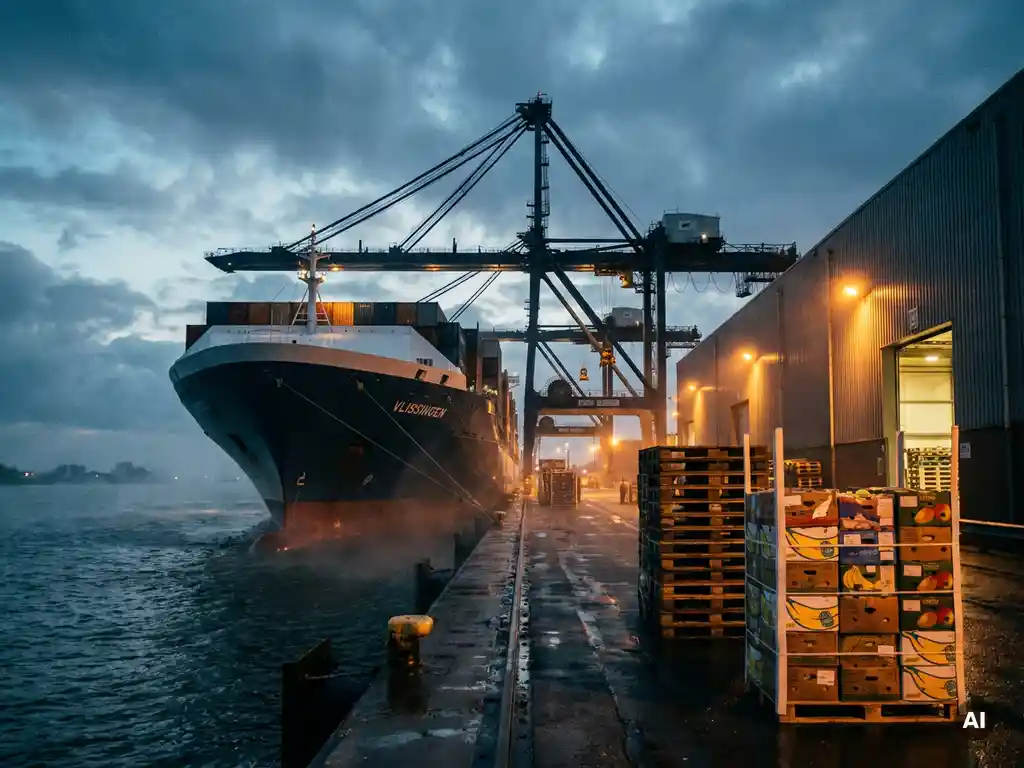
Zeeland is a logical location for European food storage thanks to direct port access, its strategic location between Rotterdam and Antwerp, and the availability of specialized cooling and storage facilities. For importers and logistics partners processing fresh food products from overseas markets, the region offers a combination of speed, infrastructure, and climate control that is difficult to match in other Dutch regions. The questions below elaborate on each aspect of this logistical added value.
What logistical advantages does the Port of Zeeland offer for food storage?
The port of Zeeland, and in particular the port of Vlissingen, offers a direct connection between seagoing vessel and cold storage facility. This means that unloading times are minimal and that temperature-sensitive products enter a controlled environment almost immediately upon arrival. For fresh food products, this speed is not a luxury, but a quality requirement.
The logistical benefits of cold storage in the Port of Vlissingen are concrete:
- Private quays directly adjacent to cold storage facilities, meaning the route from ship's hold to cooling takes only a few moments
- Fewer intermediate transport movements compared to ports where storage is located at a greater distance from the quay
- Flexible adjustment to the sailing schedule of arriving ships, even outside regular office hours
- Option for direct import inspection via KCB (part of the NVWA) and on-site customs clearance
For supply chain managers working with tight delivery windows, this distinction is crucial. Every extra handling step or extra kilometer of transport increases the risk of quality loss for fragile products such as exotic fruit.
Why is Zeeland strategically located for European distribution?
Zeeland is situated at the intersection of two of the world's largest container ports: Rotterdam and Antwerp. Both ports are easily accessible from Vlissingen and Kruiningen, and the region has direct connections to the European hinterland routes towards Germany, France, and beyond. This location makes Zeeland an efficient hub for European food storage and distribution.
What makes the Zeeland logistics location special is the combination of seaport access and proximity to major European consumer markets. Importers do not need to send their goods to a large transshipment point before they are distributed further. In many cases, the Zeeland location can function as the first link in the European distribution chain, which reduces transport costs and lead times.
Which products are most frequently stored in Zeeland cold storage facilities?
The cold storage facilities in Zeeland primarily store tropical and subtropical fruits imported by sea vessels from producing countries outside Europe. Bananas and citrus fruits are the most common product categories, but other types of exotic fruit are also stored here under temperature-controlled conditions.
In addition to refrigerated products, nuts, peanuts, and seeds are also stored in dry storage warehouses in the region. While these products do not require refrigeration, they do require a stable and dry climate to prevent loss of quality due to moisture or temperature fluctuations. Dry storage in the region is therefore a supplement to the refrigerated capacity, not a replacement for it.
How does cold storage in Zeeland differ from other Dutch regions?
Cold storage in Zeeland distinguishes itself from other Dutch regions due to the direct port ties of the facilities. Whereas inland cold storage facilities rely on road transport to move goods from the port to storage, Zeeland facilities can receive products directly from the quay. This eliminates a transport step that always poses a risk for fresh products.
In regions such as the Westland or the Randstad, cold storage is heavily focused on greenhouse horticulture and domestic agricultural production. Zeeland focuses more on the receipt and transit of imported food products, which places different demands on infrastructure, certification, and cooperation with customs and inspection services. Consequently, facilities in Zeeland are specifically designed for import and distribution logistics, not for the processing of domestic harvests.
What are the climate requirements for the storage of exotic fruit?
Exotic fruit places high demands on temperature, humidity, and air circulation during storage. The exact settings vary by product: bananas require a different storage temperature than citrus fruits, and the ripening phase of the product also determines the necessary climate. Temperature-controlled storage must therefore be flexibly adjustable and continuously monitored.
The most important climate parameters for the storage of exotic fruit are:
- Temperature: Depending on the product and the desired shelf life, often between 8 and 14 degrees Celsius for tropical fruit such as bananas.
- Humidity: Humidity that is too low causes dehydration and weight loss; humidity that is too high promotes mold formation.
- Air circulation: Even airflow prevents temperature differences within the storage area, which is essential for uniform product quality.
- Monitoring: Continuous monitoring of all parameters, preferably 24 hours a day and seven days a week, so that deviations are immediately detected and corrected.
For importers and wholesalers working with tight quality margins for supermarket chains, this level of climate control is no minor matter. A deviation of just a few degrees can lead to accelerated ripening, spoilage, or rejection during import inspection.
What role does Zeeland play in European food logistics?
Zeeland serves as a bridge in European food logistics: the region receives overseas cargo, processes it through storage, inspection, and customs clearance, and subsequently forwards the products to customers in Europe. This role is not new, but it is evolving along with the increasing demand for fresh exotic food products in European markets.
Over the years, the Port of Vlissingen has developed into a specialized hub for the import of tropical fruit. The presence of certified storage facilities (including BRC- and SKAL-certified cold storage facilities), combined with the possibility of on-site import inspections, makes Zeeland a fully-fledged first link in the European food chain. Shipping companies, freight forwarders, and importers consciously choose this region because the total lead time from arrival to distribution is shorter here than at locations where storage and inspection are geographically separated.
How ZZColdstores helps with food storage in Zeeland
ZZColdstores operates in Kruiningen and Vlissingen and offers specialized solutions for the storage of exotic fruit and other temperature-sensitive food products. As a B2B logistics partner with over 30 years of experience, ZZColdstores combines port-based locations with certified storage and full support with import inspections and customs clearance. Specifically, ZZColdstores offers:
- Climate-controlled cold storage with flexible settings per product group, monitored 24/7
- Own quay in Vlissingen for direct unloading without an extra transport step
- Dry storage capacity of 12,000 pallet spaces for nuts, peanuts, seeds, and other food products
- Support with import inspection via KCB and on-site customs clearance
- Certifications including BRC, SKAL, and Demeter, relevant for buyers in organic and conventional retail
Would you like to know if the Zeeland location suits your logistics needs? Contact ZZColdstores for a consultation with one of our specialists.
Frequently Asked Questions
How quickly can products be placed in the cold storage facility after arrival?
Thanks to the private quay in Vlissingen and the direct connection to the cold storage facilities, products can be placed in a temperature-controlled environment almost immediately after unloading. In practice, this means that the transition from the ship's hold to refrigerated storage takes only a few moments. For time-critical products such as ripe or nearly ripe exotic fruit, this speed is essential to prevent loss of quality.
What are the minimum storage volumes or periods for using cold storage services in Zeeland?
Minimum volumes and lead times vary by provider and product type. It is advisable to contact a logistics partner such as ZZColdstores directly to discuss your specific situation, as capacity planning depends on the season, the product, and the desired lead time. Many B2B partners offer flexible agreements that accommodate fluctuating import volumes.
Which certifications are required for the storage of organic food products in Zeeland?
For the storage of organic products, SKAL certification of the storage facility is a requirement, as this guarantees the integrity of the organic chain. In addition, certifications such as BRC and Demeter are relevant for customers in both organic and conventional retail. Always check whether the chosen facility holds the correct certifications that align with the requirements of your customers and the specific product category.
As an importer, can I fully outsource my customs clearance and import inspection to the warehousing partner?
Yes, specialized logistics partners in Zeeland offer support with both import inspections via the KCB (part of the NVWA) and customs clearance, and this can be handled entirely on-site. This saves importers significant time and coordination, as they do not have to liaise between different agencies or locations themselves. Discuss in advance which specific services the partner offers and which documentation you, as an importer, need to provide yourself.
What happens if the temperature in the cold room deviates from the set values during storage?
Professional cold storage facilities monitor all climate parameters 24 hours a day, seven days a week via automated monitoring systems that immediately generate an alarm in the event of deviations. In the event of a temperature deviation, technical personnel intervene immediately to prevent further damage. As an importer, it is advisable to inquire about the escalation protocol and the liability arrangements regarding potential quality damage when concluding a storage agreement.
Is cold storage in Zeeland also suitable for smaller importers, or is it primarily aimed at large volumes?
Although the Zeeland cold storage sector was originally focused on large-scale imports, there are facilities that also serve smaller or medium-sized importers with flexible storage capacity per pallet or per batch. The key is to contact a logistics partner early on to determine whether your volume and frequency fit within the available capacity and operational procedures. Smaller importers benefit just as much from the strategic location and the combined inspection and customs clearance services.
How does the process work if I want to distribute products from Zeeland to multiple European destinations?
From the Zeeland storage locations, products can be distributed directly to European customers via road transport after inspection and customs clearance, with direct connections to Germany, France, Belgium, and beyond. Many logistics partners in the region collaborate with freight forwarders and transport companies specializing in refrigerated road transport. It is advisable to coordinate the distribution planning with your storage partner before the shipment arrives, ensuring that transport capacity is available in time and the total lead time remains as short as possible.
Related articles
- How much does it cost to rent a cold room?
- How does seasonal supply affect storage planning for importers?
- What are the NVWA rules for import inspection of dried fruit in 2026?
- How does the supply of garlic from China via European ports work?
- How do you recognize insect infestation in stored nuts or garlic?