
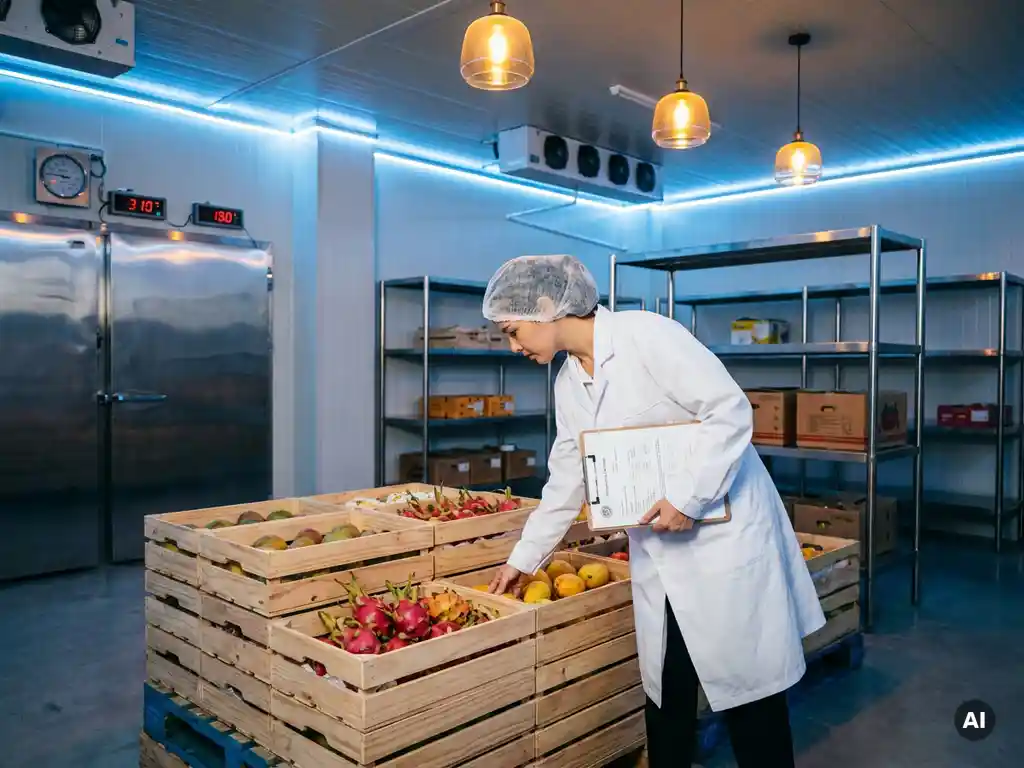
A warehouse that stores food products must comply with multiple certification requirements, for which HACCP principles form the legal basis. Depending on the type of product and the customers served by a storage partner, additional voluntary but in practice mandatory certifications apply, such as BRC, SKAL, or KCB/NVWA approval. Exactly which certificates are required depends on the product type, the sales market, and the requirements of purchasing organizations such as supermarket chains.
The questions below provide a clear answer per topic, so that you as a logistics manager or buyer can quickly assess what is relevant to your situation.
Which certifications are required for food storage in a warehouse?
Compliance with the General Food Regulation (EC 178/2002) and the application of HACCP principles based on the Hygiene Regulation (EC 852/2004) is legally required for every warehouse storing foodstuffs in the EU. This also applies to storage locations that do not produce themselves. Registration with the NVWA is also mandatory.
In addition to this legal basis, there are in practice a number of certifications that the market actually mandates:
- BRC Global Standard for Storage and Distribution, required by most British and European supermarket chains for their suppliers
- SKAL certification, mandatory when organic products are stored or skipped
- KCB/NVWA approval, required for the import inspection of fresh fruit and vegetables from outside the EU
- ISO 22000 or FSSC 22000, common in larger international supply chains as an alternative to or supplement to BRC
In practice, the combination of certificates a storage location requires is largely determined by customer requirements, not just by the law. A warehouse supplying the purchasing organization of a large supermarket chain will almost always need to be able to demonstrate BRC certification.
What does the BRC certification for storage and distribution entail?
The BRC Global Standard for Storage and Distribution is an international food safety standard that sets requirements for the management system, the physical storage environment, hygiene, traceability, and risk management in the logistics chain. A warehouse holding this certification has demonstrated that it works systematically and demonstrably on food safety.
The standard has multiple levels, from a basic level to a higher level for companies that perform more complex operations. Specifically, BRC sets requirements for:
- Documentation and internal audits of the food safety management system
- Hygiene of employees, rooms, and materials
- Damage prevention and pest control
- Temperature control and recording for climate-sensitive products
- Traceability of batches via LOT numbers and supplier registration
- Procedures for handling non-conforming products
An external, accredited auditor checks annually whether the warehouse meets all requirements. Upon a successful audit, the company receives a certificate valid for twelve months. Supermarket purchasing organizations often use BRC status as a strict condition when selecting a storage partner.
When is SKAL certification required for a storage location?
SKAL certification is required as soon as a storage location stores, transships, or otherwise handles organic products. This also applies when the warehouse itself does not produce organic products but functions solely as a link in the chain. Without SKAL certification, organic products may not be traded as organic after they have left the storage location.
SKAL Biocontrole is the Dutch control body that monitors compliance with the European Organic Production Regulation (EU 2018/848). A storage location must demonstrate that organic batches are stored separately from conventional products and that there is no risk of mixing. Annual inspections and records providing full insight into the origin and flow of organic batches are necessary for this.
Demeter-certified products fall under a supplementary standard for biodynamic agriculture. A warehouse that also wishes to store Demeter products requires Demeter accreditation in addition to SKAL.
What are the requirements for temperature-controlled storage of food?
For temperature-controlled storage of foodstuffs, requirements apply regarding technical management, monitoring, and recording. The storage area must be capable of continuously maintaining the required temperature, even with varying outdoor temperatures or fluctuating occupancy rates. Continuous recording and alerting in the event of deviations are mandatory in this regard.
The specific temperature limits depend on the product type. Different ranges apply to fresh fruit and vegetables than to frozen products. What is required in any case from a legal and technical standards perspective is:
- Continuous temperature monitoring with calibrated sensors at multiple points in the storage area
- Registration and archiving of temperature data, minimally traceable per batch
- Alerting upon exceeding the set limit values, even outside office hours
- Validation of the cooling system to demonstrate that the desired temperature is consistently achieved
- Procedures for deviations, including decision criteria for assessing products after a temperature exceedance
For dry storage at a constant temperature, such as approximately 11 degrees for certain food products, similar requirements apply to monitoring and recording, even though active cooling in the conventional sense is not required. Control of environmental conditions remains a core requirement for food safety.
How does dry storage certification differ from cold storage certification?
The fundamental difference is that cold storage certification imposes additional technical requirements on active temperature control, whereas dry storage primarily has requirements regarding humidity control, pest prevention, and separation of product streams. Both types of storage fall under the same basic food safety standards, but the practical implementation differs.
In cold storage certification, the emphasis is on:
- Demonstrable control of a specific temperature range
- Validation and calibration of refrigeration systems
- Loading and unloading procedures to prevent temperature fluctuations
- Specific requirements for products with a short shelf life
In dry storage, also known as ambient storage , the emphasis is on preventing humidity and temperature fluctuations that cause quality loss, without the need for active cooling. Products such as nuts, seeds, and dried fruit require a stable, dry environment but not a refrigerated cell. The BRC standard also makes this distinction: there are separate modules for refrigerated and non-refrigerated storage, with corresponding audit criteria.
How long does it take to obtain a food safety certification?
Obtaining a food safety certification such as BRC takes an average of six to twelve months for a warehouse that does not yet have a formal management system. This is the time required to build the system, test it internally, and collect sufficient records before an external audit makes sense.
The lead time depends on several factors:
- Starting position: a warehouse that already works with HACCP documentation and internal audits has a shorter lead time than a location starting from scratch.
- Complexity of the operation: more product types, more temperature zones, and more operations require more extensive documentation.
- Availability of internal capacity: setting up a food safety management system requires time from employees who are also operationally active.
- Scheduling of the external audit: accredited certification bodies sometimes have a waiting time of several weeks to months.
SKAL certification has a comparable lead time but also requires an application procedure with SKAL Biocontrole itself, which entails some administrative processing time. KCB/NVWA approval depends on an on-site inspection and the specific product categories for which approval is requested.
What do supermarkets and purchasing organizations ask of a storage partner?
Supermarkets and their purchasing organizations primarily set requirements for a storage partner regarding demonstrable food safety, traceability, and reliability. For most large retailers, a valid BRC certification is a strict requirement, not a nice-to-have. Additionally, they request specific operational guarantees that align with their supply chain requirements.
In practice, purchasing organizations assess a storage partner on the following points:
- Certification status: BRC, SKAL, KCB/NVWA or equivalent standards, with current audit reports
- Traceability: can batches be fully traced back via LOT numbers and grower information?
- Quality control upon receipt: are shipments checked upon arrival for damage, labeling, and product condition?
- Temperature and climate recording: is historical data available per batch and per storage period?
- Incident management: what are the procedures for a non-conforming batch or a temperature deviation?
- System connection: is EDI integration possible for automatic inventory and status updates?
Suppliers who deliver directly to a supermarket's purchasing organization are also audited themselves. They must be able to demonstrate that their storage partner meets the same standards as they do. This makes the choice of a certified storage location part of their own compliance responsibility.
How ZZColdstores helps with food storage certification requirements
ZZColdstores holds the certifications that purchasing organizations of supermarkets and processing plants expect from a storage partner: BRC, SKAL, and Demeter, supplemented by KCB/NVWA approval for import inspections of fresh fruit and vegetables. As a result, the location meets the requirements applicable to both refrigerated and dry storage of food products.
Specifically, ZZColdstores offers:
- Certified dry storage (ambient) for nuts, seeds, peanuts, and similar products in a stable storage environment
- Quality control upon arrival, including temperature, humidity, and Brix measurements and full QC reporting
- Barcode-driven traceability via LOT and grower numbers, connectable to your systems via EDI
- Procedures for non-conforming parties, so that your supply chain demonstrably meets the requirements of your customers
- Locations in Kruiningen and Vlissingen, strategically located in the Rotterdam-Antwerp corridor
Would you like to know whether ambient storage facilities meet your certification requirements or those of your customers? Contact ZZColdstores for a concrete discussion about your situation.
Frequently Asked Questions
Can a storage partner manage multiple certifications simultaneously, and how does that work in practice?
Yes, most professional warehouses combine multiple certifications, such as BRC, SKAL, and KCB/NVWA, within a single management system. In practice, the requirements of the various standards are integrated as much as possible into one food safety management system, so that documentation, internal audits, and procedures reinforce each other rather than duplicate. However, it is important to keep track of the specific audit cycles and reporting obligations for each certification, as each certifying body applies its own scheme and requirements.
What are the most common mistakes warehouses make when preparing for a BRC audit?
A common mistake is underestimating the documentation burden: BRC requires not only that procedures exist, but also that they are demonstrably complied with through records and internal audit reports. Additionally, auditors regularly observe that temperature data is stored but not analyzed for trends or deviations. A third pitfall is insufficient training of employees on the shop floor: the management system may be correct on paper, but if operators do not know or apply the procedures, this immediately results in findings during an audit.
What happens if a storage partner loses its certification or is temporarily suspended?
If a warehouse loses its BRC or SKAL certification, this has direct consequences for the suppliers using that location: they can no longer demonstrate that their supply chain meets the required standards, which can lead to contractual issues with their customers. It is therefore advisable to inquire about the audit history and any previous non-conformities when selecting a storage partner, and to contractually stipulate what happens in the event of loss of certification. Also, regularly check the current certification status via the public registers of the relevant certifying bodies.
How can I, as a buyer or logistics manager, quickly verify whether a warehousing partner is actually certified?
BRC certifications can be verified via the public BRCGS Directory on the BRCGS website, where you can view the current certificate status, audit result, and validity. SKAL certifications can be checked via the public register on the SKAL Biocontrole website. For KCB/NVWA approvals, you can inquire with the NVWA itself or ask the storage partner to show the current approval document. Always ask for the most recent audit report, not just the certificate, so that you also gain insight into any areas for attention or points for improvement.
Are there specific certification requirements for the storage of nuts, seeds, and dried fruit that differ from other dry products?
Nuts, seeds, and dried fruit fall under the regular BRC standard for dry storage, but in practice require extra attention regarding moisture control, aflatoxin risks, and pest prevention due to their susceptibility to mold growth and insect infestations. Depending on the origin of the products, a KCB/NVWA import inspection may also be required. Furthermore, supermarket purchasing organizations often impose additional requirements for sampling and laboratory analyses upon receipt for these product categories, which the storage partner must be able to facilitate.
What does it cost on average to make a warehouse BRC-certified, and what are the recurring costs?
The initial costs for BRC certification consist of the establishment of the management system (internally or with external consultancy), the external audit costs of the certifying body, and any investments in physical modifications to the storage location. Depending on the complexity of the operation and the starting position, initial costs range from a few thousand to tens of thousands of euros. Annual recurring costs consist primarily of the re-audit costs of the certifying body and the internal capacity for maintaining the system, records, and internal audits.
What is the difference between a BRC certification and an ISO 22000 or FSSC 22000 certification, and which one should I choose?
BRC is a retail-driven standard that is widely accepted by European and British supermarket chains and is specifically designed for warehousing and distribution, whereas ISO 22000 and FSSC 22000 are broader management system standards that are more common in international industrial supply chains. The choice depends primarily on the requirements of your customers: if you supply or store for parties that supply large supermarket chains, BRC is almost always the required standard. In sectors where large food manufacturers or international retailers set the tone, FSSC 22000 may be preferred or even required alongside BRC.
Related articles
- Which temperature zones are possible in cold storage?
- When does a wholesaler need extra refrigerated storage space?
- Why do Ukrainian buyers choose storage via Dutch ports?
- How does import inspection via the KCB and NVWA work in the Netherlands?
- What is the difference between refrigerated storage and dry storage?