
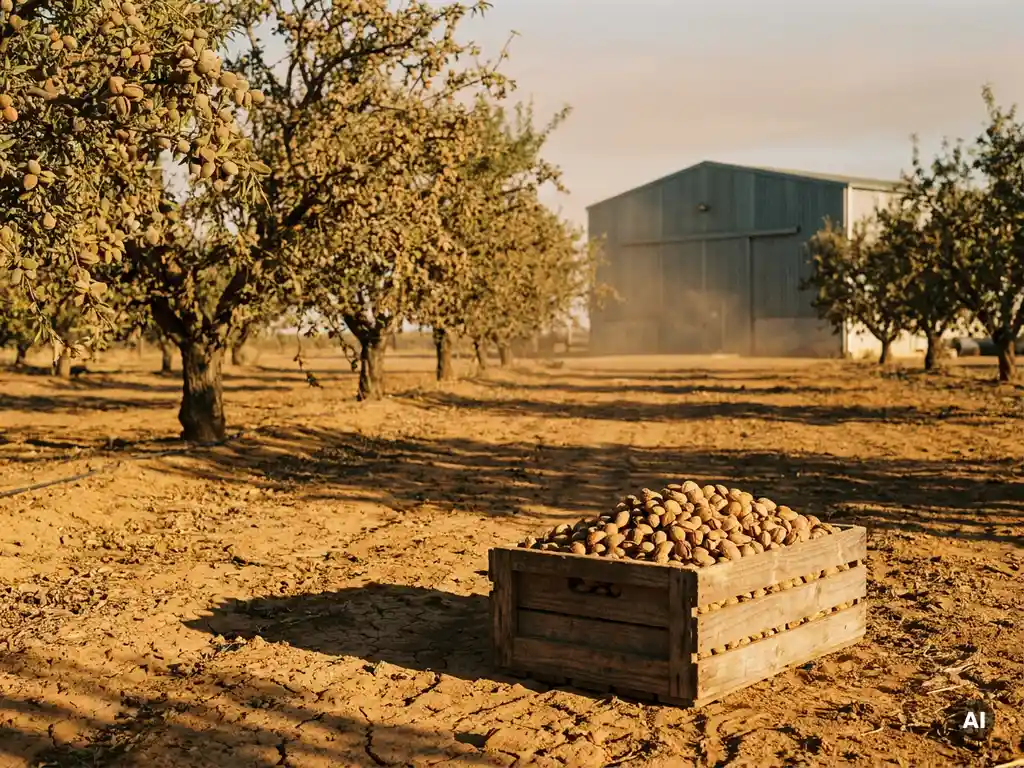
Harvest variation in South Africa directly influences almond purchasing planning: a disappointing season leads to shortages on the European market, higher purchase prices, and longer delivery times. For buyers dependent on a stable supply, it is therefore essential to anticipate production signals early in the season. This article answers the most frequently asked questions regarding harvest variation, pricing, alternative origins, and the role of dry storage in a robust almond supply chain.
What are the main causes of yield variation in almonds in South Africa?
Almond yield variation in South Africa is primarily caused by weather conditions during the flowering period, water availability, and the condition of pollinating bee colonies. These three factors largely determine the yield of almonds per hectare and have a different impact each season.
South Africa is considered a relatively young almond producer, with most orchards concentrated in the Western Cape region. That region is susceptible to drought, which has become a structural bottleneck in recent years. Insufficient irrigation water in the run-up to flowering weakens the trees and significantly reduces the yield per tree.
In addition, the flowering time is critical: almond trees bloom early in the year, when night frost or unexpected rainfall can disrupt pollination. Almonds are self-sterile, which means that cross-pollination by bees is necessary. If bee colonies are less active due to disease or bad weather conditions, fruit set drops immediately.
Finally, planting age and orchard management also play a role. Young plantings in new areas do not yet produce at full capacity, while older trees are more prone to failure during prolonged drought. This makes the South African almond harvest structurally less predictable than that of established production regions such as California or Australia.
How significant are the price fluctuations for almonds due to poor harvest years?
The price of almonds can rise by tens of percent in a short time in the event of a significant setback in the South African harvest, depending on the size of the shortage and how quickly alternative sources can replenish the market. Consequently, price variation for almonds is greater than for many other nuts, partly due to the limited global production base.
California is responsible for the vast majority of global almond production. When a disappointing season there coincides with a poor South African harvest, the two shortages reinforce each other on the world market. European buyers then notice this almost immediately in spot prices.
For buyers working without a stock buffer, the impact of a poor almond harvest in South Africa is particularly significant. Those who have not entered into contracts or do not maintain a strategic stock pay the highest price at a time when the market is already tight. Consequently, almond price variation is not only a purchasing risk but also a logistical planning issue.
When should a buyer respond to signals of a disappointing harvest?
A buyer must respond to the first reliable harvest forecasts, typically two to three months before the actual harvest begins. For the almond harvest in South Africa, which takes place between February and April, this means that signals from November and December already warrant adjusting the purchasing strategy.
The most relevant signals to look out for are:
- Official harvest forecasts of the South African Almond Industry Association
- Weather reports and drought indicators in the Western Cape region during the summer
- Price movements on the almond futures market
- Messages from regular suppliers regarding expected availability and delivery times
- Signals regarding bee colony health in the production areas
Those who wait too long risk the available batches already being bought up by competitors or the price having risen sharply. Acting early provides room to activate alternative sources or purchase additional stock under still acceptable conditions.
Which alternative sources bridge a shortage of South African almonds?
In the event of a shortage of South African almonds, California, Australia, and Spain are the most logical alternative sources for European buyers. Each of these regions has its own harvest time and quality profile, allowing them to offer a reasonably stable supply throughout the year when combined.
The harvest times vary, which allows for strategic diversification:
- California harvests between August and October and is the largest global producer. Californian almonds are widely available in Europe, but are more expensive from a logistical perspective due to the longer transport route.
- Australia harvests between March and May, partially overlapping with the South African season. Australian almonds are comparable in quality and are increasingly being used as an alternative on the European market.
- Spain harvests in August and September. Spanish almonds are geographically close and therefore attractive to European buyers, although the volume is smaller than that of the other production regions.
A robust almond supply chain ideally combines multiple origins so that a setback in one region does not immediately lead to delivery problems. However, this requires the buyer to conclude contracts in a timely manner and have sufficient storage capacity available to bridge batches from different seasons.
How does temperature-controlled dry storage help absorb harvest fluctuations?
Temperature-controlled dry storage enables buyers to purchase almonds when price and availability are favorable, and then maintain their quality for months. This is the most direct way to limit the impact of harvest fluctuations on the supply chain.
By building up a strategic inventory during periods of abundant supply, a buyer does not need to react to the spot market when there is a shortage. This provides not only a price advantage but also security of supply to processing plants and supermarket purchasing organizations, which typically have little tolerance for supply interruptions.
Dry storage for almonds does not require active refrigeration, but it does require a stable, controlled environment. Excessive temperature or fluctuating humidity accelerates oxidation and affects taste and shelf life. Properly designed ambient storage for nuts offers this stability without the costs of refrigerated storage, making almond storage cost-efficient.
What are the storage requirements for almonds to prevent loss of quality?
Almonds must be stored at a temperature between 10 and 15 degrees Celsius, with a relative humidity of no more than 65 percent, and in an environment free from odor or taste contamination. Deviation from these conditions results in oxidation, which leads to a rancid taste and a shorter shelf life.
The most important storage requirements for almonds at a glance:
- Temperature: stable between 10 and 15 degrees Celsius, without major fluctuations
- Humidity: maximum 65 percent relative humidity to prevent mold formation
- Air circulation: sufficient ventilation to avoid moisture accumulation in pallets
- Separation of odors: almonds easily absorb foreign odors; storage next to strongly scented products is not recommended.
- Hygiene: a clean, pest-free environment is a basic requirement, especially for BRC-certified storage.
For long-term storage, ranging from several months to a year, it is advisable to have a quality control performed upon arrival. This way, batches with abnormal moisture levels or damaged packaging are immediately identified before they can affect the rest of the stock.
How ZZColdstores helps with almond storage
ZZColdstores offers specifically designed ambient storage for dry food products such as almonds, nuts, and seeds. The storage facilities in Kruiningen are designed for a stable, dry, and clean storage environment, tailored to the quality requirements of food products that do not require active refrigeration but are sensitive to temperature and humidity fluctuations.
What ZZColdstores specifically offers for buyers and supply chain managers:
- Ambient storage at approximately 11 degrees Celsius, ideal for storing almonds and other nuts
- Capacity of 12,000 pallet spaces in the dry storage warehouse, with separate areas per product category
- Quality control upon arrival, including inspection for damage, packaging deviations, and moisture measurements
- Barcode-driven traceability per pallet, including linking of LOT numbers and origin data
- EDI connections for automatic order processing, inventory updates, and inbound notifications
- BRC, SKAL, and Demeter certifications, ensuring storage meets the requirements of processing plants and supermarket purchasing organizations
Would you like to know how ZZColdstores can support your almond purchasing planning with flexible storage capacity? Contact our team for a no-obligation discussion about the possibilities.
Frequently Asked Questions
How long do almonds keep when stored correctly in an ambient environment?
Under optimal storage conditions — a stable temperature between 10 and 15 degrees Celsius and a relative humidity of no more than 65 percent — almonds typically have a shelf life of 12 to 18 months without significant loss of quality. This makes it possible to store batches from a favorable season long enough to bridge a subsequent shortage season. However, it is advisable to carry out periodic quality checks during long-term storage to detect oxidation or moisture absorption early.
What are common mistakes when building a strategic almond stock?
A common mistake is entering the market too late: by the time a poor harvest is widely known, prices have already risen and the best lots have been bought up. Another pitfall is underestimating storage requirements — almonds stored in an environment that is too warm or too humid lose quality quickly, negating cost savings. Finally, buyers sometimes forget to have a quality check performed upon arrival, meaning a defective batch is only discovered late in the chain.
Is it worthwhile to enter into futures contracts for almonds, and when is the best time to do so?
Forward contracts are an effective instrument for limiting price risks and guaranteeing security of supply, especially for buyers with predictable and structural demand for almonds. The best time to enter into contracts is before harvest forecasts are widely published — so for South African almonds, ideally as early as November or December. At that time, market information is still limited, and suppliers are willing to offer sharper prices and more favorable delivery terms than later in the season.
How do I combine multiple origins in my supply chain without making the logistics too complex?
The key is to define clear purchasing windows per origin that align with harvest times: California in the autumn, Australia and South Africa in the spring, and Spain in the summer. By bringing together batches from different seasons in a single central storage location with good traceability per pallet and origin, logistics remain manageable. A logistics service provider with EDI connections and barcode-driven inventory tracking helps maintain an overview of batches with different LOT numbers and purchasing dates.
Which certifications are important when choosing a storage partner for almonds?
For buyers supplying almonds to processing plants or supermarket purchasing organizations, BRC (British Retail Consortium) and FSSC 22000 are the most requested certifications, as they demonstrate that the storage environment meets strict food safety standards. Additionally, those purchasing organic almonds require a SKAL-certified storage location to maintain the organic status of the batch. The lack of the correct certification at the storage partner can lead to rejection during audits or the loss of organic certification for the batch itself.
As a buyer, how do I notice early on that my almond batch is deteriorating in quality during storage?
The first signs of quality deterioration in almonds are a slightly rancid or greasy odor, discolored or grainy surfaces, and elevated moisture levels upon measurement. A good storage partner performs periodic inspections and reports deviations proactively, allowing you to decide in a timely manner whether to process or sell a batch early. Always ensure that the moisture content of the batch is measured upon arrival: almonds with a moisture content above 6 percent are more susceptible to mold and oxidation during long-term storage.
What is the difference between ambient storage and refrigerated storage for almonds, and when do you choose which option?
Ambient storage at approximately 10 to 15 degrees Celsius is sufficient for most almond batches and significantly more cost-effective than active cooling. Refrigerated storage below 5 degrees Celsius is only recommended for very long-term storage of more than 18 months, or when the batch already has an elevated moisture content upon arrival. For most buyers working with a turnover rate of 6 to 12 months, well-designed ambient storage is the most practical and cost-effective choice.
Related articles
- How do you prevent a break in the cold chain during storage?
- What data is recorded during the storage of foodstuffs?
- How does warehousing work after the arrival of a sea container?
- What are the NVWA rules for import inspection of dried fruit in 2026?
- Why do supermarket suppliers opt for external buffer storage in Europe?