
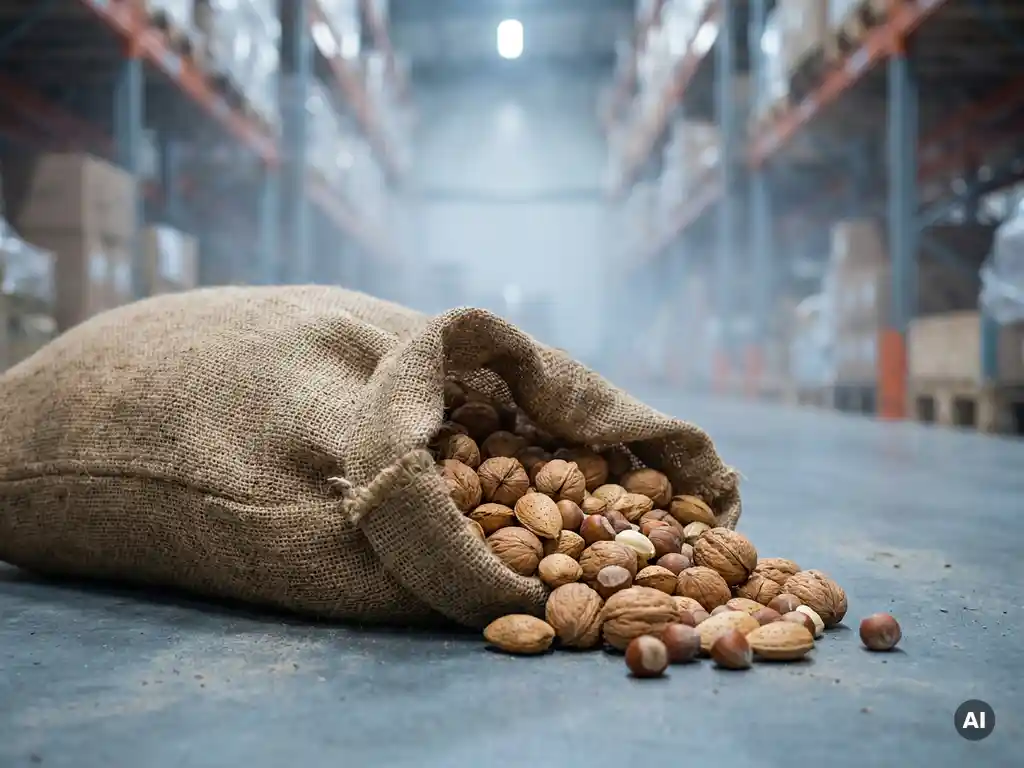
Conditioned storage is significantly better for nuts than a standard uncooled warehouse, because nuts are extremely sensitive to moisture, heat, and exposure to oxygen. In a standard warehouse without climate control, nuts age quickly: fats oxidize, mold thrives, and shelf life decreases sharply. For importers and wholesalers who want to limit quality loss and food safety risks, climate-controlled storage is not a luxury but a logistical necessity. This article answers the most frequently asked questions about nut storage, from risks in a standard warehouse to certifications and the choice between different storage types.
What happens to nuts in an ordinary uncooled warehouse?
In an ordinary, uncooled warehouse, nuts quickly lose quality due to uncontrolled temperature and humidity. The fats in nuts are susceptible to oxidation, which leads to rancidity. High humidity promotes mold growth, including potentially harmful mycotoxins. Condensation occurs during temperature fluctuations, which further accelerates spoilage.
In concrete terms, this means that batches stored in a standard warehouse have a shorter shelf life and run a higher risk of rejection during food safety inspections. For an importer or wholesaler, this translates directly into financial loss: rejected batches, customer complaints, and reputational damage. An uncooled warehouse is suitable for products that are not very sensitive to environmental influences, but nuts simply do not fall into that category.
Which climatic factors are critical for the storage of nuts?
The three most critical climate factors for nut storage are temperature, humidity, and air circulation. Each of these factors directly influences the chemical and microbiological processes that cause quality loss. Without active control of these variables, long-term storage of nuts without quality loss is virtually impossible.
- Temperature: Higher temperatures accelerate the oxidation of fats and promote the growth of fungi and bacteria. Cooler and stable temperatures significantly slow down these processes.
- Relative humidity: Humidity that is too high (above approximately 65%) increases the risk of mold formation and clumping. Humidity that is too low can lead to drying out and weight loss.
- Air circulation: Good ventilation prevents moisture buildup in specific areas of the storage space and ensures an even temperature distribution throughout the entire batch.
- Light exposure: Direct exposure to light, particularly UV light, accelerates oxidation. Storage areas without daylight are preferred.
For professional nut storage, it is therefore essential that these factors are continuously measured and adjusted, not just checked periodically.
How does conditioned storage for dry food products work?
Conditioned storage, also known as climate-controlled or ambient-controlled storage, maintains the storage space at a constant, preset temperature and humidity. For dry food products such as nuts, peanuts, and seeds, this means that ambient conditions are closely monitored and automatically adjusted, without the products being cooled to freezing temperatures.
In practice, this works via a combination of automated climate control systems, sensors, and monitoring systems that are active 24 hours a day. The settings are tailored to the specific product: nuts require different conditions than, for example, dried fruit. Pallets are positioned so that air circulation around the load is optimal. By keeping conditions stable, the chemical processes that cause spoilage are slowed down without exposing the products to extreme cold, which can affect the texture of some nuts.
What is the difference between cold storage and dry conditioned storage for nuts?
The main difference is the temperature range. Cold storage operates at temperatures between approximately 0 and 8 degrees Celsius and is intended for fresh, perishable products such as exotic fruit. Dry conditioned storage for nuts operates at higher, but still controlled temperatures, typically between 10 and 18 degrees Celsius, combined with strictly regulated humidity.
Nuts are dry products and cannot tolerate environments that are too cold or too humid. Cold storage at low temperatures can cause condensation when products are moved to a warmer area, which promotes mold growth. Dry conditioned storage offers the right balance: cool enough to slow down oxidation and spoilage, but without the risks associated with storage temperatures intended for fresh products. It is therefore important for importers to choose a storage method specifically tailored to dry food products.
How much longer do nuts remain fresh in conditioned storage?
Nuts stored under controlled conditions remain edible significantly longer than nuts in a standard warehouse. The exact gain in shelf life depends on the type of nut, the initial quality upon arrival, and the specific climate settings, but in general, controlled storage can double or more the shelf life compared to uncontrolled conditions.
Walnuts and pecans, which contain relatively high levels of polyunsaturated fats, are the most susceptible to oxidation and benefit most from climate control. Almonds and hazelnuts are slightly more stable but still react noticeably to temperature and humidity fluctuations. The gain in quality is visible not only in a longer shelf life but also in the preservation of taste, aroma, and texture—factors of direct importance to professional customers in the food industry.
Which certifications and food safety requirements apply to nut storage?
Strict food safety requirements, laid down in national and international standards, apply to the professional storage of nuts. The most relevant certification for storage companies in the food sector is the BRC Global Standard for Storage and Distribution, an internationally recognized standard that sets requirements for hygiene, temperature control, traceability, and risk management.
- BRC certification: Assesses the entire supply chain for food safety, from receiving to delivery, and is a requirement of many major food producers and retailers.
- SKAL certification: Relevant for parties storing organic nuts. SKAL verifies whether organic and conventional products are stored separately and whether the supply chain is demonstrably organic.
- NVWA supervision: The Netherlands Food and Consumer Product Safety Authority (NVWA) supervises food safety in the supply chain. Import inspections for products from outside the EU are carried out by the KCB, a division of the NVWA.
- Traceability requirements: European legislation (EU 178/2002) requires all links in the food chain to ensure full traceability: every batch must be traceable to its origin and destination.
A storage location without the proper certifications poses a risk to the entire supply chain. Customers in the food industry typically require demonstrable compliance with these standards as a condition for cooperation.
When is conditioned storage the right choice for a nut importer?
Conditioned storage is the right choice whenever an importer faces storage periods of more than a few weeks, large batch volumes, or customers requiring food safety certification of the supply chain. For short-term transit without quality requirements, a standard warehouse may suffice, but in the professional nut trade, this is the exception rather than the rule.
Specific situations where conditioned storage is indispensable include seasonal purchasing where large volumes are stored for extended periods, imports from tropical countries where products have already been exposed to heat during transport, and deliveries to processing plants or retailers with strict quality and traceability requirements. Furthermore, when nuts are stored together with other dry food products such as peanuts or seeds, climate control is essential to prevent cross-contamination and loss of quality throughout the entire storage area.
How ZZColdstores helps with conditioned nut storage
ZZColdstores offers temperature-controlled dry storage specifically designed for food products such as nuts, peanuts, and seeds. From locations in Kruiningen and Vlissingen, ZZColdstores manages the entire storage chain, from receiving and import inspection to storage and loading. This makes it a full-fledged partner for importers and wholesalers looking to streamline their logistics without compromising on quality or food safety.
What sets ZZColdstores apart for nut storage:
- Climate-controlled dry storage for nuts with a capacity of 12,000 pallet spaces, with separate areas for nuts, peanuts, and seeds.
- BRC, SKAL, and Demeter certified, which meets the requirements of professional customers in the food industry
- Import inspection via the KCB (part of the NVWA) and customs clearance as an integrated service
- Flexible storage tailored to the customer's supply schedule, also for large seasonal batches
Would you like to know if temperature-controlled storage at ZZColdstores suits your logistics situation? Contact ZZColdstores for a no-obligation discussion about the possibilities.
Author: Frans van der Maas, Operations Director ZZColdstores
Frequently Asked Questions
How do I measure if my current storage location is sufficiently climate-controlled for nuts?
Have continuous measurements of temperature and relative humidity performed over a minimum of two to four weeks, preferably across different seasons. Data loggers can be used for this purpose and provide insight into fluctuations that remain invisible during a visual inspection. Compare the measured values with the recommended storage conditions for your specific type of nut: if the temperature regularly exceeds 18°C or the humidity exceeds 65%, your current location is unsuitable for professional nut storage.
What are the most common mistakes importers make when storing nuts?
A common mistake is storing nuts immediately upon arrival without sufficient acclimatization, which causes condensation to form on the packaging and promotes mold growth. Additionally, pallet spacing is frequently underestimated: pallets stacked too closely together block air circulation, creating warm or damp spots within the batch. A third mistake is mixing nut varieties with significantly different moisture sensitivities in the same storage area without climate zoning.
Can I also store nuts in a cold room if conditioned dry storage is not available?
This is not recommended as a structural solution. A standard cold room is set to temperatures intended for fresh products and typically has higher humidity than is desirable for dry nuts. When nuts are subsequently moved to a warmer room, condensation forms on the packaging, which promotes mold growth. As a temporary emergency solution for a short period, it may suffice in some cases, but for storage periods of more than a few days, conditioned dry storage is the only responsible choice.
As an importer, how can I demonstrate to my customers that my nuts are stored correctly?
Choose a storage partner that works with continuous monitoring and digital recording of climate conditions, so that you can provide a temperature and humidity log for each batch. Certifications such as BRC and SKAL offer buyers independent confirmation that the storage chain complies with recognized food safety standards. Combine this with full traceability documentation in accordance with EU Regulation 178/2002, so that you can demonstrate for every batch where the nuts came from, how they were stored, and to which buyer they went.
Does it matter whether nuts are stored in bulk or in packaged form for the climate settings?
Yes, the packaging type influences the optimal climate settings and risk profiles. Nuts in closed, vacuum packaging or in a modified atmosphere are better protected against oxidation and humidity fluctuations than nuts in open big bags or jute sacks. Bulk or loose nuts require more precise climate control and better air circulation around the load. Always discuss the packaging type with your storage partner so that the pallet arrangement and climate settings can be tailored accordingly.
Which types of nuts are most critical to store under controlled conditions and why?
Walnuts and pecans top the list due to their high content of polyunsaturated fats, which are particularly susceptible to oxidation and quickly become rancid under unfavorable conditions. Pine nuts and macadamia nuts are also very sensitive and have a relatively short shelf life without climate control. Almonds and cashews are slightly more stable, but still clearly benefit from conditioned storage for storage periods of more than six weeks. As a rule of thumb: the higher the fat content and the longer the intended storage period, the greater the need for climate-controlled storage.
How do I start the transition from regular warehouse storage to temperature-controlled storage for my nut batches?
Start by taking stock of your current storage volumes, storage periods per nut variety, and the quality requirements of your key customers. Based on this, you can determine the capacity and type of temperature-controlled storage you need. Next, contact a specialized storage partner with experience in dry food products and the necessary certifications, so that you can integrate not only storage but also import inspection and logistics into a single partnership. A no-obligation consultation with a specialist will help you quickly gain insight into the concrete steps and costs.
Related articles
- When is external warehousing beneficial for food producers?
- Which checks are important when storing imported food products?
- How does packaging quality affect the shelf life of dried fruit?
- What are the consequences of aflatoxin in poorly stored peanuts?
- Why is Zeeland a logical location for European food storage?