
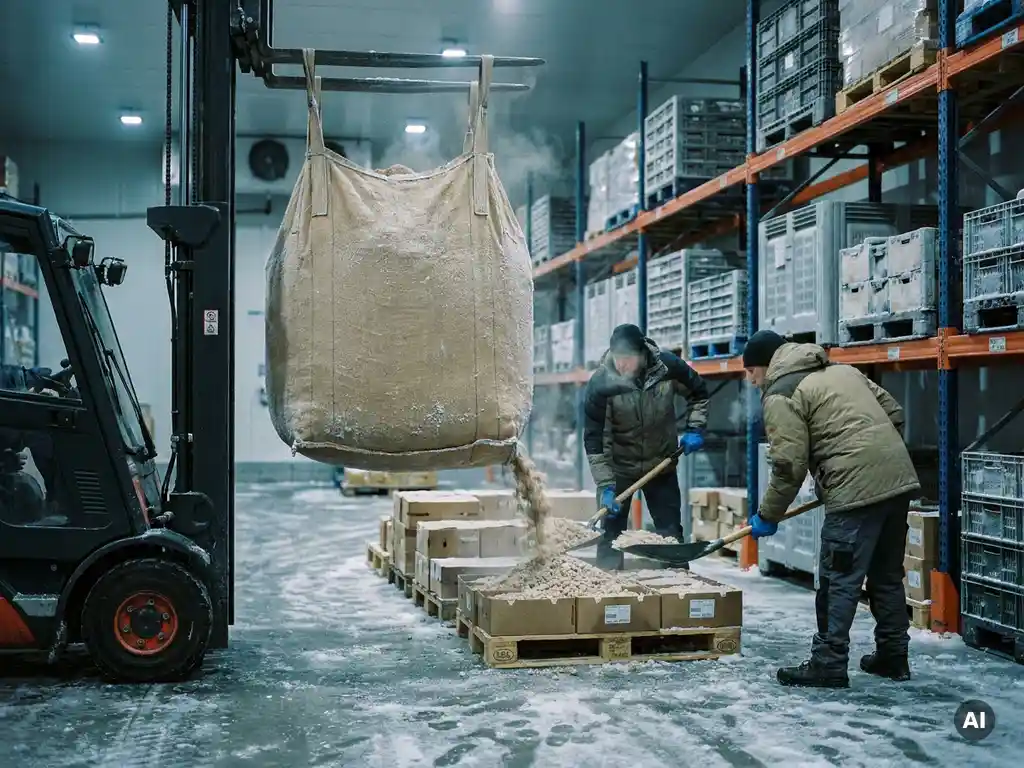
Unloading and redistributing big bags onto pallets in a warehouse is accomplished using a combination of hoisting equipment, chutes or dosing systems, and palletizing processes in which the contents are packed or stacked into smaller units. The exact approach depends on the product type, the weight of the big bag, and the desired final packaging. This article answers the most frequently asked questions about big bag handling in a warehouse environment.
What are the most commonly used methods for unloading big bags in a warehouse?
The most commonly used methods for unloading big bags in a warehouse are: hoisting with a forklift or gantry crane, the use of a big bag unloading station with a hopper at the bottom, and partial manual unloading for smaller volumes. The choice depends on the product type, throughput speed, and available equipment.
When unloading via an unloading station, the big bag is suspended above a hopper or bunker. Subsequently, the discharge hose of the big bag is opened, after which the contents flow into the hopper by gravity or with the aid of a vibrating plate. This is the most common method for bulk goods such as nuts, seeds, and peanuts.
Some warehouses use a tilting system where the big bag is tilted to accelerate the outflow. This is particularly useful for products that do not flow well or that clump together. For smaller batches or less frequent operations, manual unloading is sometimes chosen, where employees transfer the contents using scoops or buckets. This is time-consuming and physically demanding, but does not require major investments in equipment.
How is the contents of a big bag transferred to pallets?
The contents of a big bag are transferred to pallets by repacking the bulk or dispensed products into bags, boxes, or crates, which are then stacked on pallets. Depending on the desired final packaging, this can be done manually, semi-automatically, or fully automatically.
After unloading via a hopper or bunker, the product is guided via a conveyor belt or dosing screw to a filling station. There, smaller packages are filled, sealed, and prepared for palletizing. The filled units are placed on a pallet in a fixed stacking pattern so that the load is stable for storage and transport.
For dry products such as nuts or seeds, it is common to use weighing systems that accurately regulate the filling quantity per package. This prevents weight deviations and meets the requirements of customers and quality controls. After palletizing, the pallets are wrapped with stretch film for stability.
What equipment is needed for unloading and palletizing big bags?
For unloading and palletizing big bags, at a minimum, a lifting device (forklift or gantry crane), an unloading station with a hopper, a conveyor belt, and a palletizing unit are required. For higher volumes or higher accuracy requirements, weighing systems, dosing screws, and automatic palletizing robots are added.
The basic equipment for big bag handling in a warehouse consists of:
- Lifting equipment: forklift with boom or a fixed gantry crane above the unloading station
- Unloading station: a frame with a hopper, discharge hose, and optionally a vibrating plate to promote flow.
- Conveyor belt or dosing screw: for gradually feeding the product to the filling station
- Filling station with weighing system: for accurately filling bags or boxes
- Palletizing unit: manual, semi-automatic or robot-controlled
- Stretch film wrapper: for covering and securing the finished pallet
The choice of specific equipment is determined by the daily volume, the properties of the product (liquid, granular, lumpy), and the desired final packaging.
What are the most important safety rules when working with big bags?
The most important safety rules when working with big bags are: never stand under a hanging big bag, always respect the maximum load capacity of the lifting equipment, inspect the big bag for tears or damage before use, and secure the unloading station so that employees cannot come into contact with moving parts.
Depending on the type, a big bag can weigh up to 2,000 kilograms. This makes correct hoisting and positioning essential. The lifting brackets and loops of the big bag must always be fully and symmetrically attached to the lifting hook or frame. Uneven loading can lead to tears or an uncontrolled fall.
During unloading, employees must remain at a safe distance from the discharge opening and the hopper. For products that generate dust during unloading, such as flour or fine seeds, dust masks and ventilation are mandatory. Good lighting, clear walking routes, and demarcated work zones around the unloading station significantly reduce the risk of accidents.
How does the product type influence the method of unloading and redistribution?
The product type largely determines how a big bag is unloaded and how the contents are redistributed. Free-flowing products such as seeds and nuts unload easily by gravity, while lumpy or sticky products require additional aids such as vibratory plates or pounding bars to maintain the flow.
For dry, granular products such as peanuts or sunflower seeds, a standard unloading station with a hopper is usually sufficient. The products flow evenly and are easy to dose. For products sensitive to moisture or temperature fluctuations, it is important that the unloading process is fast and that the environment is climate-controlled to prevent loss of quality.
Products with a high fat content, such as certain nuts, may stick together or clump together at higher temperatures. In that case, unloading is carried out at a lower ambient temperature or the big bag is pre-cooled. The method of redistribution onto pallets is also influenced by the desired final packaging: loose bags require a different line than boxes or crates.
When is automated palletizing better than manual palletizing?
Automated palletizing is better than manual palletizing when the volume is high, the stacking patterns are complex, or when the physical strain on employees becomes too great. Beyond a certain daily volume, automation is also more economically advantageous than manual labor.
The choice between automatic and manual palletizing depends on a number of specific factors:
- Volume and throughput: for large numbers of pallets per day, a robot or automatic palletizer is faster and more consistent than manual labor.
- Weight per unit: heavy boxes or bags increase the risk of physical complaints among employees; automation reduces this risk.
- Stacking pattern: complex or varying stacking patterns are easy for a robot to program, but require more concentration and time from employees.
- Product variation: with a limited number of fixed product formats, automation is easier to implement than with a broad and changing assortment.
- Personnel availability: in tight labor markets, automation offers continuity without dependence on sufficient manual labor.
Manual palletizing remains sensible for low volumes, highly variable products, or when the investment in automation does not outweigh the expected savings. A hybrid approach, combining manual and automatic processes, is the most practical choice in many warehouses.
How ZZColdstores helps with the storage of dry bulk products
For importers and wholesalers working with dry bulk goods such as nuts, peanuts, and seeds, ZZColdstores offers a suitable storage solution. From the dry storage facilities in Kruiningen and Vlissingen, products are professionally received, stored, and managed until the moment of shipment.
What ZZColdstores offers for dry bulk products:
- A dry storage warehouse with a capacity of 12,000 pallet spaces
- Separate storage areas for nuts, peanuts, seeds, and other food products
- Certified storage in accordance with BRC, SKAL and Demeter
- Logistical support for receiving, storage, and loading from the port
- Flexible deployment tailored to the sailing schedule and the client's wishes
Would you like to know how ZZColdstores can support your bulk flow? Please contact us for a no-obligation discussion about the possibilities.
Author: Frans van der Maas, Operations Director ZZColdstores
Frequently Asked Questions
How long does it take on average to unload one big bag and redistribute it onto pallets?
The unloading time for a single big bag depends heavily on the equipment and product type, but with a well-designed unloading station, the unloading itself typically takes 10 to 30 minutes per big bag. Redistributing onto pallets takes extra time, depending on the desired final packaging and the level of automation. With a semi-automatic line, you can count on a throughput of 30 to 60 minutes per big bag, including packaging and palletizing.
What are the most common mistakes made when setting up a big bag unloading line in a warehouse?
A common mistake is underestimating the flow properties of the product, causing the hopper or dosing screw to become clogged and production to come to a standstill. Additionally, safety zoning around the unloading station is frequently overlooked, posing risks to employees. A third common error is the lack of an accurate weighing system, resulting in weight discrepancies per package leading to customer complaints or non-compliance with legal requirements.
Can a big bag also be unloaded if the discharge hose is damaged or clogged?
A damaged discharge hose must never be opened without first safely positioning the big bag and assessing the damage, as this can lead to an uncontrolled outflow of sometimes hundreds of kilograms of product. In the event of a blockage, you can often use a vibratory plate or beaters to get the flow going, but forcing it is not recommended as this can damage the big bag. If in doubt, always consult your unloading station supplier or call in a specialist for tailored advice.
How do I best store big bags of dry bulk products before they are unloaded?
Big bags containing dry bulk products such as nuts, seeds, and peanuts must be stored in a dry, well-ventilated area with stable temperature and humidity to prevent clumping, mold formation, and loss of quality. Ensure that big bags are stored upright on a clean, flat surface and are not stacked unless explicitly permitted by the manufacturer. Always inspect the big bags for damage to the outer packaging and loops before storage to prevent problems during unloading.
Which certifications or standards are relevant for big bag handling of food products in a warehouse?
For big bag handling of food products, BRC (British Retail Consortium), IFS (International Featured Standards), and FSSC 22000 are the most relevant certifications, as they demonstrate that your processes comply with international food safety requirements. Additionally, specific certifications apply to organic products, such as SKAL in the Netherlands. It is also important that the big bags themselves comply with the UN standard for safe transport and that your lifting equipment is regularly inspected in accordance with occupational safety and health legislation.
When does it make sense to invest in a fully automated big bag unloading line?
A fully automated big bag unloading line becomes financially attractive when you structurally process more than 20 to 30 big bags per day, when labor costs constitute a large part of your operational costs, or when accuracy and hygiene are high priorities. The payback period for an automated line is typically between two and five years, depending on the volume and complexity of the installation. If in doubt, have a process analysis performed by a specialized machine supplier to make the business case concrete.
How can I monitor the quality of my dry bulk products during unloading and redistribution?
Quality control during unloading begins with checking every incoming big bag for odor, color, and visual abnormalities before the discharge hose is opened. During the filling of smaller packages, you can take samples for laboratory analysis regarding moisture content, contamination, or abnormalities. Additionally, ensure that your equipment is cleaned regularly and that employees work according to an established hygiene protocol to prevent cross-contamination between product types.