
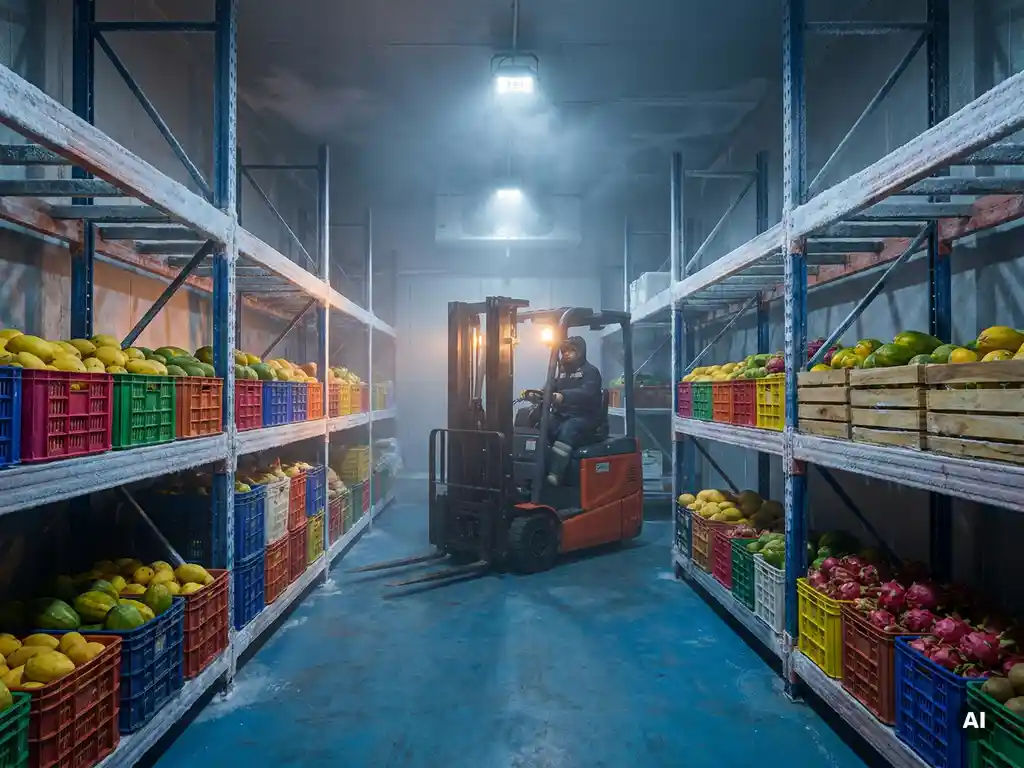
Cold storage during high seasonal supply works by deploying cooling capacity flexibly: warehouses are planned in advance for peak deliveries, climate zones are specifically adjusted per product type, and transshipment from ship or container takes place as quickly as possible to keep the cold chain intact. For importers and wholesalers of fresh fruit, this is not only a logistical choice but a directly determining factor for product quality and shelf life. The questions below answer the most practical aspects of cold storage during seasonal peaks.
What happens to fruit if the cooling capacity is insufficient?
If cooling capacity is insufficient during large seasonal supplies, the temperature in the warehouse rises uncontrollably. For delicate fresh fruit such as bananas and citrus fruits, this means accelerated ripening, loss of quality, and in the worst case, complete spoilage of the batch. The damage often occurs within just a few hours of arrival.
Fruit that remains outside the optimal temperature zone for too long shows discoloration, soft spots, and a shorter shelf life. Supermarket suppliers and processing plants maintain strict quality requirements: products that do not meet the set standards are rejected. The financial consequences are immediate: rejected batches, claims from buyers, and reputational damage among regular customers.
Capacity shortages occur most frequently during unexpected supply peaks, when multiple ships unload simultaneously, or when a season gets underway earlier or more intensely than expected. A cold storage partner lacking buffer space cannot offer a solution in such situations. Therefore, it is important to know in advance how much flexible cooling capacity is available in addition to regular occupancy.
How does cold storage scale with major seasonal peaks?
Cold storage scales with seasonal peaks by combining modular cold rooms, flexible pallet capacity, and pre-scheduled intake appointments. A well-designed cold storage facility reserves buffer space for anticipated peak periods and aligns staffing levels with the expected daily throughput.
In practice, this means that a cold storage partner works closely with importers and freight forwarders to map out sailing schedules and delivery times in a timely manner. This allows available cold storage space to be reserved and scheduled before the first containers arrive. This prevents waiting times at the quay and ensures that products are placed in the correct climate zone immediately after unloading.
Seasonal flexibility also requires adjustable climate settings per cell. When the product mix changes—for example, more citrus fruits in winter and more tropical fruit in summer—temperature and humidity must be able to be adjusted quickly. Cold storage warehouses with fixed, non-adjustable climate zones are vulnerable in this respect to fluctuating seasonal supply.
Which products require separate cold storage rooms for seasonal supply?
Products requiring separate cold storage for seasonal supply are primarily those with widely varying temperature and humidity requirements. Bananas should not be stored next to citrus fruits, as bananas are sensitive to ethylene gas produced by other fruits. Each product type requires its own climate zone.
In practical terms, the following breakdowns apply to exotic fruit:
- Bananas require a constant temperature of approximately 13 to 14 degrees Celsius and high humidity, with strict protection against cold and drafts.
- Citrus fruits such as oranges and grapefruits are stored at lower temperatures, often between 5 and 10 degrees, depending on the variety and origin.
- Nuts, peanuts, and seeds require dry storage at a controlled temperature, separated from humid refrigerated environments.
Mixing incompatible products in a single cell not only leads to a loss of quality but can also result in rejections during import inspections by the KCB (part of the NVWA). A cold storage partner with multiple separate cells and flexible climate settings per cell is therefore essential for varied seasonal supply.
How does the transfer from ship to cold storage work as quickly as possible?
The transfer from ship to cold storage is fastest when the cold location is situated directly at the quay, ensuring that transport time between the ship's hold and the refrigerated storage is minimized. Every minute outside the cold chain counts towards the final product quality and shelf life.
At a location with its own quay, such as in the port of Vlissingen, the fruit does not need to be transported by road via a detour. The product goes directly from the ship into the cold storage, which limits exposure to outside temperatures and mechanical stress. This is particularly relevant for tropical fruit, which is extremely sensitive to temperature fluctuations immediately after the sea voyage.
Upon arrival, containers or pallets are immediately inspected for damage, temperature deviations, and packaging integrity. Products that do not meet the specified specifications are immediately separated from the batch so that the rest of the shipment is not affected. Speed and accuracy go hand in hand during transshipment.
What is the difference between cold storage and dry storage for seasonal products?
The difference between cold storage and dry storage for seasonal products lies in the required climate conditions: cold storage actively regulates temperature and humidity for fresh, perishable products, whereas dry storage focuses on stable, controlled environments for products that do not require refrigeration but must be protected against moisture and heat.
Dry storage, also known as ambient storage, is used for products such as nuts, peanuts, seeds, and dried food products. These are stored at a constant temperature of approximately 11 degrees Celsius, without the high humidity associated with fresh products. The storage is separated from cold rooms to prevent cross-contamination and moisture problems.
During seasonal peaks, it is important for importers and wholesalers to know which part of their assortment belongs in which storage type. A batch of mixed cargo, such as fresh fruit and nuts from the same container, must be separated immediately upon arrival and directed to the correct storage zone. A partner offering both refrigerated and dry storage at a single location prevents extra transport movements and shortens processing time.
Which certifications are required for seasonal storage of food products?
For seasonal storage of food products in the Netherlands, the most relevant certifications are BRC (British Retail Consortium), SKAL, and inspection by the KCB (part of the NVWA). These certifications guarantee that storage complies with international food safety standards and that products are suitable for admission to the European market.
BRC is an international standard for food safety required by most major supermarket chains and processing plants as a condition for cooperation. SKAL certification is mandatory for the storage of certified organic products and guarantees that organic and conventional products are stored strictly separately. Demeter certification applies specifically to biodynamic products.
The KCB carries out import inspections on behalf of the NVWA for fresh fruit and vegetables entering the European Union. Products may not be released onto the European market without an approved import inspection. A cold storage facility that can facilitate this inspection on-site saves importers additional transport movements and significantly shortens lead times.
For supply chain managers, when choosing a cold storage partner, it is wise to check which certifications are current and whether the partner has experience with the specific inspection procedures applicable to their product category.
When is external cold storage better than in-house cooling capacity?
External cold storage is better than in-house cooling capacity when seasonal demand fluctuates significantly, the investment in in-house cooling infrastructure is disproportionate to average utilization, or when the location of in-house storage does not align with supply routes via the port. For most importers and wholesalers, external cold storage is the most cost-effective choice.
Owning your own cold storage capacity is only profitable with a constant, high occupancy rate throughout the year. For seasonal products such as exotic fruit, this is rarely the case: supply concentrates in certain periods, after which demand falls. An own cold storage warehouse that stands half-empty out of season generates fixed costs without corresponding revenue.
In addition, external cold storage offers access to additional services that an on-site warehouse rarely provides: on-site import inspections, container handling, repalletization, labeling, and customs clearance. For suppliers delivering directly to supermarket purchasing organizations, being able to demonstrate certified storage and traceable logistics is a requirement, not an option.
How ZZColdstores helps with cold storage during seasonal peaks
ZZColdstores offers a fully integrated solution for importers, wholesalers, and logistics service providers dealing with large seasonal supplies of fresh fruit and other food products. The approach focuses on speed, quality preservation, and flexibility, from the moment the ship docks until the goods leave the cold storage.
What ZZColdstores specifically offers:
- Climate-controlled cold rooms in Kruiningen and Vlissingen, with flexible temperature and humidity settings per room
- A private quay in the Port of Vlissingen for direct transfer from ship to cold storage, without unnecessary transport time
- Dry storage with 12,000 pallet spaces for nuts, peanuts, seeds, and other ambient products
- Quality control upon arrival, including temperature, humidity, and Brix measurements and full QC reporting
- Barcode-driven traceability of every pallet, from receipt to delivery
- BRC, SKAL, and Demeter certifications, and facilitation of on-site KCB import inspections
- Value Added Services such as repalletization, labeling, box picking, and EDI connections with your systems
Would you like to know how climate-controlled cold storage at ZZColdstores aligns with your seasonal logistics? Contact us and discuss your specific situation with one of our specialists.
Frequently Asked Questions
How far in advance should I reserve cooling capacity for a seasonal peak?
It is advisable to reserve cold storage capacity at least four to six weeks before the expected peak in supply, so that the cold storage partner can plan occupancy and keep buffer space available. For large or fixed seasonal volumes, it is wise to enter into annual contracts or framework agreements, whereby sailing schedules and delivery times are shared on a structural basis. The earlier the planning is coordinated, the smaller the risk of a capacity shortage when multiple shipments arrive simultaneously.
What are the most common mistakes made when choosing a cold storage partner for seasonal products?
A common mistake is focusing solely on the price per pallet space without verifying whether the partner has sufficient flexible buffer capacity for peak periods. Additionally, importers frequently underestimate the importance of location: a cold storage warehouse not situated directly on the quay adds unnecessary transport time and temperature risks to the cold chain. Finally, the presence of current certifications such as BRC and the possibility of on-site KCB import inspections are too often considered secondary, whereas this is a strict requirement for supermarket suppliers.
As a smaller importer, can I also use a specialized cold storage facility, or is that only reserved for large volumes?
Specialized cold storage facilities typically work with both large and medium-sized importers, as it is precisely the combination of clients that enables efficient utilization. For smaller volumes, external cold storage is often even more cost-effective than for large players, because the fixed costs of climate control, certifications, and inspection facilities are shared. However, it is advisable to ask in advance whether the partner has experience with your specific product category and whether minimum intake volumes apply.
As an importer, how do I keep track of my inventory during a busy seasonal peak?
A modern cold storage partner offers barcode-driven traceability per pallet, allowing you to see at any time where your inventory is located, what the arrival date was, and what the current status is. Many locations also offer EDI connections or portal access, enabling you to integrate your inventory data directly into your own WMS or ERP system. When selecting a partner, always inquire about reporting capabilities and the frequency of inventory movements, especially during peak periods when throughput is high.
What happens if part of my shipment does not meet the quality requirements upon arrival?
At a professional cold storage facility, every shipment is inspected immediately upon arrival for temperature deviations, damage, and packaging integrity. Products that do not meet the specified requirements are immediately separated from the approved batch and documented in a QC report, enabling you as an importer to take swift action towards your supplier or insurer. It is important that your cold storage partner performs this quality control as standard practice and not just upon request, to prevent rejections at the end customer.
Are there specific requirements for the cold storage of certified organic fruit during seasonal peaks?
Yes, a SKAL-certified storage location is mandatory for the storage of organically certified fruit. This means that organic and conventional products must be stored strictly physically separated, with their own pallet spaces and clear registration of receipts and dispatches. During seasonal peaks, when throughput is high and pressure on logistics increases, it is especially important that your partner has demonstrable experience with the administrative obligations surrounding SKAL storage, so that your organic status is not jeopardized.
What additional services can I expect besides the pure cold storage function?
In addition to climate-controlled storage, specialized locations typically offer a wide range of value-added services, such as repalletization, labeling, box picking, and consolidation of shipments for various customers. Customs clearance and the facilitation of on-site import inspections are also services that significantly reduce lead times and eliminate the need for additional transport movements. For supermarket suppliers, additional services such as EDI connections and comprehensive QC reporting are often not a luxury but a basic requirement for the partnership.
Related articles
- What storage space do you need for temperature-sensitive foods?
- Can you use warehousing for temporary storage?
- What happens to goods between arrival and departure from a warehouse?
- How does import inspection via the KCB and NVWA work in the Netherlands?
- How does ambient storage for nuts and dried fruit work?