
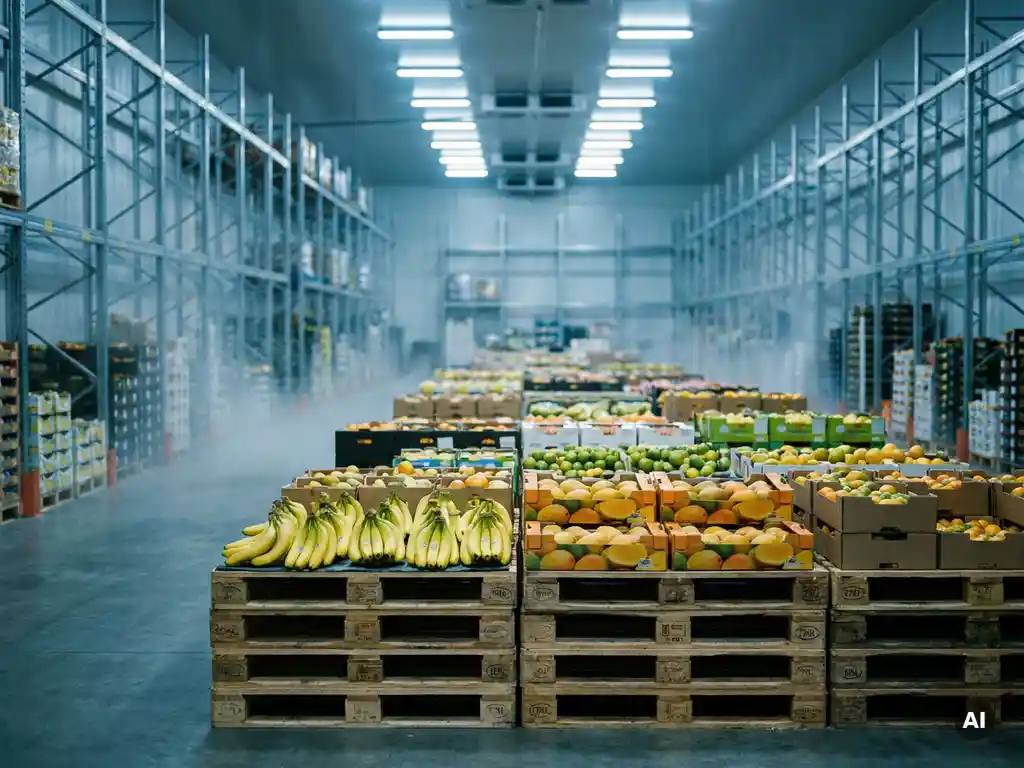
For the storage of temperature-sensitive food products, you need a specialized storage facility that actively manages the climate: think of refrigerated rooms for fresh products and dry, tempered warehouses for non-perishable food products such as nuts and grains. Exactly which storage space is needed depends on the product, the desired shelf life, and the logistics chain in which the product is located. This article answers the most frequently asked questions about food storage so that you can make an informed choice.
Which temperature zones are used for food storage?
Food storage is divided into three main zones: freezer (below -18 degrees Celsius), refrigerated (typically 0 to 15 degrees Celsius, depending on the product), and dry or tempered storage (approximately 10 to 18 degrees Celsius). Each product requires a specific zone to prevent loss of quality, spoilage, and food safety risks.
The exact temperature zone depends heavily on the type of food product. Exotic fruits such as bananas and citrus fruits are susceptible to cold damage and are stored at higher refrigeration temperatures than, for example, dairy or meat. Nuts, peanuts, and dried food products do not require freezing temperatures, but benefit from a stable, dry environment of around 11 degrees Celsius to prevent oxidation and moisture problems.
In addition to temperature, humidity plays at least as important a role. Fresh products such as fruit require high relative humidity to prevent dehydration, while dry products must be protected from humid air. A good storage facility actively manages both parameters independently of each other.
What is the difference between cold storage and dry storage?
Cold storage is actively cooled and intended for fresh, perishable products that require a low temperature to remain shelf-stable. Dry storage is not refrigerated, but is tempered and controlled for humidity, and is suitable for non-perishable food products that do not require freezing or strong refrigeration but must be protected against temperature fluctuations and moisture.
In practice, this means that a banana importer stores his products in a climate-controlled cold room, while a trader in nuts or dried seeds uses a dry warehouse with a stable ambient temperature. Both forms of storage require active climate control, but the technical requirements and investments in installations differ significantly.
A common mistake is that dry storage is equivalent to ordinary warehouse space without climate control. For food products, this is incorrect: temperature fluctuations, condensation, and insufficient ventilation can damage perishable products or reduce their quality. Dry storage for food therefore requires specific facilities and monitoring.
What requirements do temperature-sensitive products place on a storage facility?
Temperature-sensitive food products place high demands on a storage facility: constant temperature control without spikes, active control of humidity and air circulation, a hygienically designed space that meets food safety standards, and a reliable monitoring system that immediately signals deviations.
In concrete terms, for a storage location this means:
- Insulated walls, floors, and ceilings that minimize temperature loss
- Cooling or heating systems with precision control equipment
- Ventilation systems that actively manage air circulation and humidity
- Continuous temperature monitoring and alerting in case of deviations
- Hygienic layout and working methods in accordance with food safety standards
- Separate zones for products with different climate requirements
Additional requirements apply to fresh products such as exotic fruit. The speed of storage upon arrival is crucial: the shorter the time between unloading and storage at the correct temperature, the better the quality is preserved. This also places demands on the location of the warehouse relative to the goods' arrival point, such as a port or terminal.
How do you choose the right storage location for food products?
You choose the right storage location for food products based on four factors: the location relative to supply and distribution points, the available climate infrastructure suitable for your product, the logistical services the location can offer in addition to storage, and the facility's food safety certifications.
Location is a decisive factor for importers and exporters. A warehouse directly adjacent to a quay or terminal reduces the time between unloading and storage to a minimum, which directly benefits the quality of fresh products. For distribution to customers in Germany or other European markets, a location in the Rotterdam-Antwerp corridor is strategically attractive due to the multimodal connections.
In addition, it is important to assess which additional services a storage location offers. Consider quality control upon arrival, labeling, palletizing, customs clearance, and import inspections. For food products going directly to supermarket distribution centers or processing plants, a partner capable of handling the entire process from arrival to shipment is more efficient than multiple separate links in the chain.
Which certifications must a food storage company have?
A food storage company must possess at least a recognized food safety certificate such as BRC (British Retail Consortium) and, depending on the product, additional certifications such as SKAL for organic products or accreditation by the NVWA for import inspections. These certifications are not quality marks, but a basic requirement for cooperation with professional trading partners.
BRC is the most common standard in the European food sector and is required by most major supermarket chains and purchasing organizations. A storage company with BRC certification demonstrates that it operates according to documented procedures for hygiene, temperature control, traceability, and food safety.
For importers of organic products, SKAL certification is a requirement to be able to call storage and handling organic. Demeter certification is relevant for biodynamic products. For the import of plant products from outside the EU, the KCB (part of the NVWA) plays a role in import inspections. A storage partner that can coordinate these inspections itself saves time and reduces the risk of delays in the chain.
When is shared storage capacity better than private storage?
Shared storage capacity with a specialized party is better than on-site storage when volumes vary by season, when the investment costs for certified climate-controlled infrastructure outweigh the benefits, or when you require additional logistics services alongside storage that you cannot perform efficiently yourself.
In-house storage seems attractive due to control, but it entails high fixed costs: investments in refrigeration systems, certifications, maintenance, monitoring, and qualified personnel. For companies with fluctuating volumes or a broad product range requiring different climate zones, this is rarely economically justifiable.
Shared storage capacity, also known as public warehousing or shared warehousing, offers flexibility: you pay for what you use, scale up during peak volumes, and can rely on the expertise and certifications of the storage partner. This is particularly relevant for importers and wholesalers who rent storage space as part of a broader logistics collaboration, without wishing to invest in specialized infrastructure themselves.
How ZZColdstores helps with the storage of temperature-sensitive food products
ZZColdstores combines climate-controlled cold storage and dry storage at strategic locations in Kruiningen and Vlissingen, with direct port access for a rapid transfer from ship to storage. As a B2B partner for importers, wholesalers, and logistics service providers, ZZColdstores offers a fully hassle-free process, from arrival to loading.
Specifically, ZZColdstores offers:
- Climate-controlled storage with 24/7 monitoring of temperature, humidity, and air circulation
- Dry storage for nuts, peanuts, seeds, and other non-perishable food products at approximately 11 degrees Celsius
- Quality control upon arrival, including temperature and humidity measurements
- Barcode-driven traceability of every pallet
- Certifications: BRC, SKAL and Demeter
- Coordination of import inspections via KCB and customs clearance
Would you like to know if climate-controlled storage at ZZColdstores aligns with your product and logistics chain? Contact us for a no-obligation consultation. ZZColdstores is happy to help find the most efficient storage solution for your situation.
Frequently Asked Questions
How soon should a temperature-sensitive product be placed in the refrigerator after arrival?
The rule of thumb is: the shorter the time between unloading and storage, the better the quality is preserved. For most fresh products, such as exotic fruit, every extra hour outside the correct temperature zone can noticeably affect shelf life and quality. Therefore, preferably choose a storage location with direct port access or a terminal within walking distance, so that the cold chain is interrupted as little as possible.
What happens if the temperature in a storage room temporarily deviates from the norm?
Depending on its duration and extent, a temporary temperature deviation can lead to loss of quality, reduced shelf life, or, in the worst case, food safety risks. A professional storage facility has a continuous monitoring system that immediately triggers an alarm in the event of deviations and activates corrective measures. When selecting a storage partner, always ask about the protocols for temperature incidents and how they are documented for traceability.
Can products with different climate requirements be stored in the same warehouse?
Yes, provided the warehouse has separate climate zones that are managed independently of each other. A professional storage facility has separate areas for freezer, refrigerated storage, and dry tempered storage, each with its own temperature and humidity control. It is inadvisable to store products with widely differing climate requirements in the same area, as this can compromise the quality of both product groups.
How do I know if a storage partner is reliable enough for my food products?
At a minimum, verify whether the storage partner holds relevant certifications such as BRC, and request the most recent audit results. Additionally, inquire about the monitoring systems used, how incidents are recorded and communicated, and whether the partner has experience with your specific product category. A tour of the facility and requesting references from similar customers provide additional assurance.
What are the most common mistakes made when choosing a storage location for food products?
The most common mistake is choosing based on price alone, without considering the technical suitability of the facility for the specific product. Other common errors include underestimating the location relative to supply points, failing to take into account the necessary certifications for the sales market, and forgetting to inquire about additional services such as customs clearance or import inspections. An apparently cheaper location can ultimately turn out to be more expensive if the cold chain is not secured or if extra links in the logistics are required.
Is climate-controlled storage also suitable for organic or biodynamic food products?
Yes, but not every climate-controlled storage location is certified for this. For organic products, SKAL certification of the storage partner is mandatory to maintain organic status during storage and handling. For biodynamic products, Demeter certification applies in addition. Therefore, always check whether the storage partner has the correct certifications for your specific product category, even if the climate infrastructure itself is technically suitable.
How does traceability work in a professional food storage facility?
In a professional facility, every pallet is fitted with a barcode or RFID label upon arrival, ensuring that the location, origin, storage date, and climate conditions are recorded and accessible throughout the entire storage period. This makes it possible to quickly identify which batches are affected and where they are located in the supply chain in the event of a quality or food safety issue. Traceability is not only an operational tool but also a requirement within certification standards such as BRC.