
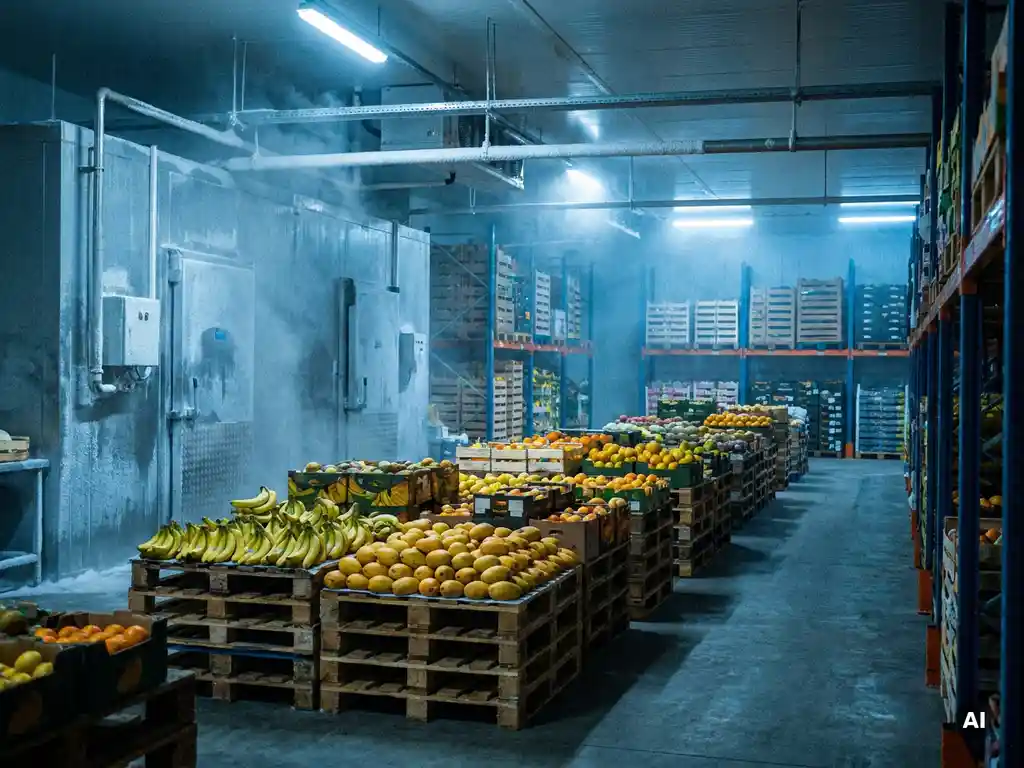
The most suitable storage space for imported food products depends on the product type and the required temperature. Fresh products such as exotic fruit require climate-controlled cold storage, while dry goods such as nuts and seeds thrive in a tempered dry storage space of approximately 11 degrees. For B2B parties renting storage space for imported food products, certification, location, and customs clearance are determining factors in addition to temperature. The questions below will help you make the right choice.
What temperature is required for imported foodstuffs?
The required storage temperature for imported food products varies significantly by product group. Fresh products such as bananas are typically stored between 13 and 15 degrees Celsius, citrus fruits around 8 to 10 degrees. Dry products such as nuts, seeds, and peanuts are stored at a tempered ambient temperature of approximately 11 degrees, where humidity also plays a crucial role.
For importers and wholesalers, it is essential that the storage location does not maintain a single fixed temperature, but offers flexible climate settings. Products arriving in the same port can require widely varying storage conditions. A cold storage facility that can adjust its climate settings per room or per cell gives logistics managers the assurance that every product is stored optimally.
In addition to temperature, humidity and air circulation are also determining factors for shelf life. Insufficient ventilation can cause condensation, which accelerates mold formation and loss of quality. Advanced climate control continuously monitors these three parameters, ensuring the quality of the cargo remains guaranteed throughout the entire storage period.
What is the difference between cold storage and dry storage?
Cold storage is intended for fresh and perishable products that require active cooling to maintain their quality, such as exotic fruits, vegetables, and other perishable goods. Dry storage, also known as ambient storage, is suitable for products that do not need to be refrigerated but do require a stable, controlled environment, such as nuts, seeds, peanuts, and grain products.
The practical difference lies in the infrastructure and energy consumption. Cold storage requires active cooling systems, humidity control, and strict temperature monitoring. Dry storage operates with a tempered space that protects against moisture, heat, and temperature fluctuations, without the intensive cooling technology of a cold storage facility.
For importers who process both fresh and dry products, it is advantageous to choose a storage partner that offers both types of storage space at the same location. This simplifies logistical planning, reduces transport movements, and makes it possible to have a single point of contact for the entire flow of goods.
Which certifications are required for food storage in the Netherlands?
For the storage of imported foodstuffs in the Netherlands, statutory and sector-specific requirements apply regarding food safety and quality assurance. The most relevant certifications are BRC (British Retail Consortium), SKAL for organic products, and recognition by the NVWA via the KCB for the import inspection of fresh fruit and vegetables.
In practice, BRC is a basic requirement for storage partners supplying supermarket chains and processing plants. The certificate demonstrates that the warehouse complies with international food safety standards regarding hygiene, traceability, and process control. For organically certified products, SKAL accreditation is additionally required at the storage location.
The KCB inspection, carried out by the KCB as part of the NVWA, is specifically relevant for fresh products imported from countries outside the EU. When importing exotic fruit, the KCB checks whether the products meet the phytosanitary requirements of the European Union. A storage location that can facilitate these inspections on-site saves transport time and reduces the risk of quality loss due to unnecessary movements.
How do you choose a storage location for imported food?
When choosing a location to rent storage space for imported food products, four factors play a decisive role: geographical location relative to the arrival location, the availability of suitable storage conditions, existing certifications, and the possibility of on-site customs clearance.
Geographical location is particularly critical for fresh products. The shorter the route from the ship to cold storage, the less quality loss. A storage location with a direct quayside or proximity to a seaport in the Rotterdam-Antwerp corridor offers importers a logistical advantage that is immediately visible in product quality upon delivery.
In addition, flexibility is a distinguishing factor. Logistics managers working with fluctuating volumes, multiple product types, or irregular sailing schedules benefit from a storage partner that adapts to the rhythm of the inflow rather than the other way around. When comparing locations, always inquire about the possibility of quality control upon arrival, repalletization, and barcode-driven traceability, as these services contribute to the efficiency of the entire supply chain.
What are the risks of improper storage conditions for food?
Incorrect storage conditions for imported food products lead to loss of quality, increased rejection during inspection, and financial damage. The most common risks are temperature deviations that accelerate ripening or cause frost damage, excessive humidity that promotes mold growth, and insufficient ventilation that causes condensation and ethylene buildup in sensitive products such as bananas.
For B2B parties supplying supermarket purchasing organizations, the consequences of poor storage quality are immediately noticeable throughout the supply chain. Rejection upon arrival at the retailer, claims from buyers, and reputational damage among long-standing contract partners are real risks that often originate in the storage phase, not in cultivation or transport.
An additional risk is the lack of traceability. If a quality incident occurs and the origin of a specific batch cannot be quickly traced, the entire shipment may be placed in quarantine. Systems that register at the pallet or lot level and link them to grower and lot numbers significantly limit this risk and expedite handling in the event of a recall.
How does customs clearance work for imported food storage?
When importing foodstuffs from outside the EU, the consignment must be cleared by customs before it can be placed into free circulation. This process includes the customs declaration, the phytosanitary inspection by the KCB on behalf of the NVWA, and possibly additional food safety checks. The storage location plays a central role in this: goods are often temporarily stored in a bonded warehouse until customs clearance is completed.
A storage partner that can facilitate on-site customs clearance significantly shortens lead times. When the storage location has its own quay and inspection can take place immediately upon arrival, products do not need to be moved additionally for inspection. This is not only more efficient but also better for the quality of temperature-sensitive products.
For importers who regularly import goods, it is advisable to choose a warehousing partner that can handle the entire process from arrival to customs clearance and storage. This simplifies communication, reduces the number of links in the chain, and provides greater control over the lead time of the import procedure.
How ZZColdstores helps with the storage of imported food
ZZColdstores offers a fully integrated solution for importers, wholesalers, and logistics service providers looking for reliable storage space for imported food products. The main benefits at a glance:
- Climate-controlled cold storage in Kruiningen and Vlissingen, with flexible temperature and humidity settings per cell, monitored 24/7.
- Dry storage with a capacity of 12,000 pallet spaces for nuts, peanuts, seeds, and other dry food products at approximately 11 degrees.
- Own quay in Vlissingen, ensuring the distance from the hold to the cooling unit is minimal and quality loss is limited.
- Import inspection via KCB/NVWA and on-site customs clearance , so that the entire process from arrival to storage is handled by a single partner
- Quality control upon arrival, including temperature measurements, sampling, and QC reporting per shipment
- Barcode-driven traceability at pallet level, linked to grower and LOT numbers
- Certifications: BRC, SKAL, and Demeter, tailored to the requirements of supermarket chains and processing plants.
Would you like to know which storage solution best suits your products and logistics chain? View the range of climate-controlled storage at ZZColdstores or contact us directly for a no-obligation consultation.
Frequently Asked Questions
As an importer, can I rent storage space for both refrigerated and dry products from the same partner?
Yes, and that is even highly recommended. A storage partner offering both cold and dry storage space at the same location significantly simplifies your logistics planning. You work with a single point of contact, a single administrative system, and a single location for all your goods flows, which reduces transport movements and communication errors.
What should I do if my product requires a specific temperature range that is not offered as standard?
Always explicitly ask potential storage partners about the possibility to adjust climate settings per cell or per room. Not every cold storage facility offers this flexibility. In your request, specify the exact storage temperature, desired humidity, and any sensitivity to ethylene so that the storage partner can confirm whether the infrastructure is suitable for your specific product.
How long does average customs clearance take for the import of food products from outside the EU?
The processing time for customs clearance depends on the product type, origin, and the completeness of the documentation. With well-prepared files and a storage location equipped with its own quay and on-site inspection by the Quality Control Bureau (KCB), the process can be completed within one to two working days. However, missing certificates or additional phytosanitary checks can significantly extend the processing time.
What documents do I need to have imported food products stored in a certified warehouse?
For the storage and customs clearance of imported foodstuffs, you generally require at least the following documents: a bill of lading or airway bill, a commercial invoice, a packing list, a phytosanitary certificate from the country of origin and, depending on the product, a certificate of origin. For organic products, an additional organic certificate is required that aligns with the SKAL accreditation of the storage location.
How do I know if a storage partner is reliable enough for my supply chain?
At a minimum, verify whether the location holds relevant certifications such as BRC, and inquire about the possibility of barcode-driven traceability at the pallet level. Also ask for references from similar importers or product groups, and ask about the availability of QC reports per shipment. A transparent storage partner provides you with insight into temperature logs, inspection reports, and inventory movements via a customer portal or periodic reporting.
What are the most common mistakes when choosing storage space for imported food?
The most common mistake is choosing based on price per pallet space without taking into account the total logistics costs, such as extra transport movements to an external inspection location or the lack of flexible climate settings. Other common mistakes include failing to check the current certification status of the location and underestimating the importance of proximity to the port for temperature-sensitive products.
Is it possible for a smaller importer or a start-up wholesaler to rent storage space, or is that only reserved for large companies?
In most cases, certified storage locations work with flexible rental models based on actual pallet spaces used, giving smaller importers and start-up wholesalers access to professional cold or dry storage. Always discuss your expected volumes, delivery frequency, and seasonal peaks during your initial contact so that the storage partner can make a suitable proposal that scales with your company's growth.
Related articles
- What should you look out for when outsourcing food storage?
- What should you pay attention to when cold storing citrus fruit?
- What are the certification requirements for a warehouse that stores food products?
- What is dry storage and when do you need it?
- What is a European hub and why do importers choose one?