
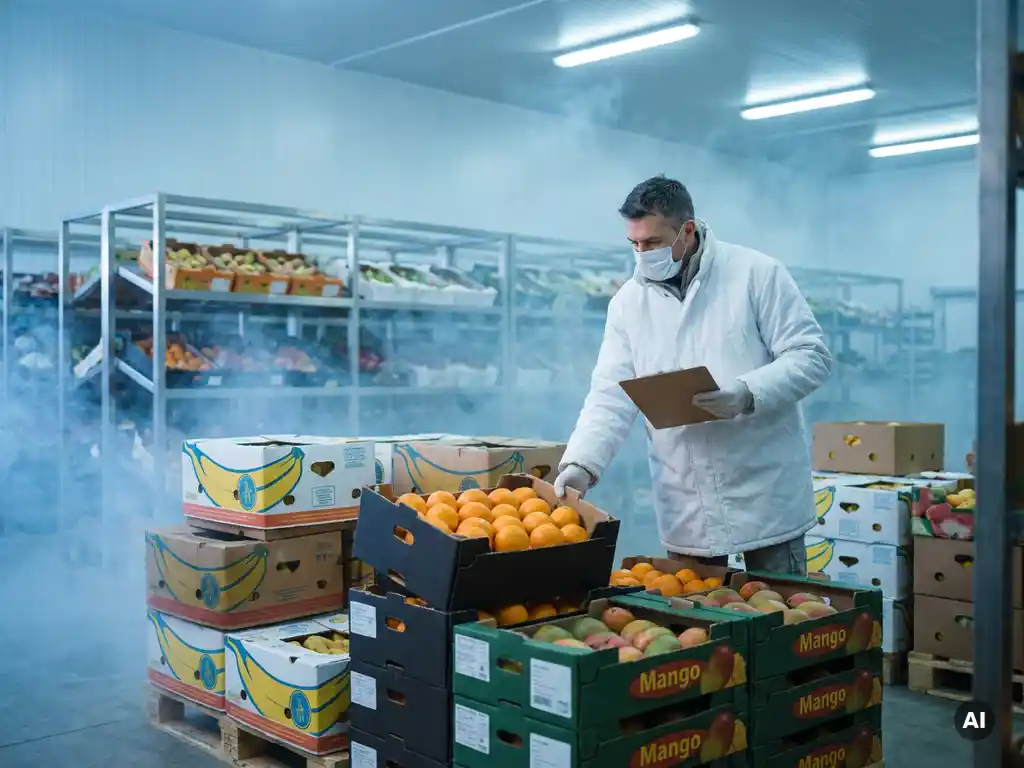
When outsourcing food storage, you consider certifications, storage conditions, location, flexibility, and whether the partner can handle the entire logistics process. For B2B parties such as importers, wholesalers, and supermarket suppliers, the choice of a storage partner is a direct risk factor for product quality and delivery reliability. The questions below will help you make the right decision.
Which certifications must a food storage partner have?
A reliable partner for food storage must possess at least BRC (British Retail Consortium) certification for food safety. Depending on the type of product, additional certifications such as SKAL (organic) and KCB/NVWA accreditation (import inspection of fresh products) are required. Without these certifications, as a supplier to supermarkets or processing plants, you cannot meet the requirements of your customers.
In practice, BRC is the minimum standard expected by large retailers and purchasing organizations. SKAL is relevant if you store organically certified products and wish to move them through the supply chain without losing the certification status. The KCB accreditation is specifically for the import inspection of fresh plant-based products and is a requirement when goods enter Europe from third countries via an accredited inspection post.
Ask every potential storage partner for their current certificates and verify whether the scope of the certification actually covers your product category. A certificate that applies only to dry storage offers no guarantees for refrigerated products, and vice versa.
What is the difference between cold storage and dry storage for food products?
Cold storage is intended for fresh and temperature-sensitive products that require active climate control, such as exotic fruit, vegetables, and other perishable goods. Dry storage, also known as ambient warehousing, is suitable for products that can be stored stably at a controlled but not refrigerated ambient temperature, such as nuts, peanuts, seeds, and potato flakes.
The distinction lies not only in the temperature but also in the degree of climate control. In cold storage, temperature, humidity, and air circulation are continuously monitored and adjusted, sometimes per product type. Bananas, for example, require different conditions than citrus fruits. Dry storage typically operates with a fixed target temperature, such as around 11 degrees, where the primary goal is to prevent fluctuations and keep the environment dry.
For supply chain managers, it is important to know that some products fall into the borderline zone: they are not perishable enough for cold storage, but too sensitive to standard warehouse temperatures. Think of certain nuts or dried fruits. A good storage partner can advise you on which storage type best suits the specific characteristics of your goods.
How do you assess the location of an import and export storage facility?
The location of a storage facility determines the speed and costs of the entire logistics process. For import and export flows, proximity to a seaport, a customs office, and key sales markets is the most relevant criterion. The shorter the distance between unloading and storage, the lower the risk of quality loss for temperature-sensitive products.
For companies active in the Rotterdam-Antwerp corridor, the location in Zeeland is strategically relevant. A facility with its own quay, such as in the Port of Vlissingen, makes it possible to transport containers directly from the ship to cooling without an intermediate transport step. This minimizes exposure to fluctuating outside temperatures and significantly shortens turnaround times.
Also assess the location based on its accessibility for road transport towards Germany, Eastern Europe, and other sales markets. If Germany is your largest sales market, you will want to know what the connection via the A58 or other corridors looks like and whether the warehousing partner can provide its own transport or shuttle services for the first and last mile.
What are the risks of an incorrect storage temperature for food products?
An incorrect storage temperature leads to accelerated spoilage, loss of quality, and in the worst case, the complete rejection of a batch. For fresh products such as fruit and vegetables, a temperature that is too high means accelerated ripening or mold formation; a temperature that is too low can cause cold damage that permanently affects the structure and taste of the product.
The financial consequences are immediate: rejected batches lead to returns, claims from customers, and reputational damage. Moreover, for suppliers positioned directly ahead of a supermarket's purchasing organization, a quality incident poses a risk to the continuity of the partnership. Supermarkets and processing plants maintain strict standards for quality upon arrival.
In addition to the temperature itself, stability also plays a role. Fluctuations, for example caused by the frequent opening of doors or insufficient insulation, are sometimes more damaging than a structurally slightly too high or too low temperature. Therefore, when asking a potential storage partner, do not just ask about the set temperature, but also about how fluctuations are prevented and how deviations are recorded and communicated.
How flexible must a storage partner be for supply chain partners?
A storage partner for food products must be able to adapt to variable supply, fluctuating volumes, and ship schedules. In practice, flexibility means being able to scale up during peak supply, being able to switch quickly in response to changed order specifications, and being willing to operate outside standard office hours when a ship arrives earlier or later than planned.
For logistics service providers, freight forwarders, and shipping companies, this is a critical selection criterion. A warehousing partner that only works with fixed time windows and fixed volumes does not fit the dynamics of international food flows. Specifically inquire about the possibilities for repalletizing, box picking, labeling, and other value-added services, so that you do not have to engage multiple parties for operations that take place immediately after unloading.
Flexibility also has a digital dimension. EDI connections for automated order processing, inbound notifications, and inventory updates reduce manual communication and accelerate throughput. A partner who can connect systems to your own WMS or ERP makes the collaboration structurally more efficient.
What questions do you ask when comparing food storage providers?
When comparing food storage providers, you ask questions at four levels: certification and compliance, technical capacity, operational flexibility, and additional services. A provider who gives clear answers at all four levels is generally a more reliable partner than one that competes only on price.
Concrete questions to ask:
- Which certifications do you hold and what is the scope of each certificate?
- How do you monitor temperature and humidity, and how are deviations reported?
- Can you set climate chambers per product type?
- What is your capacity during peak periods and how do you communicate in the event of bottlenecks?
- Do you also provide import inspection, customs clearance, and additional logistics services?
- Do you have experience with my specific product category?
- Which traceability systems do you use and can you link to my systems?
Also pay attention to the transparency with which a provider responds. A partner who is open about their working methods, certificates, and any limitations is more reliable than a party that communicates exclusively positively without concrete substantiation.
How ZZColdstores helps with outsourcing food storage
ZZColdstores combines climate-controlled cold and dry storage with a full package of additional services, so that you, as a supply chain partner, do not have to liaise with multiple parties. What ZZColdstores specifically offers:
- Climate-controlled storage in Kruiningen and Vlissingen, with 24/7 monitoring of temperature, humidity, and air circulation
- Own quay in the port of Vlissingen for direct unloading from ship to cooling
- Dry storage with a capacity of 12,000 pallet spaces for nuts, seeds, and other ambient products
- Quality control upon arrival, including temperature and humidity measurements and QC reporting
- Repalletizing, box picking, labeling and barcode-driven traceability
- EDI connections for automatic order processing and inventory updates
- Certifications: BRC, SKAL and KCB/NVWA recognition
Would you like to know if ZZColdstores' climate-controlled storage aligns with your product flow and supply chain requirements? Contact us for a no-obligation consultation. ZZColdstores is happy to help find the best storage solution for your specific situation.
Frequently Asked Questions
How long does it take on average to select a food storage partner and start the contract?
The selection process takes an average of two to six weeks, depending on the complexity of your product flow and the required certifications. After signing the contract, expect a technical onboarding phase of one to two weeks for connecting systems, setting up climate chambers, and aligning operational procedures. Start the selection process well before a planned import peak to avoid making a suboptimal choice under time pressure.
What are the most common mistakes companies make when outsourcing food storage?
The most common mistake is selecting based on price without taking the total chain cost into account: a cheaper storage partner located far from the port can end up being more expensive than a more expensive partner with its own quay due to extra transport costs and loss of quality. A second common mistake is failing to verify whether the scope of a certification actually covers your product category and storage type. Also ensure that you contractually stipulate how deviations in temperature or humidity are reported and who bears financial responsibility in the event of an incident.
Can I connect my existing WMS or ERP system to a storage partner's system?
Most professional warehousing partners support EDI connections for automated order processing, inbound notifications, and inventory updates, but the technical implementation varies by partner and system. Ask in advance which EDI standards or API connections are supported and who is responsible for integration and maintenance. A successful system connection reduces manual communication, accelerates throughput, and minimizes the risk of errors during order processing.
How does traceability work in outsourced food storage, and what minimum evidence do I need to be able to demonstrate?
With outsourced storage, as a supplier, you must be able to demonstrate at a minimum which batch arrived when, under what conditions it was stored, and to which customer the goods were shipped — this is the basis for FIFO management and recall procedures. Professional storage partners work with barcode-driven traceability and record temperature logs that are retrievable per batch. Check whether the traceability data can be exported in a format that meets the requirements of your customers or certification body.
Is it possible to combine storage with customs clearance and import inspection through a single party?
Yes, an increasing number of specialized storage partners offer an integrated package in which storage, import inspection (KCB/NVWA), and customs clearance are arranged through a single point of contact. This is particularly relevant for importers of fresh plant products from third countries, where the goods must undergo a phytosanitary inspection immediately upon arrival. By consolidating these operations with one partner, you save on coordination time, reduce the risk of communication errors, and shorten the total lead time from ship to recipient.
How do I handle seasonal peaks in my supply when working with a fixed storage partner?
Discuss seasonal patterns and expected peak volumes during contract negotiations so that the storage partner can reserve or schedule capacity for this. Good partners work with flexible capacity agreements where you establish a base volume and peak capacity is available on demand, possibly at an adjusted rate. Provide a supply forecast as early as possible and agree on how the partner will communicate once capacity approaches its limits, so that you can take alternative measures in time.
What are the minimum requirements for inclusion in an SLA with a food storage partner?
An SLA for food storage must contain at least the following elements: the required temperature and humidity ranges per product category, the maximum response time for deviations, and the manner in which incidents are documented and communicated. Additionally, it is essential to contractually establish liability for loss of quality, return procedures, and the minimum reporting frequency. Have the SLA reviewed by someone knowledgeable in food quality standards before signing to ensure that the agreements align with your customers' requirements.