
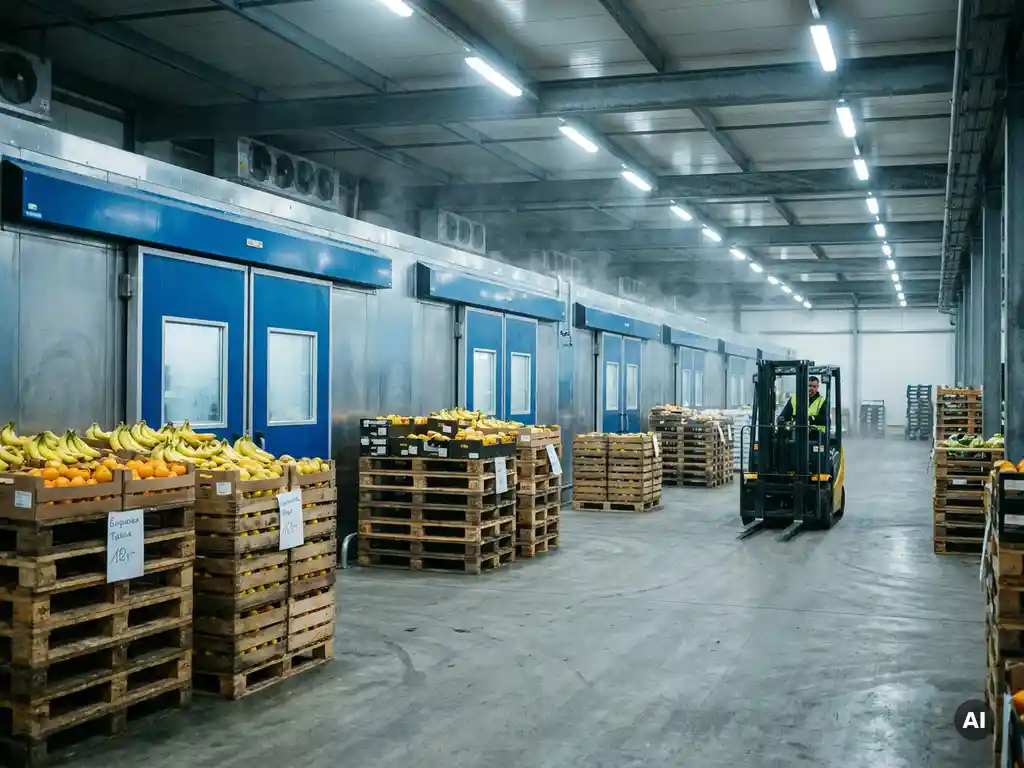
Factories opt for outsourcing intermediate storage in Europe because it enables them to reduce logistics costs, limit operational risks, and focus entirely on their core activities. Instead of investing in their own cooling capacity, infrastructure, and personnel, they engage specialized storage partners who flexibly adapt to production and delivery rhythms. The following questions elaborate on the key considerations.
What are the benefits of outsourced intermediate storage for factories?
Outsourcing intermediate storage gives factories direct access to specialized infrastructure, certified storage, and logistical expertise without having to invest in buildings, facilities, or personnel themselves. The primary advantage is flexibility: capacity scales with demand, without fixed costs that continue during low occupancy.
In addition, outsourcing offers access to storage locations strategically situated near ports or major distribution routes in Europe. This significantly shortens the lead time between the arrival of goods and further processing or delivery. For factories working with fresh or perishable products, this difference in transit and storage time directly impacts product quality.
Other benefits are:
- Access to certified storage environments (such as BRC-certified facilities)
- Professional management of temperature, humidity, and air circulation
- Lower administrative burden regarding compliance and inspections
- Improved scalability during seasonal peaks or unexpected volume changes
- Possibility of combined services such as customs clearance and import inspection
What costs do factories save by outsourcing intermediate storage?
By outsourcing intermediate storage, factories avoid the high fixed costs of their own cooling capacity: investments in buildings, refrigeration systems, maintenance, energy, and specialized personnel. With in-house management, these cost items are largely fixed, whereas outsourcing converts them into variable costs that fluctuate with actual usage.
Specifically, this concerns savings in the following areas:
- Capital investments: no purchase or lease of cold storage space, installations, or internal transport equipment
- Energy costs: cooling is energy-intensive; a specialized partner spreads those costs across multiple customers.
- Personnel costs: no in-house warehouse staff required for storage, management, and monitoring
- Maintenance costs: technical maintenance of cooling systems is the responsibility of the storage partner
- Compliance costs: certifications and audits are managed and financed by the partner.
In addition to direct cost savings, factories also avoid hidden costs such as quality loss due to suboptimal storage, losses due to temperature deviations, and fines for non-compliance with certification requirements.
How does temperature-controlled intermediate storage work in Europe?
Temperature-controlled intermediate storage in Europe entails that goods are stored in a climate-controlled environment where temperature, humidity, and air circulation are continuously monitored and adjusted. The settings are tailored to the specific requirements of the product, ensuring that quality and shelf life are optimally maintained during the storage period.
Modern cold storage facilities in Europe operate with automated monitoring systems that are active 24 hours a day, 7 days a week. Deviations are immediately detected and corrected, which significantly reduces the risk of quality loss. The storage locations are typically equipped with flexible climate zones, allowing different product types with varying requirements to be stored in the same warehouse.
For goods transported by sea, the location of the cold storage facility plays a crucial role. A storage facility directly on the quay eliminates additional transport steps and the associated temperature fluctuations, resulting in a significant quality advantage, particularly for fresh products.
Which products are suitable for outsourced intermediate cold storage?
Products suitable for outsourced intermediate cold storage are fresh, perishable goods that require precise temperature and humidity control to guarantee quality and shelf life. Examples include exotic fruits such as bananas and citrus fruits, as well as other fresh food products that are sensitive to temperature fluctuations.
In addition to refrigerated products, there are also goods that benefit from conditioned dry storage, such as nuts, peanuts, and seeds. These products do not require refrigeration, but they do require stable environmental conditions to prevent spoilage, mold formation, or loss of quality. For this type of product, conditioned dry storage a suitable and cost-effective solution.
Products less suitable for standard intermediate cold storage include hazardous materials, pharmaceuticals, and products requiring special vacuum storage. It is always advisable to check with a storage partner in advance whether the facility and certifications align with the specific product requirements.
What are the risks of in-house intermediate storage for factories?
In-house intermediate storage entails significant operational and financial risks for factories. The greatest risk is that the in-house cooling capacity is not flexible enough to adapt to fluctuations in production or supply, leading to overcapacity during quiet periods or shortages during peak demand.
Other risks are:
- Technical malfunctions: a defective refrigeration system can lead to large-scale loss of quality or complete loss of stock.
- Compliance risk: independently meeting certification requirements such as BRC or SKAL requires continuous investment and expertise.
- Operational complexity: in-house storage requires specialized personnel, planning capacity, and management attention that comes at the expense of the core business.
- Location disadvantage: own warehouses are rarely optimally located in relation to ports or distribution routes, which leads to additional transport costs and longer transit times.
For factories not primarily active in logistics, in-house intermediate storage is therefore rarely the most efficient choice. In most cases, the operational burden and risk profile do not outweigh the perceived control that on-site storage offers.
How do you choose the right partner for intermediate storage in Europe?
You choose the right partner for intermediate storage in Europe based on location, certifications, technical capabilities, and demonstrable experience with your type of product. A partner located near a seaport, certified for food safety, and equipped with flexible climate zones offers the best guarantees for quality preservation and logistical efficiency.
Take the following criteria into account during the selection:
- Location and port connectivity: is the storage facility accessible by sea, road, and rail without unnecessary additional transport?
- Certifications: Does the partner hold relevant certifications such as BRC, SKAL, or Demeter for your product category?
- Technical infrastructure: are 24/7 monitoring, flexible climate zones, and proven temperature management systems present?
- Additional services: can the partner also handle import inspections, customs clearance, and container handling?
- Flexibility: does the partner adapt to your delivery rhythm and volume fluctuations, or do you work with fixed, inflexible contracts?
Always ask potential partners for references within your product category and preferably have the facility physically assessed before concluding an agreement.
How ZZColdstores helps with outsourcing intermediate storage
ZZColdstores supports factories and supply chain partners with the complete outsourcing of temperature-controlled and dry intermediate storage in Europe. From locations in Kruiningen and Vlissingen, with its own quay directly next to the cold storage facility in Vlissingen, ZZColdstores offers a continuous logistics chain from arrival to storage.
What ZZColdstores specifically offers:
- Climate-controlled cold storage with 24/7 monitoring of temperature, humidity, and air circulation
- Dry storage with a capacity of 12,000 pallet spaces for nuts, peanuts, seeds, and other food products
- Container handling and direct unloading at our own quay in Vlissingen
- Import inspection via KCB (part of the NVWA) and customs clearance
- Certifications: BRC, SKAL and Demeter
- Flexible storage tailored to the sailing schedule of arriving ships
Would you like to know if outsourcing intermediate storage to ZZColdstores aligns with your supply chain? Contact us for a no-obligation consultation with our specialists.
Author: Frans van der Maas, Operations Director at ZZColdstores
Frequently Asked Questions
How long does it take on average to successfully outsource intermediate storage to an external partner?
The onboarding lead time varies by partner and product type, but generally allow two to six weeks for the full setup. During this period, contracts are finalized, product-specific storage protocols are established, and reporting and monitoring systems are set up. Good preparation—including a visit to the facility and the submission of product specifications—significantly shortens this period.
What happens if my storage volume suddenly increases sharply, for example due to a large order or seasonal peak?
A professional storage partner is specifically equipped to handle volume fluctuations and can, in most cases, quickly free up extra capacity. During contract negotiations, explicitly discuss how the partner handles peak demand: are there guarantees on minimum available space, or do you work based on availability? Transparent agreements on this in advance prevent operational surprises when it really matters.
As a factory, how do I keep track of my inventory if storage is outsourced?
Reliable warehousing partners offer access to a digital inventory management system (WMS) that provides real-time insight into inventory movements, temperature logs, and inbound and outbound movements. When selecting a partner, specifically ask about the possibilities for reporting and system integration with your own ERP or supply chain software. Good information transparency is a basic requirement, not a luxury.
Which certifications are most relevant for the storage of food products in Europe?
For food products, BRC (British Retail Consortium) and IFS (International Featured Standards) are the most common and widely recognized certifications in Europe. Depending on your product category, additional certifications may be relevant, such as SKAL for organic products or Demeter for biodynamic products. Always check whether the storage partner's certifications align with the requirements of your customers and the markets you supply.
Can a storage partner also arrange customs clearance and import inspection for me, or do I have to organize that myself?
Many specialized warehousing partners offer these services as part of an integrated logistics package, which significantly reduces the administrative burden for you as a factory. Examples include import inspections via agencies such as the NVWA or KCB, and customs procedures for goods from outside the EU. When selecting a partner, check whether these services are performed in-house or through external parties, as this affects lead time and coordination.
Is outsourced intermediate storage also suitable for smaller factories with limited volumes?
Yes, outsourcing is actually attractive for smaller factories as well, because they completely avoid the high fixed costs of their own cooling infrastructure and only pay for capacity actually used. However, it is wise to check in advance whether a partner's minimum purchase requirements match your volumes. Some storage partners work with minimum pallet quantities or contract durations; compare multiple providers to find the best match.
What are the most common mistakes factories make when choosing a storage partner?
A common mistake is selecting a partner based purely on price, without paying sufficient attention to location, certifications, and technical capabilities. Additionally, factories frequently underestimate the importance of flexibility agreements: fixed, inflexible contracts can be costly with fluctuating production volumes. Finally, we recommend always requesting references within the same product category and physically visiting the facility before signing.