
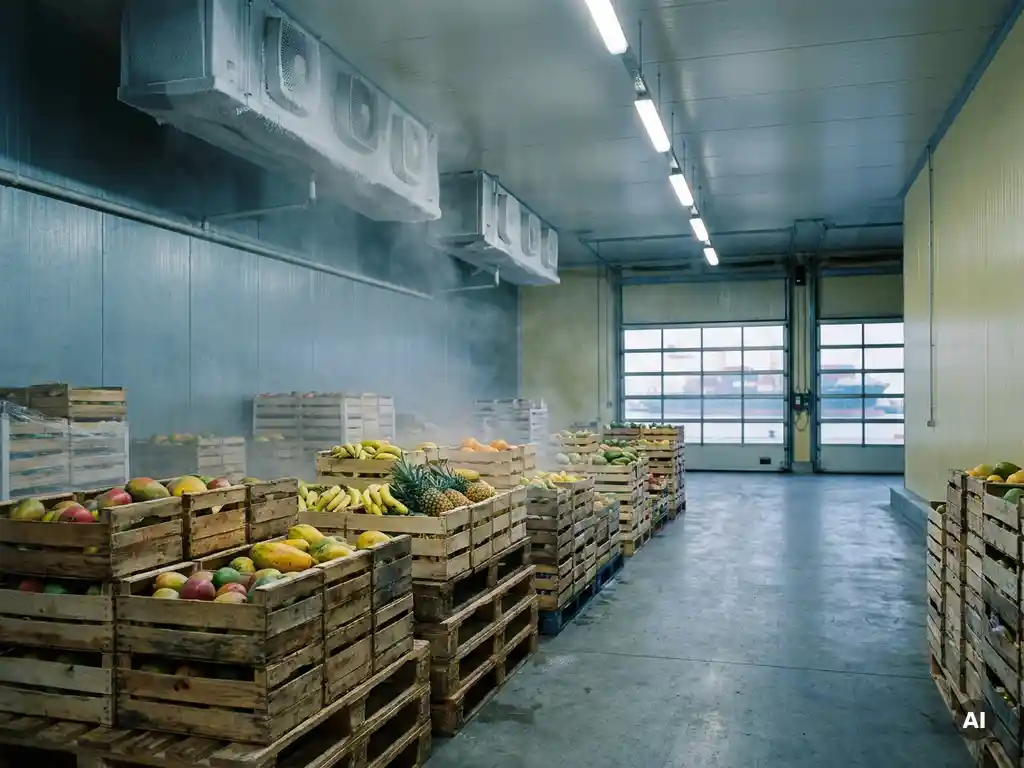
Yes, you can rent storage space for import shipments that are not being delivered immediately. This is a common practice in international trade, where goods are temporarily stored upon arrival until they are ready for distribution, processing, or further sale. Both refrigerated and dry storage space is available, depending on the product type and the required conditions.
For B2B parties such as importers, wholesalers, and supermarket suppliers, temporary storage offers flexibility in the supply chain: you do not have to deliver immediately the moment a ship unloads. The questions below provide a clear overview of everything you need to know about renting storage space for import parties.
What kind of goods are suitable for temporary storage space?
Virtually all food products imported are suitable for temporary storage, provided the correct storage conditions are offered. This applies to both fresh and perishable products requiring climate control, as well as dry foodstuffs that can be stored stably at a constant temperature.
Concrete examples of goods that are regularly temporarily stored after import:
- Exotic fruits such as bananas and citrus fruits, which require precise temperature and humidity control
- Vegetables and other fresh products that are sensitive to temperature changes
- Nuts, peanuts, and seeds, which are stored dry and at a stable temperature
- Other dry foods such as cereals or dried fruits that tolerate ambient storage
Each product places different demands on the storage environment. Fresh and fragile products are particularly sensitive to changes in temperature, humidity, and air circulation. Dry products such as nuts and seeds require a stable, dry environment without extreme temperature fluctuations. It is therefore essential that the storage facility can set and monitor the correct conditions for each product category.
How does renting storage space work for an import party?
Renting storage space for an import consignment begins with the arrival of the goods, usually by container via a seaport. The operator receives the goods, performs a quality control check, and places the consignment in the appropriate storage cell. The goods then remain stored until you, as the client, indicate that they need to be delivered.
In practice, the process proceeds as follows:
- Arrival and unloading: Containers are unloaded, whereby products are immediately checked for damage, temperature deviations, and packaging condition.
- Quality control: Shipments are inspected upon arrival. Depending on the product, temperature, humidity, and Brix measurements may also be performed.
- Palletizing and storage: Goods are palletized or repalletized if necessary and provided with barcodes for traceability.
- Storage until delivery: The consignment is placed in the correct storage cell and monitored until you authorize delivery or further processing.
- Delivery: At the agreed time, the goods are prepared for transport to the next link in the chain.
Modern warehouses use barcode-driven traceability, where every pallet is fully traceable via grower and lot numbers. This provides clients with continuous insight into the status of their batch.
What is the difference between cold storage and dry storage for imported goods?
The main difference between cold storage and dry storage is the temperature and the level of climate control. Cold storage, also known as climate-controlled storage, is intended for fresh and perishable products that require a specific, low temperature and precise humidity. Dry storage, also known as ambient storage, is suitable for products that can be stored stably at a higher, but controlled temperature.
Cold storage: for fresh and perishable products
In climate-controlled cold storage, temperature, humidity, and air circulation are monitored and regulated 24/7. The settings can be adjusted per cell to the specific requirements of the product. This type of storage is indispensable for exotic fruits, vegetables, and other fresh products that deteriorate rapidly in quality under unsuitable conditions.
Dry storage: for stable food products
Dry storage is suitable for products that do not require refrigeration but do require a stable, controlled environment. Nuts, peanuts, seeds, and other dry food products are typically stored at approximately 11 degrees. A good dry storage warehouse features separate areas for different product categories to prevent cross-contamination or odor transfer.
How long can you rent storage space for an import shipment?
The storage duration for an import consignment is in principle flexible and is tailored to the client's logistical needs. There is no fixed minimum or maximum storage period that applies to all consignments. The duration depends on factors such as the product type, the shelf life of the goods, agreements with buyers, and the distribution schedule.
Practical considerations that determine the storage duration:
- Product shelf life: Fresh products have a shorter maximum storage duration than dry foods. Bananas and citrus fruits require a rapid turnover; nuts and seeds have a longer shelf life.
- Distribution planning: When goods are delivered to supermarkets or processing plants at a later stage, temporary storage provides the necessary buffer.
- Ship's sailing schedule: Upon arrival via a seaport, the storage duration sometimes depends on the unloading schedule and the subsequent transport planning.
- Seasonal demand: Importers who purchase large quantities at the peak of the harvest use storage as a buffer to meet demand over an extended period.
A reliable storage partner adapts to ship sailing schedules and client delivery schedules, ensuring that storage aligns seamlessly with the broader supply chain.
Which certifications are important when renting storage space for food products?
When renting storage space for food products, certifications are a direct indicator of quality, food safety, and compliance with laws and regulations. The most relevant certifications for import batches of food products are BRC, SKAL, and KCB/NVWA.
- BRC (British Retail Consortium): An internationally recognized food safety standard demonstrating that a warehouse meets stringent requirements regarding hygiene, traceability, and product quality. Required by many supermarket chains and processing plants.
- SKAL: Relevant for organic products. SKAL certification guarantees that organic goods are stored separately and that the organic status is maintained throughout the entire logistics process.
- KCB/NVWA: The KCB (Quality Control Bureau), part of the NVWA, is responsible for the import inspection of fresh fruit and vegetables. A storage partner that can facilitate this inspection significantly accelerates the customs and import process.
- Demeter: For biodynamic products, a supplement to SKAL certification for the strictest organic standards.
Always verify whether the storage partner holds the certifications required by your customers or legislation. Missing certifications can lead to rejections, delays, or the loss of product organic status.
Where in the Netherlands can you rent storage space close to a seaport?
For import consignments arriving by sea, the proximity of a seaport is a crucial factor. The shorter the distance between the ship and the storage location, the fewer temperature fluctuations and quality losses occur during transport from the hold to the warehouse. In the Netherlands, the most important locations for port-related storage can be found in the Rotterdam-Antwerp corridor.
Relevant storage locations in the Netherlands for import batches:
- Rotterdam: The largest port in Europe, with a wide range of cold and dry storage facilities in the immediate vicinity.
- Vlissingen: A strategic port location in Zeeland, with a direct quay connection for seagoing vessels. The short distance between the ship and the storage cell minimizes quality risks for fresh products.
- Kruiningen: Located in Zeeland, a short distance from Vlissingen, with facilities for both cold and dry storage and shuttle transport to the port.
- Antwerp (Belgium): Although just across the border, Antwerp is part of the same logistics corridor and is frequently used by Dutch importers.
For importers distributing goods from Zeeland to Germany or other European markets, locations in Vlissingen and Kruiningen offer a favorable geographical position in the supply chain.
How much does it cost to rent storage space for import shipments?
The costs of renting storage space for import shipments vary widely and depend on multiple factors. There is no fixed market price that applies to all situations. The final costs are determined by the type of storage, the number of pallet spaces, the storage duration, and the additional services purchased.
Factors influencing the price:
- Storage type: Climate-controlled cold storage is generally more expensive than dry ambient storage, due to higher energy costs and technical requirements.
- Volume and pallet spaces: Larger volumes often lead to lower costs per pallet. The price is typically calculated per pallet space per week or per month.
- Storage duration: Short-term storage can be billed per day or week; long-term storage is often invoiced on a monthly basis.
- Additional services: Quality control, repalletization, labeling, EDI connections, and shuttle transport are typically priced separately as value-added services.
- Location: Storage locations directly on a quay or in a port area may have a higher price than locations further from the port.
For an accurate price indication, it is advisable to contact a storage partner directly. Prices are always determined on a case-by-case basis, depending on the specific goods, volume, and desired services.
How ZZColdstores helps with temporary storage of import batches
ZZColdstores offers both climate-controlled cold storage and dry ambient storage in Kruiningen and Vlissingen for import shipments temporarily stored for further distribution. With its own quay in Vlissingen, goods are stored immediately after unloading from the ship, minimizing quality loss due to unnecessary transport.
What ZZColdstores offers for importers and logistics partners:
- Climate-controlled storage with 24/7 monitoring of temperature, humidity, and air circulation, tailored to the specific product
- Dry storage with a capacity of 12,000 pallet spaces, with separate areas for nuts, peanuts, seeds, and other dry food products
- Quality control upon arrival, including temperature, humidity, and Brix measurements and reporting
- Repalletization, labeling, and barcode-driven traceability per pallet
- EDI connections for automatic order processing and inventory updates
- Shuttle transport between production locations and the warehouse in Kruiningen (radius up to 40 km)
- Certifications: BRC, SKAL, and Demeter, with facilitation of KCB/NVWA import inspection
Would you like to know which storage solution best suits your import shipments? Contact ZZColdstores for a no-obligation discussion about the possibilities.
Frequently Asked Questions
Can I rent storage space for a one-off import shipment, or do I need to take out a long-term contract?
You can rent storage space for both one-off batches and on a structural basis. Most professional storage partners work with flexible arrangements tailored to your specific situation, without you being tied to a long-term contract. This also makes temporary storage attractive for importers who purchase large batches on an occasional basis, for example during a seasonal harvest.
What happens if my goods do not meet the quality requirements upon arrival?
With a professional storage partner, a quality control is performed immediately upon arrival. If deviations are detected — such as temperature damage, packaging issues, or a Brix value that is too low — you, as the client, are notified immediately via an inspection report. You can then decide in consultation whether the batch should still be stored, returned, or rejected. Prompt detection prevents damaged goods from affecting the rest of the batch.
How do I, as an importer, keep track of my stored stock?
Modern warehouses utilize barcode-driven traceability and Warehouse Management Systems (WMS) that make every pallet fully traceable based on grower and lot numbers. Via EDI connections or a customer portal, you as a client can gain real-time insight into the status, location, and quantity of your stored batch. This makes it easy to plan delivery orders and monitor inventory levels without needing to be physically present.
Can I also have my import batch processed or repacked during the storage period?
Yes, many storage partners offer so-called value-added services alongside the storage itself. Examples include repalletization, labeling, sorting, repackaging, or applying product-specific barcodes. This is particularly useful if you want to prepare goods for direct delivery to supermarket chains or processing plants with specific packaging or labeling requirements. Discuss these requirements with your storage partner in advance to ensure the necessary capacity and resources are available.
What is the difference between storage in a customs bonded warehouse and regular temporary storage?
Storage in a bonded warehouse involves storing goods without the immediate payment of import duties or VAT — this is deferred until the goods enter the EU market. This is advantageous if you import goods that you intend to (partially) transit to countries outside the EU, or if you wish to spread the tax payment. Regular temporary storage assumes that the goods have already been cleared and customs formalities have been completed. Which form is most suitable depends on your customs strategy and the destination of the goods.
How do I choose the right storage partner for my import shipments?
When choosing a storage partner, pay attention to at least four criteria: the available certifications (such as BRC, SKAL, or KCB/NVWA) required by your customers or legislation, the proximity of the port of arrival to minimize quality loss during transport, the technical climate control capabilities tailored to your product type, and the availability of additional services such as quality control and traceability. Always ask for a reference or visit the facility before entering into a partnership.
Can I rent storage space for imported organic products while maintaining their organic status?
Yes, but only if the storage partner holds a valid SKAL certification. This certification guarantees that organic products are stored strictly separately from conventional products and that the organic status is maintained throughout the entire logistics process. Furthermore, Demeter certification is required for biodynamic products. Always check this in advance, as storage with a non-certified party can lead to the loss of the organic status of your entire batch.