You outsource food storage when in-house storage capacity, climate control, or logistical expertise becomes a bottleneck in your supply chain. For B2B companies working with fresh, temperature-sensitive, or dry food products, outsourcing is often the most reliable way to ensure quality and keep operational costs manageable. The questions below will help you determine whether and when outsourcing is the right step for your situation.
What signals indicate that own storage is insufficient?
In-house storage falls short when you experience structural capacity problems, the climate control does not meet the requirements of your products, or when quality losses occur that can be directly traced back to storage conditions. These are not isolated problems, but structural signals that the current infrastructure can no longer keep up with growth or product demands.
Concrete signals to look out for:
- Products become damaged or lose quality during storage, despite proper supply
- You do not have the option to set temperature, humidity, and air circulation separately per product type
- Peaks in supply lead to overcrowded storage spaces or emergency solutions
- Quality checks upon arrival or delivery are missing or insufficiently structured
- Traceability of pallets and batches is limited or manual, and therefore prone to errors
- Certifications such as BRC or SKAL are required by customers, but are not feasible with the current facilities
As soon as multiple of these signals occur simultaneously, it makes sense to seriously investigate whether outsourcing food storage offers a better solution.
What are the benefits of outsourced food storage?
Outsourced food storage offers three core benefits: access to specialized climate-controlled infrastructure without capital investment, professional quality assurance along the entire flow of goods, and operational flexibility that your own capacity cannot provide. For B2B companies in the agri-food sector, these are typically the decisive arguments.
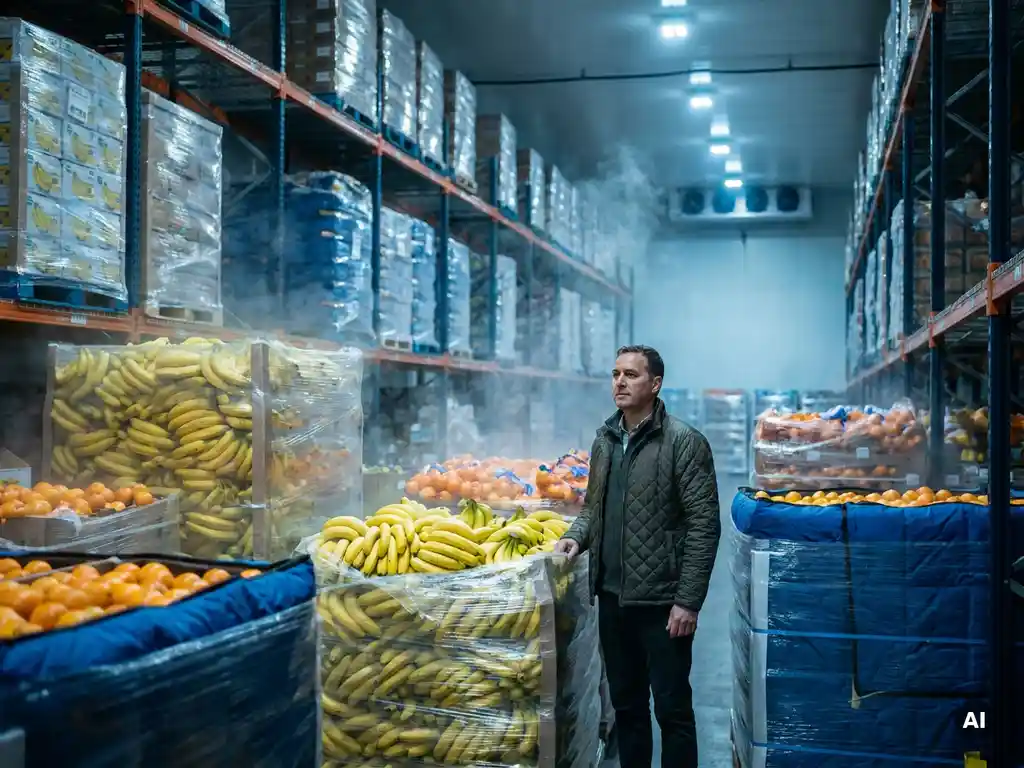
When working with fresh products such as exotic fruit, vegetables, or nuts, storage requirements are specific and demanding. Temperature fluctuations, incorrect humidity, or insufficient air circulation can quickly lead to irreversible quality loss. A specialized storage partner has climate-controlled chambers that are configured per product type and are continuously monitored.
In addition, outsourced warehousing partners take over logistical tasks that consume a lot of time and manpower internally: quality control upon arrival, repalletization, labeling, barcode-driven traceability, and EDI connections with your systems. This accelerates throughput and reduces the risk of errors in the order processing chain.
Finally, outsourcing offers scalability. You pay for the capacity you actually use, without fixed costs for space that stands empty during quiet periods.
Which types of food products are most suitable for outsourced storage?
Food products most suitable for outsourced storage are those with specific climate requirements, a short shelf life, or a high risk of quality loss due to improper storage conditions. Examples include exotic fruits, citrus fruits, nuts, seeds, and other temperature-sensitive agricultural products.
Fresh and climate-sensitive products
Products such as bananas and citrus fruits require precise control of both temperature and humidity. A temperature that is too low can cause cooling damage, while a temperature that is too high accelerates the ripening process. Only specialized climate chambers with continuous monitoring can guarantee this balance.
Dry food products with specific conditions
Nuts, peanuts, and seeds are preferably stored at a stable temperature of approximately 11 degrees, in a dry environment without humidity fluctuations. This requires a different type of storage facility than standard warehouse space, but less intensive climate control than refrigerated fruit. For this category, ambient warehousing with controlled conditions is the appropriate solution.
Products that are less suitable for outsourced storage are goods without specific climate requirements, bulk products with a long shelf life that require little handling, or products for which you already have certified internal facilities that meet your customers' requirements.
How much does it cost to outsource food storage?
The costs of outsourced food storage depend on the product type, the required climate conditions, the volume, the desired additional services, and the duration of the agreement. There is no fixed market price, as the cost structure varies significantly depending on the situation.
Factors that determine the price:
- Storage type: climate-controlled cold storage is more expensive than dry ambient storage
- Volume and utilization rate: higher volumes generally lead to lower costs per pallet space
- Handling: unloading, loading, repalletizing, quality control, and labeling are typically priced as separate services.
- Added services: EDI connections, barcode traceability, and reporting may incur additional costs.
- Location and logistical integration: proximity to the port or a private quay can significantly reduce transport costs.
Comparing costs only makes sense if you include the entire cost structure: not only the storage price per pallet, but also the avoided costs of quality loss, own staff deployment, certification costs, and investments in infrastructure.
How do you choose the right storage partner for food products?
The right food storage partner possesses the appropriate certifications for your product category, has demonstrable experience with similar goods flows, and can manage the entire chain from arrival to delivery. Certifications such as BRC, SKAL, and KCB/NVWA approval are a strict requirement for many customers in the supermarket and processing industries.
What to look for during the selection:
- Certifications: are BRC, SKAL, or other relevant quality marks present and up-to-date?
- Climate infrastructure: can the partner set up separate climate chambers per product type?
- Traceability: are pallets and batches fully tracked via a barcode system?
- Location: Is the storage location conveniently situated in relation to your supply routes, such as the Rotterdam-Antwerp corridor?
- Flexibility: can the partner scale up during peaks and adapt to your sailing schedule or delivery rhythm?
- Additional services: does the partner also offer quality control, customs clearance, repalletization, and EDI integration?
A partner that only offers storage but does not provide quality control, traceability, or customs services forces you into extra links in the chain. This increases the risk of errors and extends lead times.
When does in-house storage remain the better choice?
In-house storage remains the better choice when your products have no specific climate requirements, you have sufficient certified capacity, and the logistical integration with your own production or distribution process is so close that external storage costs more coordination than it yields.
This is usually the case with:
- Products with a long shelf life and low sensitivity to temperature fluctuations
- Companies with a stable, predictable flow of goods without seasonal peaks
- Organizations that already have certified storage facilities that meet the requirements of their customers
- Situations where the distance to an external storage location increases transport costs and risks to an unacceptable degree
Ultimately, the trade-off is not solely financial. If in-house storage leads to quality risks, insufficient traceability, or the inability to meet customer certification requirements, those disadvantages outweigh the direct cost benefits of internal management.
How ZZColdstores helps with food storage
ZZColdstores offers a fully integrated solution for food storage, both refrigerated and dry. Active since 1994, with locations in Kruiningen and Vlissingen, ZZColdstores supports importers, wholesalers, and suppliers in the agri-food sector with:
- Climate-controlled storage with 24/7 monitoring of temperature, humidity, and air circulation, adjustable per product type
- Dry ambient storage for nuts, seeds, and other food products at approximately 11 degrees, with a capacity of 12,000 pallet spaces
- Quality control upon arrival, including temperature, humidity, and Brix measurements and comprehensive QC reports
- Barcode-driven traceability of every pallet, including grower and LOT numbers
- Repalletization, labeling, box picking, and EDI connections as part of the logistics chain
- Own quay in Vlissingen for direct transshipment from the hold to cooling
- Certifications: BRC, SKAL and Demeter
Would you like to know if outsourced food storage at ZZColdstores aligns with your goods flow and logistical requirements? View our range of climate-controlled storage or contact us directly for a discussion about your specific situation.
Frequently Asked Questions
How long does it take on average to complete the transition to outsourced storage?
The lead time for a transition to outsourced food storage typically varies between two and six weeks, depending on the complexity of your goods flow and the required system integrations, such as EDI connections. During this period, climate profiles are established per product type, traceability systems are set up, and operational agreements are made regarding delivery schedules and quality protocols. A phased transition—starting with one product category—significantly reduces operational risk.
What happens if my products do not meet the quality standards upon arrival?
A professional storage partner performs a structured quality control upon arrival, including temperature, humidity, and Brix measurements, and records the findings in a QC report. Based on this, you can take immediate action towards the supplier or carrier, even before the products enter the supply chain. This gives you a strong legal and commercial position, something that is often lacking with in-house storage without formal incoming inspection.
Can I combine outsourced storage with my own warehousing or distribution activities?
Yes, outsourced storage does not have to be an all-or-nothing choice. Many B2B companies use external storage capacity to supplement their own facilities, for example for seasonal peaks, specific climate categories, or products for which they do not have certification. Through EDI connections and barcode-driven traceability, the flow of goods remains fully visible within your own systems, ensuring smooth integration with internal logistics processes.
Which certifications do I, as the client, need to have myself, and which are the responsibility of the storage partner?
The certifications required for the storage facility itself — such as BRC, SKAL, or Demeter — are held by the storage partner and are a prerequisite for choosing that partner in the first place. As the client, you are personally responsible for the certifications relating to your product or trading position, such as organic trade certification or import permits. It is advisable to discuss with your storage partner in advance which certifications are required in your specific purchasing situation to ensure that no gaps arise in the chain.
How is my inventory monitored, and how do I, as the client, keep track of my products?
Professional warehousing partners work with barcode-driven Warehouse Management Systems (WMS) that register every pallet movement, including LOT numbers, grower information, and location data. As a client, you typically gain access to real-time inventory reports and can synchronize your own ERP or order system with the inventory status via EDI connections. This eliminates manual counts and gives you full insight at any time into what is in stock, where it is located, and when it was received or shipped.
What are the most common mistakes when selecting a food storage partner?
The most common mistake is comparing partners solely on the price per pallet space, without taking into account the total cost structure, including handling, quality control, and certification value. A second common mistake is failing to verify whether the climate infrastructure is actually individually adjustable per product type — generic cold storage facilities often do not meet the specific requirements of, for example, exotic fruit or organic products. Always ask for references with similar goods flows and have the certifications shown before concluding an agreement.
Is outsourced storage also beneficial for smaller volumes or seasonal supply?
Especially for smaller volumes and seasonal supply, outsourced storage can be financially more attractive than in-house facilities, because you only pay for the capacity you actually use. With in-house storage, you pay for fixed costs such as energy, maintenance, and personnel even during quiet periods. Always discuss the minimum volumes and flexibility margins in the contract with a potential partner so that you do not get stuck in the event of an unexpectedly lower seasonal volume.
Related articles
- Can you store different food products refrigerated at the same time?
- What should you look out for when outsourcing food storage?
- What influence does storage time have on refrigerated food products?
- What are the NVWA rules for import inspection of dried fruit in 2026?
- Why is conditioned storage better than a regular warehouse for nuts?