
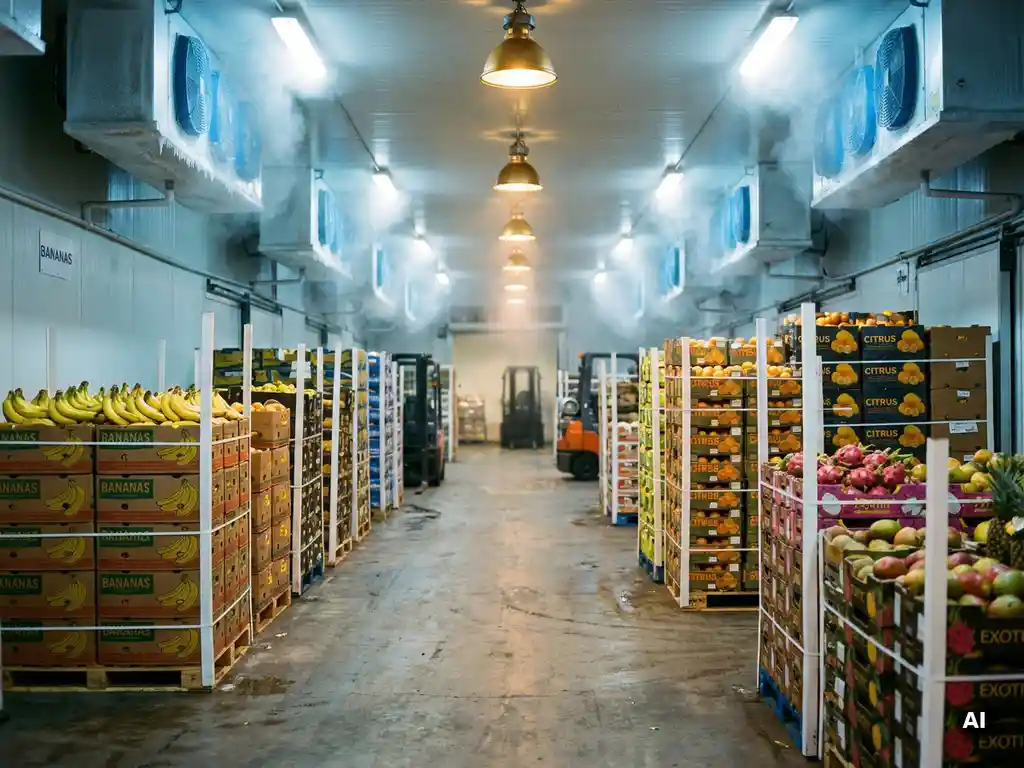
Yes, various food products can be stored under refrigeration simultaneously, but only if the storage is properly set up to meet the specific requirements of each product. Temperature, humidity, and ethylene sensitivity determine which products can be stored together and which must be kept strictly separate. The questions below answer the most frequently asked practical questions regarding mixed cold storage in a professional warehouse.
Which food products must not be stored together?
Products that produce ethylene must not be stored together with products that are ethylene-sensitive. Ripe fruit such as bananas and citrus fruits emit ethylene gas, which accelerates the ripening process of other products. In addition, products with significantly different temperature requirements, such as tropical fruit and products stored close to freezing point, must never be kept in the same room.
In practice, there are three main criteria that determine whether products can be stored together:
- Ethylene production and sensitivity: Bananas, avocados, and mangoes produce ethylene. Products such as citrus fruits, nuts, and seeds are sensitive to this gas and ripen or spoil more quickly upon exposure.
- Temperature requirements: Tropical fruit does not tolerate temperatures below 12 degrees Celsius. Products stored at 2 to 4 degrees cannot be kept in the same cell as banana boxes at 14 degrees.
- Moisture transfer and odor transfer: Products with a high moisture content can cause condensation on dry products such as nuts and peanuts, which promotes mold formation.
Anyone wishing to store multiple product categories simultaneously must create a clear segregation matrix for each product type in advance. Without this separation, you run the risk of quality loss that only becomes apparent upon delivery.
What is the risk of ethylene gas in mixed cold storage?
Ethylene gas is a colorless, odorless gas emitted by ripening fruit that significantly accelerates the ripening process of surrounding products. In mixed cold storage without proper ventilation or compartmentalization, a batch of ripe fruit can cause an entire adjacent load of unripe products to ripen prematurely, resulting in direct economic damage for importers and wholesalers.
The concentration of ethylene in a closed cold storage unit rises rapidly if there is no active air circulation. Even small amounts, in the order of a few parts per million, are sufficient to measurably affect sensitive products. For trade consignments with tight shelf-life margins, such as exotic fruit arriving by ship and going directly to a processing plant or supermarket distribution center, this can mean the difference between an approved and a rejected shipment.
Professional cold storage utilizes active ventilation and separate cells with individual air treatment per product group. This prevents ethylene buildup without sacrificing the temperature within the cell.
Which temperature zones are needed for different food products?
Most food products fall into three main zones: cool storage between 0 and 4 degrees Celsius for temperate products, climate-controlled storage between 10 and 14 degrees for tropical and subtropical fruit, and dry storage around 11 degrees for nuts, seeds, and peanuts. Each product has a specific optimum, and deviations of more than two degrees can already lead to loss of quality or cold damage.
Tropical and subtropical fruit
Bananas are typically stored at 13 to 14 degrees Celsius. Citrus fruits such as oranges and grapefruits require slightly lower temperatures, usually between 8 and 12 degrees, depending on the variety and ripening stage. Mangoes and avocados are stored at 10 to 13 degrees. Temperatures below 8 degrees cause cold damage in these products, visible as browning and taste defects.
Dry products and nuts
Nuts, peanuts, and seeds are not refrigerated in the traditional sense, but they do require a controlled ambient temperature of approximately 11 degrees and low humidity. Excessive humidity promotes mold growth and contamination by mycotoxins, which in the case of food products leads directly to rejection by the NVWA or, during import inspections, by the KCB.
How does compartmentalization work in a professional cold storage facility?
Compartmentalization in a professional cold storage facility means that the warehouse is divided into separate cells or zones, each with its own climate control system, air circulation, and temperature control. This allows multiple product categories to be stored simultaneously without affecting each other's quality. Each cell functions as an independent storage unit with its own monitoring.
In practice, this means that a cold storage facility with compartmentalization contains the following elements:
- Physically separated cells with insulated walls and private cooling systems
- Separate air handling units per cell, so that ethylene and moisture do not circulate between cells
- Digital temperature and humidity recording per cell, 24 hours a day
- Flexible settings per cell, so that the climate can be adjusted per batch
Good compartmentalization also makes it possible to keep products with different lead times or destinations separate. A batch that is unloaded the same day and departs the very next morning has different storage requirements than a batch that remains in storage for two weeks for further distribution to Germany or Ukraine.
What are the certification requirements for the storage of multiple food categories?
For the storage of multiple food categories in a single warehouse, multiple certifications are required in most cases. The most important are BRC (British Retail Consortium) for food safety, SKAL for organic products, and KCB/NVWA for import inspection of fresh fruit and vegetables. Which certifications are mandatory depends on the product categories and the customers.
BRC is the standard required by most European supermarket chains and processing plants as a basic requirement for their suppliers. The certificate sets requirements for hygiene, traceability, separation of product flows, and recording of temperature data. For organically certified products, SKAL certification applies in addition, which sets requirements for the separation of organic and conventional products in the warehouse.
For importers of fresh produce from countries outside the EU, the KCB inspection, carried out on behalf of the NVWA, is mandatory upon arrival. This applies specifically to fruit and vegetables entering via Dutch ports. A warehouse facilitating this inspection must comply with the associated layout requirements and registration obligations. Combining multiple product categories in a single warehouse therefore requires a carefully designed quality system that maintains the correct documentation for each category.
When is dry storage better than refrigerated storage for food products?
Dry storage is better than refrigerated storage when products cannot tolerate elevated humidity, are not perishable in the classic sense, or when refrigeration actually damages the product. Nuts, peanuts, seeds, and dried food products belong in dry storage at a constant temperature of approximately 11 degrees, not in a cold room with high humidity.
In practice, the choice between dry and refrigerated storage revolves around three questions:
- Is the product sensitive to moisture? Nuts and seeds absorb moisture from the environment, which causes mold formation and loss of quality. Dry storage with controlled humidity is the right choice in this case.
- Does the product tolerate cold temperatures? Tropical fruit suffers at temperatures below 8 degrees. But products like nuts also do not require active cooling, only a stable, cool environment.
- What are the customer's requirements? Processing plants and supermarket distribution centers sometimes set specific requirements for storage conditions. These requirements help determine whether dry or refrigerated storage is preferred.
Dry storage at 11 degrees is in many cases also more cost-efficient than active cooling, because the energy load is lower and the infrastructure is less complex. For importers and wholesalers distributing nuts, peanuts, or similar products to the European market, a certified dry warehouse with sufficient pallet capacity is therefore a logical choice.
How ZZColdstores facilitates mixed cold storage
ZZColdstores offers climate-controlled cold and dry storage in Kruiningen and Vlissingen, specifically designed to meet the requirements of importers, wholesalers, and suppliers of fresh food products. The locations are certified with BRC and SKAL and collaborate with KCB/NVWA for import inspections, allowing multiple product categories to be stored under one roof without compromising quality or certification.
What sets ZZColdstores apart for parties looking to store multiple product types:
- Separate climate chambers with flexible temperature and humidity settings per product group
- Dry storage warehouse with 12,000 pallet spaces for nuts, peanuts, seeds, and similar products at approximately 11 degrees
- Private quay in Vlissingen for direct transfer from ship to cooling, with minimal exposure to external conditions
- Barcode-driven traceability per pallet, with linking of grower and LOT numbers for full control
- Quality control upon arrival, including temperature, humidity, and Brix measurements per shipment
Would you like to know if your product combination is suitable for storage at ZZColdstores, or which storage solution best fits your supply chain? View the climate-controlled storage solutions or contact us for a tailored consultation.
Frequently Asked Questions
What is the maximum length of time tropical fruits such as bananas and mangoes can be stored in climate-controlled storage?
The maximum storage duration depends heavily on the ripening stage upon arrival and the exact temperature setting. Bananas can generally be stored in an unripe state at 13 to 14 degrees Celsius for two to four weeks before the ripening process accelerates irreversibly. Mangoes and avocados have a shorter margin of one to three weeks, depending on the variety and origin. It is therefore essential that the storage temperature is set correctly immediately upon arrival and that the batch is continuously monitored for temperature and ripening stage.
What do I need to arrange if I want to store multiple product categories in a professional cold storage facility for the first time?
Start by compiling an overview of all product categories you wish to store, including the required temperature zones, humidity, and any ethylene sensitivity per product. Subsequently, discuss this overview with the cold storage operator so that a segregation matrix and a customized storage plan can be created. Additionally, check which certifications your customers require, such as BRC or SKAL, and verify whether the cold storage facility meets those requirements before entering into an agreement.
How do I know if a party has suffered damage due to incorrect storage conditions, and who is liable for this?
Cold damage to tropical fruit often only manifests after some time as browning, taste deviations, or accelerated ripening, making it visible upon arrival at the buyer rather than immediately after unloading. A professional cold storage facility continuously records temperature and humidity per cell, allowing deviations to be demonstrated retrospectively via log data. Liability depends on the conditions upon arrival, the agreed storage specifications, and the demonstrable compliance therewith by the storage party. Always ensure an incoming inspection with recorded measurements serves as a baseline measurement when receiving the batch.
Can I store organic and conventional products simultaneously in the same cold storage without losing my SKAL certification?
Yes, that is possible, but only if there is a strict physical separation between organic and conventional products and if administrative traceability is maintained completely separately per batch. SKAL imposes a strict requirement that mixing or cross-contamination is demonstrably excluded, both physically and documentaryly. A cold storage facility with SKAL certification has the correct procedures and registration systems in place to guarantee this. When choosing a storage partner, always verify whether the SKAL certification actually applies to the specific cell or zone where your organic products are stored.
What is the difference between climate-controlled storage and conventional cooling, and when do I really need climate control?
Conventional refrigeration only regulates temperature, whereas climate-controlled storage also actively manages humidity, air circulation, and sometimes ethylene concentration. For products with narrow quality margins, such as fresh tropical fruit, exotic vegetables, or organic products for supermarket chains, climate control is not a luxury but a requirement. Without active humidity control, dry products such as nuts can absorb moisture and mold, while excessive humidity causes condensation and rot in certain types of fruit. Climate-controlled storage is particularly indispensable when products are stored for several weeks or when customers prescribe specific conditions as part of their purchasing specifications.
How is it prevented that odors from one product affect the quality or taste of another product during mixed storage?
Odor transfer between products is an underestimated risk in mixed cold storage and is prevented by using physically separated cells with their own air handling units, so that airflows are not exchanged between product groups. Products with strong odors, such as certain spices, garlic, or ripe fruit, should never be stored in the same cell as odor-absorbing products such as nuts, butter, or dairy. A good segregation matrix takes into account not only temperature and ethylene but also the odor profiles of the stored products. Discuss this explicitly with your storage partner when drawing up the storage plan.
What are the most common mistakes made when planning mixed cold storage, and how do I avoid them?
The most common mistake is underestimating the impact of ethylene: batches of ripe and unripe fruit are stored too close together without intermediate compartmentalization, resulting in premature ripening and economic damage. A second common mistake is failing to record a baseline measurement upon arrival, meaning that quality differences at the time of dispatch cannot be traced back to the storage period. Finally, the administrative separation between product categories, essential for certifications such as BRC and SKAL, is frequently underestimated. Avoid these errors by drawing up a detailed storage plan in advance, documenting incoming measurements, and only working with a certified storage partner who has demonstrable experience with your specific product combination.