
Warehousing limits delays in the supply chain by temporarily storing goods at strategic locations, ensuring that supply and demand align better and transport disruptions are mitigated. For B2B parties trading in fresh or perishable products, this effect is even greater: proper storage conditions prevent quality loss that would otherwise lead to rejection, rescheduling, and additional costs. This article answers the most frequently asked questions about the role of warehousing in an efficient supply chain.
What are the most common causes of delays in the supply chain?
The most common causes of supply chain delays are capacity shortages in storage or transport, unexpected peaks in demand, customs procedures that take longer than planned, and quality issues upon arrival of goods. For importers of fresh food products, temperature damage during transport adds an additional risk factor.
In practice, most delays occur at the transition between two links: from ship to storage, from storage to distribution, or from import to customs clearance. At each of these nodes, a lack of coordination or capacity can hold up the entire chain. When a ship arrives earlier or later than planned, the rest of the chain is immediately affected. Storage partners who cannot flexibly adjust their capacity and processes exacerbate this effect.
In addition, quality controls play a role. Products that do not meet the set standards upon arrival must be separated, assessed, and sometimes returned. Without a structured inspection process at the storage location itself, this takes extra time and delays delivery to the next link in the chain.
How does a strategic warehouse location prevent delays?
A strategic warehouse location shortens the time between the arrival of goods and further distribution because storage, transshipment, and transport are physically close together. The shorter the distance between unloading and storage, the lower the risk of temperature fluctuations, handling errors, and loss of time.
For importers working via Northwest European ports, the location of a cold storage or dry warehouse relative to the berth is crucial. When a cold storage facility is directly adjacent to the quay, goods can be stored under controlled conditions within minutes of unloading. That sounds simple, but in practice, it makes a significant difference in turnaround time and quality preservation, especially for fresh products that are sensitive to temperature fluctuations.
Furthermore, locations in the Rotterdam-Antwerp corridor offer logistical advantages for distribution towards Germany and other European destinations. The proximity to major ports, highways, and rail connections makes it possible to transport goods onward quickly and cost-efficiently once they have completed the storage phase.
What role does temperature-controlled storage play in lead time reduction?
Temperature-controlled storage shortens lead times because products remain in optimal condition longer, preventing unnecessary rejections, returns, and rescheduling. Fresh products stored outside the correct temperature range lose quality more quickly, leading to extra handling and delays further down the chain.
For fragile products such as exotic fruit, storage temperature is not only a matter of quality but also a planning tool. When bananas or citrus fruits are stored under the right conditions, an importer can better align deliveries with customer demand. This provides flexibility in planning without compromising freshness.
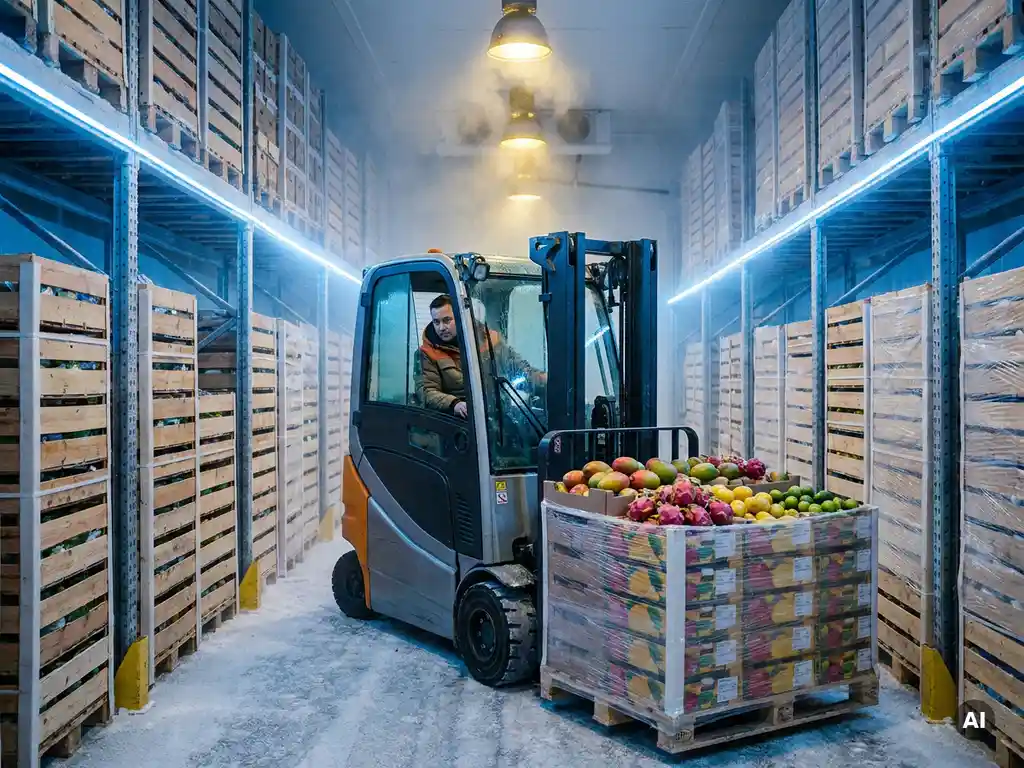
Climate-controlled facilities continuously monitor temperature, humidity, and air circulation. This makes it possible to store products longer without loss of quality, rendering the storage period usable as a buffer in the supply chain rather than a risk. More information regarding the possibilities of climate-controlled storage is available for parties working with fresh products.
How does flexible storage capacity help absorb supply chain disruptions?
Flexible storage capacity helps resolve supply chain disruptions by allowing parties to temporarily store more or less volume without fixed contractual obligations that do not align with the actual flow of goods. This is essential when shipping schedules run behind, seasonal peaks occur, or unexpected increases in demand take place.
In the agri-food sector, sailing schedules are rarely fully predictable. Ships unload earlier or later than planned, consignments are larger or smaller than expected, and buyers can adjust their orders at the last minute. A storage partner capable of adapting its capacity and processes to these variations prevents goods from being left unattended on the quay or onward delivery from stagnating.
Flexibility in warehousing also means that storage conditions can be adjusted per batch. Not every product requires the same temperature or humidity. Warehouses with adjustable climate zones offer the possibility to manage multiple product flows simultaneously without them influencing each other.
What is the difference between dry storage and refrigerated storage for supply chain efficiency?
The difference between dry storage and refrigerated storage lies in the storage temperature and the products for which they are suitable. Dry storage, also known as ambient storage, is intended for products that do not need to be refrigerated but do require a stable, controlled environment. Refrigerated storage is intended for fresh and perishable products that are temperature-sensitive.
Dry storage: stable and scalable
Dry storage at approximately 11 degrees Celsius is suitable for products such as nuts, peanuts, seeds, and other dried food products. The environment is controlled but does not require active cooling, as is the case with fresh products. This makes dry storage more cost-effective for products that do not have a strict temperature limit but must be protected against moisture and temperature fluctuations.
Refrigerated storage: precision for fresh products
Refrigerated storage requires active climate control with precise settings per product type. For exotic fruits, vegetables, and other fresh food products, this is not a luxury but a prerequisite for maintaining quality and food safety. Refrigerated storage presents greater technical complexity but also more control over the product condition throughout the entire storage period.
For supply chain managers, the choice between the two storage methods determines the total lead time. Products in the wrong storage environment are damaged more quickly, leading to rejects and rescheduling that slow down the entire chain.
How does combined warehousing and customs clearance accelerate turnaround time?
Combined warehousing and customs clearance accelerates lead times because goods do not need to be moved from location to location for inspection and clearance. When warehousing, quality control, and customs procedures take place at the same location, an entire logistical step is eliminated.
This is particularly relevant for importers of fresh food products. Import inspections by agencies such as KCB (part of the NVWA) and customs clearance are mandatory steps that take time. If these steps take place at the storage location itself, rather than at a separate inspection site, unnecessary transport movements are avoided and the cold chain remains intact.
Moreover, certifications such as BRC and SKAL give buyers and authorities confidence in quality assurance at the storage location. This can shorten inspection turnaround times, as certified parties demonstrably meet the established standards for food safety and traceability.
How ZZColdstores helps with warehousing and supply chain continuity
ZZColdstores offers B2B logistics partners an integrated approach to warehousing and supply chain continuity, with locations in Kruiningen and Vlissingen and its own quay in the Port of Vlissingen. The combination of climate-controlled cold storage and dry storage capacity makes it possible to manage diverse product flows under one roof.
- Climate-controlled storage for fresh and perishable products, with 24/7 monitoring of temperature, humidity, and air circulation
- Dry warehouse with approximately 12,000 pallet spaces for nuts, peanuts, seeds, and other food products
- Own quay in Vlissingen for direct transshipment from ship to cold storage without unnecessary transport steps
- Quality control and sampling upon arrival, including temperature and humidity measurements
- Import inspection via KCB/NVWA and on-site customs clearance
- Certifications: BRC, SKAL and Demeter
- Flexible capacity that aligns with sailing schedules and fluctuating cargo volumes
Would you like to know how ZZColdstores can support your supply chain? Contact us for a no-obligation discussion about the possibilities for your specific product flows and logistical needs.
Frequently Asked Questions
How do I know which type of storage is most suitable for my specific products?
The choice between refrigerated and dry storage depends on the temperature sensitivity, shelf life, and packaging type of your products. A good storage partner conducts an intake that takes product specifications, origin, and desired delivery conditions into account. If in doubt, contact a specialized warehousing partner with experience in your product category so that the storage conditions are set correctly from the outset.
What do I need to arrange before my first shipment arrives at a new cold storage facility?
Ensure that you provide clarity in advance regarding the expected volume, desired storage temperature, sailing schedule, and any customs or inspection requirements. The sooner a storage partner has this information, the better they can align capacity, climate zones, and inspection processes with your arrival. Also, inquire about the location's certifications, such as BRC or SKAL, to ensure that the facility meets the standards set by your customers or authorities.
What happens if my shipment arrives earlier or later than planned?
A flexible storage partner adjusts its capacity planning to changed sailing schedules and proactively communicates regarding available storage space and processing times. Ensure that you make agreements on how deviations in arrival times are communicated and what buffer space is available. In port-near facilities with their own quay, the impact of an earlier or later unloading is smaller, because storage and transshipment are handled in a single operation.
How can I minimize quality loss during the storage phase?
Loss of quality during storage is most effectively limited by a combination of correct temperature and humidity settings, structured quality control upon arrival, and a well-thought-out FIFO (first in, first out) system for delivery. Ensure that your storage partner immediately performs temperature and humidity measurements upon arrival and documents any deviations, so that you, as an importer, can intervene in a timely manner. Also, discuss in advance what action will be taken if a batch does not meet the set standards.
Can I house multiple product streams with different storage requirements simultaneously with a single storage partner?
Yes, that is possible at facilities that use adjustable climate zones, where each zone has its own temperature and humidity profile. This makes it possible to store exotic fruit and dried nuts simultaneously, for example, without one flow affecting the other. Ask your storage partner explicitly about the available zones, the minimum and maximum temperature settings per zone, and how product flows are physically separated.
How does the import inspection work in practice at a combined storage and customs location?
At a combined location, the storage partner reports the arrival of a shipment to the relevant inspection authority, such as KCB or the NVWA, after which the inspection takes place at the storage location itself. This eliminates the need to first transport goods to a separate inspection location, which saves both time and transport costs and keeps the cold chain intact. Certified locations go through this process regularly and have established working methods aligned with the requirements of the inspection authorities, which further shortens the inspection turnaround time.
What are the most common mistakes made when choosing a warehousing partner for fresh food products?
The most common mistakes are selecting solely based on price without checking certifications, flexibility, and location advantages, and underestimating the impact of the distance between the port and the storage location on the cold chain. Additionally, importers sometimes choose a generic logistics service provider without specific experience with fresh or perishable products, which poses risks during quality control and climate management. Choose a partner who has demonstrable experience with your product category, possesses relevant certifications, and is transparent regarding their capacity planning and communication in the event of deviations.
Related articles
- How does warehousing work after the arrival of a sea container?
- How does the transfer of ownership work when storing goods in a third-party warehouse?
- What is the difference between refrigerated storage and dry storage?
- How does the transit of dry goods to Germany or Ukraine work?
- How do you switch from on-premises storage to outsourced ambient storage?