
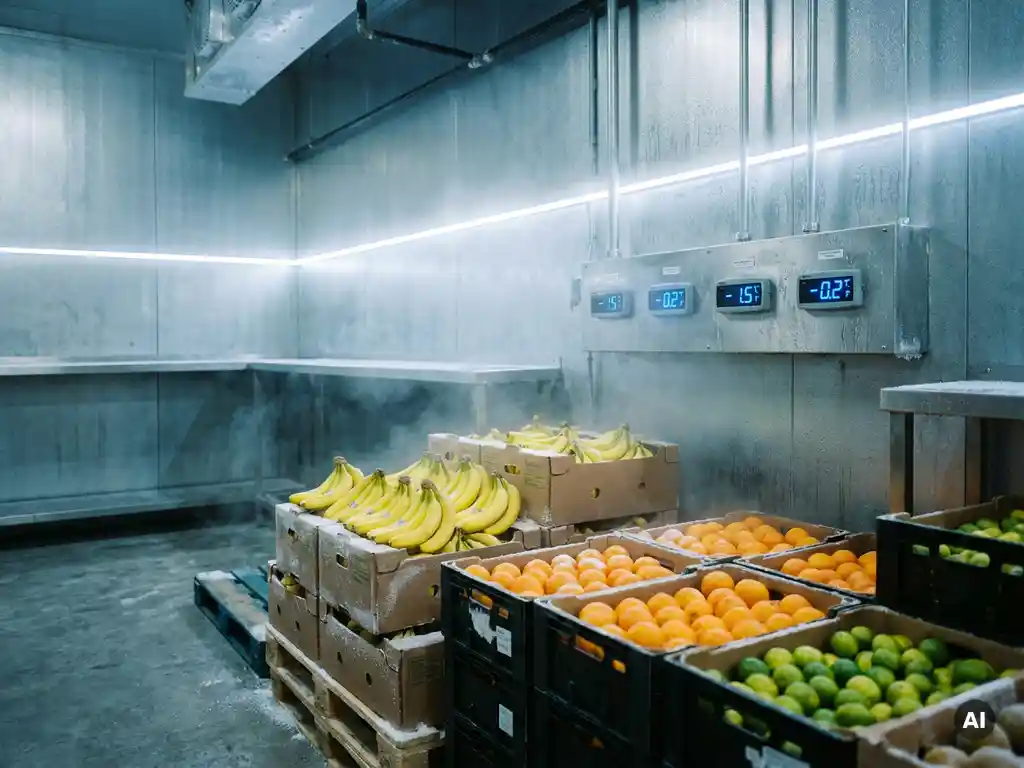
Climate-controlled cold storage is necessary as soon as a product loses its quality, safety, or shelf life outside a precisely controlled temperature and humidity range. For fresh food products such as exotic fruit, citrus fruits, and delicate vegetables, active temperature control is not a luxury but a basic logistical requirement. This article answers the most frequently asked questions about cold storage, from which products truly require it to the certifications involved.
Which products require mandatory climate-controlled storage?
Products that require mandatory climate-controlled storage are fresh food products where biological degradation at room temperature occurs too rapidly to guarantee quality and food safety. Examples include exotic fruits such as bananas and citrus fruits, but also tropical vegetables and other fresh, fragile agricultural products that are sensitive to temperature fluctuations and changes in humidity.
Bananas are a good example: they ripen much faster at higher temperatures and require a precisely controlled climate to ripen in a controlled manner or, conversely, to remain in a green phase. Citrus fruits are susceptible to drying out and mold formation if humidity is not maintained. For all these products, it is not just about temperature, but also about the right combination of humidity and air circulation.
In addition to exotic fruit, climate-controlled cold storage is also considered necessary for:
- Fresh tropical vegetables with high respiration activity
- Products intended for supermarket chains with strict quality requirements
- Shipments where the cold chain must remain continuous due to import inspection requirements
Different requirements apply to dry products such as nuts, peanuts, and seeds. They require a stable, controlled environment without high humidity, but not necessarily active cooling at low temperatures.
What happens to fruit and vegetables without temperature control?
Without temperature control, the biological degradation of fruit and vegetables proceeds significantly faster. Cells break down, moisture evaporates, molds and bacteria develop more rapidly, and products become unsaleable. Damage often occurs within just a few hours if the cold chain is interrupted, especially with tropical products fresh from a refrigerated container.
The consequences are concrete and costly. A batch of bananas stored at too high a temperature ripens unevenly and is no longer suitable for supermarket shelves. Citrus fruits stored at the wrong temperature for too long show signs of dehydration or develop mold spots that can contaminate the entire batch.
For importers and wholesalers supplying supermarkets or processing plants, these are risks with direct financial consequences: rejected batches, damage claims, and reputational damage to customers. In this light, cold storage is not a cost but a protection of the cargo's value.
What is the difference between cold storage, dry storage, and freezer storage?
The difference between cold storage, dry storage, and freezer storage lies in the temperature range and the purpose of storage. Cold storage stores products above freezing point, typically between 2 and 15 degrees Celsius, depending on the product. Freezer storage stores below freezing point, often between minus 18 and minus 25 degrees. Dry storage, also known as ambient or tempered storage, operates at a stable but less low temperature, often around 11 degrees, without active cooling to low temperatures.
Cold storage: for fresh and perishable products
Cold storage is intended for products that remain fresh due to low temperatures but must not freeze. Exotic fruits, citrus fruits, and fresh vegetables fall into this category. It is not just about temperature: humidity and air circulation are equally crucial for quality.
Dry storage: for stable products at a controlled temperature
Dry storage is suitable for products such as nuts, peanuts, seeds, and other dry food products that do not require cold storage but must be protected against temperature fluctuations, moisture, and pests. A stable environment of approximately 11 degrees is often sufficient for this and more cost-effective than active cold storage.
Freezer storage: for long-term storage below zero
Cold storage is relevant for products that need to be stored for extended periods without any loss of quality due to biological processes. This requires the most robust infrastructure and the highest energy consumption of the three options.
When is dry storage sufficient instead of refrigeration?
Dry storage is sufficient when a product does not require active refrigeration to maintain quality and food safety, but benefits from a stable, controlled environment. This applies to products with low moisture activity and a longer natural shelf life, such as nuts, peanuts, seeds, and dry food ingredients.
The boundary between dry storage and cold storage depends on three factors:
- Product characteristics: Does the product have high moisture activity or active biological respiration? Then cold storage is necessary.
- Destination requirements: Does the purchaser, such as a supermarket buyer or processing plant, impose specific temperature requirements on storage? If so, the customer co-determines the storage method.
- Certification requirements: Some certifications prescribe which storage conditions are mandatory for certain product categories.
For importers of dry agricultural products, tempered dry storage is often the most cost-effective choice that still meets the requirements of major buyers. It is a misconception that all food storage must by definition be refrigerated.
How does the supply chain influence the choice of cold storage?
The position of a link in the supply chain largely determines the necessary form of storage. An importer delivering directly from the port to a processing plant has different requirements than a wholesaler maintaining a buffer of several days for delivery to supermarkets. The longer the lead time in the chain, the more critical the storage conditions become.
An important consideration is the connection between the storage location and transport. If a refrigerated container is unloaded directly at the quay and reaches the cold storage facility within a few minutes, the cold chain remains intact. Any interruption, no matter how brief, increases the risk of quality loss for sensitive products. The geographical location of the storage site relative to the port is therefore a logistical factor that directly influences the choice of cold storage.
In addition, the requirements of the end customer play a guiding role. Supermarket chains and processing plants are increasingly imposing specific requirements on suppliers' storage conditions, including traceability per pallet and verifiable temperature recording. This makes the choice for professional cold storage not only a choice of quality but also a commercial necessity.
Which certifications are required for refrigerated food storage?
For professional refrigerated food storage in the B2B supply chain, BRC, SKAL, and KCB/NVWA are the most relevant certifications. BRC (British Retail Consortium) is an internationally recognized food safety standard that is mandated by many supermarket chains and major buyers. SKAL is the certification body for organic products in the Netherlands. KCB is part of the NVWA and conducts import inspections for fresh fruit and vegetables entering the EU.
For importers and suppliers delivering to supermarket purchasing organizations, BRC certification is virtually indispensable in practice. Without this certificate, a warehousing partner is not accepted by many large retailers as a link in their approved supply chain.
SKAL certification is relevant for parties storing certified organic products. The storage of organic and conventional products must take place separately, which places specific demands on the layout of the warehouse and administrative record-keeping.
KCB inspection is mandatory for the import of fresh fruit and vegetables from outside the EU. For this purpose, the storage location must be recognized as an inspection station or cooperate closely with a recognized inspection body, so that products can be inspected immediately upon arrival without unnecessary delay in the cold chain.
How ZZColdstores provides cold storage for B2B parties
ZZColdstores offers climate-controlled cold storage in Kruiningen and Vlissingen, specifically designed for fresh and perishable food products such as exotic fruit. The approach is aimed at supply chain partners who require a reliable, certified storage partner in the Rotterdam-Antwerp corridor. What sets ZZColdstores apart:
- 24/7 monitoring and control of temperature, humidity, and air circulation
- Private quay in Vlissingen for direct connection of the ship to the cold storage
- Flexible climate settings per storage area, tailored to the specific product
- Full traceability per pallet via barcode systems
- Certifications: BRC, SKAL and Demeter
- Import inspection via KCB (part of the NVWA) and customs clearance
- Dry storage with 12,000 pallet spaces for nuts, peanuts, seeds, and other dry food products
For importers, wholesalers, and logistics managers looking for a partner to handle the entire process from arrival to customs, a conversation with ZZColdstores is the logical next step. Contact us to discuss which storage solution best suits your product and supply chain.
Frequently Asked Questions
How quickly must a product be placed in the cold storage after arrival to keep the cold chain intact?
For the most sensitive products, such as ripe exotic fruit and tropical vegetables, any interruption of the cold chain of more than 30 to 60 minutes can already cause noticeable quality loss. Ideally, transport should be connected directly to the cold storage, such as via a private quay where the ship adjoins the cold facility directly. The shorter the exposure to outside temperatures, the better the final quality and the lower the risk of rejection by the buyer.
As an importer, can I store my organic and conventional products with the same storage partner?
Yes, that is possible, but only if the storage location is SKAL-certified and has physically separated storage areas for organic and conventional products. The separation must also be administratively demonstrable through comprehensive registration per pallet. Always check with your storage partner whether the SKAL certification is up-to-date and whether the warehouse layout meets the separation requirements set by SKAL.
What are the most common mistakes importers make when choosing a storage partner?
A common mistake is choosing a storage partner based purely on price, without checking whether the required certifications are present or if the storage location is suitable for the specific product. Another common oversight is underestimating the logistical location: a cold storage facility situated far from the port significantly increases the risk of cold chain interruptions. Always verify whether the partner can guarantee traceability per pallet and whether temperature recording is demonstrably and continuously performed.
How do I know which temperature and humidity settings are right for my specific product?
The optimal climate settings for each product are defined in international guidelines, such as those of the FAO or product-specific protocols from exporting countries. For example, bananas require a storage temperature of approximately 13 to 14 degrees Celsius during the green phase, while citrus fruits are generally better stored between 5 and 10 degrees with a relative humidity of 85 to 95 percent. A professional storage partner sets the climate settings per cell based on your product and can advise you based on experience with similar products and shipments.
Is BRC certification also required if I do not supply directly to supermarkets, but to wholesalers or processing plants?
Not always, but increasingly often. Wholesalers and processing plants that supply supermarket chains directly are required by those chains to ensure that their suppliers and storage partners also comply with BRC standards. This means that the BRC requirement indirectly impacts the entire chain, even if you do not have a direct relationship with a retailer yourself. It is advisable to verify with your customers which certification requirements they impose on the storage locations in your supply chain.
How does the KCB import inspection work in practice, and how much delay does it cause?
The KCB import inspection takes place at the accredited inspection station and comprises a visual and sometimes also a laboratory check of the batch for quality, size sorting, and phytosanitary requirements. If the storage location is accredited as an inspection station or collaborates closely with an accredited institution, the inspection can take place immediately upon arrival without the batch having to be transported elsewhere first. In practice, this means that a well-organized inspection procedure limits the delay to a few hours, minimizing the strain on the cold chain.
What specifically should I bring to an initial meeting with a potential storage partner?
In any case, please bring information regarding the type of product, the desired storage temperature and humidity, the expected volume in pallets per month, and the lead time in your supply chain. Also, mention which certifications your customers require and whether there are organic products that need to be stored separately. The more specifically you can describe your logistics situation, the more targeted the storage partner can make a suitable proposal that aligns with your product, your supply chain, and your commercial requirements.