
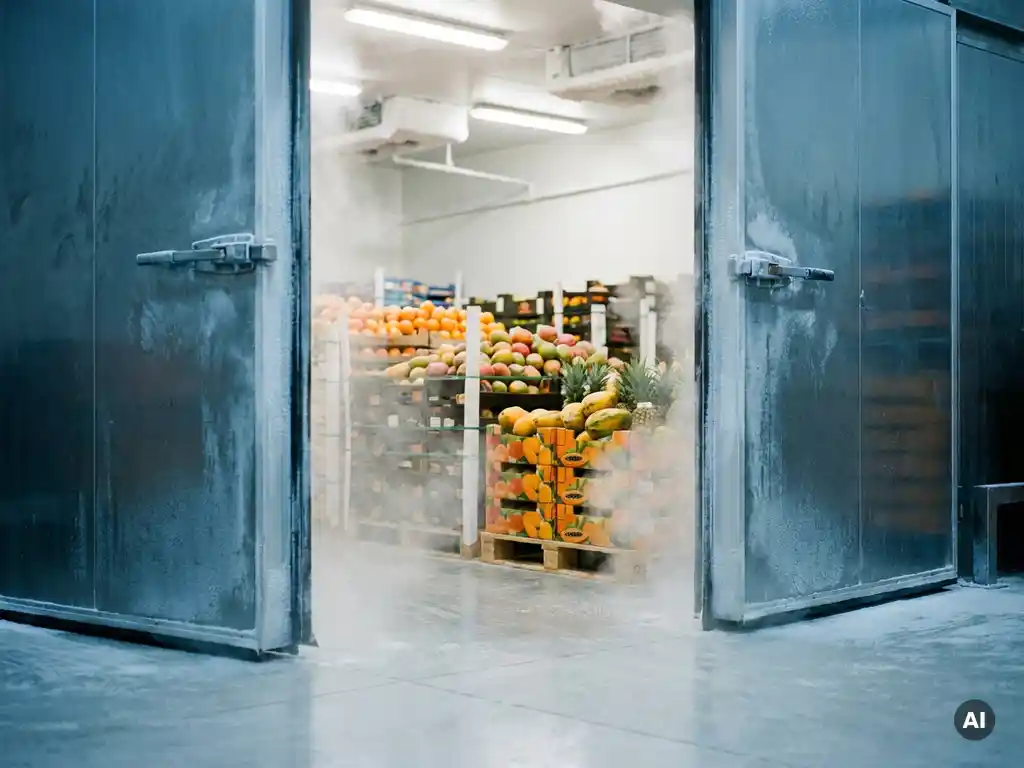
The cost of renting a cold storage unit typically ranges between €8 and €20 per pallet space per month, depending on the temperature range, the desired services, and the contract duration. Rates tend to be higher for fresh and perishable products such as exotic fruit, as climate control requires greater precision. In this article, we answer the most frequently asked questions about cold storage, from pricing structure to certifications and choosing the right partner.
What determines the price of cold storage space?
The price of cold storage space is determined by four main factors: the required temperature range, the necessary humidity control, the contract duration, and ancillary services such as loading, unloading, and quality control. The more specific the climate requirements of your product, the higher the operating costs for the storage location.
Products that require a narrow temperature window, such as bananas or citrus fruits, demand continuous monitoring of temperature, humidity, and air circulation. This requires advanced systems that operate 24/7. The more intensive the management, the more it impacts the price.
Other factors that influence the price:
- Location and accessibility: a storage location with its own quay or direct port access reduces transport costs, but may have a higher base price.
- Flexibility: short-term contracts are more expensive per unit than long-term agreements.
- Additional services: container handling, repalletizing, labeling, and quality control are charged separately and increase the total amount.
- Certifications: certified storage locations (BRC, SKAL) have higher operational standards, which is reflected in the rates.
How much does cold storage cost per pallet per month?
In practice, cold storage costs on average between €8 and €20 per pallet space per month. This wide range reflects the wide variation in climate requirements, locations, and service levels. Dry storage at a constant temperature (such as around 11 degrees) is cheaper than active cooling for fresh products that need to be stored closer to 0 degrees.
Please note that the pallet space price rarely reflects the full cost picture. With most cold storage providers, additional costs apply for:
- Inbound and outbound traffic per pallet
- Handling upon arrival (unloading, checking, palletizing)
- Administrative processing and reporting
- Any customs or inspection costs
For a realistic cost estimate, it is best to request a quotation based on your specific product volume, climate requirements, and desired service level. Fixed rates per pallet space are a good indication, but the total price always depends on your logistical situation.
What is the difference between cold storage and dry storage?
Cold storage keeps products actively cooled at a specific temperature, usually between 0 and 15 degrees Celsius, with precise control of humidity and air circulation. Dry storage (also called ambient storage) stores goods at a stable ambient temperature, typically around 11 degrees, without active cooling or humidity control.
The distinction is relevant for the choice of storage type:
- Cold storage is suitable for fresh, fragile products such as exotic fruit, vegetables, and other perishable goods that are sensitive to temperature fluctuations.
- Dry storage is suitable for products such as nuts, peanuts, seeds, and other dry food products that do not require active refrigeration but do require a stable, controlled environment.
In practice, many companies combine both forms of storage. An importer of exotic fruit can store his fresh batches in climate-controlled cold rooms and his dry by-products in an ambient warehouse. The two types place different demands on the infrastructure and therefore also have a different price level.
When is renting a cold storage unit more cost-effective than having your own storage?
Renting a cold storage unit is more cost-effective than on-premise storage once the fixed costs of an in-house installation no longer outweigh the variable storage needs. For most importers and wholesalers, this is the case when volumes fluctuate by season or shipment, and when the maintenance of their own refrigeration systems becomes too expensive.
Owning your own cold storage facilities entails significant fixed costs: investment costs, maintenance, energy, personnel, and certification. These costs continue to accrue, even when the facility is not fully utilized. With an external cold storage provider, you only pay for the space and services you actually use.
Renting is generally more economical when:
- Your storage volume is seasonal or varies significantly
- You do not have your own logistics infrastructure near the port or the import point
- You wish to make use of additional services such as container handling, quality control, or customs clearance
- You need the flexibility to scale up or down quickly
Which certifications must a cold storage company have?
A reliable cold storage company for food products holds at least BRC certification (British Retail Consortium), the international standard for food safety in storage and distribution. Depending on the type of product, additional certifications such as SKAL (for organic products) and approval by the KCB/NVWA for import inspections are relevant.
What the certifications mean in practice:
- BRC: guarantees food safety, hygiene, and traceability throughout the entire storage process. Supermarket suppliers and processing plants almost always require this from their logistics partners.
- SKAL: required for the storage of organically certified products. Without SKAL certification, a storage location may not handle organic products as such.
- KCB/NVWA: the Food and Consumer Product Safety Authority (Keuringsdienst van Waren) carries out import inspections on fresh products such as fruit. A storage location that facilitates this process must be accredited for this purpose.
When selecting a partner, always ask for current certificates and check whether the scope of the certification matches your product type and market.
How does container handling work at cold storage locations?
At cold storage locations with container handling, a container is unloaded, inspected, and transferred to the cold room immediately upon arrival. The goal is to maintain the so-called cold chain: the shorter the time between opening the container and placing the goods in the cold room, the better product quality is preserved.
Efficient container handling typically includes the following steps:
- Arrival and scheduling: the container is scheduled based on the ship's sailing schedule and available quay space or stopping point.
- Unloading: goods are removed from the container, whether in bulk or on pallets.
- Quality control: upon arrival, products are checked for damage, temperature, and packaging condition.
- Repalletize if necessary: goods are repalletized according to the recipient's specifications.
- Entry into the cold room: products are moved to the correct climate zone as quickly as possible.
Locations with their own quay, such as in the port of Vlissingen, have a logistical advantage: the distance between the ship's hold and the cold storage is minimal, which significantly limits quality risks.
What should you look out for when choosing a cold storage partner?
When choosing a cold storage partner, the five most important criteria are: the right certifications, the technical capacity for your specific climate requirements, the location relative to your supply route, contract flexibility, and the service level, including additional services. A partner who meets only one of these criteria strongly is rarely the best choice.
Always check the following during the selection process:
- Technical capacity: can the location guarantee the required temperature range and humidity for your product, and are these monitored 24/7?
- Traceability: does the partner work with a system that tracks every pallet from arrival to delivery, including LOT numbers and barcode registration?
- Flexibility: does the partner adapt to your sailing schedules and volumes, even during peak periods?
- Additional services: does the location also offer container handling, quality control, labelling, and customs clearance, or do you have to go to multiple parties for that?
- Certifications: are BRC, SKAL, and the required NVWA accreditations current and applicable to your product category?
How ZZColdstores helps with cold storage
ZZColdstores offers climate-controlled cold storage for fresh and perishable products such as exotic fruit, with locations in Kruiningen and Vlissingen. The facilities are designed to monitor temperature, humidity, and air circulation 24/7 and tailor them to the specific requirements of your goods. As a B2B logistics partner, active since 1994, ZZColdstores combines technical expertise with a comprehensive range of services.
What ZZColdstores specifically offers:
- Climate chambers adjustable per product type, from exotic fruit to dry food products
- Dedicated quay in Vlissingen for minimal exposure of products outside the cold chain
- Container handling including unloading, quality control and repalletizing
- Barcode-driven traceability from arrival to delivery
- Certifications: BRC, SKAL and KCB/NVWA accreditation for import inspections
- Dry storage with a capacity of 12,000 pallet spaces for nuts, seeds, and other dry products
Would you like to know the cost of cold storage for your specific product flows or which storage solution best suits your supply chain? Contact ZZColdstores for a no-obligation consultation.
Frequently Asked Questions
How soon can I start renting cold storage space from an external provider?
With most cold storage providers, you can be operational within a few working days, provided the capacity is available and the necessary documentation is ready. It is advisable to contact them well in advance, especially if your first shipment is already on its way. During the initial meeting, ask directly about the turnaround time for contract processing, certification checks, and setting up your specific climate zone.
What happens if my product is not at the correct temperature upon arrival?
A professional cold storage partner performs a temperature check upon arrival as part of the quality check. If the core temperature of your product deviates from the specifications, you will be informed immediately, and it will be determined in consultation whether the product is still suitable for storage or further distribution. This is precisely why traceability and a structured arrival protocol are so important: problems are detected early, allowing you to take timely action.
Can I also use a cold storage company for small volumes or occasional shipments?
Yes, many cold storage providers also work with smaller volumes or short-term agreements, although the rates per pallet space are generally higher than with fixed contracts. For importers with fluctuating volumes or those wishing to test a new product line, a flexible short-term arrangement can be a good entry point. However, be sure to discuss minimum purchase obligations and any fixed handling costs in advance so that you can accurately estimate the total cost.
How is the quality of my products monitored and reported during storage?
Reliable cold storage companies work with continuous digital monitoring of temperature, humidity, and air circulation, linked to an alarm system that is active 24/7. In addition, many providers offer periodic reports on storage conditions and the status of your inventory, including LOT numbers and barcode registration per pallet. When selecting a partner, explicitly ask about the frequency and format of these reports, and whether you have access to real-time data.
What is the difference between a refrigerated distribution hall and a specialized cold storage facility for exotic fruit?
A general refrigerated distribution hall is designed for a wide range of products and typically maintains a fixed, average temperature. A specialized cold room for exotic fruit offers adjustable climate zones per product type, where temperature, humidity, and air circulation are precisely tailored to the specific ripening phase and shelf life of the product. For delicate products such as bananas, mangoes, or avocados, this difference is immediately noticeable in product quality and spoilage.
What documents or information do I need to request a quote for cold storage?
For an accurate quotation, a cold storage provider requires at least the following information: the type of product and the required storage temperature, the expected volume in pallet spaces, the frequency of inbound and outbound movements, the desired contract duration, and any additional services such as container handling or quality control. The more specific you provide this information, the more accurate the quotation and the lower the risk of unexpected additional costs afterwards.
What are the most common mistakes when choosing a cold storage partner?
The most common mistake is selecting a partner based purely on the lowest pallet space price, without taking into account handling costs, certifications, and the technical capacity for your specific product. A second common mistake is failing to verify whether the scope of BRC or SKAL certification actually applies to your product category. Finally, many importers underestimate the importance of location: a cold storage location close to the point of supply or the port limits exposure outside the cold chain and thereby significantly reduces the quality risk.