
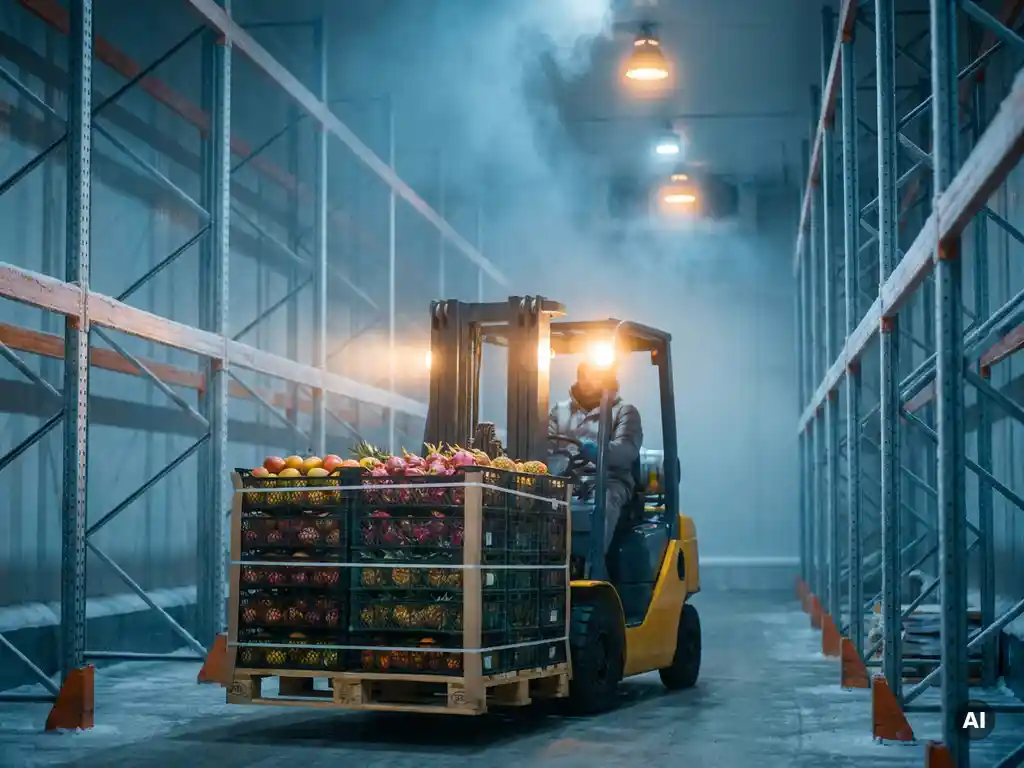
External warehousing is attractive for food producers as soon as in-house storage capacity becomes a barrier to growth, the costs of on-site storage are no longer proportionate to occupancy, or when products have specific climate requirements that are not feasible internally. For many food companies, this is the case during seasonal peaks, expansion into new markets, or when compliance requirements become stricter. The questions below will help you determine whether external warehousing is the right step for your situation.
What costs does a food producer with its own storage incur?
A food producer with its own storage facilities bears structurally high fixed costs: rent or depreciation of the premises, energy for cooling or climate control, maintenance of installations, personnel costs, and investments in certification and food safety systems. These costs continue, even when the occupancy rate is low.
In addition to the direct costs, there are also hidden costs that are often underestimated:
- Capital tied up: Own warehouse space ties up capital that can also be invested in production or market development.
- Maintenance and replacement: Refrigeration installations and climate control systems require periodic major maintenance and have a limited lifespan.
- Certification costs: Certifications such as BRC or SKAL entail annual audit and administrative costs.
- Staff flexibility: Extra staff is needed during peak loads, but at low occupancy, you pay for overcapacity.
The actual cost per pallet space turns out to be higher than expected for many food producers, especially when the space is not fully utilized throughout the year.
When is on-premise storage no longer scalable?
In-house storage loses scalability when demand fluctuates sharply, storage needs grow faster than available space, or when new product categories impose different climate requirements than existing facilities can accommodate. At that point, expanding internally becomes more expensive than outsourcing.
Concrete signs that your own storage is reaching its limits:
- Seasonal peaks regularly cause space shortages, while overcapacity exists for the rest of the year.
- Expanding the product range requires other temperature zones or humidity settings that are not available internally.
- Growth towards new export markets requires storage locations closer to ports or distribution hubs.
- Increasing compliance requirements call for investments in systems and certifications that do not support the core business.
Scalable warehousing is not just a matter of square meters. It is also about the flexibility to quickly scale up or down without affecting the fixed cost structure.
What are the benefits of external warehousing for food companies?
External warehousing offers food companies the opportunity to flexibly align storage capacity with actual needs, without the fixed costs of their own infrastructure. In addition, a food producer benefits from the specialized knowledge, certified facilities, and integrated logistics services of a professional warehousing partner.
The main benefits at a glance:
- Cost flexibility: You pay for actual used capacity, not for vacancy.
- Access to certified facilities: External partners typically possess BRC, SKAL, or other food safety certifications that are costly to obtain and maintain internally.
- Integrated services: In addition to storage, specialized partners also offer quality control, labeling, barcode-driven traceability, and EDI connections for automated order processing and inventory updates.
- Strategic location: A warehousing partner near a port or logistics hub shortens lead times and reduces transport costs.
- Focus on core activity: Outsourcing logistics provides room to invest in production, product development, and market growth.
Which products are most suitable for external dry storage?
Products best suited for external dry storage are stable, non-perishable, or long-shelf-life food products that do not require active refrigeration but do require a controlled environment. Examples include nuts, peanuts, seeds, dried fruit, and other ambient-stabilized food products.
Dry storage involves products stored at a controlled ambient temperature, often around 11 degrees Celsius, with attention to humidity and ventilation. This distinguishes dry storage from ordinary warehouse space: the conditions are actively monitored to prevent loss of quality, mold formation, or moisture damage.
Products suitable for external dry storage:
- Nuts and peanuts
- Seeds and grains
- Dried food products
- Potato products such as potato flakes
- Packaged dry ingredients for processing plants
For fresh and perishable products such as exotic fruit, different requirements apply, and climate-controlled cold storage is the appropriate solution.
How does the collaboration with an external warehousing partner work?
Collaboration with an external warehousing partner begins with mapping out product specifications, storage conditions, and logistical flows. Subsequently, agreements are made regarding inbound and outbound processes, quality controls, reporting, and any additional services such as labeling, repalletizing, or shuttle transport.
In practice, a collaboration typically follows these steps:
- Intake and coordination: The warehousing partner maps out the product requirements, volumes, and logistical wishes together with you.
- Inbound processing: Upon arrival, goods are checked, sorted, and, if necessary, palletized or provided with customer-specific labels.
- Supervised storage: Products are stored under the agreed conditions, with continuous monitoring of temperature and humidity.
- Order picking and delivery: Based on orders, products are picked, assembled, and prepared for transport.
- Digital integration: Systems are linked via EDI connections for automatic order processing, inbound notifications, and inventory updates, so that you always have up-to-date insight into your inventory.
A well-functioning collaboration is based on clear agreements, transparent communication, and systems that seamlessly integrate.
What should you look out for when choosing an external storage partner?
When choosing an external storage partner for food products, certification, location, flexibility, and the availability of additional services are the decisive factors. A partner that meets your customers' food safety requirements saves you significant compliance costs and risks.
Concrete selection criteria:
- Certifications: Check whether the partner holds relevant certifications such as BRC, SKAL, or KCB/NVWA approval, depending on your product category and target market.
- Location and accessibility: A strategic location near ports, highways, or your production site reduces transport costs and lead times.
- Climate control: Check whether storage conditions are adjustable per product category and whether temperature and humidity are monitored 24/7.
- Traceability: A barcode-driven system where every pallet is fully traceable is not a luxury for food products, but a basic requirement.
- Flexibility: Can the partner scale up during peak periods, and are additional services available such as quality control, labeling, and shuttle transport?
- System integration: EDI connections for automated order processing and inventory updates prevent manual errors and increase the efficiency of the entire chain.
Preferably ask for references in the same product category and assess whether the partner has experience with the specific requirements of your customers, such as supermarket purchasing organizations or processing plants.
How ZZColdstores meets your warehousing needs
ZZColdstores offers food producers and logistics partners a complete package for both dry and climate-controlled storage, from locations in Kruiningen and Vlissingen. The company has been active since 1994 and holds certifications including BRC, SKAL, and Demeter. The services are specifically tailored to B2B flows towards supermarket purchasing organizations, processing plants, and wholesalers in Europe.
What ZZColdstores specifically offers for food producers:
- Dry storage at controlled temperature (approx. 11 degrees), with a capacity of 12,000 pallet spaces for nuts, peanuts, seeds, and other dry food products
- Climate-controlled cold storage for fresh and perishable products, with 24/7 monitoring of temperature, humidity, and air circulation.
- Quality control upon arrival, including temperature, humidity, and Brix measurements and QC reporting
- Barcode-driven traceability per pallet, linked to grower and LOT numbers
- Labeling, repalletizing, and EDI connections for seamless system integration
- Own shuttle transport within a 40 km radius of Kruiningen
Would you like to know if external warehousing at ZZColdstores suits your logistics situation? Contact us for a no-obligation discussion about the possibilities.
Frequently Asked Questions
How quickly can I switch from on-site storage to an external warehousing partner?
The transition to external warehousing can typically be realized within a few weeks, depending on the complexity of your product flows and the required system integrations. A good partner starts with an intake during which product specifications, volumes, and logistical requirements are reviewed, after which an implementation plan is drawn up. It is advisable to schedule the transition outside your busiest seasonal period to allow sufficient time to properly set up and test processes.
What if my storage needs vary significantly by season — how does an external partner handle that?
A specialized warehousing partner is specifically geared towards flexible capacity demand and typically charges based on the actual pallet spaces used per period. This means that you scale up during peak months without extra fixed costs, and during quiet periods, you only pay for what you actually utilize. When selecting a partner, explicitly discuss how they handle peaks and what the lead time is for making extra capacity available.
Which certifications are required for the storage of organic food products?
For the storage of organic products, SKAL certification of the warehousing partner is a strict requirement — without this certification, the organic status of your products may not be maintained during the storage phase. Additionally, verify whether the partner has separate storage zones for organic and conventional products to ensure there is no risk of mixing. For export flows outside the EU, additional equivalence requirements may apply, further increasing the importance of a certified partner.
How do I keep track of my inventory if it is stored externally?
Through EDI connections and a Warehouse Management System (WMS), you gain real-time insight into your inventory movements, inbound and outbound notifications, and current pallet positions, without needing to be physically present. A reliable partner offers customized reports and connects their systems to your ERP or order management system, ensuring inventory data is automatically synchronized. When making your selection, always ask for a demonstration of the customer portal or the reporting tools the partner makes available.
What are the most common mistakes food companies make when outsourcing their warehousing?
A common mistake is selecting based on price per pallet space without considering the total cost structure—including handling, booking-in and booking-out costs, and additional services—in the comparison. Additionally, companies frequently underestimate the importance of system and process alignment beforehand, which later leads to communication errors or delays in order picking. Finally, the partner's certification status is checked too infrequently, even though this can be a strict purchasing requirement for buyers such as supermarket purchasing organizations.
Can an external warehousing partner add value beyond pure storage?
Yes, specialized partners often offer a wide range of Value Added Services (VAS) that goes beyond storage alone, such as quality checks upon arrival, labeling, repalletizing, Brix and moisture measurements, and the assembly of customer-specific pallets. This is particularly valuable for food producers supplying demanding customers such as supermarket chains or processing plants, where products must meet specific presentation or traceability requirements. By bundling these services with a single partner, you save on transport movements and reduce the risk of errors in the supply chain.
Is external warehousing also worthwhile if I still have relatively small volumes?
External warehousing can also be attractive for smaller volumes, particularly when your products have specific climate requirements that are not feasible internally, or when you wish to supply customers who require certified storage as a purchasing condition. The advantage is that you avoid the high fixed costs of your own certified facilities while still having access to professional infrastructure. Discuss with a potential partner what the minimum volumes are and whether flexible contract forms are available that suit your growth phase.
Related articles
- Can you combine warehousing with container handling?
- What is the risk of condensation when unloading refrigerated containers?
- How does seasonal supply affect storage planning for importers?
- How does the traceability of dry raw materials work in a European warehouse?
- How do you manage irregular shipping from Asia or Brazil?