
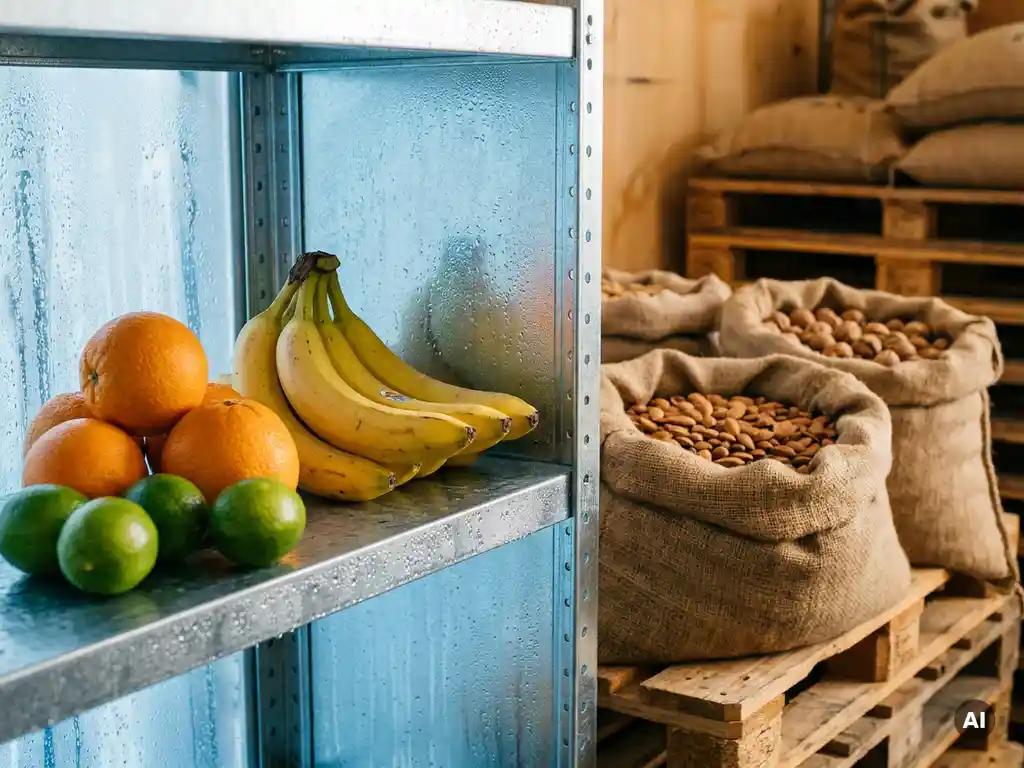
The difference between refrigerated and dry storage lies in the degree of climate control. Refrigerated storage actively regulates temperature and humidity to keep perishable products fresh. Dry storage, also known as ambient storage, stores products at room temperature without active cooling, but under controlled conditions such as dryness and ventilation.
The choice between the two storage types depends entirely on the characteristics of the product: how sensitive is it to temperature fluctuations, moisture, or ripening? For supply chain managers and importers, this distinction is decisive for product quality, shelf life, and logistics costs. The questions below provide a concrete answer for each aspect.
Which products require refrigerated storage and which do not?
Products that are perishable, ripen quickly, or are sensitive to temperature fluctuations require refrigerated storage. Examples include fresh exotic fruits such as bananas and citrus fruits. Products that remain stable at room temperature, such as nuts, peanuts, seeds, and grains, are suitable for dry storage without active refrigeration.
The distinction is not always black and white. Some products are on the borderline: they do not spoil quickly, but lose significant quality at excessively high temperatures or in case of too much moisture. A practical rule of thumb for logistics managers:
- Refrigerated storage: fresh fruit, vegetables, products with a short shelf life that require active temperature control
- Dry storage: nuts, peanuts, seeds, dried food products, packaged goods that remain stable at ambient temperature
When in doubt, the question is: what happens to the product if the temperature rises by five degrees or if the humidity increases? If the quality changes noticeably, refrigerated storage is the safest choice.
How exactly does temperature-controlled storage work?
Temperature-controlled storage, also known as climate-controlled storage or cold storage, actively regulates three parameters: temperature, humidity, and air circulation. Advanced systems continuously monitor these values and make adjustments as soon as a deviation is detected. The goal is a stable microclimate tailored to the specific requirements of the product.
For exotic fruit such as bananas, this is particularly critical. Bananas ripen rapidly at temperatures that are too high and can be damaged at temperatures that are just slightly too low. The cold storage must be flexibly adjustable so that the climate is precisely tailored to each batch.
What makes cold storage technically effective:
- 24/7 Temperature Monitoring: Sensors continuously record the temperature throughout the entire warehouse, including hotspots near doors or loading docks.
- Humidity control: Air that is too dry damages the structure of fresh fruit; air that is too humid promotes mold formation. The correct balance is product-specific.
- Air circulation: Even air distribution prevents temperature differences between pallets and ensures that the climate is consistent throughout the entire room.
- Flexible settings per chamber: Different products require different climate zones, making multiple chambers with their own settings necessary.
The location of the cold storage facility relative to the unloading time also plays a role. The shorter the time between unloading and cooling, the less quality loss occurs.
What are the requirements for dry storage of food products?
Dry storage for food products does not require active cooling, but it does place demands on the environment. The space must be dry, well-ventilated, and free of moisture. Temperature fluctuations must not be extreme, and the storage must comply with food safety standards such as BRC certification.
For products such as nuts, peanuts, and seeds, the main risks are moisture and cross-contamination. Moisture leads to mold formation and loss of quality; cross-contamination occurs when products with different properties or allergens are stored in the same room without adequate separation.
Specific requirements for dry food storage:
- Dry, ventilated storage space without direct exposure to outside air or humid environments
- Separate areas or zones per product category to prevent cross-contamination
- Floors and shelving that make cleaning and inspection easy
- Registration of temperature and humidity, even if active control is not required
- Certifications such as BRC as proof of compliance with international food safety standards
Dry storage is therefore not an uncontrolled space. It is ambient storage with passive climate control and strict hygiene requirements, specifically designed for stable, non-perishable food products.
What happens if a product is stored in the wrong storage type?
Storing a product in the wrong type of storage almost always leads to a loss of quality and, in severe cases, to complete rejection of the shipment. Perishable products stored in dry conditions ripen too quickly, dry out, or spoil. Products that must remain dry can develop condensation in a refrigerated environment, causing mold growth and damp packaging.
The damage is not always immediately visible. Nuts that have been left in a humid environment for too long may already be internally damaged, even though the packaging appears intact. Fresh fruit that has been left outside refrigeration for too long continues to ripen and, upon arrival at the customer, has already passed its optimal quality point.
From a supply chain perspective, the consequences are concrete: rejections during quality control, returns, claims from customers, and reputational damage to supermarkets or processing plants. For importers positioned just ahead of retailers' purchasing organizations, this risk is particularly high.
When is combined cold and dry storage the best choice?
Combined cold and dry storage is the best choice when an importer or logistics partner manages multiple product categories, each with different climate requirements. In practice, this applies to many wholesalers and processing companies that import both fresh fruit and non-perishable products such as nuts or seeds.
The advantage of a single location with both storage types is logistical efficiency. Goods from the same container or ship can be routed directly to the correct storage cell without additional transport or transshipment. This shortens the chain, reduces quality risks, and simplifies the administration surrounding customs clearance and import inspection.
A combined setup is also strategically relevant for companies looking to expand their product range. Those who currently only store refrigerated goods but are considering adding dry products benefit from a partner who manages both facilities under one roof and is certified for both storage types.
How do you choose the right storage solution for your cargo?
You choose the right storage solution based on four criteria: the temperature sensitivity of the product, the desired shelf life, the required certifications of the customer, and the logistics chain surrounding arrival and loading. By mapping out these four factors, one can almost always make a well-founded choice between refrigerated and dry storage.
Start with the product specifications from the manufacturer or supplier. They indicate the temperature and humidity ranges within which the product is optimally stored. Next, compare those requirements with the certifications of the storage facility: a BRC-certified cold storage or dry warehouse provides assurance regarding compliance with international food safety standards.
Next, take the logistics chain into account. A cold storage facility located directly on the quay reduces the time between unloading and cooling to a minimum, which limits quality loss. For dry products, the location relative to the final destination or processing plant determines the total lead time.
Finally: think not only about today, but also about flexibility. Assortments change, volumes fluctuate seasonally, and new product lines sometimes require different climate zones. A storage partner that adapts to ship sailing schedules and client specific requirements offers greater long-term security than a rigid, standard solution.
How ZZColdstores helps with the choice between refrigerated and dry storage
ZZColdstores offers both climate-controlled cold storage and certified dry storage from locations in Kruiningen and Vlissingen. For importers and supply chain managers who manage multiple product flows, this is a practical advantage: both storage types are available under one roof, with a direct connection to the port and a private quay in Vlissingen.
What ZZColdstores specifically offers:
- Climate-controlled cold storage with flexible temperature and humidity settings per cell, suitable for fresh exotic fruit such as bananas and citrus fruits
- Dry storage with a capacity of 12,000 pallet spaces, with separate areas for nuts, peanuts, seeds, and other food products.
- BRC, SKAL, and Demeter certifications as a guarantee of food safety and quality
- Support with import inspection via KCB and customs clearance
- Flexible scheduling aligned with the sailing schedule of arriving ships
Would you like to know which storage type best suits your cargo and logistics chain? Contact ZZColdstores for a no-obligation consultation with one of our specialists.
Frequently Asked Questions
What is the maximum time fresh exotic fruit can remain outside refrigeration after arrival at the port?
This varies by product, but as a rule of thumb, perishable fruit such as bananas and citrus fruits must be transferred to a climate-controlled cell as soon as possible—preferably within a few hours. Every extra hour at ambient temperature accelerates the ripening process and can lead to measurable loss of quality. A cold storage facility with its own quay or direct port connection significantly minimizes this critical time span.
What are the most common mistakes when dry storing nuts and seeds?
The most common mistake is underestimating moisture risks: even in a 'dry' room, temperature fluctuations can cause condensation on packaging or pallets, initiating mold formation. A second common mistake is the lack of adequate separation between product categories with different allergen profiles, which causes cross-contamination and rejections at the customer's site. Regular monitoring of humidity and strict zoning by product type prevent both problems.
What certifications must a storage partner have as a minimum for the import of food products?
For most international food importers, BRC (British Retail Consortium) certification is the minimum requirement, as it is required by virtually all major retailers and supermarkets as proof of food safety. Depending on the product and the buyer, additional certifications such as SKAL (for organic products) or Demeter may be relevant. Always check your buyer's specific purchasing conditions before selecting a storage partner to avoid certification issues later on.
Can a product that has been stored incorrectly still be saved, or is the damage always permanent?
In some cases, limited recovery is possible — a product that has briefly been kept too warm can sometimes still be stabilized by cooling it down quickly — but this depends heavily on the duration of exposure and the type of product. In the case of nuts and seeds that have absorbed moisture, the damage is usually irreversible: internal mold formation or oxidation is not visible from the outside but renders the product unsuitable for consumption. Prevention through the right storage choices from the moment of unloading is always cheaper than remedial measures taken afterwards.
How do customs clearance and import inspections work in combination with cold or dry storage?
When importing food products via Dutch ports, customs clearance often requires a physical inspection of the cargo, which ideally takes place at or directly next to the storage location to minimize quality risks. For fresh fruit, the import inspection is usually carried out by the KCB (Quality Control Bureau), where the product is already stored in the correct climate environment. A storage partner that facilitates and supervises this inspection prevents unnecessary delays and loss of quality during the administrative processing.
Is refrigerated storage significantly more expensive than dry storage, and how do you weigh those costs?
Refrigerated storage entails higher operating costs due to energy consumption, technical maintenance, and more complex infrastructure. However, the relevant question is not whether cold storage is more expensive, but rather the costs of quality loss or rejection without adequate cooling. For products with a high market value or strict customer quality requirements, storage costs generally far outweigh the financial risk of a rejected shipment or reputational damage for a retailer.
How do you adjust your storage strategy if your assortment fluctuates seasonally?
Preferably choose a storage partner that can flexibly switch between volumes and climate zones, so that you can purchase extra pallet capacity during peak periods without having to enter into long-term fixed contracts. Communicate your sailing schedule and expected supply volumes as early as possible so that the storage facility can reserve and configure the correct cells in a timely manner. A partner who actively aligns their planning with your supply rhythm reduces both waiting times and quality risks during busy import periods.