
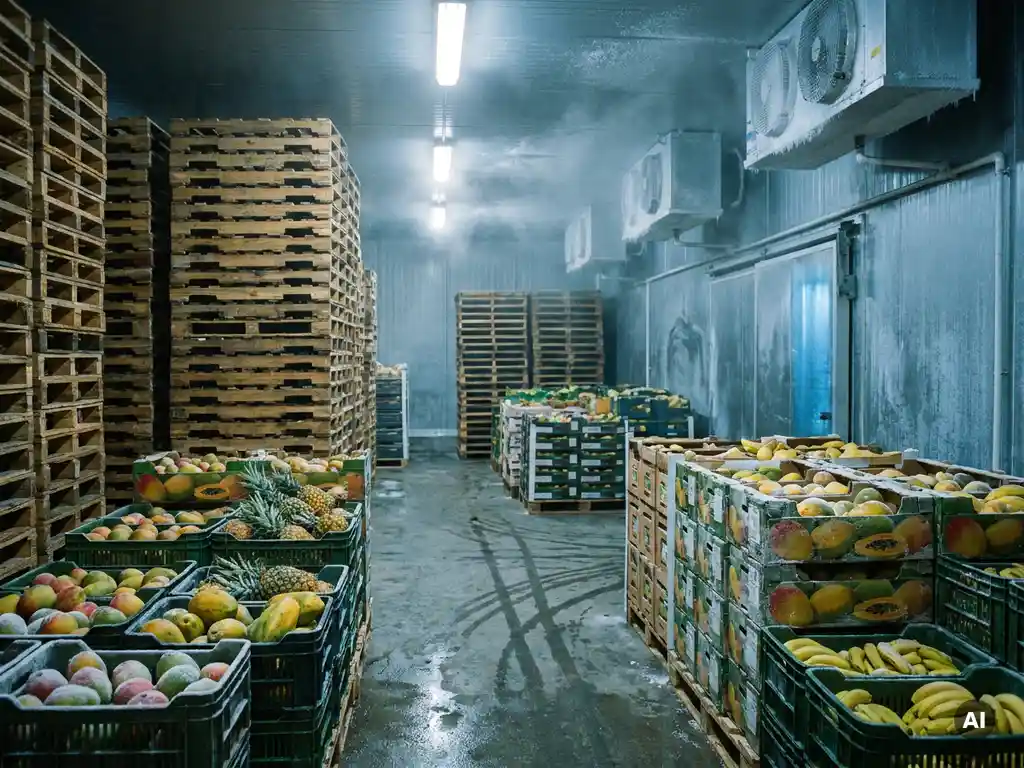
Yes, renting storage space for seasonal peaks in fresh produce is certainly possible. Many specialized cold and dry storage partners offer flexible capacity that can be hired temporarily when the supply of seasonal products peaks. This is particularly relevant for importers, wholesalers, and supermarket suppliers dealing with fluctuating volumes throughout the year. The questions below will help you determine which options suit your situation and what you need to arrange.
What are the options for temporary storage during seasonal peaks?
During seasonal peaks, there are two main options for temporary storage space: flexible capacity agreements with a fixed storage partner, or hiring ad-hoc storage capacity based on pallet spaces per period. Most professional cold and dry storage companies work with variable rate structures that align with fluctuating volumes, so you only pay for the space you actually use.
For fresh products such as exotic fruit, vegetables, or nuts, there are three commonly used structures in practice:
- Pallet spaces per day or week: You rent a specific number of spaces for a defined period, tailored to the expected supply.
- Contractual seasonal blocks: You reserve capacity for an entire season, with agreed minimums and maximums based on historical volumes.
- Emergency capacity on demand: During unexpected peaks, you request extra capacity outside of a fixed agreement. This is less certain and depends on availability.
Which option fits best depends on how predictable your seasonal pattern is and how critical the temperature requirements are for the product.
How does renting flexible storage space for fresh produce work?
Renting flexible storage space for fresh products works basically the same as regular storage: you agree on the number of pallet spaces, the desired temperature zone, and the duration. The difference lies in the variable structure: the occupied space is billed periodically based on actual usage, without being tied to a fixed floor area for an entire year.
In practice, the process begins with an intake during which the storage partner maps out the product requirements. Examples include the desired temperature range, humidity, expected weekly volume, and desired turnaround time. Based on this, a storage zone is assigned that aligns with those requirements.
In addition, there are supplementary services included as standard or optionally, such as incoming quality control, repalletizing, labeling, and barcode-driven traceability. These value-added services are relevant if your product goes directly to a processing plant or a supermarket distribution center after storage and meets specific packaging or labeling requirements.
What temperature requirements apply to the storage of fresh seasonal products?
Temperature requirements for fresh seasonal produce vary significantly by product category. Exotic fruits such as bananas typically require a temperature between 12 and 14 degrees Celsius, while citrus fruits are stored slightly cooler, around 6 to 10 degrees. Dry products such as nuts and seeds are preferably stored at approximately 11 degrees, in a dry environment with controlled humidity.
In addition to temperature, two other factors play a critical role:
- Humidity: Too much moisture leads to mold formation; too little moisture accelerates dehydration and weight loss. The right balance varies per product.
- Air circulation: Even airflow prevents hot spots in the storage area, which is essential for uniform quality across the entire batch.
A professional storage partner monitors these parameters 24 hours a day via automated systems and adjusts the settings as soon as product requirements change. This is particularly important when storing multiple product types with different climate requirements in the same season.
What are the advantages of storage close to a seaport?
Storage close to a seaport minimizes the time between unloading and refrigerated storage, which has a direct impact on product quality. The longer fresh products remain outside a controlled environment, the greater the risk of quality loss. At a storage location directly on the quay, the transfer from ship to cold storage can take place within a few minutes.
In addition, port-related storage offers logistical advantages for the rest of the chain:
- Shorter transport times to processing plants or distribution centers in the region
- Direct link with customs clearance and import inspections (such as via KCB/NVWA)
- Fewer transition points between shipping company, terminal, and storage partner
- Flexible connection to the sailing schedule of arriving ships
For importers operating in the Rotterdam-Antwerp corridor, the location of the storage site is therefore a strategic choice, not just an operational one.
Which certifications must a storage partner for fresh products have?
A reliable storage partner for fresh food products must possess at least BRC certification (British Retail Consortium). This is an internationally recognized food safety standard required by virtually all major supermarket chains and processing plants. Without BRC certification, you, as a supplier, are often unable to deliver to retailers' purchasing organizations.
Depending on the type of product and the destination, additional certifications are relevant:
- SKAL certification: Mandatory for the storage of organic products. Without SKAL recognition, an organic product may not retain its organic status after storage.
- Demeter certification: Relevant for biodynamic products, a stricter variant than conventional organic.
- KCB/NVWA accreditation: Necessary for the import inspection of fresh products entering the EU, particularly for exotic fruit and vegetables from outside the EU.
Always ask for current certificates and verify whether the storage partner demonstrably operates in accordance with the associated protocols. A certificate without operational assurance offers no real guarantee.
When is it wise to reserve storage space in advance?
It is best to reserve storage space for fresh produce at least four to eight weeks before the expected peak period. Refrigerated storage capacity is scarce, especially near seaports and during well-known seasonal peaks such as the banana campaign, the lemon season, or the nut harvest. Those who reserve too late risk finding that suitable capacity is no longer available in the correct temperature zone.
There are two situations where booking early is especially important:
- When the volume is large or uncertain: The more pallet spaces you need, the sooner a storage partner must be able to schedule this into their utilization schedule.
- When product specifications are strict: Products that require a specific temperature zone or certification (such as organic or biodynamic) cannot simply be stored in any available space.
If you work with a fixed storage partner, you can make agreements on capacity blocks early in the year based on historical volumes and seasonal patterns. This provides you with certainty regarding availability and allows the storage partner to plan capacity optimally.
How ZZColdstores helps with flexible storage during seasonal peaks
ZZColdstores offers B2B logistics partners concrete solutions for seasonal storage challenges, for both chilled and dry products. With locations in Kruiningen and Vlissingen and its own quay in the Port of Vlissingen, the company is strategically positioned for importers and wholesalers working with fresh products from overseas supply.
What ZZColdstores specifically offers for seasonal peaks:
- Climate-controlled storage with flexible settings per product category, monitored 24/7 for temperature, humidity, and air circulation
- Dry storage capacity of 12,000 pallet spaces for nuts, seeds, and other dry food products
- Direct connection from ship to cold storage via our own quay in Vlissingen
- Value-added services such as quality control, repalletizing, labeling, and barcode-driven traceability
- Certifications: BRC, SKAL, and Demeter, supplemented with KCB/NVWA accreditation for import inspections
- Flexible arrangements tailored to the sailing schedule of arriving vessels and the client's wishes
Would you like to know which storage option suits your seasonal volumes and product requirements? View the range of climate-controlled storage or contact ZZColdstores to discuss the possibilities.
Frequently Asked Questions
Can I also rent storage space if I do not yet have an established relationship with a storage partner?
Yes, most professional storage companies also work with new clients on a project basis. You start with an intake meeting where product requirements, volumes, and duration are discussed, after which a customized quotation is prepared. It is advisable to contact them well in advance, especially when it concerns refrigerated storage, as available capacity fills up quickly during peak periods.
What if my seasonal peak falls earlier or later than expected?
This is a common challenge with seasonal products, especially with harvests that depend on weather conditions or shipping times. Discuss this scenario with your storage partner in advance and ask if the reserved capacity blocks can be flexibly shifted. Good storage partners work with agreements that offer some margin, but keep in mind that full flexibility depends on the total occupancy at that moment.
How do I know if the temperature in the storage cell is actually being kept constant?
Ask your storage partner about the monitoring systems used and whether you, as the client, have access to real-time or periodic temperature reports. Professional parties with BRC certification are required to maintain and make temperature logs available. At ZZColdstores, temperature, humidity, and air circulation are monitored 24/7 via automated systems, providing transparency regarding the storage conditions of your consignment.
What information do I need to provide to get a good quote for seasonal storage?
To receive an accurate quotation, it is important to provide at least the following information: the type of product and the associated temperature and humidity requirements, the expected volume in pallet spaces per week, the desired storage period, and any additional services such as quality control or labeling. The more specific the information, the better the storage partner can determine availability and price, and the smaller the chance of surprises afterwards.
Is it possible to store multiple product types with different temperature requirements simultaneously?
Yes, provided the storage partner has multiple climate zones or individually adjustable cells. However, it is essential that products with significantly different temperature or humidity requirements are not placed in the same cell, as this can compromise the quality of both batches. Always specify the requirements per product type when booking so that the correct zone can be assigned.
What are the most common mistakes when planning seasonal storage for fresh produce?
The most common mistakes are: reserving too late, resulting in no suitable capacity being available; insufficient specification of temperature and humidity requirements; and failing to take into account additional services such as quality control or labeling that prove necessary later in the chain. Another common mistake is failing to check whether the storage partner holds the correct certifications for the specific product, such as SKAL for organic products.
How do customs clearance and import inspections proceed when stored immediately after arrival in the port?
When stored directly at the quay, import inspection by the KCB or NVWA can take place before or while the products are being loaded. In this case, the storage partner collaborates with the customs broker and the inspection body to ensure the process runs as smoothly as possible. It is important to confirm in advance that the storage location holds the necessary KCB/NVWA accreditation and that the logistical planning aligns with the ship's arrival time, in order to avoid unnecessary waiting times outside a refrigerated environment.