
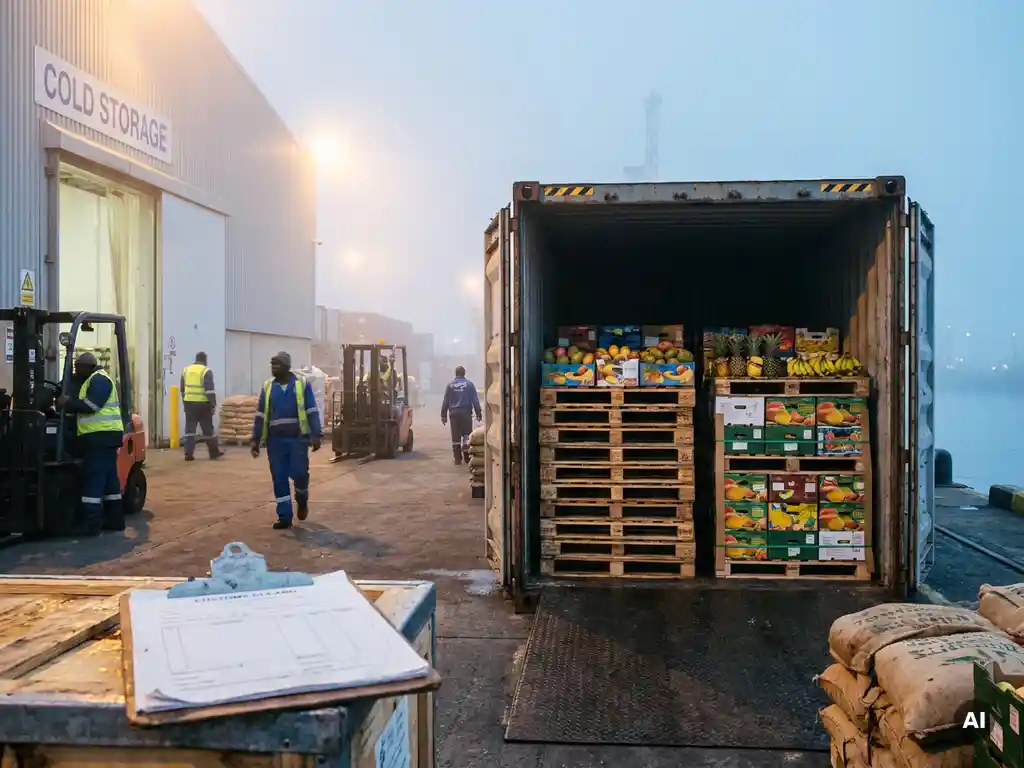
Combining inventory management with customs clearance makes sense whenever goods are not immediately resold upon arrival but remain in temporary storage while the customs status has not yet been settled. For importers of exotic fruit, nuts, and other food products entering via European ports, this combination offers immediate gains in time and quality. The questions below elaborate on when integration yields the greatest benefits and for whom.
What are the benefits of integrated warehousing and customs clearance?
Integrated storage and customs clearance means that a product is stored and processed for customs purposes at the same location, without intermediate transport. The biggest advantage is time savings: goods do not need to be moved from a temporary depot to a bonded warehouse. For temperature-sensitive products, this time difference directly affects quality.
In addition, integration provides clarity. When inventory management and customs clearance are handled by a single party, there is one point of contact for the status of a shipment. This reduces communication errors between parties and makes it easier to intervene quickly if a shipment is held for inspection.
For supply chain managers working with multiple countries of origin and fluctuating supply volumes, this is also a planning advantage. Goods can be held in customs warehousing until market demand or the sailing schedule indicates the right moment for further distribution, without causing additional transport movements.
How does customs clearance work in a temperature-controlled warehouse?
Customs clearance in a temperature-controlled warehouse proceeds in principle the same way as in a standard bonded warehouse, but in a climate-controlled environment. Upon arrival, goods are registered under a customs status, stored at the required temperature, and only released after clearance has been completed. In this way, the cold chain remains uninterrupted during the administrative process.
In practice, this means that the warehouse holds a customs license or collaborates with a recognized customs broker who processes the declarations. Products entering from a third country, such as exotic fruit from tropical countries of origin, are declared to customs upon arrival. As long as customs clearance is ongoing, they remain in the controlled storage area without being released into free circulation.
This is particularly relevant for products that also require a phytosanitary or quality inspection, such as inspections by the KCB (part of the NVWA). These inspections can take place while the goods are already in the correct storage environment, which benefits both quality and turnaround time.
When is separate customs clearance a disadvantage for refrigerated products?
Separate customs clearance is a disadvantage for refrigerated products when the goods have to be moved to another location that is not climate-controlled, or when the waiting time at an external customs office increases. Any time outside the optimal storage temperature affects quality, especially for fresh products with a short shelf life.
A second disadvantage arises when the customs broker and the warehousing company are not connected. Information regarding the shipment must then be passed on manually, which causes delays and increases the risk of errors. For products that must meet strict quality standards, such as fresh exotic fruit destined for supermarket chains, that margin is small.
This principle also applies to dry products such as nuts and seeds. Although these products are less sensitive to short-term temperature fluctuations, unnecessary movement always poses a risk of damage to packaging and product quality. An integrated approach prevents that risk.
Which certifications are required for customs storage of food products?
For the customs warehousing of food products, several certifications are relevant, depending on the product type and destination. The most common are BRC (British Retail Consortium) for food safety, SKAL for organic products, and Demeter for biodynamic products. In addition, a customs license or cooperation with a recognized customs agent is mandatory for the management of uncleared goods.
The following certifications and permits are generally relevant for food products in customs storage:
- BRC certification: Proves that the warehouse complies with international standards for food safety, hygiene, and traceability.
- SKAL certification: Required for the storage of organically certified products, so that the organic status is maintained.
- Demeter certification: For biodynamic products that require a separate processing and storage status.
- KCB/NVWA inspection status: Required for phytosanitary control of fresh products such as fruit and vegetables upon import from third countries.
- Customs authorization (AEO or bonded warehouse authorization): Makes it possible to store goods without them being immediately released into free circulation.
The combination of certifications required depends on the product, the country of origin, and the final destination. Importers trading both organic and conventional products often require multiple certifications and must also ensure that storage takes place separately.
What is the difference between a customs bonded warehouse and ordinary cold storage?
A bonded warehouse is an approved storage location where goods can be stored without import duties or VAT being paid immediately. The goods are outside free circulation until they are cleared. Ordinary cold storage has no customs status: goods stored there have already been cleared and are in free circulation within the EU.
The practical difference for importers is the timing of tax payment and the associated flexibility. In a bonded warehouse, goods can be stored, distributed, or forwarded to another EU country without import duties having been paid yet. This makes it attractive for traders working with multiple markets in Europe who wish to determine the destination of the goods only at the moment of delivery.
Conventional cold storage is simpler to manage and administer, but offers less financial flexibility. For products destined directly for the Dutch or German market, regular cold storage suffices. For products with an uncertain final destination or for traders working with multiple destinations simultaneously, a bonded warehouse is the more logical choice.
Who benefits most from combined storage and customs clearance?
Importers and wholesalers of fresh or dry food products entering through European ports and working with multiple European markets benefit most from combined storage and customs clearance. They can store, inspect, and clear goods at a single location, without additional transport movements that compromise time and quality.
Specifically, it concerns the following parties:
- Importers of exotic fruit who wish to transport products directly from the quay to refrigerated storage and have the phytosanitary inspection and customs clearance carried out simultaneously.
- Traders in nuts, seeds, and dried fruit who work with large volumes and flexible delivery dates to processing plants in Germany or other EU countries.
- Freight forwarders and cargo agents who want to offer a complete logistics package on behalf of their clients, including warehousing and customs, without having to coordinate multiple subcontractors.
- Suppliers to supermarket chains that work with tight delivery times and quality requirements, where every link in the chain must be reliable and certified.
For all these parties, combining storage and customs clearance at a single location is not only more efficient but also reduces the risk of errors and loss of quality. The closer customs clearance takes place to the storage location, the better the control over the entire process.
How ZZColdstores helps with inventory management and customs clearance
ZZColdstores offers an integrated approach for importers and logistics partners who wish to combine storage and customs clearance at a single location. From the locations in Kruiningen and Vlissingen, with their own quay directly adjacent to the cold storage facility, goods are placed directly into the appropriate storage environment after unloading. Quality control via KCB/NVWA and customs clearance are arranged in parallel with storage, ensuring the cold chain remains uninterrupted.
For dry products such as nuts, seeds, and peanuts, ZZColdstores offers ambient storage in a stable, controlled environment, with the same integrated approach for customs and quality inspection. The services include:
- Storage in climate-controlled or dry warehouses with BRC, SKAL, and Demeter certification
- Quality control upon arrival, including sampling and QC reporting
- Barcode-driven traceability per pallet, linked to grower and LOT numbers
- EDI connections for automatic order processing and inventory updates
- Flexible storage tailored to the client's sailing schedule and delivery plan
Would you like to know if combined storage and customs clearance at ZZColdstores suits your logistics situation? Contact us to discuss the possibilities.
Author: Frans van der Maas, Operations Director ZZColdstores
Frequently Asked Questions
How long can goods be stored in a bonded warehouse before they need to be cleared?
In principle, there is no statutory maximum period for storage in a bonded warehouse within the EU, provided the goods are correctly declared and the licensing conditions are met. In practice, importers aim for the shortest possible stay to limit storage costs and safeguard the quality of fresh products. For perishable products such as exotic fruit, it is advisable to prepare the customs clearance procedure before the shipment arrives, so that the goods can be released as soon as possible.
What happens if a shipment is held for an additional phytosanitary inspection?
If the KCB or NVWA detains a consignment for additional inspection, the goods remain at the storage location until the inspection is completed — provided the location has the appropriate permits and climate control. In an integrated setup, where storage and inspection take place at the same location, a detention therefore has minimal impact on product quality. In a non-integrated approach, a detention can mean that goods remain in an unsuitable environment for a longer period, which results in immediate quality loss for fresh products.
As a smaller importer, can I also make use of combined warehousing and customs clearance, or is this only beneficial for large volumes?
Combined storage and customs clearance is not exclusive to large importers. Smaller parties with fluctuating volumes can also benefit, especially when working with multiple countries of origin or uncertain delivery dates. The advantage lies not only in economies of scale, but precisely in flexibility: goods can be held in customs storage until the right moment for distribution presents itself, regardless of volume. It is advisable to discuss with the storage partner which minimum volumes or contract types apply.
How do I ensure that my certified organic products retain their SKAL status during storage and customs clearance?
To maintain SKAL status, organic products must be stored separately from conventional products, and the storage location itself must be SKAL-certified. In addition, accurate record-keeping of grower and LOT numbers is essential to ensure that the traceability of organic batches is demonstrable at all times. When choosing a storage partner, always verify that the SKAL certification is up-to-date and that the separation of organic and conventional streams is operationally secured, not just on paper.
Which documents do I need to get my shipment through customs clearance smoothly?
The most essential documents are the commercial invoice, the packing list, the bill of lading or consignment note (B/L or CMR), the certificate of origin, and — for fresh products from outside the EU — a phytosanitary certificate from the country of origin. Depending on the product, additional documents may be required, such as an organic certificate for SKAL products or a quality certificate for specific product categories. Submitting complete and correct documentation to the customs agent in advance is the most important way to avoid delays in customs clearance.
What is the difference between AEO certification and a bonded warehouse license, and which one do I need?
An AEO (Authorised Economic Operator) certification is a quality status issued by Customs to companies that operate demonstrably reliably and compliantly within the international supply chain; it accelerates and simplifies customs processes for the certified party itself. A bonded warehouse license is a specific permit for the physical storage location, allowing uncleared goods to be stored at that location. As an importer, you do not necessarily need your own AEO status if you work with a recognized customs broker acting on your behalf; the bonded warehouse license is tied to the storage location and is managed by the storage partner.
How can I, as a supply chain manager, track the inventory management and customs status of my shipments in real-time?
Modern warehousing partners offer Electronic Data Interchange (EDI) connections that automatically synchronize inventory information with your own ERP or WMS system, ensuring you always have up-to-date insight into the status of every pallet. Additionally, barcode- or RFID-driven traceability makes it possible to see where a shipment is in the process at the batch level, from arrival to release. When selecting a warehousing partner, always inquire about the available system integrations and reporting capabilities so that you do not have to request separate manual status updates.
Related articles
- What happens in the event of a temperature deviation during cold storage?
- Can you combine warehousing with container handling?
- What is the difference between bulk and packaged storage of potato powder?
- What happens to nuts that are stored at too high a temperature during transport?
- How do you know if your current storage location is suitable for nuts?