
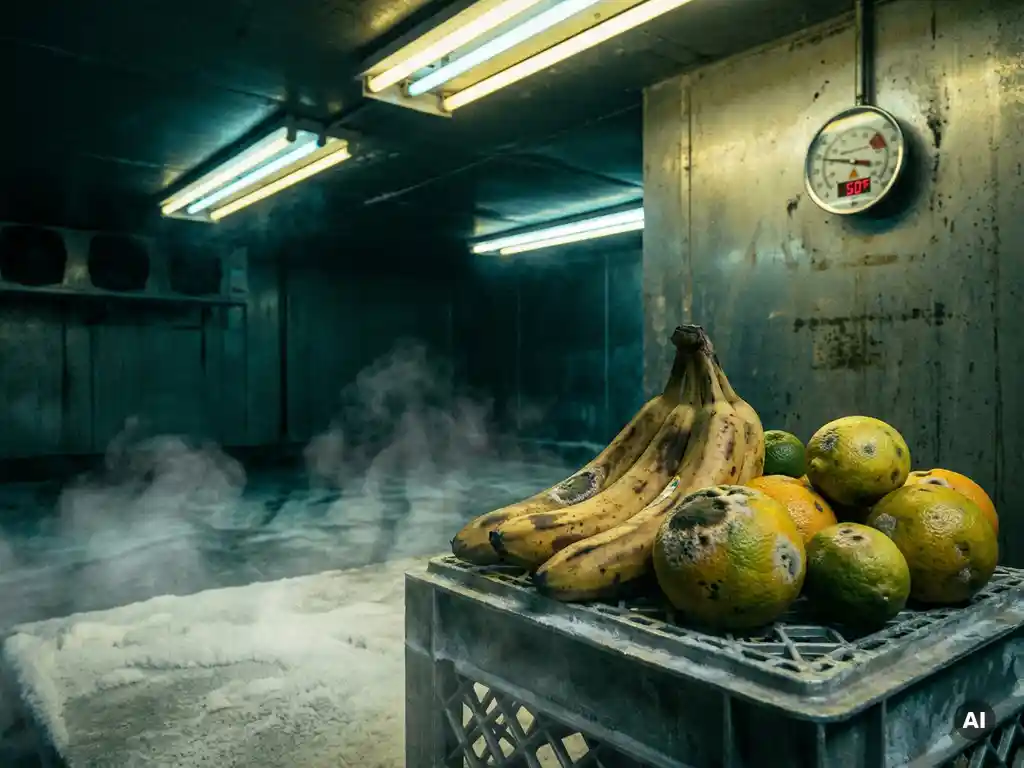
A temperature deviation during cold storage can lead to loss of quality, increased spoilage, and in severe cases, the complete rejection of a batch. For fresh products such as exotic fruit, even brief exposure to an incorrect temperature causes measurable damage. This article answers the most frequently asked questions about temperature deviations, from the initial damage to the subsequent steps taken.
What damage does a temperature deviation cause to fresh fruit?
A temperature anomaly in fresh fruit causes damage at the cellular level: fruits ripen too quickly, discolour, become soft, or develop cold or heat damage. The severity depends on the type of fruit, the degree of anomaly, and the duration of exposure. Visible consequences include browning, moisture loss, mould formation, and loss of structure.
Exotic fruits such as bananas and citrus fruits are particularly sensitive to temperature fluctuations. Bananas react to temperatures just below ten degrees with chilling, visible as dark spots on the peel. Citrus fruits can dry out or break internally at temperatures that are too low without this being immediately visible on the outside. This makes temperature damage in these products particularly insidious: the batch may look acceptable on the outside, while the internal quality has already been compromised.
In addition to direct product damage, there are also commercial consequences. An affected batch has a shorter shelf life, which causes problems for customers working with tight schedules for supermarket delivery or industrial processing.
How quickly does quality loss occur in the event of a temperature malfunction?
Loss of quality due to a temperature malfunction can occur within a few hours, depending on the product and the extent of the deviation. Fresh, ripe products react faster than unripe or less fragile varieties. With a deviation of more than five degrees above the set storage temperature, the ripening process of bananas can noticeably accelerate within just two to four hours.
The rate of quality loss is determined by three factors. First, the degree of deviation: a slight overshoot of one or two degrees has a different effect than a malfunction where the temperature rises by ten degrees. Second, the duration: a short peak of twenty minutes is different from a deviation that persists for several hours. Third, the condition of the product upon arrival: a batch that is already slightly damaged or far into the ripening process will deteriorate faster than a fresh, well-chilled shipment.
This is relevant for logistics planners and buyers because loss of quality is not always immediately visible after a malfunction. The damage only becomes apparent at a later stage, upon delivery or at the customer's. This increases the importance of proper recording and documentation at the moment of the deviation itself.
What are the most common causes of temperature deviations in a cold room?
The most common causes of temperature deviations in a cold room are technical malfunctions in the refrigeration system, insufficient sealing of doors or loading docks, an excessive simultaneous supply of warm goods, and errors in the settings of the climate control system. Human error, such as leaving a cold room door open for too long, also plays a significant role.
Technical failures are the most serious cause. A defective compressor, a leak in the cooling circuit, or a malfunction in the control electronics can cause the temperature to rise significantly within a short time. Preventive maintenance and regular inspection of the installation are therefore essential in professional cold storage.
Another common cause is the so-called heat load during loading. When large quantities of warm goods are introduced into a cold storage cell simultaneously, the internal temperature rises temporarily. If the cooling capacity is not calculated to handle this peak load, it takes too long for the desired temperature to be reached again. This is particularly relevant during the transfer of containers directly from the ship to the cooling unit, where speed and throughput are high.
How is a temperature deviation detected and recorded?
A temperature deviation is detected via continuous temperature monitoring using sensors distributed throughout the cold room. Alarm systems trigger automatically when the measured value falls outside the set range. All measurements are digitally recorded, ensuring a complete logbook is available for analysis and reporting.
Professional cold storage facilities use multiple measuring points per cell so that local deviations, for example near a door or in a corner with reduced air circulation, are also detected. The frequency of measurements varies, but in climate-controlled storage for fragile products, intervals of a few minutes are common.
In addition to automatic monitoring, manual checks also play a role. Upon arrival of a shipment, temperature measurements are performed as part of quality control. Deviations are recorded in a report including the time, measured value, location in the cell, and the set standard. This report forms the basis for further decision-making and is also relevant as documentation in the event of a potential damage claim.
What steps are taken after a detected temperature deviation?
Upon detection of a temperature deviation, four steps are immediately taken: the cause is determined and remedied if possible, the involved party is identified and isolated, a quality assessment of the goods takes place, and all findings are documented and communicated to the client.
The first priority is restoring the correct storage temperature. As soon as the cause has been resolved, it is assessed which products may have been exposed to the deviation. This is done based on the location in the cell, the duration of the malfunction, and the measured temperature values.
Subsequently, a visual and sometimes measurable quality assessment takes place. For fresh products, this may be a Brix measurement (to assess sugar content and degree of ripeness) or a moisture and temperature measurement of the fruit itself. Products that no longer meet the set quality standards are separated from the batch to prevent further contamination or deterioration of quality.
The client is informed as soon as possible, preferably with a written report containing all relevant data. Transparent communication is essential in this regard, especially if the goods are intended for supermarket delivery or industrial processing with strict specifications.
When is a temperature deviation grounds for rejection or a damage claim?
A temperature deviation is grounds for rejection if the goods demonstrably no longer meet the agreed quality standards or statutory food safety requirements. A claim for damages is applicable if the deviation is the result of demonstrably inadequate storage and the damage can be documented.
The rejection threshold depends on the product and the agreed specifications. For supermarket deliveries, strict standards often apply regarding shelf life, appearance, and temperature history. If a batch of bananas has ripened too quickly due to a malfunction and no longer falls within the set shelf-life margins, rejection by the buyer is a real risk.
Three elements are required for a damage claim: proof of the deviation (temperature logs), proof of the damage (quality reports or rejection reports), and a demonstrable link between the two. Good record-keeping is therefore not only operationally valuable but also legally relevant. Without conclusive documentation, it is difficult to establish liability, regardless of which side of the chain one is on.
Certifications such as BRC also play a role here: they set requirements for the registration and follow-up of temperature deviations, which means that certified storage partners are generally better equipped to document and resolve these types of situations.
How ZZColdstores handles temperature deviations in cold storage
ZZColdstores offers climate-controlled cold storage in Kruiningen and Vlissingen, specifically designed for fresh and perishable products such as bananas and citrus fruits. The approach to temperature deviations is based on a combination of prevention, rapid detection, and structured follow-up:
- 24/7 monitoring of temperature, humidity, and air circulation via advanced climate systems
- Flexible climate settings per cell, tailored to the specific requirements of the product
- Quality control upon arrival, including temperature, humidity, and Brix measurements
- Full traceability per pallet via a barcode system, from arrival to departure
- Written QC report with clear findings, available to the client
- Certifications including BRC, SKAL, and Demeter as the basis for quality assurance
Do you work with fresh or fragile products and would you like to know how ZZColdstores optimally protects your batch against temperature risks? Contact us for a discussion about your specific storage needs.
Frequently Asked Questions
How long is a temperature deviation allowed to last before I need to contact my storage partner?
In principle, any temperature deviation must be reported and followed up immediately, regardless of duration. Even a deviation of twenty to thirty minutes can have noticeable consequences for sensitive products such as bananas. In case of doubt, always contact your storage partner immediately so that they can assess the situation and document it in a timely manner for any necessary follow-up steps.
What can I, as an importer or buyer, do myself to mitigate temperature risks?
As an importer or buyer, you can mitigate risks by always having a temperature check performed upon arrival and requesting the shipment's temperature history (for example, via a data logger in the container). Furthermore, choose storage partners with demonstrable certifications such as BRC, which set requirements for climate control and recording. Establish clear temperature specifications contractually for each product type to avoid disputes regarding what constitutes a deviation.
What is the difference between cold exposure and heat damage, and how do I recognize them?
Chilling injury occurs when a product is exposed to temperatures that are too low for that specific species, but still above freezing. In bananas, this manifests as dark discoloration of the peel; in citrus fruits, as internal degradation without a visible outer layer. Heat damage, on the other hand, accelerates the ripening process and manifests as soft spots, fermentation, or mold formation. Both forms of damage can occur simultaneously if a product has experienced fluctuating temperatures during transport or storage.
Can a batch still be salvaged or repurposed after a temperature deviation?
That depends on the severity of the damage and the destination of the goods. Products that have ripened too quickly but are still safe and edible can sometimes be repurposed for a customer with less strict shelf-life specifications, such as a processing plant or juice producer. A thorough quality assessment by a specialist is essential in this regard. Always discuss repurposing in consultation with your storage partner and the relevant quality department, and document the decision in writing.
What documentation do I need at a minimum to successfully file a damage claim?
For a successful damage claim, you need at least three types of documentation: temperature logs demonstrating the deviation (including time, duration, and measured values), a quality report or rejection report describing the damage to the product, and proof of the agreed storage conditions as stated in your contract or product specifications. The more detailed and timely the recording, the stronger your position. Therefore, always ask your storage partner for a written report immediately after detecting a deviation.
How do I know if my storage partner is well-equipped to prevent and resolve temperature deviations?
When choosing a storage partner, pay attention to three concrete indicators: does the location have continuous, automated temperature monitoring with multiple measuring points per cell? Are relevant certifications in place, such as BRC, which set requirements for quality registration and incident follow-up? And does the partner have a documented protocol in place in the event of a temperature malfunction? Feel free to ask for examples of incident reports to assess how transparent and professional a partner handles these types of situations.
Does it matter in which part of the cold room my products are stored?
Yes, the position within the cold room can make a significant difference. Near doors, loading docks, or in corners with less air circulation, temperature differences can arise relative to the core temperature of the cell. Professional storage facilities take this into account by placing fragile products centrally and using multiple monitoring points per cell. Ask your storage partner how they determine the placement of sensitive products and what measures they take to minimize temperature differences within the cell.
Related articles
- What happens to goods between arrival and departure from a warehouse?
- How do you plan the inventory turnover of dry raw materials with a long lead time?
- What is the risk of condensation when unloading refrigerated containers?
- How does the transit of dry goods to Germany or Ukraine work?
- How does customs clearance for nuts from China or Vietnam work?