
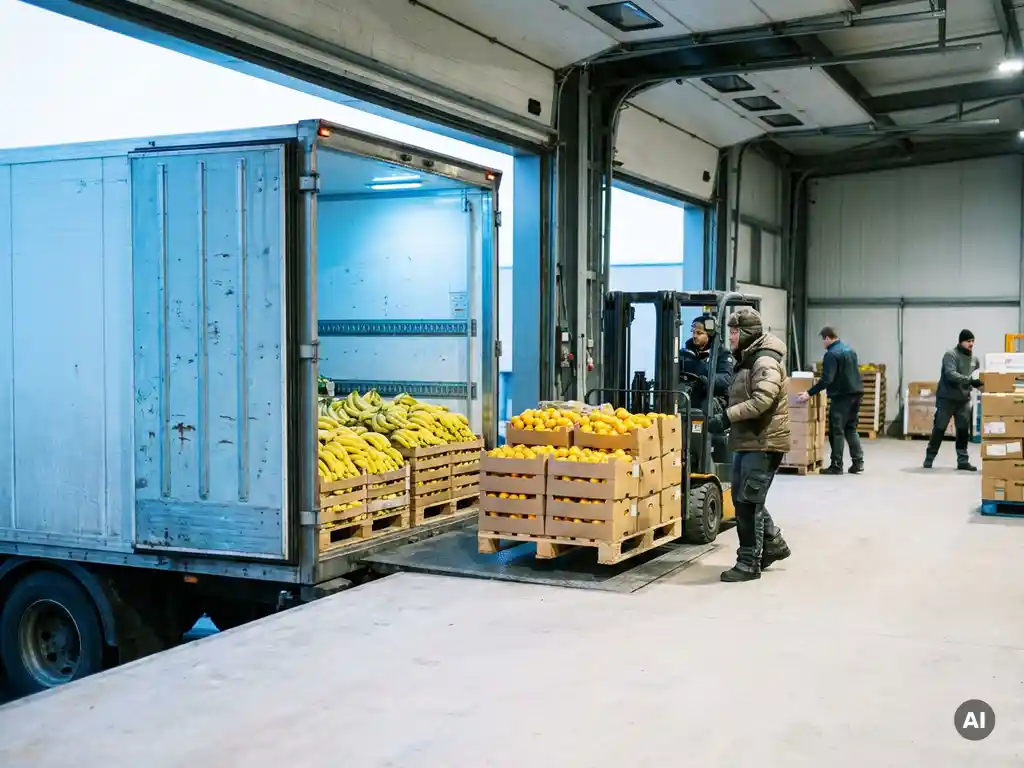
Cross-docking is a logistics method in which goods are transferred directly from inbound transport to outbound transport without intermediate storage. It is a viable alternative to buffer storage when products flow quickly, supply and demand are well aligned, and unnecessary dwell time in the warehouse results in costs or loss of quality. The choice between cross-docking and buffer storage depends heavily on the type of product, the supply chain structure, and the destination. This article answers the most frequently asked questions about both methods.
How does cross-docking work in practice?
In cross-docking, incoming shipments are received at a loading dock, immediately sorted or consolidated, and then transferred to outgoing vehicles without storage. The process aims to keep dwell time in the distribution center as short as possible, ideally within a few hours. The core of the system is tight coordination between inbound and outbound logistics.
In practice, cross-docking takes place in a fixed sequence:
- The incoming cargo arrives at the inbound side of the cross-docking point.
- Goods are checked for completeness and quality (QC).
- Pallets are sorted, and possibly rebuilt or labeled.
- The goods are driven directly to the outbound side.
- Loading onto the outgoing transport takes place immediately.
This model requires precise planning of arrival and departure times. Delays on one side of the process have a direct impact on the other. This makes timing and communication between all involved parties crucial.
What are the advantages of cross-docking compared to traditional storage?
The biggest advantage of cross-docking over traditional buffer storage is speed: goods reach their destination faster, without storage costs or the risk of quality loss due to prolonged storage. For time-sensitive and fresh products, this can make the difference between a high-quality shipment and a rejected one.
Other relevant benefits are:
- Lower storage costs: No use of expensive warehouse space or climate control for the transit period.
- Fewer handling steps: Products are touched less frequently, which limits damage.
- Faster lead time: The supply chain becomes more compact, leading to shorter delivery times for customers such as supermarkets or processing plants.
- Lower inventory risks: Fewer goods are sitting idle in the warehouse, reducing the risk of spoilage or depreciation.
For importers and wholesalers working with tight delivery windows for supermarket purchasing organizations, cross-docking makes a direct contribution to delivery reliability.
When is buffer storage a better choice than cross-docking?
Buffer storage is a better choice than cross-docking when supply and demand are not synchronized, when products require a ripening or stabilization period, or when the logistics chain cannot be coordinated tightly enough to guarantee immediate throughput. In those cases, controlled storage actually offers more certainty than rapid throughput.
Concrete situations where buffer storage is preferred:
- The buyer is not yet ready to receive the goods.
- The product requires further ripening or acclimatization, like certain types of exotic fruit.
- There are seasonal peaks during which goods are stocked for later distribution.
- Customs or inspection processes result in an unavoidable waiting time.
- The quantity of goods exceeds what can be delivered immediately.
In the agri-food sector, and certainly for temperature-sensitive products, buffer storage is therefore not a loss of time but a quality measure.
Which products are suitable for cross-docking and which are not?
Products suitable for cross-docking are of stable quality, have a fixed destination, and require no further processing or ripening. Examples include packaged dry products such as nuts, seeds, or grains that go directly from ship to distribution center. Products unsuitable for cross-docking are fresh or fragile goods that require a ripening period, or shipments for which extensive inspections are mandatory.
In practice, the following product characteristics determine suitability:
- Suitable for cross-docking: Stable quality, regular customer, no post-processing required, short delivery window.
- Less suitable: Products that are ripening, are sensitive to temperature fluctuations, or are awaiting inspection by KCB or NVWA.
For dry products such as peanuts, flakes, or dried fruit, cross-docking is in principle possible, provided the logistics chain is well organized. However, as soon as there is uncertainty regarding arrival quality or the delivery schedule, storage is more sensible.
How does cross-docking affect the cold chain?
Cross-docking has a direct impact on the cold chain because every transfer poses a risk for temperature deviations. When refrigerated products are transferred without adequate climate control at the transfer point, the temperature may temporarily fall outside the required range. This risk is manageable but requires specific infrastructure and strict process monitoring.
For temperature-controlled storage, transfer times must be as short as possible and the platform or buffer zone must also be climate-controlled. This is particularly critical for exotic fruits such as bananas or citrus fruits: even brief exposure to incorrect temperatures can accelerate ripening or impair product quality.
Cross-docking within a refrigerated environment, also cold cross-docking , is technically possible but places high demands on the facility and the coordination between carriers. Without these conditions, short-term buffer storage in a climate-controlled warehouse is the safer option for fresh products.
What are the infrastructure requirements for efficient cross-docking?
Efficient cross-docking requires a walk-through warehouse with separate inbound and outbound sides, sufficient loading bays for simultaneous arrival and departure, and systems for rapid identification and sorting of goods. Without this basic infrastructure, bottlenecks arise that negate throughput speed.
The most critical infrastructure requirements are:
- Loading docks on two sides: Inbound and outbound traffic must be able to take place simultaneously without interference.
- Barcode- or scan-driven identification: Each product must be identified immediately upon arrival and linked to the correct outgoing order.
- System integration: EDI connections between the warehouse management system and the systems of suppliers and customers ensure error-free communication and real-time status updates.
- Climate control on the platform: Mandatory for refrigerated products to maintain the cold chain during transshipment.
- Sufficient floor space: Room to temporarily place and sort pallets without congestion.
For logistics partners who combine cross-docking with additional services such as quality control, labeling, or palletizing, an integrated workspace next to the platform is also a requirement.
When does a logistics partner combine cross-docking with storage?
A logistics partner combines cross-docking with storage when the timing of inbound and outbound does not fully align, or when part of the shipment can proceed immediately while another part awaits inspection results, final ripening, or acceptance. In practice, this hybrid approach is the most common solution for complex supply chains.
In the agri-food sector, it is common for a ship to transport multiple types of products. Part of the cargo is ready for immediate distribution, while another part must first undergo import inspection or is not yet ripe enough. In that case, the logistics partner processes the direct flow via cross-docking and places the remainder temporarily in buffer storage, refrigerated or dry depending on the product.
This combination offers importers and wholesalers the best of both worlds: speed where possible, certainty where necessary. The choice of which part flows directly through and which part is stored is determined by quality control upon arrival, acceptance agreements, and the condition of the product.
How ZZColdstores helps with cross-docking and storage choices
ZZColdstores offers an integrated logistics solution where cross-docking and storage are tailored to the product, the shipment, and the customer's schedule. Containers are unloaded and inspected directly from our own quay in Vlissingen, after which it is determined for each shipment what flows directly through and what is temporarily stored. This prevents unnecessary waiting times and loss of quality.
The services include, among others:
- Quality control upon arrival, including temperature and humidity measurements
- Barcode-driven traceability per pallet, linked to grower and LOT numbers
- Climate-controlled cold storage and dry ambient storage for products such as nuts, peanuts, seeds, and flakes
- EDI connections for automatic order processing and inventory updates
- Own transport for shuttle trips within a radius of 40 km
Whether it concerns direct flow or controlled buffer storage: ZZColdstores helps determine the most efficient and quality-assuring approach for your supply chain. Contact us to discuss which solution best suits your product and logistics situation.
Frequently Asked Questions
How long does a typical cross-docking process take from arrival to departure?
In a well-designed cross-docking process, the dwell time of goods typically ranges between two and six hours. The exact lead time depends on the volume, the number of pallets to be sorted, the complexity of the orders, and any quality checks upon arrival. The more tightly the planning between inbound and outbound transport is coordinated, the shorter the total lead time.
What are the most common mistakes when setting up a cross-docking process?
The most common mistakes are poor time coordination between suppliers and customers, insufficient system integration resulting in goods not being immediately linked to the correct outgoing order, and the lack of a clear backup plan for delays. The infrastructure is also frequently underestimated: too few loading bays or insufficient floor space quickly leads to congestion that completely negates the speed benefits of cross-docking.
Is cross-docking also suitable for smaller shipments, or does it only work for large volumes?
Cross-docking is in principle scalable, but is most efficient for larger volumes where multiple pallets are sorted and consolidated simultaneously for multiple customers. For smaller shipments, the fixed costs of planning and coordination can be relatively heavy. A hybrid approach, in which small shipments are combined with other flows via consolidation cross-docking, can then be a practical solution.
How do I know if my current logistics partner is suitable to facilitate cross-docking?
A suitable logistics partner for cross-docking possesses at least a walk-through warehouse with separate inbound and outbound sides, scan-driven goods identification, and EDI connections to your systems. Additionally, inquire about experience with your specific product category, the availability of climate control on the platform for refrigerated products, and the ability to integrate quality controls into the process. If any of these elements are missing, there is a high probability that delays or quality problems will occur.
Can cross-docking be used as part of a more sustainable supply chain?
Yes, cross-docking contributes to a more sustainable supply chain by reducing the number of transport movements through consolidation, lowering energy requirements for storage, and limiting food waste through faster flow of fresh products. Less downtime in the warehouse means lower energy consumption for climate control and a reduced risk of rejected batches being destroyed. For agri-food companies working to reduce their carbon footprint, this is a relevant additional benefit.
What happens if incoming cargo is delayed during cross-docking planning?
A delay on the inbound side has direct consequences for outbound planning, as outbound transport and customers are already scheduled for a specific time. In practice, this requires immediate communication with all involved parties and a flexible backup plan, such as rebooking transport slots or temporarily deploying buffer storage. Good logistics partners monitor arrival times in real time and take proactive action in the event of impending delays, ensuring the impact on the rest of the chain remains minimal.
How does cross-docking for imports from third countries differ from cross-docking within Europe?
For imports from third countries, cross-docking only comes into play after customs formalities and any inspections by authorities such as the NVWA or the KCB have been completed. As long as a shipment is in customs status, it cannot flow freely and temporary buffer storage is mandatory. Within Europe, where no customs threshold applies, cross-docking is generally faster and involves fewer mandatory waiting times, making the method easier to apply there for time-critical products.