
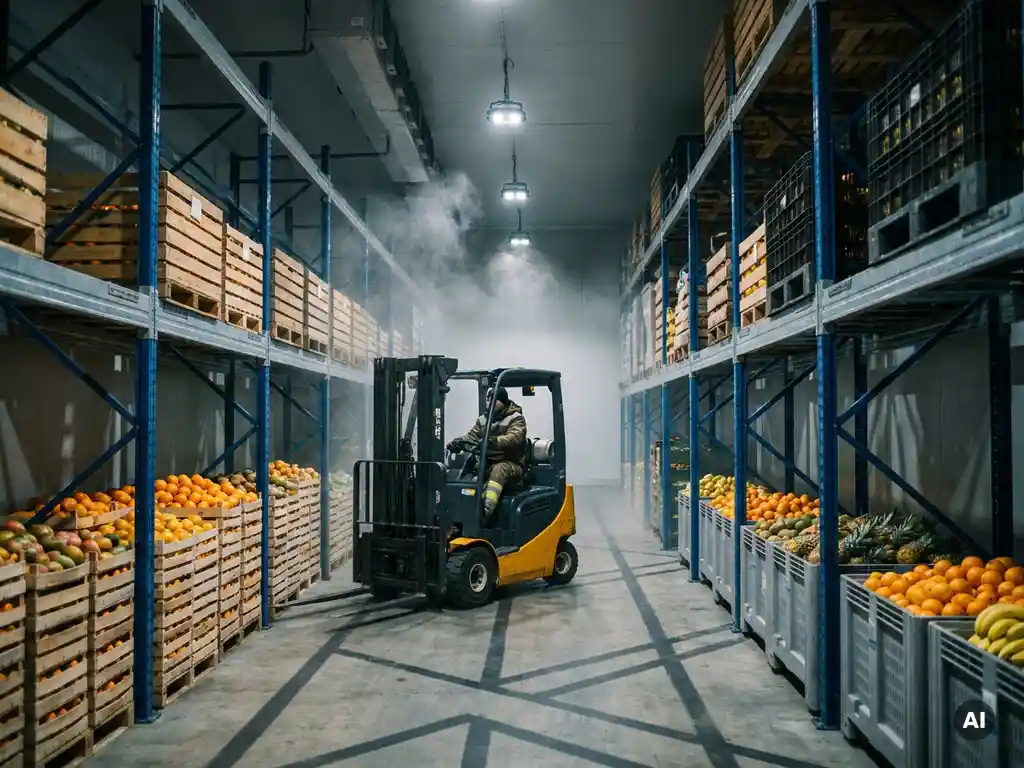
Full-service warehousing is a storage solution in which an external partner not only handles the physical storage of goods but also takes over all related logistics services, such as receiving, quality control, order processing, labeling, and shipping. It is an integrated approach where a single party manages the entire warehousing process. This model is particularly valuable for B2B companies that want to streamline their supply chain without investing in storage infrastructure or logistics personnel themselves. In this article, we answer the most frequently asked questions about full-service warehousing.
What are the benefits of full-service warehousing?
Full-service warehousing offers companies a single point of contact for their entire supply chain, leading to less coordination work, lower operational costs, and higher reliability of the flow of goods. Instead of managing multiple parties, you work with one specialized partner who manages the entire process.
The main benefits at a glance:
- Operational efficiency: Processes such as unloading, receiving, quality control, and delivery are seamlessly coordinated, minimizing delays and errors.
- Cost management: Companies pay for the capacity they actually use, without fixed costs for their own warehouse space, equipment, or personnel.
- Flexibility: A good full-service partner adjusts its capacity to seasonal peaks or fluctuating volumes, without you having to scale up or down yourself.
- Risk diversification: Quality controls, traceability, and certifications are guaranteed by the warehouse partner, which limits your own liability.
- Speed: Direct link between arrival, storage, and distribution significantly shortens lead time.
This is particularly relevant for importers, wholesalers, and suppliers delivering to supermarkets or processing plants. Every link in the chain must function precisely, and a full-service warehouse partner fully assumes that responsibility.
Which services fall under full-service warehousing?
Full-service warehousing encompasses all logistical operations surrounding the storage of goods, from receipt to delivery. This goes far beyond simply renting storage space and typically covers the entire warehousing process, including related services.
Typical services within a full-service warehouse concept are:
- Receipt and warehousing: Unloading containers, registering and booking goods into the system.
- Quality Control (QC): Inspection upon arrival for damage, labeling, and product condition, including temperature and humidity measurements for sensitive products.
- Storage: Both ambient (dry storage) and climate-controlled storage, depending on the product.
- Value Added Logistics (VAL): Repalletizing, box picking, sorting, and checking orders.
- Value Added Services (VAS): Labeling, barcode-driven traceability, and system integrations such as EDI for automated order processing and inventory updates.
- Delivery and transport: Shuttle transport to production locations or distribution centers, including loading and unloading activities.
- Customs and inspection: Import inspection and customs clearance for international goods flows.
The combination of these services makes full-service warehousing fundamentally different from renting ordinary storage space. It is an integrated logistics solution, not a passive storage facility.
What is the difference between full-service warehousing and regular storage?
The core difference is that standard storage offers only space to store goods, whereas full-service warehousing also encompasses all processes surrounding that storage. With standard storage, you remain responsible for receiving, administration, quality control, and shipping. With full-service warehousing, the partner takes over completely.
In concrete terms, this means the following distinction:
- Standard storage: You rent square meters or pallet spaces. What happens to it afterwards is your own responsibility.
- Full-service warehousing: The partner manages the entire flow of goods, from arrival and inspection to order picking and delivery, including reporting and traceability.
For companies that import goods and resell them to large customers such as supermarket purchasing organizations, standard storage is rarely sufficient. They require demonstrable quality assurance, detailed reporting, and fast turnaround times, which only a full-service approach can provide.
For which companies is full-service warehousing suitable?
Full-service warehousing is best suited for B2B companies that regularly import, store, and deliver large volumes of goods, but do not have the capacity or infrastructure to manage this entirely in-house. The model is a good fit for companies with complex supply chains or strict quality requirements.
Specifically, it is relevant for:
- Importers and wholesalers of fresh food products such as exotic fruit, vegetables, and nuts, who deal with limited shelf life and strict quality standards.
- Suppliers to supermarkets that must comply with specific labeling requirements, traceability requirements, and delivery windows.
- Processing plants that want to temporarily store raw materials before they enter the production process, without managing warehouse capacity themselves.
- Freight forwarders and logistics service providers looking for a reliable warehousing partner in the Rotterdam-Antwerp corridor for their clients.
- Exporters who consolidate goods for transport to European destinations such as Germany or Eastern Europe.
In short: any company where the storage of goods is a critical link in the supply chain, but is not the core activity, benefits from a full-service approach.
How does full-service warehousing for refrigerated and dry products work?
Full-service warehousing for refrigerated and dry products operates based on product-specific storage conditions, where the warehouse partner tailors temperature, humidity, and air circulation to the product's requirements. Not every product requires the same environment, and a good full-service partner has multiple storage cells with flexible settings.
Climate-controlled storage for fresh produce
Fresh and perishable products such as exotic fruit require precise climate control. Temperature, humidity, and air circulation are continuously monitored to prevent loss of quality. Upon arrival, products are immediately inspected and stored under the correct conditions. Every pallet is fully traceable via barcodes, including grower and LOT numbers. More information about climate-controlled storage provides insight into how this works in practice.
Dry storage for ambient products
Dry products such as nuts, peanuts, and seeds are stored in ambient warehouses, typically at a stable temperature of approximately 11 degrees. Here too, the full-service approach encompasses more than just storage: upon arrival, products are registered, inspected, and, if necessary, sorted or repalletized. Separate areas for different product categories prevent cross-contamination and safeguard quality.
Which certifications are important for full-service warehousing?
In full-service warehousing, certifications are a direct indicator of quality, food safety, and reliability. The most relevant certifications for companies that store and distribute food products are BRC, SKAL, and certification by the KCB (part of the NVWA).
- BRC (British Retail Consortium): An internationally recognized standard for food safety and quality management in the storage and distribution of food products. Supermarkets and large retailers often require this certificate from their suppliers.
- SKAL: Relevant for companies that import or store organic products. SKAL certification demonstrates that the organic integrity of products is guaranteed throughout the entire storage process.
- KCB/NVWA: The Quality Control Bureau inspection is mandatory for the import of certain fresh products, including exotic fruit. A full-service partner who can perform or facilitate this inspection themselves significantly accelerates the import process.
- Demeter: For companies that process biodynamic products, this certificate offers additional assurance of product integrity.
When selecting a warehouse partner, always check which certifications are up-to-date and whether they meet your customers' requirements. Missing certifications can lead to rejection upon delivery or problems during import inspections.
What should you look for when choosing a full-service warehouse?
When choosing a full-service warehouse, location, certifications, storage capacity, and the breadth of the service package are the most determining factors. A good match requires that the partner not only has the right infrastructure but also demonstrable experience with your type of product and goods flow.
Take the following points into consideration:
- Location relative to ports and customers: A warehouse near Rotterdam or Antwerp significantly shortens import lead times, especially if the partner has its own quay or a direct port connection.
- Product-specific storage conditions: Ask whether the partner has multiple climate zones or storage cells that can be set independently. Not every product tolerates the same temperature or humidity.
- Traceability and systems: Modern warehouses work with barcode-driven traceability and offer EDI connections for automatic inventory updates and order processing. This is essential for deliveries to large retailers or processing plants.
- Flexibility: Choose a partner who adapts to your sailing schedules, seasonal peaks, and specific product specifications, rather than a standard approach that does not align with your operation.
- Certifications: Check whether the partner holds the certifications required by your customers, such as BRC, SKAL, or KCB/NVWA accreditation.
- Service package: Explicitly ask which VAL and VAS services are offered, from quality control and repalletizing to labeling and shuttle transport.
How ZZColdstores helps with full-service warehousing
ZZColdstores has been active as a B2B logistics partner since 1994 and offers a fully integrated warehousing concept for fresh and dry food products from locations in Kruiningen and Vlissingen. The company combines climate-controlled storage, dry storage, and a wide range of Value Added Logistics (VAL) and Value Added Services (VAS) under one roof.
What ZZColdstores specifically offers within full-service warehousing:
- Climate-controlled cold storage with 24/7 monitoring of temperature, humidity, and air circulation, tailored per product
- Dry storage with a capacity of 12,000 pallet spaces, with separate areas for nuts, peanuts, seeds, and other food products
- Quality control upon arrival, including temperature, humidity, and Brix measurements with full QC reporting
- Barcode-driven traceability including grower and LOT numbers
- EDI connections for automatic order processing, inbound notifications, and inventory updates
- Own quay in Vlissingen for direct transfer from ship to cooling
- Certifications: BRC, SKAL and KCB/NVWA recognized
Would you like to know if ZZColdstores meets your logistics needs? Contact us and discuss your specific requirements; we are happy to help find a suitable solution.
Frequently Asked Questions
How long does it take to switch to a full-service warehouse partner?
The switch to a full-service warehouse partner typically takes two to six weeks, depending on the complexity of your goods flow and the required system integrations such as EDI. In practice, the process begins with an intake during which the partner maps out your product specifications, volumes, and delivery frequencies, followed by setting up traceability systems and aligning operational procedures. A phased start-up, where you begin with one product category or goods flow, reduces operational risks during the transition.
What are the most common mistakes when selecting a warehouse partner?
A common mistake is comparing solely on price per pallet space, without taking into account the breadth of the service package and product-specific storage conditions. Companies also underestimate the importance of the partner possessing the correct certifications required by their customers, such as BRC or SKAL. Additionally, always check whether the partner has experience with your specific type of product, as the requirements for exotic fruit or organic nuts differ significantly from those for generic dry goods.
As a small or medium-sized business, can I also make use of full-service warehousing, or is this only for large players?
Full-service warehousing is particularly attractive for small and medium-sized enterprises, as it provides access to professional logistics infrastructure without requiring you to invest in warehouse space, equipment, or personnel yourself. You only pay for the capacity you actually use, making the model financially accessible even for smaller volumes. However, it is advisable to verify whether the partner is flexible enough to handle smaller shipments with the same care as large container flows.
How is the quality of my products guaranteed during storage?
A full-service warehouse partner guarantees quality through a combination of quality control upon arrival, continuous monitoring of storage conditions, and full traceability per pallet. Upon arrival, products are inspected for damage, temperature, humidity, and product condition, and recorded in a QC report that you, as the client, can review. During storage, climate parameters such as temperature and humidity are continuously monitored so that deviations are immediately detected and corrected before product quality is compromised.
What happens if my volumes fluctuate significantly due to seasonal peaks?
One of the core benefits of full-service warehousing is precisely the flexibility to scale with seasonal peaks and fluctuating volumes, without having to hire staff yourself or rent additional warehouse space. Discuss expected peak periods and available maximum capacity with your partner in advance to avoid surprises during busy seasons. Some partners work with pre-agreed capacity reservations for regular customers, which offers certainty during periods of high demand.
How does the EDI connection work in practice, and is it mandatory?
An EDI (Electronic Data Interchange) connection enables the automatic exchange of orders, inbound notifications, and inventory updates between your system and that of the warehouse partner, without manual entry. This is not always mandatory, but is strongly recommended for companies supplying large retailers or processing plants that also work with EDI. Without an EDI connection, communication takes place via email or portals, resulting in more manual work and increasing the risk of errors at higher order frequencies.
What do I need to provide or prepare before starting with a full-service warehouse partner?
Ensure that you have a clear overview of your product range at the start, including storage conditions, expected volumes per period, required certifications from your customers, and any specific labeling requirements. The more detailed you map this out, the faster the partner can set up a suitable storage solution and the less risk of miscommunication during the operational start-up. Also, ask the partner to discuss a trial period or pilot run so that you can evaluate the collaboration before committing to long-term agreements.
Related articles
- What is cross-docking and when is it an alternative to buffer storage?
- How does the transfer of ownership work when storing goods in a third-party warehouse?
- What are the NVWA rules for import inspection of dried fruit in 2026?
- What is the difference between a warehouse and a distribution center?
- How do you switch from on-premises storage to outsourced ambient storage?