
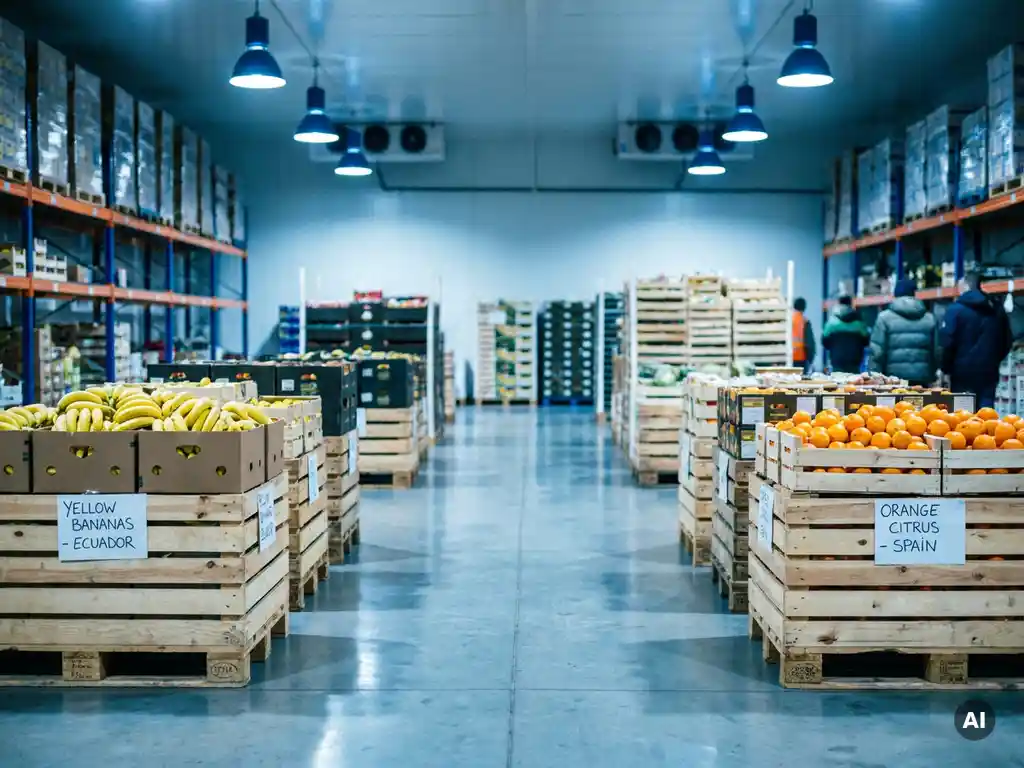
Keeping batches of food products separate in a warehouse is achieved through a combination of physical separation, clear administrative record-keeping, and strict work instructions. Each product is assigned a fixed location based on product category, temperature requirements, and LOT number to prevent batch mixing at all times. The sections below answer the most frequently asked questions about separation in food storage.
What methods are used to separate goods in a warehouse?
Goods in a warehouse are separated using three main methods: physical separation through location assignment and demarcation, administrative separation via a warehouse management system (WMS), and procedural separation through work instructions that determine who may touch what and when. In practice, these methods always work together.
Physical separation means that batches are placed at different pallet locations, in different aisles, or in separate climate zones. Visual aids such as colored floor markings, dividers, or signs help employees quickly see which zones are intended for which products.
Administrative separation means that every pallet receives a unique identification number, linked to the LOT number, the supplier, the arrival date, and the destination. This ensures that it is always traceable which party is where and who is responsible for it. In combination with barcode-driven traceability, every movement of a pallet is recorded, which significantly reduces errors during picking or loading.
What is the difference between physical and administrative separation?
Physical separation is the spatial distance between batches in the warehouse: separate locations, zones, or spaces. Administrative separation is the digital or paper record that tracks which batch is located where and what status it has. Both are necessary: physical separation without administration leads to lost batches, and administration without physical separation leads to unintended mixing.
A practical example: two batches of bananas from different suppliers can be physically located in the same cold room, but they must be placed on separate pallet locations and each have their own LOT number in the system. As soon as an employee moves a pallet without registering it, the administrative separation is broken and traceability is lost.
For certifications such as BRC, it is mandatory that both forms of separation are demonstrably present. An audit checks not only whether parties are physically separated, but also whether the records correspond to the actual situation on the floor.
How do you prevent cross-contamination between different parties?
Cross-contamination between batches is prevented by strict zoning, clean work procedures, and consistent quality control upon arrival. Products that do not meet the set quality standards are immediately separated from the approved batch, so that defective goods do not affect the rest of the shipment.
Concrete measures that contribute to preventing cross-contamination:
- Check packaging integrity upon arrival so that damaged boxes are not stored together with intact products
- Cleaning equipment such as forklifts and pallet trucks between handling different product categories
- Instruct employees never to place products from two different batches on one pallet without explicit instruction
- Establish quarantine zones for batches whose quality has not yet been approved
- Perform sampling when in doubt, so that you quickly gain insight into the condition of a shipment without slowing down the entire logistics process
For fresh and fragile products such as exotic fruit, this is especially important: one damaged box with mold can quickly affect surrounding products if immediate separation does not take place.
When is separate storage per product category mandatory?
Separate storage by product category is mandatory when products can influence each other's quality, safety, or certification status. This applies in any case to products with significantly different temperature requirements, products with an organic (SKAL) or Demeter certificate compared to conventional products, and batches in quarantine awaiting an import inspection.
In most cases, certified organic products may not be stored together with conventional products, unless there is demonstrable physical separation and this is documented. A SKAL audit specifically checks this. The same applies to products subject to the KCB/NVWA import inspection regime: these may only be released for further distribution after the inspection has been completed.
Furthermore, nuts, peanuts, and seeds require separate dry storage areas due to the risk of humidity and the specific requirements regarding temperature and air circulation. Mixing with other product categories can lead to rejection by the recipient or during a certification audit.
How does FIFO work when managing multiple parties simultaneously?
FIFO stands for First In, First Out: the batch that arrived first is also delivered first. When handling multiple batches simultaneously, this means that each batch has an arrival date and LOT number, and that the system automatically selects the oldest batch first when assembling an order.
FIFO only works well if the administrative records are accurate and the physical locations are set up so that the oldest batch is actually accessible first. A common mistake is placing new pallets in front of older ones, causing the oldest stock to be at the back and more difficult to access.
For fresh products such as fruit, FIFO is not only a best practice but a food safety requirement: products that have been sitting for too long can deteriorate in quality and may no longer be delivered. A well-configured WMS with LOT tracking prevents employees from having to manually keep track of which batch is the oldest.
What role does temperature zoning play in the separation of food products?
Temperature zoning is the division of a warehouse into zones with different climate settings, so that each product is stored at the temperature and humidity it requires. This not only prevents loss of quality but also ensures a natural separation between product categories that require different conditions.
A food storage warehouse typically has multiple zones:
- Cold rooms for fresh products such as exotic fruit, with precisely controlled temperature and humidity.
- Dry storage areas for products such as nuts, peanuts, and seeds, stored at a stable ambient temperature of approximately 11 degrees.
- Quarantine zones for products awaiting quality control or import inspection
By classifying products based on their climate requirements, you prevent temperature-sensitive products from being exposed to unsuitable conditions. Bananas stored too cold can suffer cold damage; products kept too warm ripen too quickly. Temperature zoning is therefore both a quality measure and a separation mechanism.
What are the consequences of incorrect separation for certification and liability?
Incorrect separation of food batches can lead to the loss of certifications such as BRC or SKAL, rejection of an entire batch by the NVWA or KCB, and liability towards the recipient if products are mixed or damaged. The consequences are both operational and legal.
During a BRC audit, it is specifically checked whether batches are traceable and whether non-conforming products have been demonstrably separated. If an auditor finds that LOT numbers do not match the physical locations, or that a batch in quarantine is not actually kept separate, this can lead to a non-conformity that jeopardizes the certification status.
For organic products, mixing with conventional products invalidates the organic certificate of the entire batch. This has direct financial consequences, as organically certified products have a higher market value and the recipient is entitled to compensation if the certification status is incorrect.
Liability towards customers arises when a purchaser receives a batch that does not correspond to the specified specifications, or when products are affected because separation was not performed correctly. A documented working method with demonstrable checks is the strongest protection against these types of claims.
How ZZColdstores handles the separation of food batches
ZZColdstores offers an integrated approach to the separation and storage of food batches, tailored to the specific requirements of each product and customer. Specifically, this includes:
- Quality control upon arrival, where defective products are immediately separated from the approved batch
- Barcode-driven traceability where grower and LOT numbers are linked to each pallet, so that every movement is fully traceable
- Separate climate zones for cold storage and dry storage, with precise settings per product category
- Quarantine management for batches awaiting import inspection by KCB/NVWA
- Certifications including BRC, SKAL, and Demeter, which demonstrate that separation and traceability meet the highest standards
Would you like to know how climate-controlled storage at ZZColdstores works for your product flows? Contact us and discuss the possibilities for your specific situation.
Frequently Asked Questions
How do I start setting up good batch separation if I am not using a WMS yet?
Start by implementing a paper or spreadsheet-based record keeping track of at least the LOT number, arrival date, supplier, and storage location for each pallet. Combine this with clear physical markings on the floor and laminated location cards on the racks. As volume grows, the step towards a simple WMS is quickly recouped through fewer errors during picking and loading.
What do I do if an employee has accidentally mixed products from two different batches?
Immediately isolate the affected pallets and record the deviation in your system as a non-conformity. Conduct a reassessment to determine which products are still traceable and which are not. If traceability can no longer be guaranteed, in many cases you must reject the entire mixed batch or keep it separate until a quality control check provides a definitive answer — document every step for potential audits.
How often do I need to check whether the physical locations still correspond with the administrative register?
Conduct a sample check at least weekly, comparing a number of random pallet locations with the registration in your system or records. For high-risk products, such as certified organic goods or batches in quarantine, daily checks are recommended. Regular cycle counting prevents minor deviations from accumulating into a problem that only comes to light during an audit.
Can I store organic and conventional products in the same cold room, provided they are in separate locations?
Yes, that is possible in principle, but only if the separation is demonstrably recorded both physically and administratively and there is no risk of mixing, for example due to adjacent pallets or shared use of equipment without intermediate cleaning. SKAL specifically checks this during audits and expects a documented procedure demonstrating that the biological integrity of the batch was not compromised at any point. Always consult your certification body if in doubt.
What documentation must I retain to limit liability in the event of a dispute?
At a minimum, retain the incoming consignment notes and quality reports upon arrival, the LOT number links per pallet, the movement history from your WMS or manual registration, and the exit receipts for each delivery. Add photos of the initial condition of a batch if damage was already present upon arrival. A demonstrable, chronological documentation chain is the strongest protection against claims from recipients in the event of a dispute.
How do I handle batches that have been partially approved and are partially still in quarantine?
Immediately physically separate the batch into an approved section and a quarantine section, and assign a distinct status and location to each section in your registration. Ensure that the quarantine section is inaccessible for regular picking activities, for example by blocking it in the WMS or by clear physical marking. Only release the quarantine section after written approval by the responsible quality officer or the competent inspection authority.
What is the difference between a quarantine zone and a return zone, and why is that distinction important?
A quarantine zone is intended for products whose status is still unknown, for example, awaiting an import inspection or internal quality check. A return zone is intended for products that have already been shipped but are returning from a customer. This distinction is important because returns have their own risk profile: they may have been exposed to unknown conditions outside the warehouse and may only be released after reassessment. By strictly separating both zones, you prevent products of unknown origin from being unintentionally reprocessed in an ongoing order.
Related articles
- How does cold storage work for large seasonal supplies?
- How does the transfer of ownership work when storing goods in a third-party warehouse?
- What is the risk of condensation when unloading refrigerated containers?
- Why do Ukrainian buyers choose storage via Dutch ports?
- What are the risks of improper storage of peanuts and cashews?