
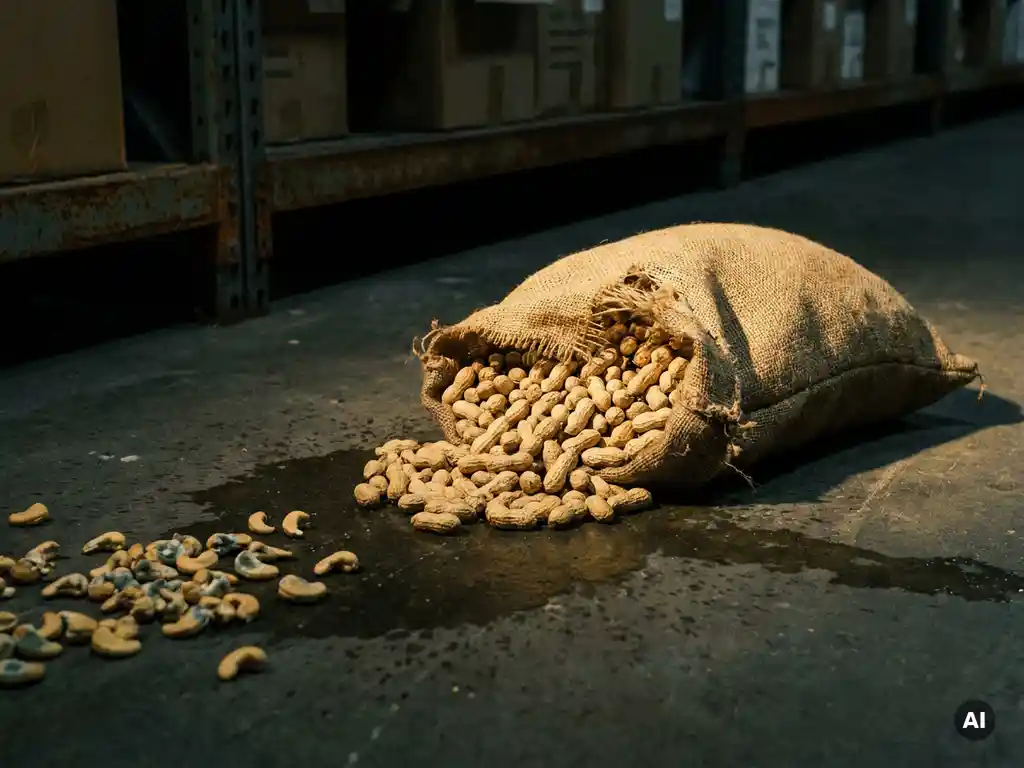
Improper storage of peanuts and cashews leads to loss of quality, mold formation, and dangerous contaminants such as aflatoxin. The risks are significant: incorrect temperature or humidity can render an entire batch unsaleable and even lead to recalls or fines for violating food safety regulations. This article answers the most frequently asked questions about nut storage risks and how to prevent them.
What damage is caused by incorrect temperature and humidity?
Peanuts and cashews spoil quickly at incorrect temperature and humidity: fats oxidize, flavors turn rancid, and mold gets the chance to grow. This loss of quality is often irreversible and renders batches unsuitable for sale or further processing. For logistics and supply chain partners, this means direct financial damage.
Nuts naturally contain a high fat content. When the storage temperature is too high or fluctuates significantly, the oxidation of these fats accelerates. The result is rancidity, an off-odor, and an unpleasant taste. Even limited exposure to heat for an extended period is sufficient to permanently damage the sensory quality.
Excessive humidity further exacerbates the problem. When nuts absorb moisture, the so-called water activity in the product increases. This creates ideal conditions for mold growth, including dangerous mold species that produce mycotoxins. Conversely, excessively low humidity can lead to dehydration and brittleness, causing visible cracks and weight loss in cashews.
What is aflatoxin and why is it dangerous in peanuts and cashews?
Aflatoxin is a toxic substance produced by molds of the genus Aspergillus, particularly Aspergillus flavus and Aspergillus parasiticus. It is one of the most harmful natural food contaminants and poses a particular risk with peanuts and cashews when stored under unfavorable storage conditions.
Aflatoxins are carcinogenic and can be harmful to public health even in small quantities. The European Union therefore sets strict maximum limits for aflatoxin levels in nuts and peanuts intended for human consumption. Batches exceeding these limits are rejected and are not allowed to enter the market.
For importers and wholesalers, this is a concrete business risk. Mold growth, and consequently aflatoxin formation, almost always results from a combination of excessive temperature and humidity during transport or storage. When the cold chain is interrupted or storage conditions are not closely monitored, the risk of contamination increases significantly. Prevention therefore begins with monitoring the correct conditions from the moment of arrival.
How does humidity affect the shelf life of nuts?
Humidity is the most important environmental factor determining the shelf life of nuts. A relative humidity above 65 percent is already sufficient to stimulate mold growth in peanuts and cashews. The higher the humidity, the faster the quality deteriorates and the greater the risk of mycotoxin formation.
Nuts are hygroscopic: they absorb moisture from the ambient air. This means that even properly dried nuts can re-absorb moisture if stored in a room with insufficient humidity control. This not only increases the risk of mold but also affects the texture and weight of the product.
Proper dry storage for nuts requires a stable, controlled environment with a relative humidity that consistently remains below critical limits. Fluctuations, for example due to varying outside temperatures or insufficient insulation, are at least as harmful as structurally excessive humidity. Air circulation also plays a role here: stagnant air promotes moisture accumulation around pallets and packaging.
What are the consequences of improper storage for food safety and regulations?
Improper storage of peanuts and cashews can lead to non-compliance with European food safety regulations, recalls, import refusals, and reputational damage. The EU regulations on maximum aflatoxin levels and microbiological standards are binding on all market operators in the chain, from importer to processor.
The consequences of an infringement are far-reaching:
- Batches are rejected during import inspection and may not be released onto the market
- Products already distributed may be recalled, resulting in high logistical and financial costs
- Fines and administrative sanctions from supervisory authorities such as the NVWA
- Long-term reputational damage among customers and purchasing organizations of supermarkets
- Loss of certifications such as BRC, which are required for access to major retail chains
Food safety begins at the storage facility. Once a batch of nuts is contaminated with aflatoxin or other mycotoxins, there is no treatment that reverses the contamination. Prevention through proper storage is therefore not only a matter of quality, but a legal obligation.
How do you prevent loss of quality during the transport and storage of nuts?
You prevent loss of quality in peanuts and cashews by controlling the entire logistics chain: from the moment of shipment in the country of origin to arrival at the storage warehouse. The key lies in maintaining stable, product-specific conditions throughout the entire process.
The most important preventive measures are:
- Check the condition upon arrival; inspect each batch immediately after unloading for moisture damage, mold growth, and abnormal odors before the goods are stored.
- Use a certified storage location; choose a warehouse with active climate control, humidity control, and monitoring, preferably BRC-certified.
- Minimize exposure to outside air; any transfer where products are exposed to uncontrolled ambient air increases the risk of moisture absorption.
- Ensure proper pallet arrangement and air circulation; do not stack pallets too close together and ensure that air can circulate freely around the load.
- Document the storage conditionsand keep temperature and humidity logs as evidence of careful storage, which is also required for certification and traceability.
During transport, the continuity of conditions is at least as important as the storage itself. Delays, unexpected transshipments, or the use of non-temperature-controlled containers are common causes of quality loss that only manifest later in the chain.
When is professional cold storage necessary for nuts and peanuts?
Professional, climate-controlled storage is necessary for nuts and peanuts when the batch size, storage duration, or origin of the product poses an increased risk of quality loss. For importers and wholesalers working with large volumes or products from tropical countries of origin, specialized storage is not a luxury, but a requirement.
In practice, professional storage is recommended in the following situations: when consignments are stored for longer than a few weeks, when the in-house storage facility lacks active climate control, or when customers require certifications such as BRC as a condition for delivery. Immediate placement in a controlled environment is also highly recommended for imports via sea freight, where products have been in containers for an extended period.
For dry storage of nuts , the storage location must not only be able to maintain the correct temperature and humidity, but must also have the appropriate certifications and procedures for import inspection and traceability.
How ZZColdstores helps with the safe storage of peanuts and cashews
From its locations in Kruiningen and Vlissingen, ZZColdstores offers specialized dry storage for nuts, peanuts, and seeds, with a total capacity of 12,000 pallet spaces. The warehouse is designed for products that require a stable, controlled environment to prevent quality loss and mold formation.
What sets ZZColdstores apart for logistics partners in the nut sector:
- BRC-certified storage facilities with active climate and humidity control
- Separate storage areas for nuts, peanuts, and seeds to avoid cross-contamination
- Direct unloading from our own quay in Vlissingen, minimizing exposure to uncontrolled ambient air
- Assistance with import inspection via KCB (part of the NVWA) and customs clearance
- Flexible storage tailored to the sailing schedule and the specific requirements of the party
Would you like to know if ZZColdstores' storage facilities meet your logistical needs? Contact us for a no-obligation discussion about the possibilities.
Frequently Asked Questions
What are the ideal temperature and humidity values for storing peanuts and cashews?
For peanuts and cashews, the recommended storage temperature is between 10 and 18°C, combined with a relative humidity of no more than 60-65%. Fluctuations in both values are at least as harmful as a structurally incorrect setting, so continuous monitoring via automated systems is essential. A stable environment significantly extends shelf life and minimizes the risk of mold formation and oxidation.
How do I recognize if a batch of nuts is already affected by mold or aflatoxin?
Visible mold growth, a musty or rancid odor, discoloration, or a sticky texture are signs that a batch may be contaminated. However, aflatoxin is not always visible or detectable by smell: contamination can be present without clear visual signs. Laboratory analysis by an accredited testing agency is the only reliable way to measure aflatoxin levels and compare them with EU maximum limits.
What should I do if I suspect that a batch of peanuts or cashews is contaminated with aflatoxin?
Immediately isolate the batch from other stocks to prevent cross-contamination and have a laboratory test performed before taking further steps. Inform your quality manager and carefully document all findings, including storage conditions and arrival times. If contamination is confirmed, you are legally obliged to report this to the competent authorities, such as the NVWA, and the batch may not be introduced into the food chain.
How long can peanuts and cashews be safely stored under the right conditions?
Under optimal storage conditions—stable temperature, controlled humidity, and good air circulation—cashews can generally be safely stored for 6 to 12 months, while peanuts can achieve a shelf life of 9 to 12 months under ideal conditions. The exact shelf life depends heavily on the initial quality upon arrival, the packaging method, and the continuity of storage conditions throughout the entire period. Regular quality checks during the storage period are always recommended.
Which packaging forms offer the best protection during the storage and transport of nuts?
Vacuum packaging or Modified Atmosphere Packaging (MAP) offers the best protection against oxidation and moisture absorption, as oxygen and humid ambient air are virtually completely excluded. For bulk storage in bags or big bags, the use of a moisture-resistant, airtight inner lining is highly recommended. Regardless of the packaging form, climate-controlled storage remains necessary: packaging slows down quality loss but does not replace a stable storage environment.
What are the most common mistakes importers make when storing nuts?
The most common mistakes are: storing nuts in unconditioned spaces without active humidity control, stacking pallets too close together which impedes air circulation, and neglecting a thorough quality inspection immediately upon arrival. Additionally, many parties underestimate the risk of condensation forming during temperature fluctuations, for example when a cold container is opened in a warm environment. All these situations are avoidable with the right procedures and a certified storage partner.
Is BRC certification mandatory for the storage of peanuts and cashews in the Netherlands?
BRC certification is not legally mandatory, but in practice, it is a strict requirement of major retailers, purchasing organizations, and many international buyers as a condition for delivery. Without BRC certification, you effectively exclude yourself from a large part of the market and run an increased risk during audits and inspection processes. Moreover, a BRC-certified storage location offers demonstrable guarantees of food safety and traceability, which strengthens your position as a reliable supplier in the chain.
Related articles
- When is climate-controlled cold storage necessary?
- Can you combine warehousing with container handling?
- How long can you safely store garlic in a temperature-controlled warehouse?
- What are the advantages of storage close to the port of Antwerp or Rotterdam?
- How do you choose a suitable storage partner for dry food products?