
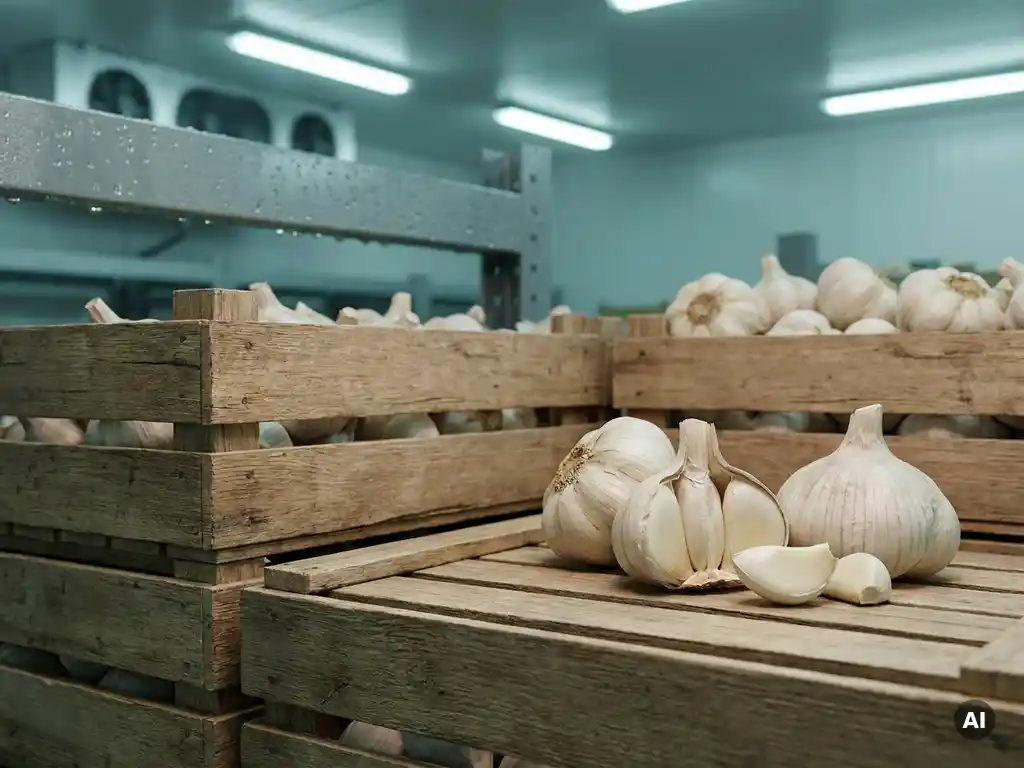
You prevent mold formation in garlic by keeping the storage temperature consistently between 0 and 2 degrees Celsius, combined with a relative humidity of 60 to 70 percent and good air circulation. Under these conditions, garlic remains stable for months without mold spores having the opportunity to develop. The following sections delve deeper into the causes, common mistakes, and practical measures for large-scale storage.
What are the ideal storage conditions for garlic?
The optimal storage conditions for garlic are a temperature of 0 to 2 degrees Celsius, a relative humidity of 60 to 70 percent, and constant air circulation. Within these parameters, the metabolism of the bulbs slows down significantly, which prevents dehydration, germination, and mold formation. Therefore, for large-scale garlic storage, precise climate control is not a luxury, but a basic requirement.
In addition to temperature and humidity, light also plays a role: garlic stores best in dark rooms, as light stimulates premature germination. Furthermore, good ventilation ensures that moisture coming off the bulbs does not linger in the immediate vicinity, which would otherwise form an ideal breeding ground for mold.
For commercial parties storing large volumes, the same principles apply as for smaller quantities, but the implementation is more complex. Temperature differences within a large storage area, known as hotspots or cold zones, can cause localized abnormal conditions that promote mold growth.
What causes mold to form on garlic during storage?
Mold on garlic develops when mold spores, naturally present on the outer layers of the bulb, get the chance to germinate and grow. This happens as soon as conditions become favorable: sufficient moisture, warmth, and oxygen. The most common mold species on garlic are Penicillium and Aspergillus, both of which thrive in higher humidity and temperatures above 5 degrees Celsius.
The cause of garlic blight is therefore rarely found solely in cultivation. Damage to the bulbs during harvest, transport, or unloading is a major risk factor: fungal spores penetrate the inner scales more easily through small tears in the skin. Condensation on the bulbs, caused by temperature fluctuations, also provides fungi with a direct opportunity to grow.
How does humidity affect mold growth in garlic?
Humidity is the most direct driver of mold growth in garlic. As soon as the relative humidity rises above 70 percent, the risk of mold development increases sharply. Mold spores require very little moisture to activate, and on the surface of garlic bulbs, even a thin layer of condensation can be sufficient.
At the same time, the humidity must not be too low. Below 55 percent, garlic dries out, the skins become brittle, and the product loses weight and quality. The optimal storage conditions for garlic therefore require a narrowly defined range, avoiding both dehydration and excessive humidity.
In practice, maintaining that bandwidth is the greatest challenge. External factors such as outside temperature, opening doors, and the arrival of new, warmer batches can quickly disrupt the humidity in a storage area. Active monitoring and automatic adjustment are therefore indispensable for professional, scaled-down garlic storage.
Which storage mistakes accelerate mold formation in garlic?
Several common storage errors significantly accelerate mold formation in garlic. The most critical errors relate to temperature management, packaging, and storage area hygiene.
- Insufficient pre-cooling: garlic entering storage warm brings heat with it that temporarily raises the ambient temperature and causes condensation on the cold bulbs surrounding it.
- Poor air circulation: pallets or crates placed too close together or against the wall block airflow and create damp zones.
- Do not remove damaged bulbs: affected or damaged garlic spreads fungal spores to healthy batches in the immediate vicinity.
- Mixing batches of different origins or ripeness: batches with different moisture levels or temperature histories react differently to the same storage conditions.
- Insufficient cleaning of the storage area: residual organic residues from previous batches are a source of mold spores for new shipments.
Each of these errors is avoidable with the right procedures and infrastructure. Nevertheless, they are regularly made in practice, particularly when storage facilities are not specifically designed for the storage of dry food products such as garlic.
How do you prevent mold in large-scale garlic storage?
In large-scale garlic storage, mold formation is prevented by a combination of precise climate control, good incoming quality control, and strict hygiene protocols. None of these measures is sufficient on its own; they reinforce each other.
The following steps form the basis of an effective approach:
- Check the quality upon receipt. Inspect each batch for damage, signs of mold, or excessive moisture before the garlic enters storage. Immediately reject damaged bulbs or isolate them.
- Chill the garlic quickly and gradually. Avoid abrupt temperature changes that cause condensation. Gradually bring the core temperature to the target level.
- Ensure sufficient distance between pallets and walls. A minimum of 15 to 20 centimeters of space around stacks guarantees that cooled air can circulate freely.
- Monitor temperature and humidity continuously. Use multiple measuring points in the room to detect hotspots or cold zones in a timely manner.
- Thoroughly clean the storage area between batches. Remove all organic material and disinfect floors and walls to reduce mold pressure.
For large volumes, manual monitoring is insufficient. Automated climate control systems with alarm functions for deviations have become the standard in professional dry storage. For garlic, which is more sensitive than many other dry products, this is not an unnecessary luxury.
When is affected garlic still usable, or when should it be rejected?
Garlic with light, superficial mold on the outer dry coat may in some cases still be usable if the inner coats and the clove itself are unaffected. As soon as mold has penetrated the edible parts, or if the bulb feels soft, is discolored inside, or has an abnormal odor, the garlic must be rejected.
For B2B parties in the food chain, the threshold for rejection is generally stricter than for private use. Supermarket suppliers and processing plants apply quality standards where even cosmetic mold spores on the outer skin can be grounds for rejecting a batch. Import inspections, such as those carried out by the KCB (part of the NVWA), assess batches based on established standards in which mold percentages are measured per batch.
In practice, the rule is: reject if in doubt. Affected bulbs remaining in a batch spread fungal spores to healthy garlic and accelerate the spoilage of the entire shipment. Early sorting and disposal of affected bulbs is always more economically advantageous than the risk of higher losses later on.
How ZZColdstores helps with garlic storage
ZZColdstores offers professional dry storage for food products such as garlic, nuts, peanuts, and seeds from locations in Kruiningen and Vlissingen. The storage facilities are designed to meet the specific requirements of dry, sensitive products that demand precise climate control.
- Dedicated dry storage warehouse with a capacity of 12,000 pallet spaces, with separate areas per product category
- Controlled environmental conditions tailored to the product's storage specifications
- Import inspection via KCB (NVWA) and customs clearance as part of the logistics process
- Certified according to BRC, SKAL, and Demeter, which aligns with the quality requirements of supermarket suppliers and the processing industry
- Flexible logistics handling tailored to the customer's supply schedule
Do you work with large volumes of garlic or other dry food products and would you like to know if our dry storage capacity meets your logistical needs? Contact ZZColdstores for a no-obligation discussion about the possibilities.
Author: Frans van der Maas, Operations Director ZZColdstores
Frequently Asked Questions
How long does garlic keep under optimal storage conditions?
At a temperature of 0 to 2 degrees Celsius and a relative humidity of 60 to 70 percent, garlic can be stored for up to 8 to 12 months without significant loss of quality. The exact shelf life depends on the variety, the dry quality upon arrival, and the consistency of climate control throughout the entire storage period. Hard varieties such as Rocambole or Silverskin generally perform better during long-term storage than softer types.
What is the difference between dry storage and cold storage for garlic, and which is more suitable?
Garlic requires dry, temperature-controlled storage, not the humid refrigerated environment used for fresh vegetables or fruit. Cold storage facilities for fresh produce often operate at higher humidity levels (above 85 percent), which is actually harmful to garlic and strongly promotes mold growth. Specialized dry storage warehouses, tailored to the storage specifications of dry food products, are therefore the only suitable choice for large-scale garlic storage.
How do I recognize mold formation early in a large batch of garlic storage?
Early signs of mold formation are a musty or earthy odor in the storage area, visible white, blue, or green spots on the outer scales of bulbs, and elevated humidity in specific areas of the room. For large-scale storage, visual inspection alone is insufficient; continuous monitoring of humidity via multiple measuring points helps identify problem zones before mold spreads to larger parts of the batch. Regular random inspection of bulbs from various pallet positions is a practical complement to automated climate monitoring.
Can I store garlic from different origins or vintages together?
This is strongly discouraged unless the batches have identical moisture levels and temperature histories. Garlic from different regions or vintages often has different degrees of dryness and ripeness, meaning that the same storage conditions may be optimal for one batch but too moist or too dry for another. If you physically separate batches, you also maintain traceability by origin, which is essential for import inspections and quality certifications such as BRC.
Which certifications are relevant for the professional storage of garlic intended for the food industry?
For garlic destined for supermarket suppliers or processing plants, BRC (British Retail Consortium) and FSSC 22000 are the most requested certifications, as they demonstrate that the storage facility complies with strict food safety standards. Additionally, for organic garlic, SKAL certification is required to maintain its organic status during the storage period. When importing from third countries outside the EU, a KCB inspection via the NVWA is mandatory before the batch may be introduced into the Dutch food chain.
What should I do if the temperature or humidity in my storage space temporarily falls outside the norm?
Act as quickly as possible: gradually restore the temperature and humidity to the target values and avoid abrupt corrections, which can themselves cause condensation and temperature shocks. Immediately thereafter, inspect the most vulnerable areas in the room, such as bulbs close to doors, ventilation grilles, or exterior walls, for signs of moisture or mold. Document the deviation, the duration, and the measures taken; this is not only good practice management but also a requirement for audits for quality certifications such as BRC.
When does it make sense to outsource garlic storage to a specialized storage partner?
Outsourcing makes sense as soon as the volume, the required climate precision, or additional logistical operations such as import inspection, customs clearance, or certified storage exceed in-house capacity. A specialized partner possesses the infrastructure, certifications, and expertise necessary to minimize quality loss due to mold or climate deviations, which has a direct impact on profitability at large volumes. Moreover, outsourcing offers flexibility in storage capacity, so you do not have to invest in fixed infrastructure for volumes that vary significantly by season.
Related articles
- Can you use warehousing for temporary storage?
- What is the difference between ambient storage and room temperature storage?
- What are the consequences of aflatoxin in poorly stored peanuts?
- How does an inspection work for the import of peanuts from Brazil?
- What is bulking and how does it work with powdered potatoes or big bags?