
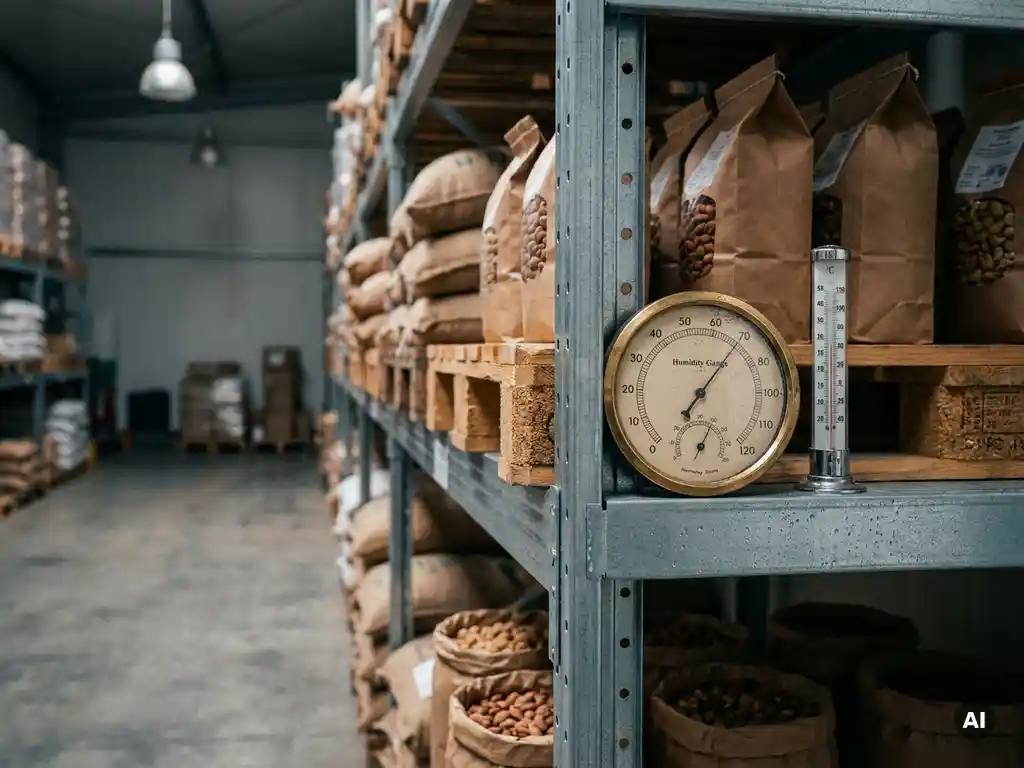
Humidity is just as important as temperature in dry storage, because incorrect moisture levels in the storage area directly lead to quality loss, mold formation, or product dehydration. Temperature determines the speed of biological and chemical processes, but humidity determines whether products retain their structure, taste, and shelf life. For B2B parties storing nuts, seeds, dried fruit, or other dry food products, climate control is therefore a matter of product quality and commercial certainty. This article answers the most frequently asked questions about humidity in a dry storage warehouse.
What happens to products if the humidity is too high or too low?
Excessive humidity in a dry storage warehouse promotes mold growth, bacterial development, and clumping of products such as nuts and seeds. Conversely, low humidity causes dehydration, weight loss, and deterioration of quality. Both extremes result in products that no longer meet the requirements of purchasing organizations for supermarkets or processing plants.
In practice, the consequences of incorrect moisture levels are often only visible when the damage has already been done. Mold does not always develop on the outside of a package but can start deeper within a batch. Clumping of peanuts or seeds is irreversible and leads to immediate rejection. Dehydration causes weight loss, which is a direct commercial cost in bulk storage. For importers and wholesalers supplying supermarkets, this is not a theoretical risk but a real operational problem that affects every shipment.
How does humidity affect the shelf life of nuts and seeds?
Humidity has a direct impact on the shelf life of nuts and seeds, because these products are hygroscopic: they absorb moisture from the environment. As soon as the moisture content in the product rises above a critical limit, oxidation accelerates, the risk of mold formation increases, and the taste deteriorates. As a result, the shelf life can be significantly shortened.
Nuts naturally contain a high fat content. When moisture comes into contact with these fats, oxidation occurs, leading to rancidity. This process cannot be stopped once it has started. Seeds are susceptible to similar reactions, but also run the risk of germination if humidity remains too high for an extended period. Therefore, for dry storage of nuts and seeds, the storage climate must be closely monitored, not only upon arrival of a batch, but throughout the entire storage period.
What is the difference between temperature control and climate control in a storage warehouse?
Temperature control means that only the temperature in a storage warehouse is regulated. Climate control goes further: it involves actively monitoring and adjusting humidity and air circulation as well. For dry products such as nuts, seeds, and dried fruit, climate control is the right choice, because temperature alone offers insufficient protection against moisture damage.
A warehouse controlled solely by temperature can still become too humid under fluctuating external conditions. Consider a hot summer day with high outdoor relative humidity, or condensation that forms when goods are transferred from a cold container to a warmer storage area. Climate control prevents this by actively measuring and adjusting humidity, regardless of external conditions. For logistics managers and buyers responsible for product quality destined for supermarkets or factories, this distinction is of direct commercial importance.
What humidity values are ideal for dry storage at 11 degrees?
For dry storage at a temperature of approximately 11 degrees Celsius, a relative humidity between 55% and 70% applies as a general guideline, depending on the specific product. Nuts and peanuts generally require a lower relative humidity than dried fruit. Deviations outside this range lead to loss of quality or a shortened shelf life.
The combination of 11 degrees and controlled humidity was deliberately chosen for products that do not require active cooling but are sensitive to temperature fluctuations and moisture. At this temperature, biological processes are slowed down without incurring the energy costs associated with full cold storage. The storage climate for dry storage thus strikes a balance between cost efficiency and product quality. The exact ideal values vary per product and must be determined based on the product specifications from the supplier or manufacturer.
How is humidity controlled in a professional storage warehouse?
In a professional dry storage warehouse, humidity is continuously measured via sensors placed throughout the storage area. The measured values are monitored centrally and, in the event of deviations, automatically or manually adjusted via dehumidifiers, ventilation systems, or climate control units. Good systems record the data so that a verifiable storage history is available.
Quality control upon arrival of a batch is an additional step. Upon arrival, moisture measurements are performed on the products themselves, alongside checks for damage and packaging deviations. This immediately establishes whether a batch has arrived in the correct condition before entering storage. This is relevant for importers who must account to their customers for the condition of the goods upon arrival. Comprehensive QC reporting provides the necessary insight for this.
Why can small fluctuations in humidity have major consequences?
Small fluctuations in humidity can have major consequences because dry products such as nuts and seeds absorb and release moisture rapidly. Even a temporary increase in relative humidity of 10 to 15 percentage points can be sufficient to initiate mold growth or accelerate oxidation processes, especially if the deviation persists for several hours.
The problem is that fluctuations have a cumulative effect. A batch that has been exposed to slight moisture spikes multiple times shows quality loss sooner than a batch that has been kept stable throughout the entire storage period. For supply chain managers working with long storage periods or large volumes, consistency in the storage climate is therefore a critical factor. Fluctuations often occur during loading and unloading, when doors are left open for extended periods, or when goods are being moved. A well-designed warehouse minimizes these risk moments as much as possible.
What should you look for when choosing a dry storage warehouse?
When choosing a dry storage warehouse for food products, there are several factors that determine product quality and operational reliability. The key considerations are:
- Climate control: Is humidity actively measured and adjusted, or is there only temperature control?
- Certifications: Does the warehouse hold relevant certifications such as BRC for food safety or SKAL for organic products?
- Storage history and traceability: Are climate data recorded and are goods traceable via barcodes or LOT numbers?
- Quality control upon arrival: Does the warehouse perform moisture measurements and inspections upon the arrival of a batch?
- Flexibility: Can the warehouse respond to fluctuating volumes and specific product specifications?
- Location and logistical integration: Does the location connect to supply routes from ports such as Rotterdam or Antwerp?
In addition to these basic criteria, it is advisable to inquire about the separation of product categories within the warehouse. Nuts, peanuts, and seeds must not be stored next to products with a strong odor or other humidity requirements. A professional storage partner has clear protocols for this and can demonstrate how the spatial layout is arranged.
- Ask about the certifications and their validity.
- Check if a QC report is available upon arrival of goods.
- Ask about the climate registration and how long the data is retained.
- Verify whether the warehouse has experience with your specific product category.
- Discuss the logistical integration with your inbound and outbound processes.
How ZZColdstores helps with humidity and dry storage
ZZColdstores offers dry storage in a climate-controlled environment specifically designed for food products such as nuts, peanuts, seeds, and dried fruit. The new dry storage warehouse has a capacity of 12,000 pallet spaces and is certified with BRC, SKAL, and Demeter. The combination of active climate control, quality control upon arrival, and barcode-driven traceability ensures demonstrable product quality throughout the entire storage period.
What sets ZZColdstores apart for B2B partners:
- Active monitoring of temperature and humidity, tailored to the product specifications
- Moisture measurements and QC reporting upon arrival of every shipment
- Full traceability via grower and LOT numbers
- Flexible capacity for fluctuating volumes and product categories
- Strategic location in the Rotterdam-Antwerp corridor, with its own quay in Vlissingen
Would you like to know if ZZColdstores' dry storage facilities align with your supply chain? Contact us directly to discuss the possibilities.
Frequently Asked Questions
How quickly can excessive humidity cause damage to a batch of nuts or seeds?
Mold growth can begin within 24 to 48 hours at a relative humidity above 75%, especially in combination with temperature fluctuations. For hygroscopic products such as nuts and seeds, even short-term moisture peaks—for example, during the unloading of a container—can initiate oxidation or mold formation that becomes visible later in the storage period. Early moisture measurement upon arrival and a stable storage climate are therefore not a luxury, but an operational necessity.
What is the difference between relative humidity and absolute humidity, and which is relevant for dry storage?
Absolute humidity indicates how many grams of water vapor are present per cubic meter of air, while relative humidity (RH%) indicates how much moisture the air contains relative to the maximum possible at that temperature. For dry storage, relative humidity is the relevant measure, as it directly determines whether a product absorbs or releases moisture to the environment. An RH% of 55–70% is generally considered safe for nuts and seeds, but the exact limits depend on the specific product and the packaging type.
As an importer, can I personally check whether my goods are stored under the correct conditions?
Yes, a professional storage partner makes climate records available showing the temperature and humidity values over the entire storage period. When selecting a warehouse, explicitly ask about the frequency of the measurements, how long the data is retained, and in what format the report is available. A QC report upon arrival of the shipment, including moisture measurements of the product itself, provides additional insight into the condition of the goods before storage begins.
What are the most common mistakes in the dry storage of food products that lead to loss of quality?
The most common mistakes are: the lack of active humidity measurement (only temperature control), storing products with different humidity requirements in the same room, and insufficient attention to risk moments such as opening loading doors in hot or humid weather. Additionally, quality control upon arrival is frequently skipped, meaning that damage that occurred during transport is only discovered later—and sometimes too late. A structured inbound process with humidity measurement and QC reporting prevents these types of problems from going unnoticed.
Does it matter whether products are stored packaged or unpackaged when it comes to humidity?
Yes, packaging has a significant influence on the extent to which products are exposed to ambient humidity. Unpackaged or bulk products are immediately hygroscopic and react quickly to fluctuations in humidity. Packaged products offer more protection, but this depends on the packaging material: breathable packaging or damaged film provides an insufficient barrier. Even for packaged products, a controlled storage climate remains necessary, as condensation can occur on or inside packaging during temperature changes.
How do I combine dry storage with efficient logistical handling for my customers?
Choose a storage partner whose location aligns with your inbound and outbound logistics, such as proximity to a seaport or multimodal hub. Ensure the warehouse uses barcode-driven traceability and Lot registration so that orders can be assembled and shipped quickly and without errors. Discuss options for flexible retrieval, cross-docking, or consolidation in advance so that the storage facility seamlessly matches the delivery frequency and volume fluctuations required by your supply chain.
What are the minimum certifications a dry storage warehouse must have for the storage of organic or certified food products?
For organic products, SKAL certification (in the Netherlands) is mandatory to guarantee the organic status of the goods during storage. For broader food safety, BRC certification (British Retail Consortium) is the most recognized standard, which is required by most supermarket chains and processing plants. Depending on your product category or market, additional certifications may be relevant, such as Demeter for biodynamic products or IFS Food for specific retail partners. Always ask a potential storage partner about the current validity of the certificates.
Related articles
- How does cold storage help limit quality loss of fresh products?
- What is the difference between ambient storage and room temperature storage?
- What are the consequences of aflatoxin in poorly stored peanuts?
- How does the traceability of dry raw materials work in a European warehouse?
- What is conditioned storage at a temperature of 11°C?