
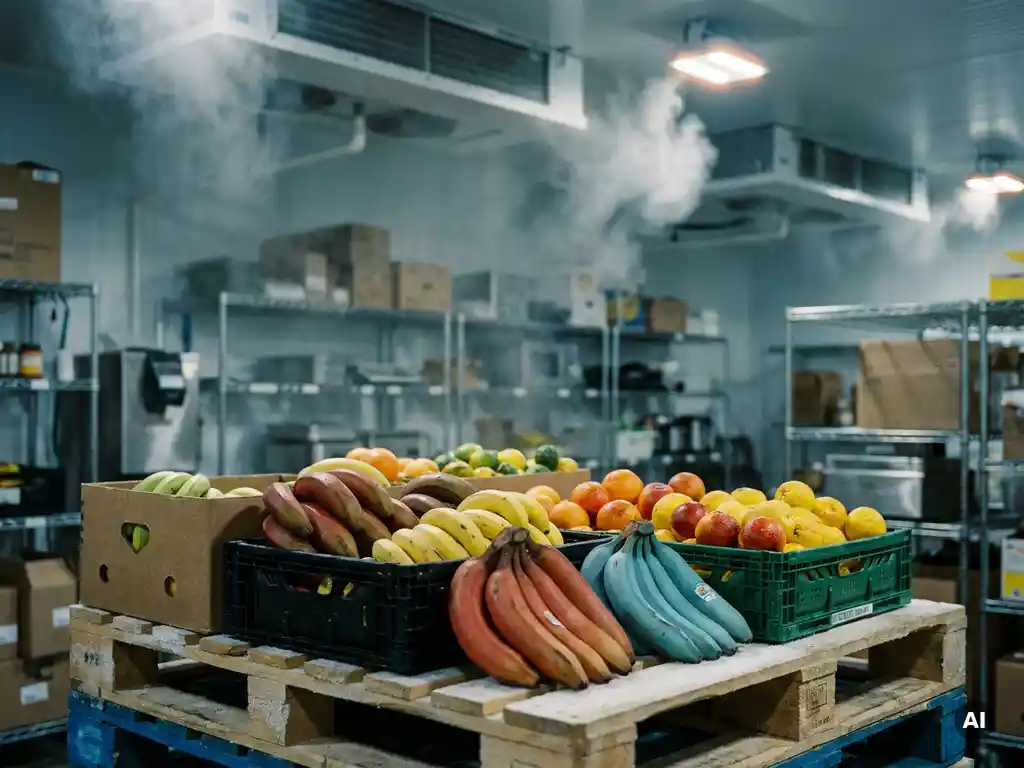
Cold storage limits quality loss of fresh products by precisely controlling temperature, humidity, and air circulation throughout the entire storage period. This slows down biological and chemical processes that cause spoilage, such as ripening, dehydration, and bacterial growth. This is relevant for every link in the chain that works with fresh food products, from importer to supermarket supplier. The following questions address the key aspects of cold storage and quality preservation.
Why do fresh products lose quality during transport?
Fresh produce loses quality during transport due to a combination of temperature fluctuations, insufficient humidity, mechanical damage, and prolonged exposure to ambient air. Each of these factors accelerates spoilage, and when multiple factors occur simultaneously, the decline in quality is exponentially faster.
Temperature fluctuations are the biggest culprit. Even short periods outside the optimal temperature range activate enzymatic processes that accelerate ripening and tissue damage. Moreover, in exotic fruits such as bananas or citrus fruits, temperatures that are too low can cause cold damage, which manifests as brown spots, soft spots, or loss of flavor.
Humidity plays an equally important role. Air that is too dry draws moisture from the product, leading to weight loss, wrinkling, and changes in texture. Conditions that are too humid promote mold growth and bacterial contamination. The right balance is product-specific and requires active control.
Mechanical damage caused by unsafe stacking or careless loading accelerates spoilage at the damaged sites. Damaged fabric produces more ethylene, a ripening gas that also causes surrounding products to ripen faster. Careful pallet construction and stable packaging are therefore not a detail, but a quality requirement.
How does cold storage slow down the spoilage of fresh fruit and vegetables?
Cold storage slows down spoilage by inhibiting the metabolic activity of fresh products. At lower temperatures, respiration, ripening, and enzymatic degradation proceed more slowly. This extends shelf life without the use of preservatives.
Fresh produce are living organisms that continue to breathe even after harvest. This respiration process consumes sugars and produces heat, moisture, and ethylene. In a well-conditioned cold room, this process is slowed down by keeping the temperature low and optimizing air circulation, so that heat and ethylene are removed before they cause damage.
Humidity control is inextricably linked to this. A climate-controlled storage space regulates not only the temperature but also the moisture content in the air, so that products do not dry out and condensation does not form that promotes mold growth. This is fundamentally different from a conventional cold room, which controls solely by temperature.
For products sensitive to ethylene, such as certain citrus fruits, active ventilation is an additional measure. By introducing fresh outside air in a controlled manner and removing ethylene-rich air, the ripening process is further slowed down.
What temperature is ideal for storing exotic fruit?
The ideal storage temperature for exotic fruit varies by product, but is generally between 8 and 14 degrees Celsius. Bananas are preferably stored at around 13 to 14 degrees, while citrus fruits are better kept between 5 and 10 degrees, depending on the variety.
Temperatures that are too low are a real risk for tropical fruit. Bananas are particularly susceptible to cold damage: at temperatures below 12 degrees, the peels can discolour and the flesh can soften, even before the fruit is visibly ripe. This makes precise temperature control for tropical fruit more complex than for products from temperate climates.
Citrus fruits tolerate lower temperatures better, but here too, the optimum is product-specific. Grapefruits tolerate cold less well than oranges, and the harvest stage and origin further influence the optimal storage temperature.
In addition to the absolute temperature, temperature stability is at least as important. Fluctuations of even a few degrees can cause condensation on the product, increasing the risk of mold growth. A professional cold storage facility continuously monitors the temperature and responds immediately to deviations.
What is the difference between cold storage and dry storage for food products?
Cold storage stores fresh, perishable products at refrigerated temperatures with active control of humidity and air circulation. Dry storage, also known as ambient storage, stores non-perishable or less temperature-sensitive products at stable room temperature or a slightly refrigerated environment, without the intensive climate control of a cold room.
In cold storage, the infrastructure is significantly more complex. The installations must be able to accurately maintain temperatures, actively regulate humidity, and ensure sufficient air circulation. This requires continuous monitoring and maintenance of refrigeration systems.
Dry storage is suitable for products such as nuts, peanuts, seeds, and dry goods. These products are less sensitive to temperature fluctuations but do require a dry, stable environment to prevent moisture absorption, mold growth, and loss of quality. A dry storage warehouse maintained at approximately 11 degrees offers a good balance between energy costs and product quality for this category.
The choice between cold storage and dry storage depends entirely on the product. Fresh vegetables and fruit belong in a climate-controlled cold room. Nuts and dry food products can be stored in a well-conditioned dry warehouse. Some logistics partners offer both facilities under one roof, which offers benefits for supply chain efficiency.
How does the location of a cold storage facility affect the freshness of products?
The location of a cold storage facility has a direct impact on product freshness, because a shorter time between unloading and cooling means that products are exposed to uncontrolled conditions for a shorter period. Every minute outside cooling counts for fresh, perishable products.
For importers working with sea freight, the proximity of the cold storage facility to the berth is crucial. When a cold storage facility is situated directly on the quay, containers or bulk cargo can be placed in cold storage within minutes of arrival. This eliminates the risk of temperature rise during transport from the port to an external cold storage facility further away.
A location in or near an active port also offers logistical advantages for further distribution. After storage, products can be loaded directly for transport to processing plants, wholesalers, or distribution centers in Europe, without unnecessary intermediate links.
In addition to direct supply, accessibility for outbound transport also plays a role. A cold storage facility that is well-connected by road transport and located close to major European transport arteries shortens the total time in the chain and contributes to the freshness of the product at the final destination.
Which certifications guarantee quality preservation in cold storage?
The most relevant certifications for quality preservation in cold storage are BRC (British Retail Consortium), SKAL, and KCB/NVWA. These certifications set requirements for food safety, biological integrity, and phytosanitary control, and provide clients with assurance regarding the quality of their products.
BRC certification
The BRC standard is an international standard for food safety that is widely recognized by retailers and the processing industry. A BRC-certified cold storage facility meets stringent requirements regarding hygiene, temperature control, traceability, and risk management. For suppliers to supermarkets, BRC certification by their logistics partner is often a strict requirement.
SKAL and KCB/NVWA
SKAL is the Dutch certification body for organic products. A SKAL-certified cold storage facility may store organic products without losing their organic status, provided that strict separation from non-organic products is ensured. KCB is part of the NVWA and conducts import inspections for fresh fruit and vegetables entering the EU from third countries. A cold storage facility that collaborates with KCB can have the import inspection performed directly on-site, which saves time and accelerates quality control.
When is specialized cold storage better than in-house cooling capacity?
Specialized cold storage is better than in-house cooling capacity when volumes fluctuate, products have specific climate requirements that cannot be met with standard cooling, or when the costs and management of in-house cooling infrastructure do not outweigh the company's core business.
Many importers and trading companies face seasonal peaks in their volumes. Designing in-house cold storage capacity for the peak period means the facility is underutilized for most of the year. Specialized cold storage offers flexible capacity that adapts to actual demand.
In addition, the storage of exotic fruit requires product-specific knowledge and facilities that go beyond a standard cold room. Precise temperature control per product type, active humidity management, and continuous monitoring are investments that are profitable for a specialized partner, but for a trading company, they constitute a distraction from the core business.
Finally, a specialized partner offers additional services that strengthen quality assurance, such as quality control upon arrival, sampling, traceability via barcode systems, and direct linking with customs and import inspection. This makes the choice for external cold storage not only a matter of cost but also a matter of quality.
How ZZColdstores limits quality loss of fresh products
ZZColdstores combines climate-controlled cold storage with a strategic port location and additional quality services that together minimize quality loss in the chain. The approach focuses on three pillars:
- Immediate cooling upon arrival: Thanks to our own quay in Vlissingen, products enter cooling within minutes of unloading, minimizing exposure to uncontrolled conditions.
- 24/7 climate control: Temperature, humidity, and air circulation are continuously monitored and adjusted to the specific requirements of the product, from bananas to citrus fruits.
- On-site quality control: Upon arrival, shipments are checked for damage, temperature deviations, and packaging condition. Products that do not meet the standards are immediately separated from the batch.
- Full traceability: Every pallet is traceable via a barcode system linked to grower and LOT numbers, ensuring that the origin and status of every product are visible at any time.
- Certifications: BRC, SKAL, and cooperation with KCB/NVWA provide clients with the assurance that quality and food safety standards are complied with.
Would you like to know how climate-controlled cold storage at ZZColdstores fits your specific products and logistical requirements? Contact us for a no-obligation consultation.
Frequently Asked Questions
How quickly must a fresh shipment be placed in cold storage after arrival?
For perishable products such as fresh fruit and vegetables, the faster, the better. Ideally, products are cooled within 30 to 60 minutes of unloading, but for heat-sensitive tropical fruit, even that is a generous margin. Every extra minute outside cooling activates ripening and degradation processes that cannot be fully reversed. A cold storage facility with its own quay or direct port access eliminates the greatest delay at this critical moment.
What are the most common mistakes when organizing refrigerated transport?
The most common mistakes are mixing products with different temperature requirements in the same container, insufficient pre-cooling of the truck before loading, and failing to check the temperature log upon arrival. A second common mistake is underestimating the impact of loading times: every time a refrigerated truck is opened, the internal temperature rises temporarily. Proper planning of loading routes and strict protocols during loading and unloading significantly reduce these risks.
Can I store products with different climate requirements simultaneously in one cold storage facility?
That depends on the infrastructure of the cold storage facility. A professional cold storage facility features multiple climate zones with individually adjustable temperature and humidity levels, so that bananas and citrus fruits can each be stored in their optimal environment. Combining products with significantly different climate requirements in a single space inevitably leads to a loss of quality in at least one of the products. Always explicitly ask your logistics partner about the possibility of separate climate zones.
How do I know if a cold storage facility truly maintains the correct temperature continuously?
A reliable cold storage facility uses continuous temperature monitoring via calibrated sensors and automatically records the data in a logbook accessible to you as the client. When considering a potential partner, always ask about the availability of temperature reports per shipment and whether an alarm system is active in case of deviations outside the set range. Certifications such as BRC require cold storage facilities to demonstrate monitoring and registration, providing an additional guarantee that climate control is structurally adhered to.
What is ethylene management and when is it relevant for my products?
Ethylene is a natural gas produced by ripening fruit that accelerates the ripening process of surrounding products. Ethylene management involves actively removing this gas from the storage area through ventilation or the use of ethylene absorbers. This is particularly relevant when storing ethylene-sensitive products such as citrus fruits, kiwis, and certain vegetables stored near highly ethylene-producing products such as bananas or ripe apples. If you store multiple types of products, it is advisable to check with your cold storage partner whether ethylene control is a standard part of the storage protocols.
How do I start outsourcing cold storage if I have never done it before?
Start with a clear inventory of your products, volumes, seasonal patterns, and specific climate requirements before entering into discussions with potential partners. Next, identify which certifications are mandatory for your customers, such as BRC for supermarket suppliers or SKAL for organic products. An initial meeting with a specialized cold storage facility will quickly provide insight into the possibilities and costs, and a good partner will actively help you think about the logistical integration with your existing supply chain.
What happens if quality problems are detected during storage?
A professional cold storage facility has protocols for quality deviations, whereby a damaged or defective batch is immediately separated from the rest of the stock to prevent cross-contamination or further quality deterioration. Good traceability via lot and grower numbers makes it possible to quickly determine whether the problem originated during delivery or storage, which is essential for claims against suppliers or insurers. Ensure that you agree in advance with your cold storage partner on how deviations will be communicated and documented, so that you always have a complete record.
Related articles
- Which temperature zones are possible in cold storage?
- When is external warehousing beneficial for food producers?
- How does warehousing work after the arrival of a sea container?
- What is the difference between refrigerated storage and dry storage?
- What are the most common mistakes when importing nuts from third countries?