
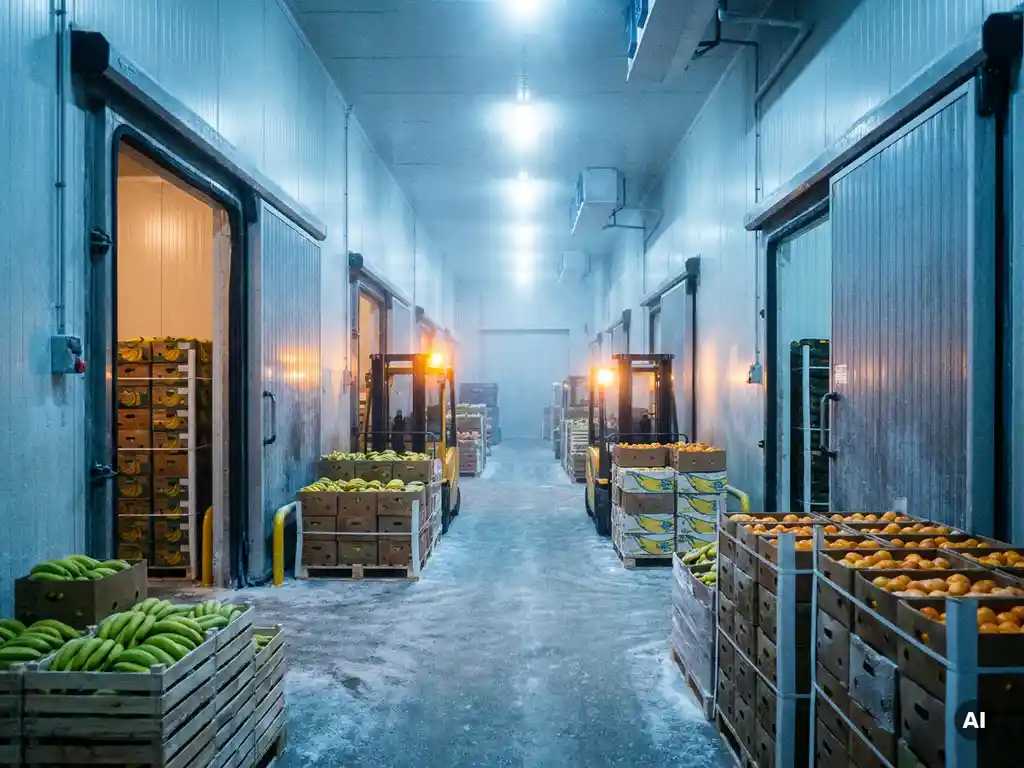
In professional cold storage, three to five temperature zones can typically be distinguished: from dry ambient storage at around 10–15 degrees Celsius, through refrigerated zones between 2 and 8 degrees, to freezer storage below zero. Which zone is suitable depends entirely on the product and the specific storage conditions it requires. This article answers the most frequently asked questions about temperature zones, certifications, and the choice between on-premise and external cooling capacity.
How many temperature zones are distinguished in professional cold storage?
In professional cold storage, three to five temperature zones are typically used. The most common classification includes ambient dry storage (approximately 10–15 degrees Celsius), refrigerated storage (2–8 degrees), tropical cooling for heat-loving products such as bananas (12–16 degrees), and freezer storage (below -18 degrees). Some facilities add an intermediate zone for specific product categories.
The exact zones vary by facility and type of goods. What all professional locations have in common is that each zone is individually controlled for temperature, humidity, and air circulation. This distinction is not only technically relevant but also commercially: products stored in the wrong zone lose quality, ripen too quickly, or are damaged due to low temperatures.
For B2B parties processing multiple product types, the presence of multiple zones within a single facility is a practical advantage. It prevents additional transport movements between locations and makes it possible to consolidate shipments with different storage conditions in one place.
Which temperature zone is suitable for exotic fruit?
In most cases, exotic fruit requires a tropical cool zone between 12 and 16 degrees Celsius, supplemented by careful control of humidity and air circulation. Bananas are the best-known example: too cold and the flesh turns black; too warm and the ripening process proceeds uncontrollably fast. Citrus fruits generally require a slightly lower temperature, around 6-10 degrees.
In addition to temperature, ethylene management plays an important role in the storage of exotic fruit. Ethylene is a ripening gas produced naturally by many fruit varieties. In a professional cold storage facility, the air composition is monitored to ensure that ripening products do not have an undesirable influence on surrounding batches.
Humidity is a second critical factor. Air that is too dry draws moisture from the product, leading to weight loss and an unattractive appearance. Excessive humidity promotes mold formation. Professional climate control systems continuously regulate both parameters, even outside office hours.
What is the difference between refrigerated storage and dry storage?
Refrigerated storage keeps products at a temperature below ambient temperature, usually between 2 and 16 degrees Celsius, depending on the product. Dry storage, also known as ambient storage, stores goods at a stable room temperature, typically around 10-15 degrees, without active cooling. The difference lies not only in the temperature but also in the nature of the products that each type of storage requires.
Refrigerated storage: for fresh and perishable products
Refrigerated storage is intended for products that require active temperature control to guarantee quality and shelf life. Examples include fresh fruit, vegetables, and other perishable goods. The refrigeration systems regulate not only the temperature but also humidity and ventilation.
Dry storage: for stable, non-perishable products
Dry storage is suitable for products that do not require active cooling but benefit from a stable, dry environment. Nuts, peanuts, seeds, and dry food products fall into this category. A constant temperature of approximately 11 degrees prevents spoilage due to humidity or temperature fluctuations, without the need to invest in intensive cooling. Dry storage is therefore a cost-effective choice for products with a longer shelf life that do not require a cold chain.
How is the temperature in a cold room kept constant?
The temperature in a cold room is kept constant through a combination of an insulated building envelope, mechanical cooling systems, and automated control equipment. Sensors continuously measure the temperature at multiple points in the room. As soon as deviations are detected, the system automatically adjusts the cooling capacity or ventilation to restore the set value.
Good insulation of the floor, walls, and ceiling is the first line of defense against external temperature fluctuations. Cold storage doors with air curtains or airlock systems prevent warm outside air from entering the cell during loading and unloading, which is one of the most common causes of temperature loss.
Modern facilities operate with 24/7 monitoring and alarming. In the event of technical malfunctions or unexpected temperature increases, immediate action is taken, either automatically by the system or by an operator receiving a notification. For sensitive products such as exotic fruit, this continuous monitoring is not a luxury, but a basic requirement.
Which certifications apply to temperature-controlled storage?
For temperature-controlled storage of food products, several certifications are relevant in the Netherlands and Europe. The most commonly used are BRC (British Retail Consortium), SKAL for organic products, and inspections by the KCB, part of the NVWA, for import inspections of fresh fruit and vegetables. Which certification is mandatory or desirable depends on the product, the destination, and the requirements of the customer.
BRC is a widely recognized standard in the food industry that sets requirements for food safety, hygiene, traceability, and internal processes. Many supermarket chains and processing plants require BRC certification as a condition for their logistics partners.
SKAL certification is specific to the organic chain. Companies that store or process organic products must be able to demonstrate that the separation of organic and conventional material is guaranteed. Demeter is a supplementary certification for biodynamic products.
The KCB inspection via the NVWA is relevant for importers of fresh fruit and vegetables from outside the EU. This phytosanitary import inspection checks whether products comply with European standards for plant health and residues. A cold storage location situated directly on the quay shortens the time between unloading and inspection, which benefits the quality of the product.
When do you choose external cold storage instead of your own cooling capacity?
External cold storage is generally the better choice when in-house cooling capacity is insufficient, seasonal peaks disrupt occupancy, or when the investment costs of own cooling infrastructure outweigh the usage. Furthermore, for importers, wholesalers, and supermarket suppliers, outsourcing cold storage is a way to mitigate operational risks and benefit from existing certifications.
In-house cooling capacity is only profitable if the capacity utilization is structurally high enough to cover fixed costs. Refrigeration systems require significant investments in equipment, maintenance, energy, and personnel. For variable volumes or changing product mixes, flexible external storage is financially more attractive.
In addition, external storage with a certified partner offers direct access to BRC, SKAL, and KCB-approved facilities, without the company itself having to go through those audits and certification processes. For suppliers delivering to large supermarket purchasing organizations, this is a concrete advantage: the storage partner's certification counts towards their own quality assurance.
Proximity to the port is a third consideration. The shorter the distance between unloading and cold storage, the better the quality of the product upon arrival. A location with its own quay completely eliminates the intermediate step of road transport, which makes a measurable difference, particularly for fragile exotic fruit.
How ZZColdstores helps with cold storage
ZZColdstores offers climate-controlled cold storage in Kruiningen and Vlissingen, specially designed for fresh and perishable products such as exotic fruit, vegetables, nuts, and seeds. The facilities are equipped with flexible climate settings per cell, so that temperature, humidity, and air circulation are precisely tailored to the requirements of the product.
What sets ZZColdstores apart for B2B parties in food logistics:
- 24/7 monitoring of temperature, humidity, and air circulation via advanced systems
- Own quay in Vlissingen for direct transfer from ship to cold storage, without an intermediate transport step
- Dry storage for nuts, peanuts, and seeds with a total capacity of 12,000 pallet spaces
- BRC, SKAL, and Demeter certifications, plus import inspections via KCB/NVWA
- Full traceability per pallet via barcode systems, from arrival to departure
- Flexible scheduling tailored to sailing schedules and fluctuating volumes
Would you like to know which temperature zone is suitable for your product, or would you like to discuss the possibilities for external cold storage? Contact ZZColdstores for a no-obligation consultation.
Frequently Asked Questions
How long can exotic fruit be stored in a professional cold room without loss of quality?
The maximum shelf life varies significantly by fruit type and depends on the ripening stage upon arrival. Bananas can generally be stored for two to four weeks in a tropical cold zone, provided the ethylene level is properly managed. For other exotic fruits such as mangoes or papayas, the optimal shelf life is shorter. Based on the product and the desired sales schedule, a professional storage partner can advise on the maximum residence time per cell.
What happens if the temperature in a cold room rises unexpectedly due to a technical malfunction?
Modern cold storage facilities are equipped with 24/7 monitoring and automatic alarm systems that immediately send a notification to an operator or technical team upon any deviation. Depending on the severity of the malfunction, the system automatically switches to a backup system or a technician intervenes personally. For sensitive products such as fresh fruit, it is therefore advisable to explicitly inquire about the emergency protocol and the availability of redundant cooling systems when selecting a storage partner.
Can I store products with different storage conditions with the same storage partner?
Yes, that is precisely one of the practical advantages of a facility with multiple temperature zones under one roof. For example, you can combine dry storage for nuts with a refrigerated zone for fresh fruit without having to transport products to multiple locations. This not only saves on transport costs but also simplifies administration and traceability, as all shipments are managed through one partner and one system.
Does my company need to be BRC or SKAL certified itself if I use a certified storage partner?
Not necessarily, but that depends on the requirements of your customers and the nature of your activities. If your company only outsources storage and does not perform any processing on the product itself, the certification of the storage partner can in many cases be included in your own quality assurance. However, for SKAL-certified organic products, you as the client must also be registered with SKAL. Consult your customer or certification body for the specific requirements that apply to your situation.
How flexible is external cold storage with highly fluctuating volumes, for example around harvest peaks or holidays?
A good external storage partner offers flexible capacity that can be scaled up and down based on your volume. In practice, this means that you do not have to purchase fixed, long-term capacity, but can plan based on sailing schedules, seasonal peaks, or campaign periods. However, it is wise to coordinate peak moments with your partner well in advance so that sufficient cell space and staffing capacity are available at the desired time.
What are the most common mistakes when choosing a temperature zone for a new product?
The most common mistake is storing cold-sensitive products — such as bananas or mangoes — in a standard refrigerated cell at 2-8 degrees, simply because that is 'the cold cell' available. This leads to cold damage, discoloration, and irreversible loss of quality. A second common mistake is ignoring ethylene sensitivity: products sensitive to ripening gas should not be stored together with fruits that produce a lot of ethylene. If in doubt, always request product-specific storage advice from your logistics partner before scheduling a shipment.
How does the import inspection via KCB/NVWA work, and what role does the storage location play in this?
The KCB inspection is a phytosanitary import control that is mandatory for fresh fruit and vegetables from outside the EU. The inspection takes place at a designated inspection location, where samples are taken and checked for plant health, residues, and quality standards. A storage location situated directly on the quay and equipped with an approved inspection room significantly shortens the time between unloading and approval — which, particularly for delicate fruit, can make the difference between a batch entering the supply chain in optimal condition or not.
Related articles
- Can you rent storage space for pallets of fresh produce?
- What are the certification requirements for a warehouse that stores food products?
- What are the customs tariffs for importing nuts from Vietnam in 2026?
- What is customs clearance and why is it mandatory for imports?
- How does pallet barcoding work in a logistics warehouse?