
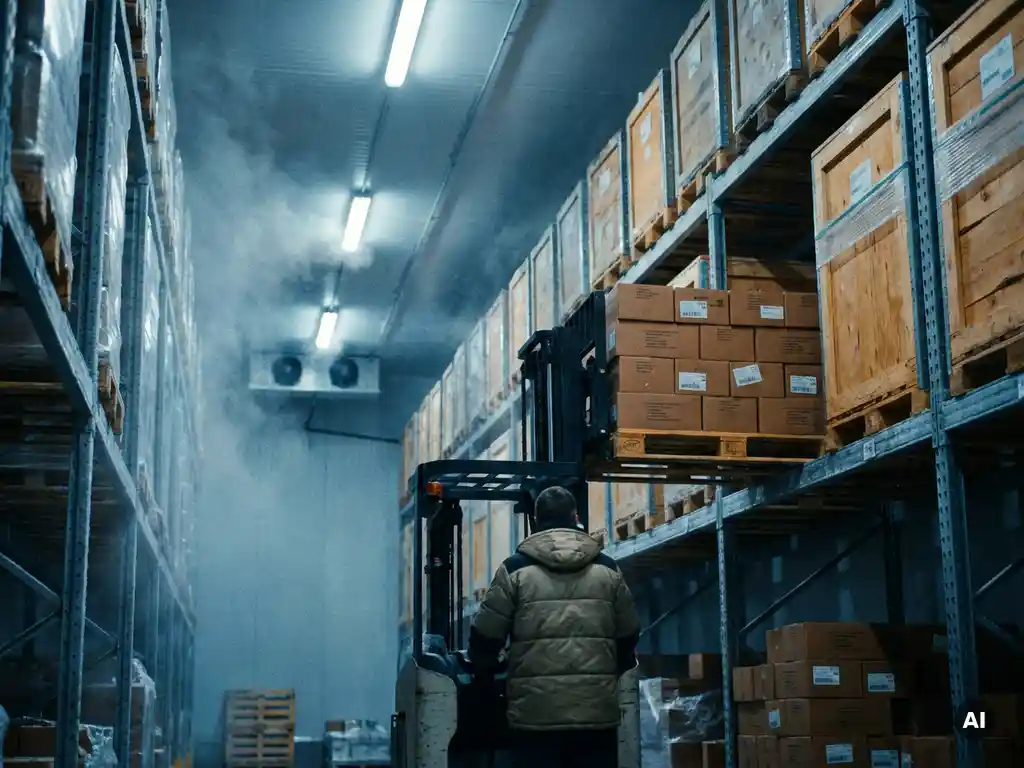
For temporary food storage, you need an average of between 20 and 200 pallet spaces, depending on the volume, turnaround time, and type of product. A practical rule of thumb: calculate the average number of pallets you have in storage at any one time, plus a buffer of 15 to 20 percent for peaks in supply or demand. The exact calculation depends on factors such as seasonality, packaging size, and the desired storage conditions. In this article, we answer the most frequently asked questions about pallet storage for food products.
How do you calculate the number of required pallet spaces?
You calculate the number of required pallet spaces by determining your average stock in pallets, multiplying it by the desired storage duration in days, and dividing that by the average lead time. Add a safety buffer of 15 to 20 percent for unexpected supply peaks or delays in dispatch.
In practice, the calculation works as follows. Suppose you receive 10 containers weekly, each containing 20 pallets, and the average dwell time in the warehouse is 5 days. Then, on average, you need approximately 140 pallet spaces at any given time. With a 20 percent buffer, you arrive at 168 pallet spaces.
Also take the following practical factors into account in the calculation:
- Incoming shipments per week or month and their distribution over time
- Dwell time per shipment: how long does a batch remain in storage on average before it is delivered?
- Peak periods: for seasonal products such as citrus fruits, the volume can be two to three times higher in certain months.
- Stacking height: not every product is stackable, which increases the required floor space
A good calculation therefore starts with insight into your own logistical rhythm, not with an arbitrary number.
Which factors determine the storage requirements for food products?
The storage requirements for food products are determined by the type of product, the required storage conditions, the packaging format, and the surrounding logistics chain. Fresh and perishable products require different facilities than dry, non-perishable goods, and this directly impacts the required capacity and the type of storage space.
For food products, the following factors play a decisive role:
- Temperature and humidity: products requiring climate-controlled storage, such as exotic fruit, typically occupy more specialized space than products that can be stored at room temperature.
- Packaging format: boxes, big bags, and bulk bags each have a different volume per pallet and different stackability.
- Throughput speed: products with a short shelf life require a faster rotation, which limits average capacity utilization but increases logistical pressure.
- Seasonal patterns: for agricultural products, supply varies significantly by season, causing peaks in storage demand.
- Certification requirements: certain products require separate storage based on quality or certification standards, which affects the warehouse layout.
For importers and wholesalers working with multiple product flows simultaneously, it makes sense to perform a separate calculation for each product group. This prevents running short on capacity for one flow while paying for unused space in another.
What is the difference between permanent and temporary pallet storage?
Fixed pallet storage means that you permanently reserve a certain number of pallet spaces, regardless of whether you fully utilize them at any given moment. Temporary storage is flexible: you rent storage space based on actual usage, which is more cost-effective if your volume fluctuates significantly or if you only need to rent storage space during specific periods.
The distinction is particularly relevant for food companies. Permanent storage offers certainty regarding availability, which can be crucial for products with a tight delivery schedule to supermarket purchasing organizations. Temporary storage provides financial flexibility but carries the risk that capacity is not always immediately available during busy periods.
The choice depends on two key questions: how stable is your volume, and how critical is the availability of storage space for your supply chain? If you regularly receive large shipments but the exact timing and volume vary, a combination of a fixed base capacity with flexible expansion is often the most efficient solution.
How many pallet spaces do you need for dry storage of nuts or seeds?
For dry storage of nuts or seeds, you generally rely on a standard Euro pallet size of 120 x 80 cm. A big bag of nuts or seeds easily weighs 1,000 kilograms and occupies one pallet space. For boxes, depending on the product, a weight of 400 to 800 kilograms per pallet applies. You therefore calculate the required pallet spaces by dividing the total batch size in kilograms by the average weight per pallet.
Dry storage of nuts and seeds requires specific conditions. The products are sensitive to moisture and temperature fluctuations, which directly affects quality and shelf life. Storage at a constant temperature of approximately 11 degrees Celsius is the standard for many of these products to prevent spoilage and loss of quality.
In addition to the number of pallet spaces, there are additional requirements that determine the required space:
- Separate storage: nuts, peanuts, and seeds are preferably stored separately from other product streams to prevent cross-contamination.
- Accessibility: with FIFO (first in, first out) management, every pallet must be individually accessible, which affects the layout of the racking.
- Traceability: Lot numbers and grower information must be recorded per pallet, which requires a barcode system.
When is temporary storage more cost-effective than your own warehouse space?
Renting temporary storage space is more cost-effective than owning your own warehouse space as soon as the occupancy rate of your own warehouse is consistently below 70 to 75 percent, or when the investment in your own facilities does not outweigh the actual storage needs. For seasonal food flows, temporary storage is almost always the cheaper choice.
Owning your own warehouse space entails fixed costs: rent or depreciation of the building, energy, personnel, maintenance, and certifications. These costs continue, even if the warehouse is half empty. With temporary storage, you only pay for what you actually use.
Specific situations where temporary storage is clearly more cost-effective:
- You receive large batches in a short period (for example, during a harvest peak) and then have low volume for weeks
- Your supply chain is growing, and you do not want to invest in your own space before the volume is stable
- You work with products that require specialized conditions (climate-controlled, certified space) that are expensive to set up yourself
- You want to be able to switch gears quickly to changing customer orders or delivery schedules
For many importers and wholesalers in the food sector, temporary storage with a specialized party is not only cheaper but also operationally simpler because the certifications, personnel, and systems are already in place.
Which certifications are required for food storage in an external warehouse?
For food storage in an external warehouse, the following certifications are generally relevant in the Netherlands and Europe: BRC (British Retail Consortium) for food safety, SKAL for organic products, and Demeter for biodynamic products. Depending on the product type, KCB or NVWA accreditation may also be required for import inspections of fresh products.
BRC is a strict requirement for many supermarket suppliers. Without BRC certification, you are virtually ineligible as an accepted warehousing partner with the purchasing organizations of major retailers. The certificate demonstrates that the warehouse meets strict standards for hygiene, traceability, and food safety.
SKAL certification is mandatory if you want to store organic products without losing the organic label. Storage must take place separately from non-organic products, and the records must demonstrate that no mixing has occurred.
For fresh products imported via the port, KCB accreditation (part of the NVWA) plays a role in import inspections. This is particularly relevant for exotic fruit and other fresh agricultural products that must be inspected upon import into the EU.
When selecting an external storage partner, always check which certifications are active and valid, and whether they meet your customers' requirements. In practice, a certification that has expired or does not cover the correct scope offers no coverage.
How ZZColdstores helps with temporary food storage
ZZColdstores offers flexible storage solutions for B2B parties requiring temporary or permanent storage space for dry or refrigerated food products. The facilities in Kruiningen and Vlissingen are certified (BRC, SKAL, Demeter) and set up to handle multiple product streams simultaneously.
What ZZColdstores specifically offers for temporary food storage:
- Dry storage at approximately 11 degrees Celsius, with a total capacity of 12,000 pallet spaces for nuts, peanuts, and seeds, among others
- Climate-controlled cold storage for fresh and perishable products, with 24/7 monitoring of temperature, humidity, and air circulation.
- Full traceability via barcode systems, linked to LOT and grower numbers
- Value Added Services such as quality control upon arrival, repalletization, labeling, and EDI connections
- Own quay in Vlissingen for direct transfer from ship to cold storage
- Shuttle transport within a radius of 40 km around Kruiningen
Would you like to know how many pallet spaces you need and whether ZZColdstores' facilities align with your product flow? Contact us for a no-obligation consultation.
Frequently Asked Questions
How quickly can I arrange temporary storage space if my volume increases unexpectedly?
With most specialized storage providers, you can reserve extra pallet spaces within one to three working days, provided capacity is available. It is advisable to conclude a framework agreement in advance with a fixed base capacity and an agreed option for expansion, so that you are not dependent on what happens to be available during peak periods. Always discuss this with your storage partner beforehand to ensure clear agreements regarding response times and maximum expansion capacity.
What are common mistakes when estimating the required pallet spaces?
The most common mistake is calculating based on average volume without accounting for peak periods, which leads to capacity shortages at precisely the times you need it most. A second common mistake is forgetting the buffer for delayed removal: if a customer delays a delivery, pallets remain in storage longer than planned. Always add a safety buffer of at least 15 to 20 percent to your calculation, and revise that calculation at least once a quarter if your volume fluctuates.
Can I store multiple product streams with different certification requirements with a single storage partner?
Yes, that is possible, but only if the storage partner holds the correct combined certifications and the physical layout of the warehouse allows for segregated storage. Organic products (SKAL), for example, may not be stored in the same area as non-organic products unless the records demonstrably prove the separation. Always explicitly ask your storage partner which product combinations are permitted within their certified zones to avoid the risk of losing your certification.
How does FIFO management work in practice for external storage, and how do I verify it?
With FIFO (first in, first out), the oldest batch is always delivered first, which is essential for products with a limited shelf life. In practice, this requires that every pallet bears an arrival date and LOT number, and that the warehouse system automatically enforces the correct picking order. As the client, regularly check via the inventory reports whether the delivered LOT numbers correspond to the expected FIFO order, and agree on how deviations are reported and corrected.
What should I bring to a quotation meeting with an external storage partner?
Ensure you have the following information ready: the average and maximum number of pallets you store at any one time, the required storage conditions (temperature, humidity), the desired certifications, the average dwell time per batch, and the frequency of incoming and outgoing shipments. The more concrete the information you provide, the more accurate the quote and the lower the chance of surprises afterwards. Also, inquire about the pricing structure: some companies charge per pallet space per week, while others work with monthly rates or volume discounts for larger quantities.
Is temporary pallet storage also suitable as an interim solution during a move or expansion of your own warehouse space?
Absolutely, temporary storage with an external party is a practical bridging solution, especially in these situations. You keep your own operations running without facing capacity issues during the transition period, and you only pay for the period you actually need the external space. Do agree on clear end dates and any extension options, so that you can respond flexibly to delays in the construction or fitting out of your new space.
How do I ensure a smooth transfer of inventory management when starting with a new storage partner?
A good handover begins with a detailed inventory count: which batches are present, with which LOT numbers, receipt dates, and weights. Agree in advance on which system will be leading for inventory administration and how integration with your own ERP or WMS will take place, preferably via EDI or an API connection. Plan the first few weeks after the start as a test phase during which you closely monitor the reports and discuss any discrepancies immediately, so that errors in the administration are detected and corrected early.