
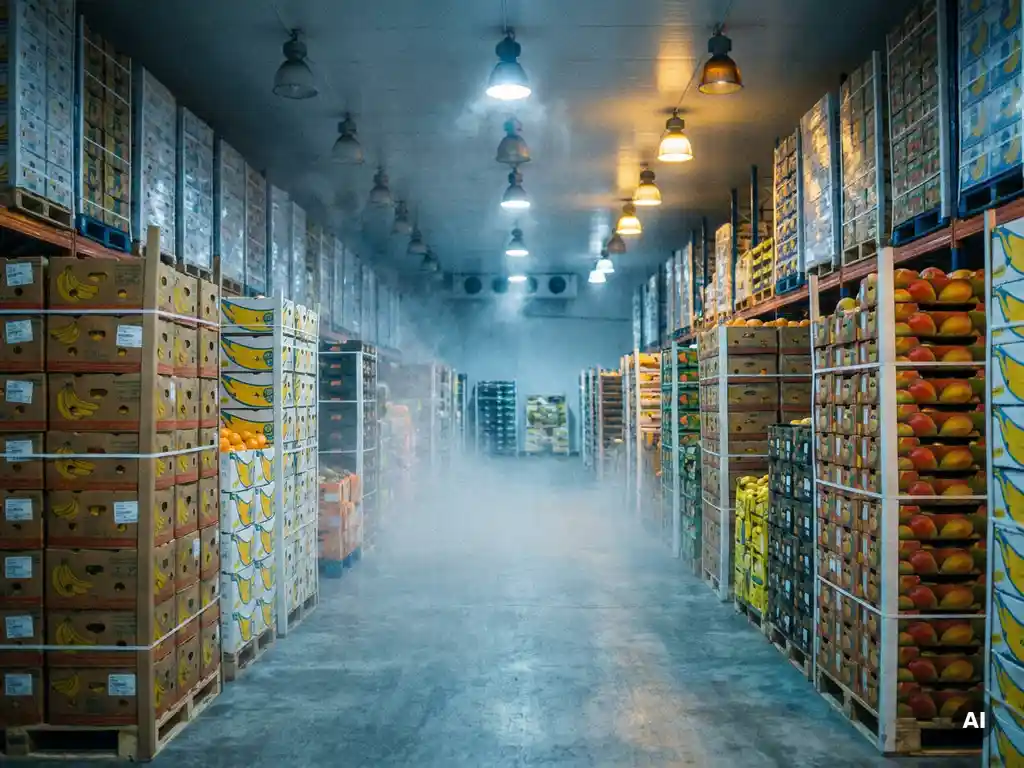
You choose a warehouse for food storage based on four key factors: the right storage conditions, valid certifications, a strategic location, and adequate logistics services. Not every warehouse is suitable for food. Fresh, perishable, or dried products place specific demands on temperature, humidity, and hygiene that a general distribution center often cannot provide. In this article, we answer the most frequently asked questions about choosing a suitable storage partner for food products.
What storage conditions are required for foodstuffs?
The required storage conditions for food depend on the product type. Fresh products such as fruit and vegetables require precise temperature and humidity control. Dry products such as nuts, peanuts, and seeds are typically stored at a constant ambient temperature of around 11 degrees Celsius. The core of any food storage is preventing spoilage, loss of quality, and microbiological growth.
For refrigerated products, it is not just about temperature, but also about air circulation and humidity. An environment that is too dry damages delicate products such as citrus fruits; an environment that is too humid promotes mold growth. Modern cold storage facilities monitor these parameters continuously, preferably 24 hours a day and 7 days a week.
For dry or ambient storage, temperature stability is key. Temperature fluctuations can cause condensation on packaging, leading to humidity, packaging damage, and loss of content quality. For food products such as nuts and seeds, a stable, cool, and dry environment is therefore essential.
Which certifications must a food storage facility have?
A food warehouse must hold at least BRC certification (British Retail Consortium), the international standard for food safety in storage and distribution. Depending on the product type and the market, certifications such as SKAL (for organic products), Demeter, or KCB/NVWA accreditation may also be required.
BRC Food Storage and Distribution is the most requested certification by supermarket purchasing organizations and processing plants. This standard guarantees that the warehouse systematically works on hygiene, traceability, pest control, and risk management. Without this certificate, a warehouse is simply not accepted as a partner by many buyers in the food chain.
For importers of exotic fruit from countries outside the EU, KCB accreditation (part of the NVWA) is relevant. This makes it possible to have official phytosanitary inspections carried out upon arrival of the goods, which significantly speeds up the import procedure. When selecting a warehouse, always check which certifications are current and whether they meet the requirements of your customers and target market.
What is the difference between cold storage and dry storage for food?
Cold storage is intended for fresh, perishable products that require controlled low temperature and humidity to maintain quality. Dry storage, also known as ambient storage, is suitable for products that remain stable at room temperature or in a lightly cooled environment, without active cooling or freezing.
The practical difference lies in the infrastructure and costs. Cold storage requires more intensive installations, higher energy costs, and stricter hygiene protocols. Dry storage is easier to manage but should not be underestimated: requirements for temperature stability, ventilation, and pest control also apply here.
Many food products require a combination of both. A banana importer needs refrigerated storage during the ripening process, but after processing, the products can be temporarily stored in a dry warehouse for further distribution. Choose a storage partner that can offer both modalities or that works closely with specialized facilities.
How do you assess the location of a food storage warehouse?
The location of a food warehouse is assessed based on its proximity to supply routes, sales markets, and customs facilities. A warehouse near a seaport, such as in the Rotterdam-Antwerp corridor, offers advantages for importers who wish to transport goods directly from the ship to storage, minimizing the time between unloading and cooling.
Relevant location criteria are:
- Distance to the port or the point of supply of the goods
- Accessibility for trucks and containers
- Proximity to customs offices for clearance
- Distance to end customers or processing plants
- Possibility for shuttle transport within a workable radius
For perishable products, every minute counts. A warehouse with its own quay directly next to the cold storage eliminates unnecessary transport time and protects the quality of sensitive products. For dry products, the location is slightly less critical, but good access to the road network towards Germany or other European markets remains an important consideration.
What logistics services must a food warehouse offer?
A food warehouse must go beyond mere storage. Essential logistics services include quality control upon arrival, container handling, palletizing, labeling, traceability via barcode systems, and customs clearance capabilities. The more services available under one roof, the more efficient the supply chain.
Quality control at inbound is a basic requirement. Upon arrival, shipments must be checked for damage, temperature deviations, packaging errors, and product condition. For fresh products, additional measurements such as Brix or moisture measurements may be necessary. Products that do not meet the set standards must be immediately separated from the approved batch.
In addition, value-added services are increasingly a requirement from customers. Examples include applying customer-specific labels and barcodes, linking grower and LOT numbers for traceability, and EDI connections for automatic order processing and inventory updates. These digital integrations reduce errors and accelerate communication between your systems and the warehouse.
Finally, having your own transport capacity for shuttle transport is a plus, particularly for companies that deliver products from a production location in the immediate vicinity of the warehouse.
How much capacity and flexibility do you need in a food warehouse?
The required capacity in a food warehouse depends on your seasonal patterns, supply frequency, and the size of your stock buffers. Flexibility is at least as important as absolute capacity: a warehouse that adapts to fluctuating volumes and sailing schedules is more valuable to many importers and traders than a fixed, large storage space.
Ask yourself the following questions when making the choice:
- How large are the peaks in your supply and when do they occur?
- How long do products need to remain in storage on average?
- Do you need separate spaces for different product categories?
- Can the warehouse scale as your volumes grow?
For dry products such as nuts and seeds, fixed pallet spaces with a stable ambient temperature are usually sufficient. For refrigerated products, it is crucial that the warehouse can respond quickly to fluctuating supply, including the processing of containers outside office hours if the sailing schedule requires it.
When is a specialized warehouse better than a general distribution center?
A specialized warehouse is better than a general distribution center when your product requires specific conditions, certifications, or processing that a generalist cannot structurally offer. This almost always applies to fresh food products, exotic fruit, organic products, and food raw materials that must meet strict quality standards.
General distribution centers are designed for large-scale efficiency but often lack the specialized knowledge, infrastructure, and certifications required for sensitive food products. A specialized partner understands product requirements, possesses the right equipment, and works with employees who have experience with the specific characteristics of the product.
Moreover, a specialist typically offers a shorter chain from arrival to storage, which for perishable products can make the difference between a party that meets quality standards and one that does not. For B2B parties supplying supermarket chains or processing plants, this risk is too great to ignore.
How ZZColdstores helps with food storage
ZZColdstores is a specialized storage partner for B2B companies in the food sector, active since 1994 with locations in Kruiningen and Vlissingen. The company offers both climate-controlled cold storage and dry ambient storage, with all associated logistics services under one roof.
What sets ZZColdstores apart as a partner for food storage:
- Climate-controlled storage with 24/7 monitoring of temperature, humidity, and air circulation, especially suitable for fresh and delicate products such as exotic fruit
- Dry storage warehouse with a capacity of 12,000 pallet spaces, including for nuts, peanuts, and seeds, stored at approximately 11 degrees Celsius
- Own quay in Vlissingen for direct transshipment from ship to cold storage, with minimal transport time
- Certifications including BRC, SKAL, and Demeter, and KCB/NVWA accreditation for import inspections
- Value-added services such as quality control, labeling, barcode traceability, and EDI connections
- Flexible deployment tailored to sailing schedules and fluctuating volumes
Are you looking for a reliable partner for the climate-controlled storage of your food products, or would you like to know more about the possibilities for dry storage? Contact ZZColdstores and discuss the best solution for your product and supply chain.
Frequently Asked Questions
How far in advance do I need to reserve storage capacity at a food warehouse?
This depends heavily on the season and the product type. For peak periods — such as summer for exotic fruit or autumn for nuts and seeds — it is advisable to reserve capacity at least four to eight weeks in advance. With a fixed, long-term partnership, you can generally make more flexible arrangements, where the warehouse scales based on your sailing schedules and supply volumes.
What are the most common mistakes when choosing a food storage partner?
A common mistake is prioritizing the lowest price per pallet space without considering the total costs of quality loss, rejects, or extra transport movements. Other common errors include failing to verify that certifications are current and relevant to your market, and underestimating the importance of location for perishable products. Always ask for concrete references and audit results before signing a contract.
Can I house multiple product categories with different storage requirements in one warehouse?
Yes, that is possible at warehouses that offer both climate-controlled cold storage and dry ambient storage under one roof. However, it is essential that the warehouse has strict separation between product flows to prevent cross-contamination and odor transmission risks. Check whether the facility has separate compartments or zones for different temperature zones and product categories, and whether this is also ensured in their BRC-certified working method.
How does customs clearance work when importing food products via a warehouse?
When importing food products from outside the EU, the shipment must be declared to customs and, depending on the product type, inspected by the NVWA. A warehouse with KCB/NVWA accreditation can facilitate these phytosanitary inspections directly on-site, significantly shortening turnaround times. Ensure that the warehouse possesses the appropriate accreditations and experience with the specific customs procedures applicable to your product to avoid delays and additional costs.
How do I check if a warehouse actually meets the promised storage conditions?
Ask the warehouse for access to their temperature and humidity records, preferably via a continuous monitoring system that captures data 24/7. Reliable partners can provide real-time reports or historical log data per storage zone. Additionally, BRC audit reports and customer references provide a good picture of how the warehouse performs in practice regarding conditioning and hygiene.
What do I need to arrange if my products arrive at the warehouse outside office hours?
For perishable products, it is crucial that the warehouse remains operational outside office hours for receiving, quality control, and immediate cooling. Make concrete agreements regarding this in advance and record them in a Service Level Agreement (SLA), including the maximum time between arrival and cooling. Also, ask whether the warehouse has a 24/7 contact person available for emergencies or deviations from the sailing schedule.
How do I integrate the warehouse into my existing ERP or order management system?
Modern food warehouses offer Electronic Data Interchange (EDI) connections that automatically exchange order information, inventory updates, and shipping instructions between your system and the warehouse management system (WMS). When selecting a partner, discuss which EDI standards or API connections they support and whether implementation support is available. Smooth digital integration reduces manual errors, accelerates order processing, and gives you real-time insight into your inventory status.
Related articles
- Can you have food products stored and logistically processed?
- How does the receipt of refrigerated goods work in a warehouse?
- When does a wholesaler need extra refrigerated storage space?
- What data is recorded during the storage of foodstuffs?
- What is customs clearance and why is it mandatory for imports?