
Yes, having food stored and logistics processed by a single partner is not only possible, but for many B2B players in the food chain, it is also the most efficient choice. A specialized storage partner combines climate-controlled or dry storage with services such as quality control, labeling, customs clearance, and transport. In this article, we answer the most frequently asked questions about combined food storage and logistics so that you can make an informed decision for your supply chain.
What exactly does combined storage and logistics entail?
Combined storage and logistics means that a single partner handles both the physical storage of food products and the associated logistical operations. Instead of storage at party A and transport or quality control at party B, the entire process from arrival to delivery runs through one location and one point of contact.
In practice, this includes unloading containers, booking in goods, conducting inspections, storing under the correct conditions, and preparing for onward transport. For food products, this integration is particularly valuable, as every extra link in the chain takes time and increases the risk of temperature deviations or quality loss. By entrusting everything to a single specialized partner, you limit those risks and maintain control over your product.
What logistics services do cold storage companies offer in addition to storage?
In addition to food storage, specialized cold storage companies offer a wide range of supplementary logistics services. These include quality control upon arrival, sampling, labeling, palletizing, barcode-driven traceability, EDI connections with customer systems, and in-house transport for shuttle runs within a radius of approximately 40 kilometers.
These services generally fall under two categories:
- Value Added Logistics (VAL): activities that directly contribute to an efficient and safe flow of goods, such as quality control, sorting, and palletizing.
- Value Added Services (VAS): services that add value to the product itself, such as applying barcodes, expiration dates, and customer-specific labels, or setting up EDI connections for automated order processing and inventory updates.
Barcode-driven traceability deserves special attention: every pallet is made fully traceable by linking grower and LOT numbers to the correct products. This provides maximum control and makes tracing back in the event of quality incidents much easier. For suppliers to supermarkets or processing plants, this type of traceability is often not a wish, but a hard requirement.
How does the chain work from arrival to delivery at a logistics warehousing partner?
With an integrated logistics warehousing partner, the chain begins the moment a container or shipment arrives and only ends when the product is ready for delivery to the next link. Every step in that process is managed by the same partner, ensuring a fast throughput and minimal risks to the product.
A typical process unfolds as follows:
- Arrival and unloading: the shipment is unloaded, immediately entered into the storage facility, and administratively booked.
- Quality control: every shipment is inspected for damage, packaging deviations, and product condition. Where necessary, temperature, humidity, and Brix measurements are performed. Products that do not meet specifications are separated immediately.
- Storage under controlled conditions: goods are stored at the correct temperature and humidity, tailored to the specific product.
- Processing and labeling: depending on the order, products are stickered, sorted, or repalletized.
- Delivery: based on order information, goods are prepared for transport, including the correct documentation.
The speed at which goods move from the ship to cold storage is a determining factor for quality. The shorter the time between unloading and storage, the better the product is preserved.
What is the difference between cold storage and dry storage for food?
The difference between cold storage and dry storage lies in the storage conditions used. Cold storage is intended for fresh and perishable products that require precisely controlled temperature and humidity. Dry storage, also known as ambient storage, is suitable for products that remain stable at a higher, but controlled, ambient temperature.
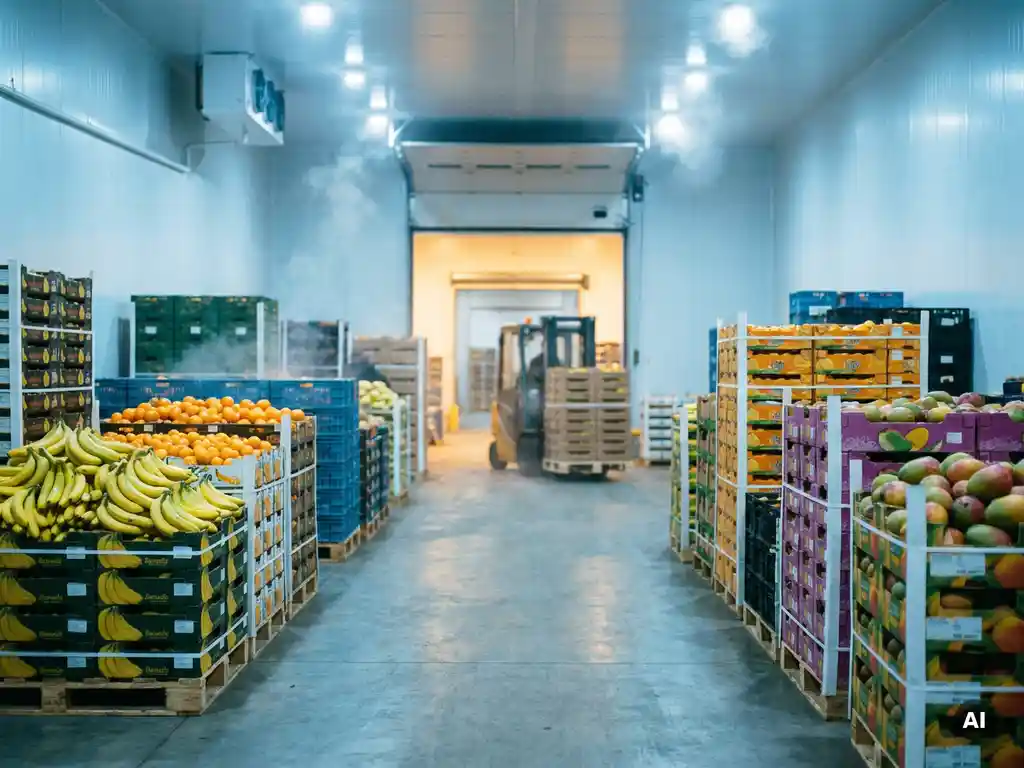
Cold storage is used for products such as exotic fruit, citrus fruits, and other temperature-sensitive fresh goods. Temperature, humidity, and air circulation are monitored here 24/7 and set per climate chamber to the specific requirements of the product.
Dry storage is suitable for products such as nuts, peanuts, seeds, and other non-perishable food products. These are stored at a stable ambient temperature, typically around 11 degrees Celsius, in a dry and ventilated room. The requirements for humidity control are less strict than for cold storage, but climate control is still relevant here to prevent mold formation or loss of quality. Which storage method is most suitable depends entirely on the product and the storage requirements set by the supplier or customer.
Which certifications must a food storage company have?
A reliable food storage company holds at least certifications demonstrating that it takes food safety, traceability, and quality assurance seriously. The most relevant certifications for B2B food storage are BRC (British Retail Consortium), SKAL (for organic products), and, for specific product streams, the KCB/NVWA inspection.
BRC is an internationally recognized standard for food safety and is a requirement for many supermarkets and processing plants before doing business with a storage partner. SKAL certification is relevant for companies that process or store organic products. The KCB, part of the NVWA, conducts import inspections for, among other things, fresh fruit and vegetables from non-EU countries.
Always ask a potential storage partner for current certificates and verify whether the certification applies to the specific storage method and product type you wish to store. Certifications are not a guarantee of quality, but they are an objective confirmation that a company meets established standards.
When does it make sense to outsource storage and logistics to a single party?
Consolidating warehousing and logistics with a single partner makes sense as soon as the complexity of your goods flow increases, quality requirements become stricter, or managing multiple parties takes more time than it yields. For companies that import or distribute fresh or perishable food products, a single integrated partner is almost always the most logical choice.
Concrete situations where it makes sense to consolidate everything with a single party:
- You import products by sea and want to keep the time between unloading and storage as short as possible.
- Your customers impose requirements regarding traceability, labeling, or quality reporting that you do not want to or cannot fulfill yourself.
- You work with products that require specific storage conditions and where every link in the chain poses a risk.
- You want to combine customs clearance and import inspection with storage, without goods being moved in the meantime.
- Your supply chain requires flexibility, for example because ship sailing schedules change regularly.
The more links you remove from the chain, the lower the chance of communication errors, delays, or loss of quality.
How do you choose the right storage partner for food products?
You choose the right storage partner for food products based on four criteria: the right storage capacity and conditions for your product, demonstrable certifications, a complete service package that aligns with your supply chain, and proven experience with similar product flows.
Start with the technical requirements of your product. Does it require refrigeration, and if so, what temperature range? Or is dry storage at a controlled ambient temperature sufficient? Next, check whether the partner holds the relevant certifications for your product category and market.
Next, look at the service package: does the partner offer quality control, labeling, traceability, and potentially customs clearance in addition to storage? And how flexible is the partner if your volumes or sailing schedules change? A partner who adapts to your company's operational reality is worth more than a partner with high capacity but little flexibility.
Finally: location is not a minor factor for food products. A storage location directly on the quay or near a seaport reduces the time between unloading and storage, which directly impacts product quality.
How ZZColdstores helps with combined food storage and logistics
ZZColdstores offers importers, exporters, and wholesalers a fully integrated solution for the storage and logistical processing of food products. From locations in Kruiningen and Vlissingen, with its own quay in Vlissingen, products are placed directly into the correct storage conditions immediately after unloading. These are the key services offered by ZZColdstores:
- Climate-controlled cold storage for fresh and perishable products such as exotic fruit, with 24/7 monitoring of temperature, humidity, and air circulation.
- Dry storage for nuts, peanuts, seeds, and other non-perishable food products, with a capacity of 12,000 pallet spaces.
- Quality control and sampling upon arrival, including customized QC reports.
- Labeling and traceability via barcode-driven systems linking grower and LOT numbers.
- EDI connections for automatic order processing, inbound notifications, and inventory updates.
- In-house transport for shuttle runs within a radius of 40 kilometers, directly linked to the inbound processes.
- Customs clearance and import inspection via KCB/NVWA, combined with storage at the same location.
ZZColdstores is certified according to BRC, SKAL, and Demeter and operates exclusively B2B. Would you like to know if climate-controlled storage aligns with your product category and supply chain? Then contact us for a no-obligation consultation.
Frequently Asked Questions
How quickly can goods be booked in and processed after arrival at the warehouse?
With an integrated warehousing partner that has its own quay or port location, goods can be booked in and stored immediately after unloading, often within a few hours of arrival. The exact turnaround time depends on the size of the shipment, the type of product, and required processing such as quality control or labeling. Always ask a potential partner for the average processing time per shipment type so that you can factor this into your planning and agreements with customers.
What happens if part of my shipment does not meet the quality requirements upon arrival?
A specialized storage partner immediately separates products that do not meet specifications from the approved batch during incoming quality control. The rejected goods are stored separately, and you receive a detailed QC report with findings, allowing you to take immediate action towards the supplier or insurer. It is advisable to make clear agreements with your storage partner in advance regarding the procedure in the event of rejection, including responsibilities and any return procedures.
As an importer, can I also make use of combined warehousing and logistics if I have relatively small volumes?
Yes, many specialized storage partners work with flexible pallet spaces and do not require you to commit to a fixed minimum capacity. This makes combined storage and logistics accessible to importers with smaller or fluctuating volumes as well. Discuss the rate structure for smaller shipments with the partner and ask if economies of scale apply as your volumes grow.
How do I ensure that my ERP or order management system integrates properly with my warehousing partner's systems?
Most specialized warehousing partners offer EDI connections that can be tailored to common ERP systems such as SAP, Microsoft Dynamics, or industry-specific platforms. Through these connections, order information, inbound notifications, and inventory updates are automatically exchanged without manual intervention. Identify in advance which data streams are essential for you, such as real-time inventory insight or automatic invoice processing, and check whether the partner is technically equipped for this.
What are the most common mistakes companies make when choosing a food storage partner?
A common mistake is selecting a partner based purely on price per pallet space, without considering the completeness of the service package and technical suitability for the specific product. Other common errors include failing to verify current certifications, underestimating the importance of location relative to the port, and the lack of clear SLA agreements regarding processing times and quality reporting. A thorough partner analysis based on product-specific requirements prevents costly adjustments later in the collaboration.
Is it possible to combine customs clearance and import inspection with storage at the same location, and what are the benefits?
Yes, when a storage partner holds the appropriate permits and collaborates with or is affiliated with authorities such as the KCB/NVWA, customs clearance and import inspection can take place at the same location as the storage. This eliminates the need to move goods to a separate inspection location in the interim, which saves both time and transport costs and reduces the risk of quality loss. For importers of fresh fruit or vegetables from non-EU countries, this is a concrete operational advantage that directly benefits the freshness and quality of the product.
How flexible is an integrated storage partner if my sailing schedules or volumes change unexpectedly?
Flexibility is one of the most important distinguishing factors between storage partners and varies significantly from company to company. A good partner possesses sufficient buffer capacity and an operational structure that anticipates the unpredictability of ship delays or sudden volume peaks. When entering into a partnership, establish how the partner handles last-minute changes, the lines of communication in the event of unexpected arrivals, and whether guarantees apply regarding available storage capacity within a specific time margin.
Related articles
- Which additional services can be performed during warehousing?
- What are the requirements for ambient storage of pistachios in Europe?
- Why is temperature control so important for nuts?
- Can poor storage of nuts lead to rejection during import inspection?
- How do you switch from on-premises storage to outsourced ambient storage?